Echoes of Aubrey

life2.jpg

More of Aubrey Beardsley’s posthumous influence and more of the delightful collision between the 1890s and the 1960s. Monsieur Thombeau turned up this striking fashion shoot from LIFE magazine for 1967 showing a model posed against one of the Salomé drawings. A couple of days after this was posted, a reader wrote to point me to this list of films featuring Beardsley artwork. Most of those I knew about already but I certainly hadn’t heard of Death Bed: The Bed That Eats (1977), a low-budget horror film about which we’re told:

A large, black, four-poster bed, possessed by a demon, is passed from owner to owner. The demon was a tree, who became a breeze and seemingly fell in love with a woman he blew past. The demon then took human form and conjured up a bed. While he was making love with the woman she died and his eyes bled onto the bed, causing it to become possessed. Those who come into contact with the bed are frequently consumed by it (victims are pulled into what is apparently a large chamber of digestive fluids beneath the sheets). The bed demonstrates a malevolent intelligence as well as some psychokinetic and limited telepathic abilities to manipulate dreams. A running commentary or chorus is supplied by the ghost—if that is the correct word—of an artist (who would appear to be Aubrey Beardsley, though this is never stated directly) trapped behind a painting on the wall.

That’s a posthumous fame Aubrey never would have anticipated. If anyone has seen this, let us know what you thought.

carryon.jpg

Carry On Loving (1970).

Absent from the list of films is Ken Russell’s Salome’s Last Dance, which features the Salomé pictures again in its title sequence, and Carry On Loving, one of the dreadful British sex comedies which has an entire scene set in a modish pad decorated with Beardsley prints. Watch the scene in question here, if you must.

galleryfive.jpg

The prints were produced by a London company, Gallery Five, in the late 60s, and their ad shows they were also selling works by Kay Nielsen (seen in the Carry On clip), John Austen, Charles Ricketts, George Barbier, Jessie King and others. Gallery Five did much to popularise Beardsley’s art among people who might otherwise have never noticed his work, and their products turn up in many films and TV dramas of the period. Finally—although it’s by no means the last word on this subject—the V&A has two great Beardsley-derived ads for Elliott Boots by Paul Christodoulou here and here.

Elsewhere on { feuilleton }
The Aubrey Beardsley archive

Deutsche Kunst und Dekoration #1

dkd01-01.jpg

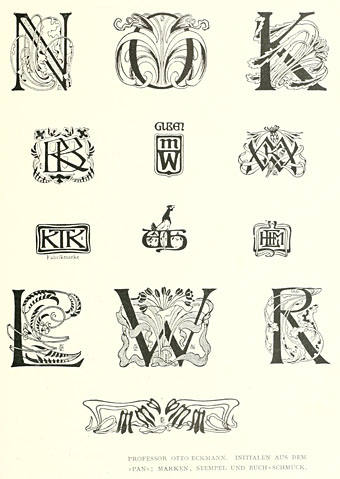
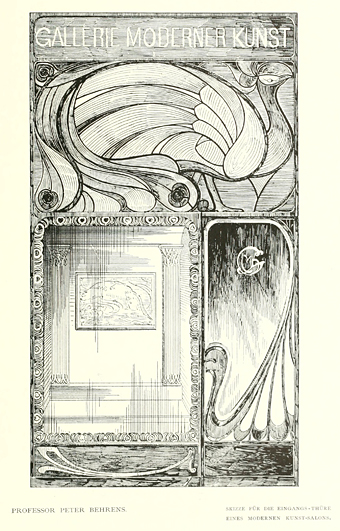
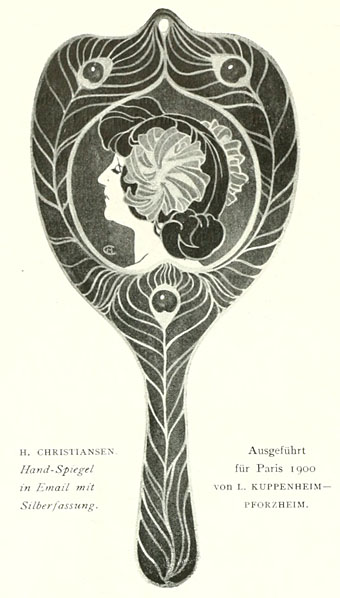
Last year saw an exploration here of the fecund pages of Jugend magazine so in the same spirit I’m embarking on a serial delve into Jugend‘s more serious contemporary Deutsche Kunst und Dekoration. I’ve made a couple of posts in this direction already but these were done before I’d had a chance to look properly through the editions at the Internet Archive, the first thirty of which form a collection which comprises some 7500 pages. Since few people would want to download and sort through that mountain these posts can serve as a select guide to the contents.

dkd01-02.jpg

Deutsche Kunst und Dekoration was published by Alexander Koch in Darmstadt and the first volume is dated October 1897–March 1898. Jugend was a humour magazine so the contents tend to be frivolous and lighthearted, Koch’s title by contrast was a guide to the best of German contemporary art and design and has the advantage of featuring furniture and architectural designs as well as graphic material. The content of this first edition is relatively sedate compared to some of the later numbers when the Art Nouveau style builds up a head of steam. There’s some astonishing design work in subsequent issues, as well as further illustration discoveries like Marcus Behmer. Watch this space.

Continue reading “Deutsche Kunst und Dekoration #1”

Art Deco bindings

deco1.jpg

Contes Oscar Wilde (c. 1928), design by Paul Bonet.

Two selections from this gallery of bookbindings from the 1920s. Few books receive this kind of treatment today but it’s by no means a lost art, The Guild of Book Workers has examples of recent designs.

deco2.jpg

La Canne de Jaspe (c. 1925), design by Pierre Legrain.

Elsewhere on { feuilleton }
The book covers archive

Previously on { feuilleton }
Prismes
The art of Thayaht, 1893–1959
The Mentor
The art of Cassandre, 1901–1968
The Decorative Age
The World in 2030

Weekend links: New Year edition

olofsdotter1.jpg

Flower Me Gently (2010) by Linn Olofsdotter.

• “Many of Moorcock’s editorials are published here, and they still make exhilarating reading. Then, as now, Moorcock set his face against a besetting English sin: a snobbish parochial weariness, an ironic superiority to the frightful oiks who have started filling up the streets. You can almost hear, behind the languorous flutter of the pages, Sir Whatsits sniggering to Lady Doo-Dah. It still goes on, and it’s usually the same flummery in different clothes. Moorcock not only would not go to the party: he threw the literary equivalent of explosive devices into the Hampstead living rooms.” Michael Moorcock’s Into the Media Web reviewed. And also here.

• “Beefheart channeled a secret history of America, the underbelly of a continent and a culture that has now all but vanished along with one of its greatest poets.” Jon Savage on the life and work of the late Captain.

Miniatures Blog, in which musician Morgan Fisher works his way through each of the fifty one-minute tracks on his extraordinary Miniatures compilation album, with details and anecdotes about the artists and the recording of each piece.

Look at Life: IN gear (1967). A Rank Organisation newsreel about Swinging London. Sardonic commentary and some great colour photography showing how the often shabby reality differs from the caricature. Many of the shots are familiar from documentaries about the era but this is the first time I’ve seen them all in one place.

olofsdotter2.jpg

Predator (Self-portrait) by Linn Olofsdotter.

Lewis Carroll’s new story: The Guardian‘s review of Through the Looking-Glass from December, 1871. Related: My Through the Psychedelic Looking-Glass 2011 calendar is now reduced in price.

The United Kingdom and Ireland as seen from the International Space Station, December, 2010. Related: Spacelog, the stories of early space exploration from the original NASA transcripts.

The “Big Basket” Fraud, 1958: “…there seems to be a limited segment with a one-track mind interested in seeing an exaggerated masculine appendage.”

• “Ancient arena of discord”: a billboard for King’s Cross by Jonathan Barnbrook. Related: Vale Royal by Aidan Andrew Dun.

• The inevitable Ghost Box link, Jim Jupp is interviewed at Cardboard Cutout Sundown.

• Amazon is still playing the random moral guardian at the Kindle store.

Antwerpian Expressionists at A Journey Round My Skull.

Salami CD and vacuum packaging by Mother Eleganza.

Paris 1900: L’Architecture Art Nouveau à Paris.

Bill Sienkiewicz speaks about Big Numbers #3.

Philippe Druillet illustrates Dracula, 1968.

Aesthetic Peacocks at the V&A.

Well Did You Evah! (1990), Deborah Harry & Iggy Pop directed by Alex Cox.

Wildeana 4

hichens.jpg

I could make these posts a lot more often since there’s seldom a week goes by when Oscar Wilde’s work or something from his life isn’t making the news somewhere. I forget now how I came across the Robert Hichens book but the Beardsley-derived cover design is the best I’ve seen for this title. The Green Carnation was first published in 1894 and is the notorious roman à clef whose lead characters, Esmé Amarinth and Lord Reginald Hastings, are based on Wilde and Lord Alfred Douglas. Hichens paints the pair as very obvious inverts with none of the “is he or isn’t he?” subtlety that Wilde managed to sustain in public. For a scandalised London the book seemed to confirm what was already suspected about Wilde and Bosie’s relationship.

The cover art is credited to one John Parsons, an illustrator whose other work, if there is any, eludes the world’s search engines. This edition was published in 1949 by Unicorn Press and it’s something I’m tempted to buy as a companion for my Unicorn Press edition of Dorian Gray.

The following links are to recent articles spotted whilst looking for other things:

Oscar Wilde, Classics Scholar. A review of The Women of Homer by Oscar Wilde, edited by Thomas Wright and Donald Mead.
• A new Broadway production of The Importance of Being Earnest has actor Brian Bedford playing Lady Bracknell.
Buyers go Wilde for Oscar as short note to his friend sells for €1,500.
Outsmarted: What Oscar Wilde could teach us about art criticism.

Elsewhere on { feuilleton }
The Oscar Wilde archive
The book covers archive