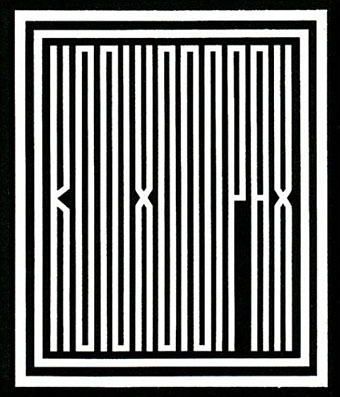
Konx om Pax

konx1.jpg

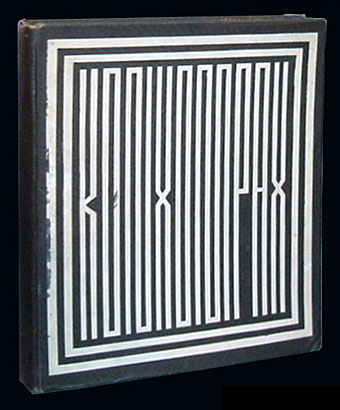
Not the musician but the book of “Essays in Light” published by Aleister Crowley in 1907. I’ve been familiar with this for years but only via the many reprints. It was only recently that I discovered the striking cover design of the first edition which, we’re told, was designed by Crowley himself during a hashish bout. I’ve not been able to find the source for this piece of information but it’s not in the chapter of his autobiography where he discusses the writing of the book. (Matters aren’t helped by Konx om Pax not being listed in the index.) If anyone has the relevant details then please leave a comment.
konx2.jpg

In design terms this cover might seem radical for 1907 but if Crowley did design it I’d guess he was thinking of a quite common geometric variation of Kufic script. Crowley travelled East as far as China, and had an abiding interest in languages of all kinds. Konx om Pax opens with a quote in Arabic from the Qur’an which is followed by a succession of quotes in different languages including Hebrew, Chinese, Ancient Greek, Sanskrit and hieroglyphic Egyptian.

konx3.jpg

Konx om Pax (2011) by Fredrik Söderberg.

Crowley’s lettering turns up much later in this painting by Fredrik Söderberg. The phrase was also referenced during the 1990s on many of Bill Laswell’s recordings, often by cryptic phrasing on CD stickers. The name forms part of one of the tracks on Laswell’s Axiom Ambient album from 1994, an album which includes a sample of Crowley’s voice. Also in the 1990s, Laswell was making frequent use of what MacGregor Mathers claimed was the English translation of the Egyptian origin of the phrase: “Khabs am Pekht” or “Light in extension”. One of Laswell’s many dub projects, Divination, released two compilation albums called Light In Extension, while the phrase “Khabs am Pekht” (which had me mystified for years) appears on the back of Material’s magnificent Hallucination Engine (1994). One of my favourite albums, which also includes a portion of a Crowley Tarot card in its James Koehnline artwork.

Previously on { feuilleton }
• Burroughs at 100
• Aleister Crowley: Wandering The Waste
• Brush of Baphomet by Kenneth Anger
• Rex Ingram’s The Magician
• The Mysteries of Myra
• Aleister Crowley on vinyl

Weekend links 220

waliszewska.jpg

Untitled painting by Aleksandra Waliszewska.

• Ben Wheatley’s forthcoming film of High-Rise by JG Ballard now has its own Tumblr. This will no doubt be spoilerific so I won’t keep on visiting but it’s there if you require it. More Ballardianism: “Worshipping the Crash” at BLDGBLOG.

• “Aickman wandered through the sixties fantasy landscape like some curmudgeonly fetch, returning from the fin de siècle heyday of the ghost story.” Boyd Tonkin profiles Robert Aickman, writer of peerless “strange stories”.

• At Dangerous Minds: “Raise a glass to Cthulhu at the Lovecraft Bar”. Looks more like a Captain Nemo bar to me (not that there’s anything wrong with that) but I appreciate the gesture.

But to demand that a work be “relatable” expresses a different expectation: that the work itself be somehow accommodating to, or reflective of, the experience of the reader or viewer. The reader or viewer remains passive in the face of the book or movie or play: she expects the work to be done for her.

Rebecca Mead on The Scourge of Relatability

• “Space as a paranoid, static rumble featuring: 20jfg, Ben Frost & Daníel Bjarnason, Coil & Eduard Artemiev”. 20 Jazz Funk Greats on the pleasures of the Solaris soundtrack.

• What do Hawkwind, Harry Nilsson, Stereolab and The Supremes have in common? David Stubbs examines the legacy of Neu! and Klaus Dinger’s “Dingerbeat”.

• A reminder that A Year in the Country features a host of worthwhile links and associations for the Hauntologically persuaded.

• Rouge Louboutin, an ad by David Lynch. Related: An improptu biscuit ad by the Eccentronic Research Council.

• Mix of the week (a year old but no matter): JG Ballard Zoom Lens Mix by Bernholz.

• At 50 Watts: More illustrated sheet music covers by Einar Nerman.

• Five book cover designers and the books that inspire them.

• Tove Jansson would have been 100 this week.

• Pangaea with modern borders

• Solaris: Dream (1990) by Edward Artemyev [sic] | Solaris (2000) by Photek | Simulacra I (2011) by Ben Frost & Daníel Bjarnason

Querelle de Brest

querelle01.jpg

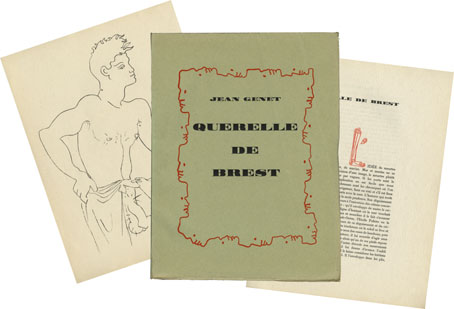
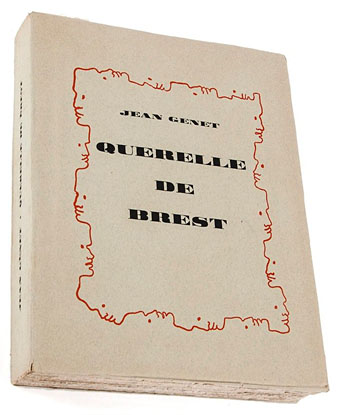
Querelle de Brest (1947) by Jean Genet. Cover design by Jean Cocteau.

This weekend’s viewing was Fassbinder’s Querelle (1982) which is marvellous in its new Blu-ray transfer, and a great improvement on the muddy picture of the earlier DVD release. The film is still only the briefest sketch of Genet’s novel (although Genet biographer Edmund White enjoyed it) but I like the overheated atmosphere, the phallic set designs, Franco Nero (hey, it’s Django Gay!), and the film as a whole is a fitting memorial to Brad Davis, everyone’s favourite sweating matelot. So in honour of all that, here’s a small collection of Querellerie past and present.

querelle02.jpg

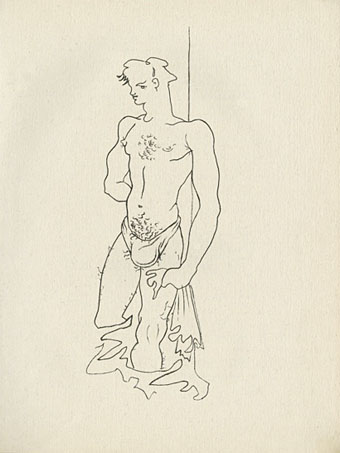
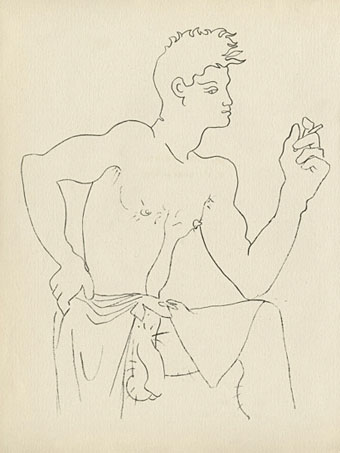
Querelle de Brest was published in a limited edition of 525 copies illustrated throughout by Jean Cocteau who didn’t avoid the pornographic details. Even though copies were seized by the authorities, and the author fined, Cocteau’s involvement did little to harm his public reputation, something that’s impossible to imagine happening elsewhere. A few of the illustrations follow below, many more of the series can be found scattered across various websites.

cocteau1.jpg

cocteau2.jpg

cocteau3.jpg

Continue reading “Querelle de Brest”

Weekend links 219

balbusso.jpg

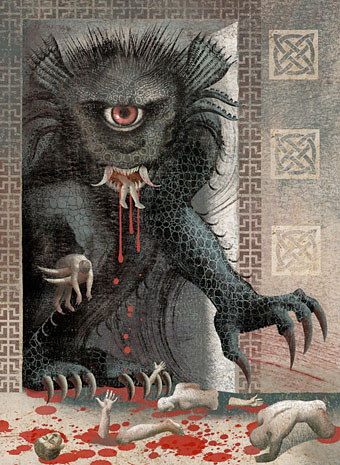
Grendel Monster (2013) by Anna & Elena Balbusso.

• Rick Poynor looks at the Guide de la France mystérieuse (1964), a fantastic (in every sense) doorstop of a volume whose collage alphabet by Roman Cieślewicz can be seen on the cover of Carnival In Babylon (1972) by Amon Düül II.

• Boolean mathematics, Charles Howard Hinton, The Voynich Manuscript, and the effects of surveillance on the political process: Adam Curtis firing on all cylinders as usual.

• At Strange Flowers: The Picture of John Gray, remembering the minor fin de siècle figure who gave Oscar Wilde a surname for his most famous creation.

In “32 Cardinal Virtues of Dennis Cooper,” Wayne Koestenbaum remarks: “Cooper’s quest for the unseeable is virtually religious. I mean: sedulous, abstract, perpetual, unrewarded, unreasonable.” There’s much more to be said of Gone, its power, its pain, its odd intrigues, but perhaps it will suffice to say that it is revealing: unlike Burroughs’ scrapbooks hidden away by some private collector, never to see the light of day, Gone (and its sister texts at the Fales Library) illuminate in perpetuity Cooper’s obscure quest for the unseeable.

Diarmuid Hester looks at Dennis Cooper’s scrapbooks

• The Sallow Tree, a single by Lutine. More music: An hour of Julia Holter‘s St John’s Sessions performance.

• At Dangerous Minds: Christian televangelists listen to Stairway To Heaven forwards.

• Cathy Camper reviews Fearful Hunter, a graphic novel by Jon Macy.

• Mix of the week: FACT mix 452 by Claude Speeed.

• Roman Cieślewicz at Pinterest.

• The Adobe Illustrator Story

• The House of Julian

• Unofficial Britain

• Amon Düül II singles: Rattlesnakeplumcake (1970) | Between The Eyes (1970) | Light (1971) | Lemmingmania (1971)

Sorcerer: Druillet and Friedkin

sorcerer1.jpg

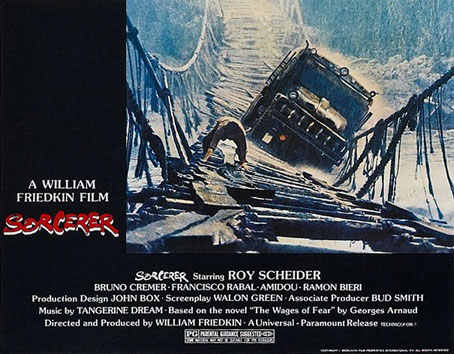
Earlier this week I finally got my hands on the recent Blu-ray reissue of William Friedkin’s Sorcerer (1977). Having only ever seen the film on the travesty of a DVD that appeared in 1998 I’m going to enjoy watching this at the weekend. Brits ought to know that (for now) the only edition available seems to be the US version although it is region-free, and if you buy from a UK film dealer on eBay you won’t get hit with import duties.

sorcerer2.jpg

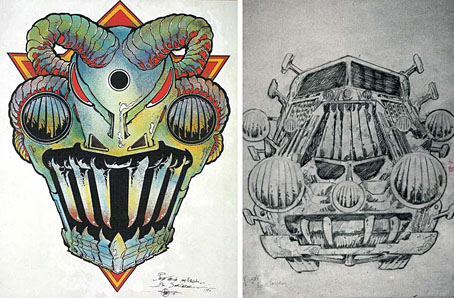
Sorcerer designs by Philippe Druillet.

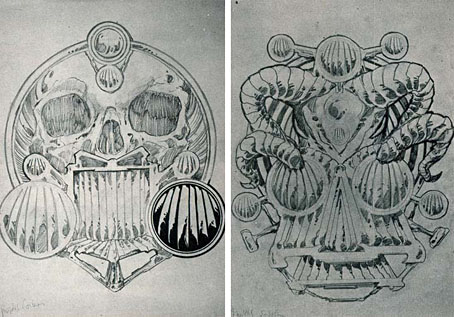
By coincidence, Sorcerer has a minor connection with Philippe Druillet, although his contribution was so minimal that there’s not even a mention of his name on the obsessively detailed Sorcerer film blog. If you’ve seen the film (or Henri-George Clouzot’s equally good earlier version, Wages of Fear), or even read George Arnaud’s novel, you’ll know that the crucial part of the story concerns a potentially suicidal expedition by four men in two trucks, each of which are carrying crates of nitroglycerine through hazardous terrain to the site of an oil-well fire. Friedkin and writer Walon Green expand the story without aping any of Clouzot’s set-pieces (something few directors today would resist), while Friedkin adds some details of his own, notably in the design of the trucks which have distinct “faces” and their own names—”Lazaro” and “Sorcerer”—hence the film’s title which also nods misleadingly to The Exorcist. The truck design was Druillet’s contribution although there’s very little of this apparent on-screen, understandably so when his sketches show fantastic designs that would have no place in the dishevelled jungle town where much of the film takes place. Later sketches by production designer John Box can be found at Wikipedia.

sorcerer3.jpg

Sorcerer designs by Philippe Druillet.

What interests me most about this connection is its being another example of the surreptitious influence of French comics on American cinema during the 70s and 80s. Moebius is the most obvious example of this but it’s also there in the influence of Métal Hurlant/Heavy Metal on the look of Blade Runner, and in Enki Bilal’s design of Molasar in Michael Mann’s The Keep. Since the 1980s we’ve seen a greater industrialisation of conceptual art for the cinema, as a result of which directors are less inclined to look outside Hollywood for their stylists. And now that the treadmill of superhero franchises is grinding away relentlessly, Continental comics and their creators are even less visible than before.

Probably the oddest thing about the Sorcerer/Druillet connection is that the commercial failure of the film in 1977 has often been laid at the door of Star Wars, the advent of George Lucas’s dismal saga being regarded, with some justification, as the opening of the gate to the barbarian hordes. (Friedkin’s film might also have fared better had it not been titled as though it were an Exorcist sequel.) The irony here is that George Lucas happened to be a big Druillet enthusiast, although there’s little evidence of this in his films; in addition to writing an appreciation for Les Univers de Druillet in 2003, he also commissioned Druillet to create a one-off piece of Star Wars art in the late 70s. Knowing this it’s tempting to imagine Lucas creating a very different kind of science-fiction film in 1977, one with some Continental weirdness at its core. But when the world has already been deprived of Jodorowsky’s Dune it’s best not to dwell too much on might-have-beens.

Previously on { feuilleton }
• Ô Sidarta: a film about Philippe Druillet
• Lovecraft: Démons et Merveilles
• Heavy Metal, October 1979: the Lovecraft special
• Philippe Druillet album covers
• Druillet’s vampires
• Salammbô illustrated
• Druillet meets Hodgson