Victor Vasarely album covers

vasarely05.jpg

Terretektorh / Nomos Gamma (no date; late 60s) by Iannis Xenakis.

Xenakis and Victor Vasarely are paired again on this album cover from the late 1960s. Given how often record companies have used abstract artwork on the sleeves of classical recordings, especially those by 20th-century composers, you’d expect there to be more examples. There may well be but Discogs (always the easiest place to search) only turns up the following examples.

vasarely01.jpg

Chamber Concerto For 11 Instruments / Symphonic Variations (no date) by
Neils Viggo Bentzon / The Royal Danish Orchestra conducted by Jerzy Semkow.

vasarely04.jpg

Kontakte For Electronic Sounds, Piano And Percussion / Refrain For Three Instrumentalists (1968) by Aloys Kontarsky, Christoph Caskel, Karlheinz Stockhausen.

vasarely06.jpg

David Bowie (1969) by David Bowie.

I confess that until I began searching for Vasarely covers I hadn’t known that this was an early example. That’s partly down to David Bowie’s second album (the first in his official canon) having been reissued for years in a different cover with Bowie’s face filling the sleeve. The album reissues in 1999 restored the original design, one of the artist’s Folklore Planetaire series. The credit is to “Vaserelli”.

Continue reading “Victor Vasarely album covers”

Weekend links 210

usaoov.jpg

Crashing Diseases And Incurable Airplanes (2014) by USA Out Of Vietnam. Artwork by Amy Torok.

Amy Torok’s cover art for the debut album by Canadian band USA Out Of Vietnam is pleasingly reminiscent of the surreal and psychedelic collages of Wilfried Sätty. The music within has been described as “a cross between ELO and Sunn O)))” which it is up to a point, although to these ears the group are more in the Sunn O))) camp than the post-Beatles pop of Jeff Lynne and co. The sound is big whatever label you apply, and promises much for the future.

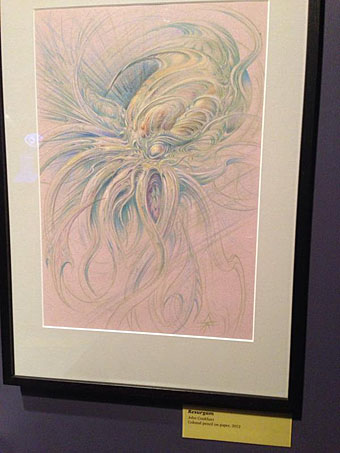
Mysterious creatures of Monterey Bay Aquarium’s ‘Tentacles’. The Aquarium bought one of my drawings last year for this exhibition which juxtaposes tentacular artwork with live creatures. The show runs until 2016.

• Jon Hassell’s 1990 album, City: Works Of Fiction, has been reissued in an expanded edition including a live concert collaboration with Brian Eno, and a collection of remixes/alternate takes.

• Photographer Jonathan Keys uses antique camera equipment to give his views of contemporary Britain a patina of the past.

Roman Polanski and the man who invented masochism. Nicholas Blincoe on Leopold von Sacher-Masoch and Venus in Fur (sic).

• Mixes of the week are by James Pianta, E.M.M.A. (whose Blue Gardens album I helped design), and Balduin.

• Sweet Jane unearths another great article about psychedelic London: The Fool and Apple Boutique, 1968.

• “Did Chris Marker think history to be not only an infinite book but a sacred one?” asks Barry Schwabsky.

• Front Free Endpaper on the story behind the cover photo of A Boy’s Own Story by Edmund White.

Mapping the Viennese Alien Event Site. Christina Scholz explores another Zone.

Moondog: The Viking of 6th Avenue. The first and only movie about Moondog.

Rick Poynor on rediscovering the lost art of the typewriter.

• At BLDGBLOG: 100 Views of a Drowning World.

Miguel Chevalier’s magic carpets

Venus In Furs (1967) by The Velvet Underground | Sex Voodoo Venus (1985) by Helios Creed | Venus As A Boy (1993) by Björk

The sphinx of Wolf City

wolfcity.jpg

Wolf City (1972) by Amon Düül II.

Behold another favourite album cover by a favourite band, one of several superb designs for Amon Düül II by Falk-U Rogner who was also the group’s keyboard player. Rogner’s suitably hallucinogenic cover images are worth a post of their own but this one requires attention today since I happened to solve the mystery of the location of the Düül sphinx during the recent hiatus.

Ever since I began these blog posts I’ve had a feeling that the endless trawling of image archives might one day turn up the location of this stone creature. It was only ever going to be something you’d find by accident, and that’s precisely what happened with the discovery of the drawing below in volume 4 of Materials and Documents of Architecture and Sculpture (1915) by A. Raguenet, a set of books I’ve been plundering recently for architectural details.

sphinx1.jpg

Compare with this photo.

The notes for the drawing offer enough information to trace the location to the Brunswick Monument in Geneva, a mausoleum built in 1879 for the Duke of Brunswick. The monument is a typically Gothic edifice guarded by a number of stone lions plus this splendid sphinx on a plinth by a pool of water. On the opposite side of the monument there’s a matching bird-headed sculpture. Amon Düül II were a German group so it was always likely that the sphinx would be in Europe somewhere, if not Germany itself. The photo below is a detail from this Flickr shot which is the best match I’ve found for the angle of the cover photo. Jean Franel was the monument architect but statues are often the work of specialist artists, and I’ve yet to find a name attached to these examples.

sphinx2.jpg

Photo by Till Westermayer.

Elsewhere on { feuilleton }
The album covers archive

Previously on { feuilleton }
Frémiet’s Lizard

Steampunk catalogued

steampunk1.jpg

Another month, another exhibition catalogue. Steampunk: The Art of Victorian Futurism is still running at Artcenter IDA in Seoul with a selection of my book covers on display among a great variety of mechanical sculptures, costumes and other creations. The catalogue is a suitably lavish affair, so much so that it puts to shame many of the bandwagon-jumping coffee-table books that have been appearing recently. Excellent printing with lots of gold-ink embellishment, and all the exhibits are given substantial space. I especially like the mechanical type designs, and can now credit them to designers Se Byeol Moon and Han Woong Yoon. Korean TV news has run a couple of reports about the exhibition, the best of which may be seen here. The exhibition itself continues until May 18th.

steampunk2.jpg

steampunk3.jpg

steampunk4.jpg

Previously on { feuilleton }
Steampunk: The Art of Victorian Futurism
Steampunk Calendar
Words and pictures
Nathanial Krill at the Time Node
Fiendish Schemes
Ghosts in Gaslight, Monsters in Steam
Steampunk Revolution
The Bookman Histories
Aether Cola
Crafting steampunk illustrations
SteamPunk Magazine
Morlocks, airships and curious cabinets
The Steampunk Bible
Steampunk Reloaded
Steampunk overloaded!
More Steampunk and the Crawling Chaos
Steampunk Redux
Steampunk framed
Steampunk Horror Shortcuts

Maximin: ein Gedenkbuch by Stefan George

maximin01.jpg

This is a strange and beautiful book, a loving paean to a dead boy-poet from another poet, Stefan George (1868–1933), published in 1907. The “Maximin” of the title was Maximilian Kronberger (1888–1904) who was around 14 when he met George; the older man was 34 at the time. George was apparently smitten by the boy, and devastated when he died from meningitis two years later. Maximin: ein Gedenkbuch (A Memorial Book) is the result, a collection of mournful poems, beautifully designed and illustrated by Melchior Lechter in that rectilinear Art Nouveau style which the artist made his own. The memory of the dead Maximin became for George a quasi-religious obsession which makes Maximin the bible of the homosocial cult that George subsequently encouraged.

maximin02.jpg

What’s most surprising about all this behaviour is that it did nothing at all to harm his reputation, even among the Nazis who later revered his poetry. George was a contemporary of Oscar Wilde but the pair were poles apart in character, George’s chilly, high-minded aestheticism preserving him from the brickbats aimed at Wilde and others. Nonetheless, the inherent camp that results from the combination of such a remote attitude combined with flagrant boy-worship secured for George a place alongside Wilde in Philip Core’s essential Camp: The Lie that Tells the Truth (1984):

Strangely enough his overtly (if classically) homosexual verses, his preference for beautiful youth, and his severe black-clad dignity, all became immensely popular in the land of brüderschaft (brothers’ love). The camp Classicism of his ‘academy’ of the spirit, in surroundings of neo-Classical kitsch, hit just the right middle ground between Edwardian sentimentality and Hitlerian Imperialism.

Maximin: ein Gedenkbuch may be browsed or downloaded at the University of Heidelberg. There’s a more academic examination of George’s homoerotics here. Further page samples follow.

maximin03.jpg

maximin04.jpg

maximin05.jpg

Continue reading “Maximin: ein Gedenkbuch by Stefan George”