Weekend links 669

claveloux.jpg

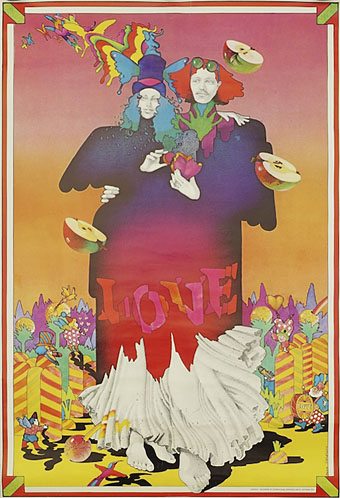
Love (1973), a poster by Nicole Claveloux.

• “Warner Brothers had been keen on a Rolling Stones movie. Jagger was keen on being a movie star. But Donald Cammell’s script was no Beatles’ jolly japes musical comedy…” Des Barry examines the ninth minute of Cammell & Roeg’s Performance.

• “…part of what made his 1970s work so original was the degree to which his band cross-pollinated guitar with synthesizer.” Aquarium Drunkard explores the esoteric jazz-rock of Steve Hillage.

• Magma, the cosmic jazz-rock group from France, have been around for 50 years without making a music video. Hakëhn Deïs is their first.

There was half-Tarkovsky embedded in async, “Solari” and “Stakra” and “Walker”, a hand outstretched to those great poems of living and light that we call films. “I had a strange dream last night,” Andrey Tarkovsky wrote in one of the diary entries collected in Instant Light, “I was looking up at the sky and it was very, very light and soft; and high, high above me it seemed to be slowly boiling, like light that had materialised like the fibres of a sunlit fabric, like silken living stitches in a piece of Japanese embroidery.”

David Toop remembers Ryuichi Sakamoto

• “Floor796 is an ever-expanding animation scene showing the life of the 796th floor of the huge space station…”

• The Electrifying Dreamworld of The Green Hand: Dan Clowes on the comic-art of Nicole Claveloux.

• At Bandcamp: Andy Thomas on the post-punk pop subversion of David Cunningham.

• At Unquiet Things: An enigmatic baroness and her collection of skulls.

• New music: River Of Dreams by Romance & Dean Hurley.

• Steven Heller’s font of the month is Ray Gun.

• Mix of the week: DreamScenes – April 2023.

• RIP Al Jaffee.

Skulls Of Broken Hill (1996) by Bill Laswell | The Bees Made Honey In The Lion’s Skull (2008) by Earth | Black Skulls (2018) by Jóhann Jóhannsson
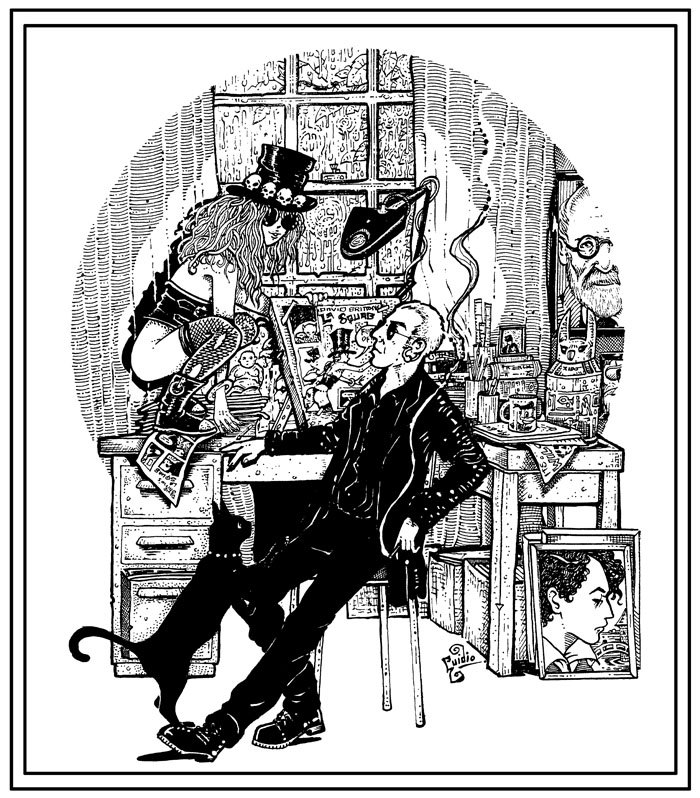
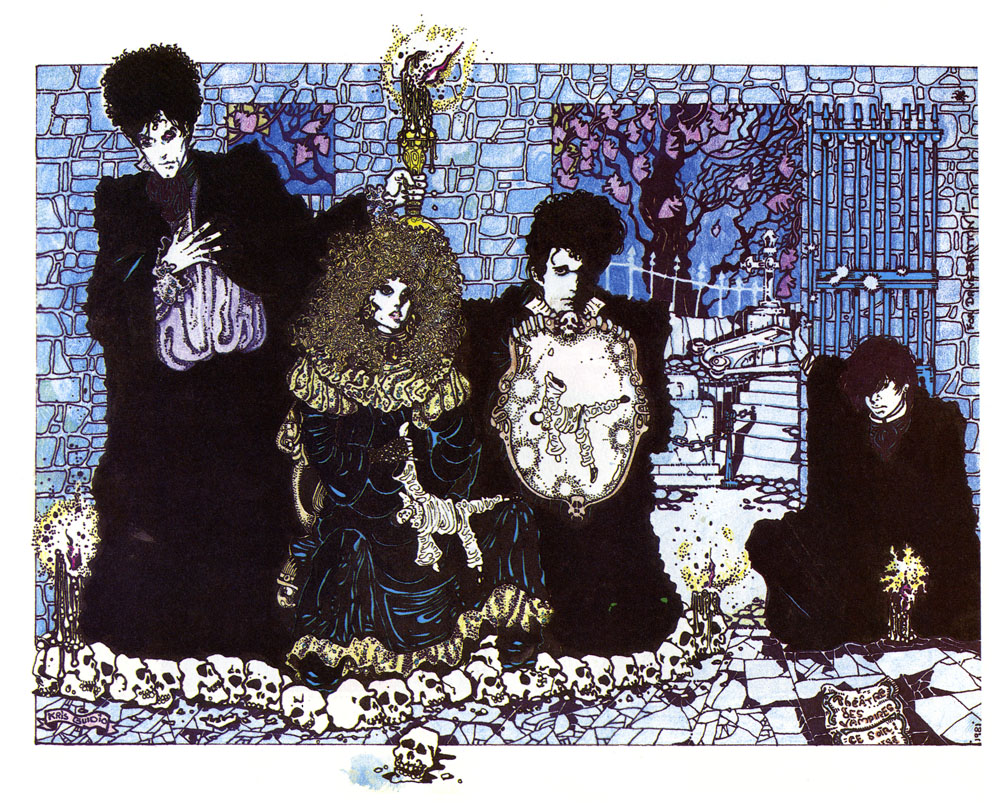
Kris Guidio, 1953–2023

kris.jpg

A self-portrait, 2011.

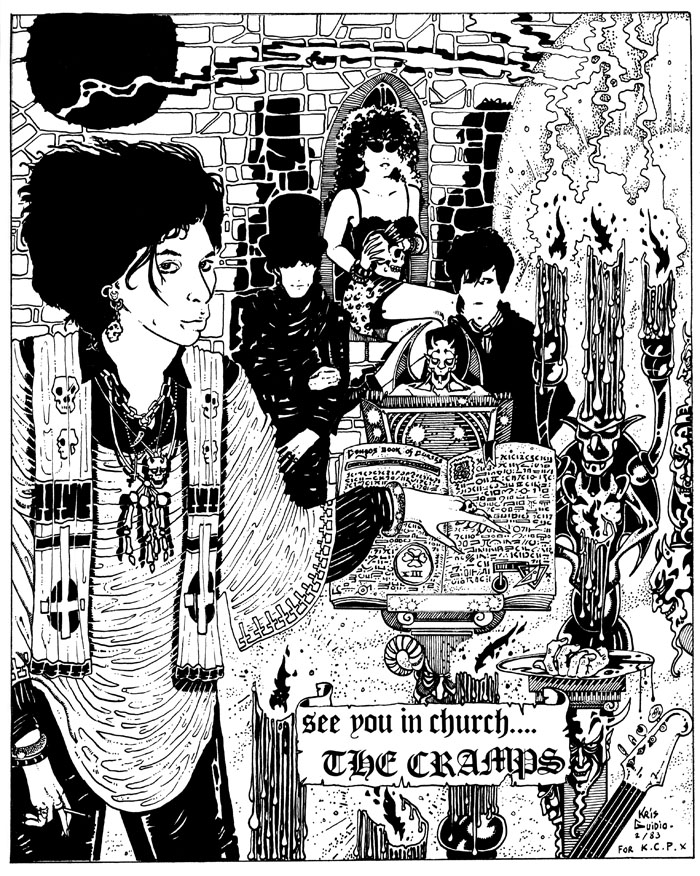
Farewell to the artist I used to refer to as my partner in art-crime. We weren’t really criminals but in the 1990s we’d both seen our published works for Savoy Books condemned as obscene in British courts of law, a farcical set of circumstances looking back, although it all seemed serious enough while it was happening. Kris and I began working for Savoy in the late 1980s, during which time our creative confederacy might be characterised as familiarity at a distance. He lived in Liverpool, and generally remained there, while the rest of us were in Manchester, so I saw his drawings much more than I saw him in person. I don’t think I ever met him more than 10 times in 30 years, yet his art was as familiar as my own, especially when I was being called upon to add backgrounds to some of his figures. I even ended up making a font based on the lettering he used in his comic strips in order to standardise the captions in the later books.

cramps1.jpg

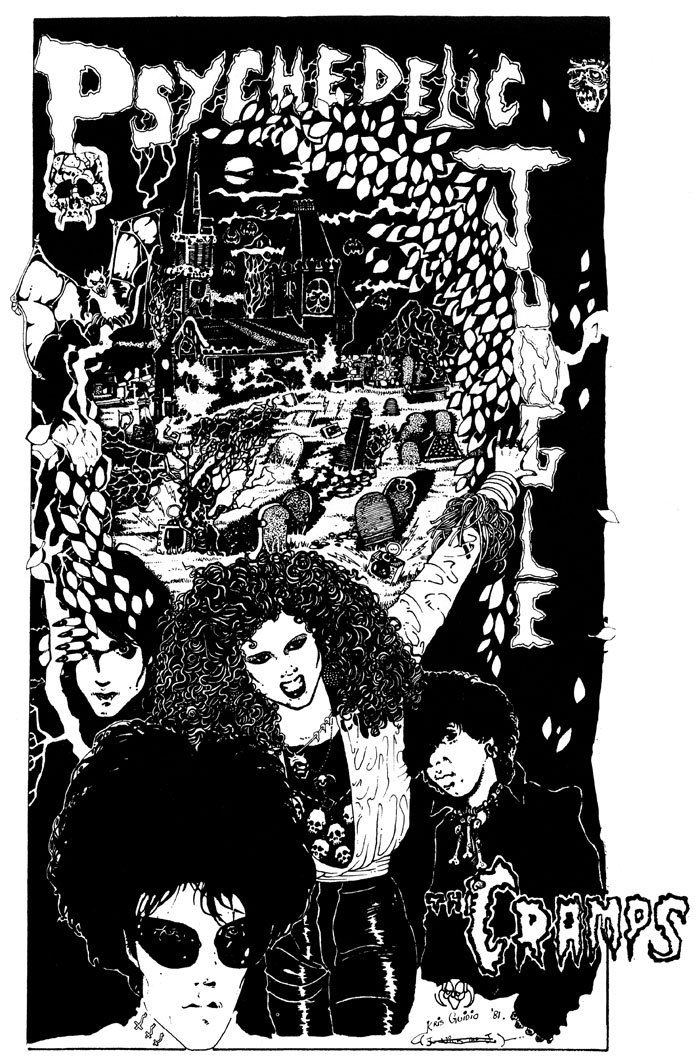
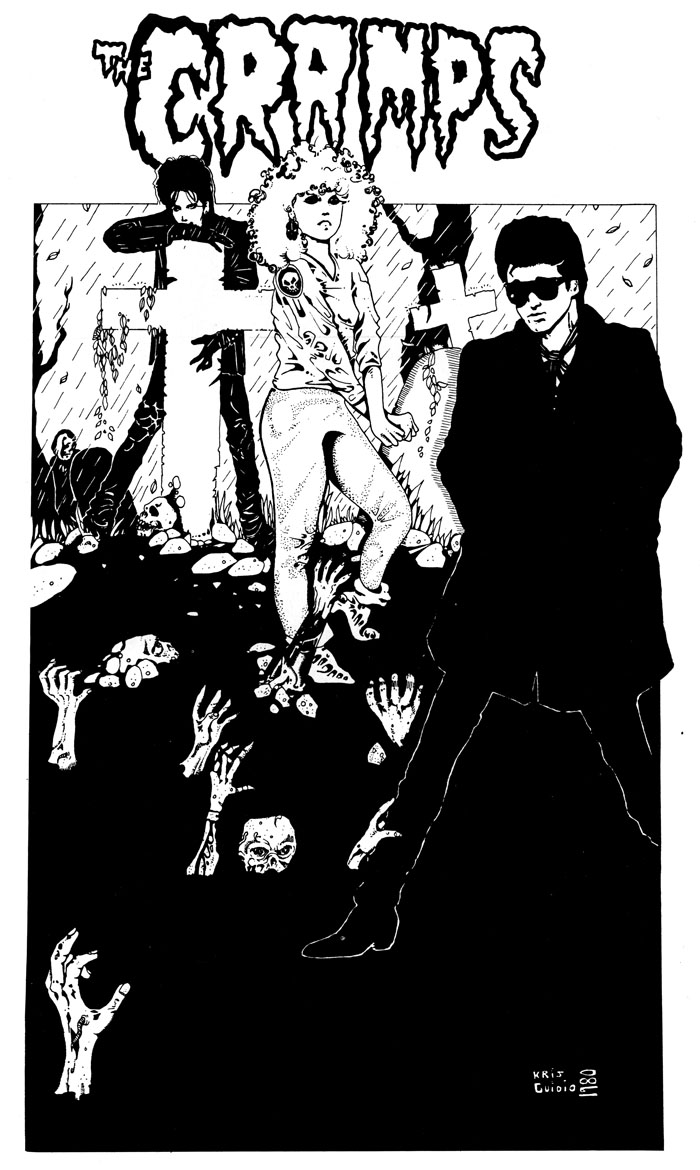
Kris and I shared a symbiotic relationship with writer David Britton, who pushed the pair of us to take our art into places we might otherwise have avoided, while we opened up artistic possibilities for Dave’s characters and the settings they occupied. We were an ideal team in this respect, each of us having strengths in different areas that suited the titles on which we worked. I brought a greater sense of realism to the Lord Horror comics, while Kris developed a hitherto unexplored flair for satire and caricature in the Meng & Ecker series. Kris was a natural cartoonist, as well as a natural humorist to a degree you wouldn’t have predicted looking at his early strips and illustrations featuring The Cramps.

cramps2.jpg

The Meng & Ecker comics provoked the ire of the authorities, thanks in part to Dave’s frequent digs at the Greater Manchester Police, but there was a lot more to Kris’s art than outrage, a quality which is always easy to generate if you push the right buttons. His Cramps strips are gems of that minor form, the rock’n’roll comic, while his later illustrations for the La Squab character had a lightness of touch that suited Dave’s conception of a world where fairy tales and childhood fantasies collide with adult themes and sensibilities. Kris’s art was analogue to the last (I don’t think he ever owned a computer), drawn with whatever pens he had to hand; watercolour-hued, and fuelled by endless cigarettes. Kris in person was generous, witty, and erudite in the autodidactic manner common to all at Savoy. Remote or not, we’ll miss him here.

Further reading:
Sinister Legends (1988)
The Adventures of Meng & Ecker (1997)
Fuck Off and Die (2005)
La Squab: The Black Rose of Auschwitz (2012)

cramps3.jpg

cramps4.jpg

Continue reading “Kris Guidio, 1953–2023”

Echoes of de Chirico

dechirico01.jpg

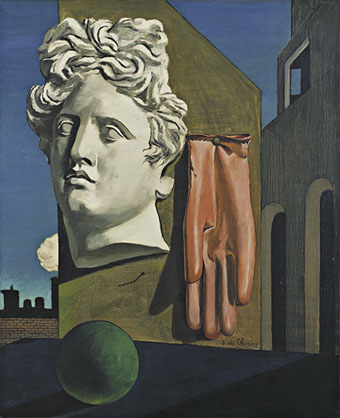
The Song of Love (1914) by Giorgio de Chirico.

His art studies, begun in Athens, were continued in Munich where he discovered the work of Max Klinger and Arnold Böcklin, not to mention the writings of Friedrich Nietzsche and Arthur Schopenhauer, whose influence is perceptible in the paintings he went on to produce in Florence and Turin. In addition, his melancholy temperament lay behind the works that Guillaume Apollinaire labelled “metaphysical,” works in which elements from the real world (deserted squares and arcades, factory chimneys, trains, clocks, gloves, artichokes) were imbued with a sense of strangeness.

Keith Aspley, Historical Dictionary of Surrealism


dechirico02.jpg

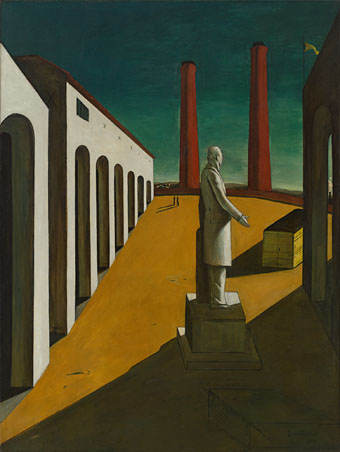
The Enigma of a Day (1914) by Giorgio de Chirico.


ernst.jpg

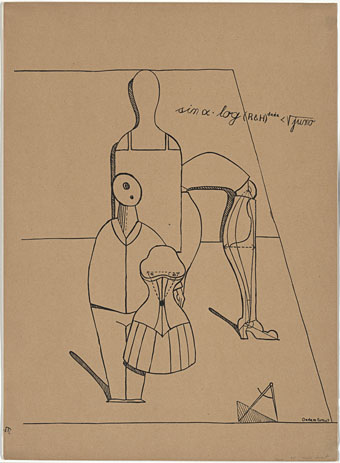
Plate II from Let There Be Fashion, Down With Art (Fiat modes pereat ars) (1920) by “Dadamax Ernst”.


magritte.jpg

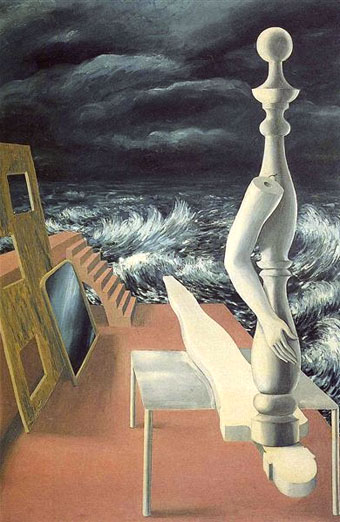
The Birth of an Idol (1926) by René Magritte.

Some time during the latter part of 1923 [Magritte] came face-to-face with his destiny, in the form of a painting by Giorgio de Chirico, who was one of the painters most admired by the Paris Surrealists: Le Chant d’amour (The Song of Love, 1914); to be more precise, a black-and-white reproduction of that painting in the review Les Feuilles libres, a very contrasty reproduction, as Sylvester has it, which only heightened the drama of the outsize objects suspended in the foreground of one of de Chirico’s “metaphysical landscapes”… He was shown it by Lecomte, or Mesens, or both. He was overwhelmed. […] Magritte always spoke of de Chirico as his one and only master. As a rule, he was exceedingly parsimonious in his assessment of other artists, past and present. In his own time, de Chirico (1888–1978) and Ernst (1891–1976) appear as the only two he admired, more or less unconditionally.

Magritte: A Life by Alex Danchev


dali4.jpg

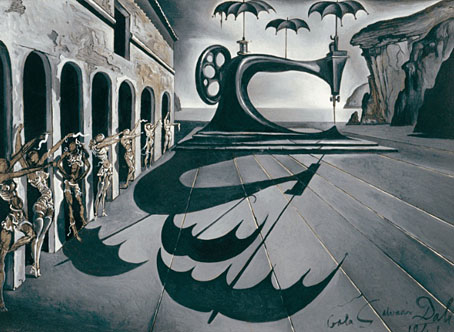
Sewing Machine with Umbrellas in a Surrealist Landscape (1941) by Salvador Dalí.

Continue reading “Echoes of de Chirico”

L’île des Morts

ile1.jpg

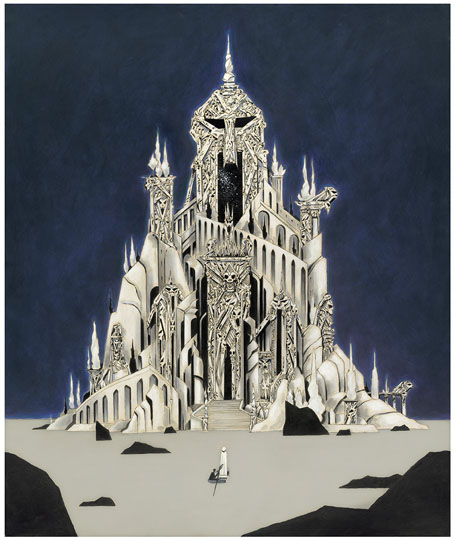
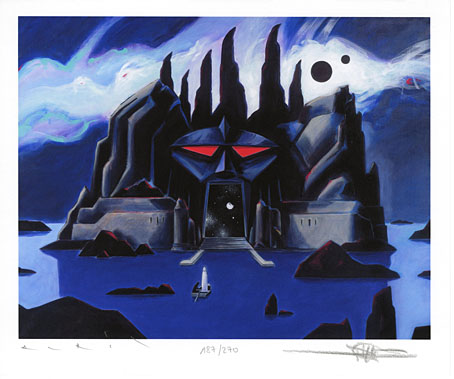
In Philippe’s studio there was always against a wall this large canvas sketched in the 80s on the theme of the Isle of the Dead. During a work session on the print, I asked him if he intended to finish it one day. He answered me: “NO”, then “we will finish it together.”

Thus François Avril writing about his collaboration with Philippe Druillet on yet another version of The Isle of the Dead, the endlessly malleable Symbolist emblem created in the 1880s by Arnold Böcklin. Druillet had already drawn an impressive version of the cemetery island for Gail, one of the later Lone Sloane stories, in 1976. These new versions are from an exhibition of prints staged last year at Galerie Barbier in Paris.

ile2.jpg

Copies of the prints are still for sale, as is a pricey (€ 100) signed and limited exhibition catalogue. More tempting, although even more expensive, is a forthcoming catalogue from another Druillet exhibition, Les 6 Voyages de Philippe Druillet which explored the artist’s “oeuvre colossale”.

All of this reminds me that when I was writing about René Laloux’s films for the previous post I was thinking once again that it was a shame Laloux never produced anything based on Druillet’s art. There is an animated series, Bleu, L’enfant de la Terre, which Druillet designed for French TV in the 1980s, but this was aimed at children so there’s none of the cosmic doom that dominates Druillet’s early books. My ideal today would be a Lone Sloane feature animated by one of those Japanese studios with a fanatic attention to detail. I can dream, can’t I?

Previously on { feuilleton }
More Isles of the Dead
Isles of the Dead
Du Tac au Tac: Druillet, Hogarth and Buscema
Sorcerer: Druillet and Friedkin
Ô Sidarta: a film about Philippe Druillet
Lovecraft: Démons et Merveilles
Philippe Druillet album covers
A Picture to Dream Over: The Isle of the Dead
The Isle of the Dead in detail
Druillet’s vampires
Druillet meets Hodgson
Arnold Böcklin and The Isle of the Dead

Weekend links 656

escher.jpg

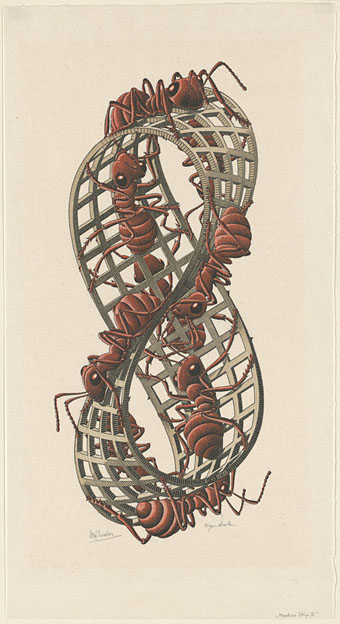
Mobius Strip II (1963) by MC Escher.

• Old music: Warp Records is reissuing two recent Jon Hassell discs later this year: The Living City (Hassell’s ensemble playing live in NYC, 1989) and Psychogeography (Zones Of Feeling) (remixes from City: Works Of Fiction), which will be available as standalone releases or bundled together as Further Fictions together with Hassell’s Atmospherics book.

• “His library is an immense and enviable wellspring, a demimonde of objects by murky creators who for decades have gnawed away at the inner organs of polite society.” Steven Heller talks to Glenn Bray about Library, an 800-page collection of scans from Bray’s trove of books, comics and print ephemera.

• New music: Tsathoggua, the latest in the Lovecraftian series of Cryo Chamber Collaborations which reminds me that I’m still missing the more recent entries. Also the non-Lovecraftian Coil by Ian Boddy.

• “Music is a way to express yourself beyond words,” says Hildur Guðnadóttir.

• See this year’s winners of the annual Close-up Photographer of the Year competition.

• At Dennis Cooper’s: Spotlight on…Ishmael Reed The Last Days of Louisiana Red (1974).

• A few new photos of Michael Heizer’s City in the Nevada desert.

City Of Night (1994) by David Toop & Max Eastley | City As Memory (1995) by John Foxx | City Appearing (2013) by Julia Holter