The horror

Last year I was asked to write something about my favourite horror comics for Nørd Nyt, a Danish comics zine. I’d pretty much forgotten about this until the printed copy arrived, so here’s my piece in English, a choice of three favourite horror stories.
breccia.jpg

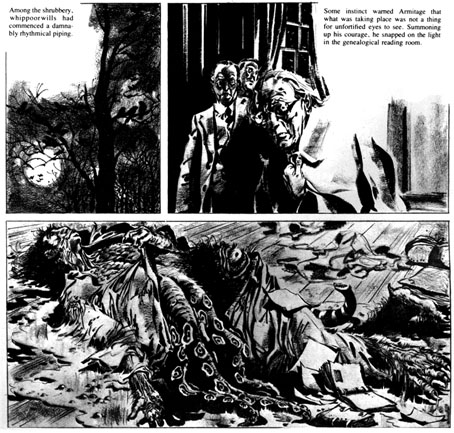
The Dunwich Horror by Breccia (1973)

The October 1979 issue of Heavy Metal magazine came as a revelation. I’d only bought a few issues prior to this, and seeing an entire magazine devoted to HP Lovecraft seemed far too good to be true. Lovecraft art is so common now that it needs to be emphasised how scarce this kind of illustration used to be, the most you saw was paperback art of varying quality. There had been a few comic-strip adaptations but they were mostly in American publications or foreign editions I hadn’t seen. As it turned out, Heavy Metal‘s great JK Potter cover promised more than it actually delivered: at least half the magazine was taken up with continuing strips that had nothing to do with Lovecraft, or strips that did little but borrow a few Lovecraftian motifs for a slight horror tale. The one really outstanding piece was Alberto Breccia’s The Dunwich Horror, one of several Lovecraft adaptations the artist produced in 1973. Breccia’s style was sketchy, shadowy and replete with period details. The faces of his characters looked absolutely right for what I still consider to be one of Lovecraft’s darkest stories (people tend to miss the implication that a backwoods magus very nearly destroys humanity). Until I encountered the artists in Heavy Metal I’d given up on comics as an artistic medium, having no time at all for superheroes or the poor science fiction of 2000AD. Artists like Breccia, Moebius and Druillet showed that there was more than one way of drawing imaginative work, that you could use the refined techniques of illustration to tell a story.
yeux.jpg

Les Yeux du Chat (The Eyes of the Cat) by Jodorowsky and Moebius (1978)

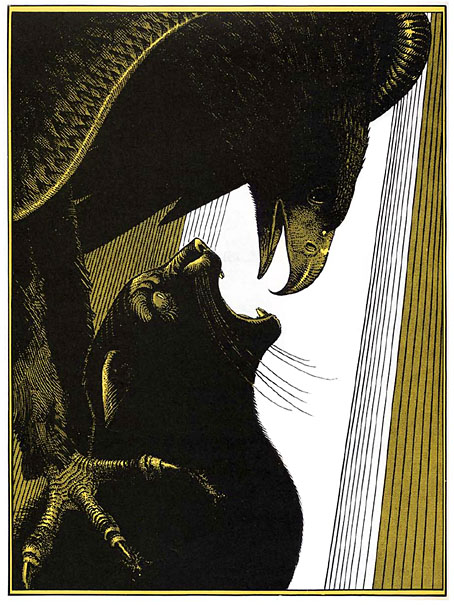
This story came to my attention when it received its first English translation in the pages of Steve Bissette’s Taboo anthology. It was printed in black on yellow paper, the original French edition having been yellow and black with white highlights. Compared to Jodorowsky’s customary flights of fancy the story is a very simple one, if typically grotesque: a silhouetted figure stands at a tall window overlooking a futuristic (or alien) city, directing with its thoughts the action of an eagle who hunts down a cat in the streets below. The horror comes from the shocking predicament revealed at the end, and the final line of dialogue, although this remains secondary to the formal perfection of the drawing and storytelling. Even by the standards of Moebius’s meticulous draughtsmanship this is a superbly controlled piece of work. Each spread operates as a kind of split-screen, with the left page showing the dialogue and the silhouetted figure, while the full-page illustration opposite shows a simultaneous moment of action somewhere in the city. One thing I immediately liked about this was Moebius’s architecture which even more than usual manages to seem otherworldly yet completely convincing. Everything we see in this brief tale poses questions that remain unanswered. And like many of the best short stories, a few carefully chosen details can imply an entire world.
fromhell.jpg

From Hell by Alan Moore and Eddie Campbell (1991–1996)

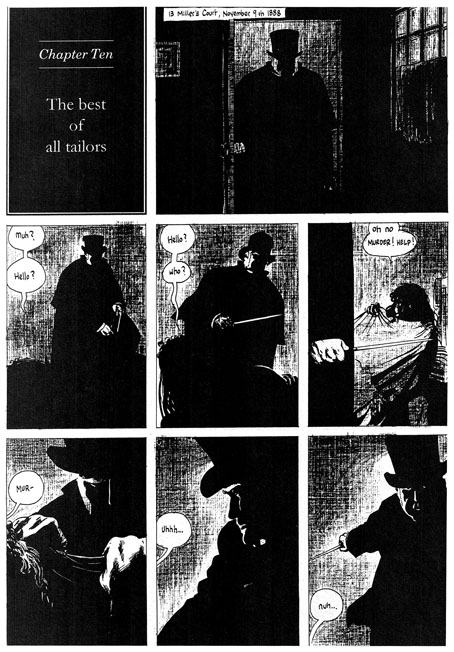
Horror doesn’t have to be delivered within genre stereotypes, in fact these days it’s often better if it isn’t when so many of those stereotypes—vampires and zombies, for example—have been diminished by over-familiarity. From Hell isn’t a horror story per se—it’s self-described as “a melodrama in sixteen parts”—but it debuted in Steve Bissette’s anthology Taboo where the brief was to offer the reader something dark or challenging that they hadn’t seen before. From Hell certainly fulfilled that brief: Alan Moore’s writing has never shied from the dark—consider the nihilistic Rorschach chapter of Watchmen—but this is as black as he gets. Eddie Campbell has been vocal about his dislike of horror stories but he was the perfect artist here with his long experience drawing ordinary human beings rather than posturing superheroes. Together the pair delivered a story that was novelistic in scope and minute in its attention to detail. Most people would have thought they knew more than enough about Jack the Ripper but no other representation has been this thorough in its exploration of all aspects of the case.

Watchmen had already aimed for a panoramic range of characters—from the president to a newspaper-seller—but From Hell went much further and in greater detail, with a scope that ranges from a group of homeless women to the head of the British Empire and all the classes in between. One of the most impressive aspects of the story was its exposure of the awful gap at the heart of previous dramatisations, namely the reduction of the lives of the murdered women to a cast of frequently nameless unfortunates who we glimpse for a moment sidling up an alley before their blood splashes on a wall. Moore’s script showed us (as much as is possible) the real women behind the roll-call of victims, crushed by poverty yet still distinct individuals. Looking for human detail has always been a feature of Moore’s writing, it’s why his work seemed so fresh in the 1980s compared with lesser writers who were simply recycling clichés as though there was no other way to behave. So too with Campbell’s artwork which has never been subject to the exaggerations of the superhero genre. One of my favourite moments in the entire story was utterly human and utterly trivial: the scene in Chapter 3 when Walter Sickert and Annie Crook meet. Annie says “I need a wee” so she hitches up her shift and squats in the road. It’s the accumulation of numerous human moments such as this—the moments that genre comics invariably avoid—that makes From Hell such a powerful and memorable piece of work. Eddie Campbell’s art shows us the true London dark, a city as black and terrible as it would have been in the days before electric light.

Previously on { feuilleton }
Heavy Metal, October 1979: the Lovecraft special

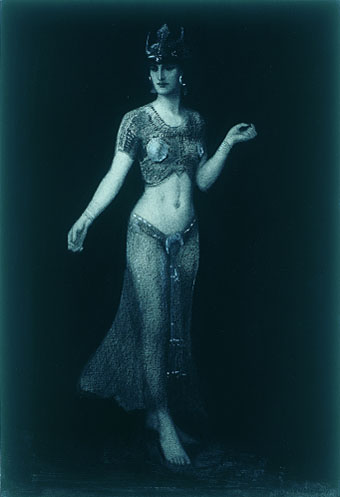
Several more Salomés

durnov.jpg

Cover of Salome by Oscar Wilde (1903) by Modest Alexandrovich Durnov.

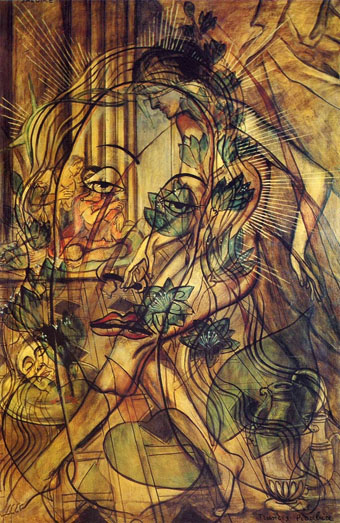
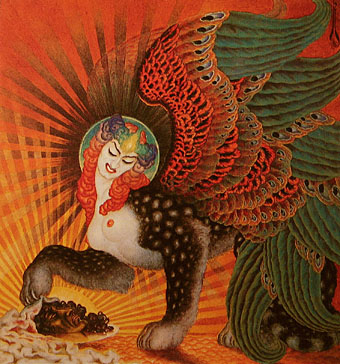
Gathering a few more Salomé renderings which have caught my attention recently. The biggest surprise is the one from Picabia since he’s an artist who these days is almost always associated with the Cubists and Dadaists. In the 1920s he returned to figurative painting and produced a number of pieces in this style. The overlaying of images reminds me of some of Hans Bellmer’s drawings.

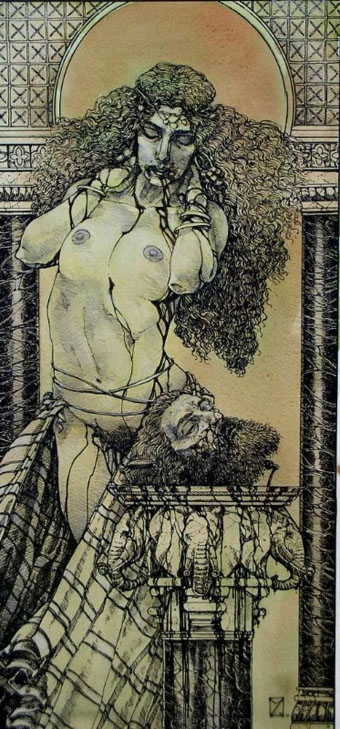
Michael Zulli is an American comic artist whose work I’ve always liked a great deal. No information about his drawing, unfortunately, so I can’t say whether it’s a one-off or part of a larger project.

wilmer.jpg

Salomé (1917) by John Riley Wilmer.

picabia.jpg

Salomé (c. 1928) by Francis Picabia.

kalmakov.jpg

Salomé Sphinx (1928) by Nicholas Kalmakoff.

zulli.jpg

Salomé (no date) by Michael Zulli.

Elsewhere on { feuilleton }
The Salomé archive

Reverbstorm at Supervert

reverbstorm.jpg

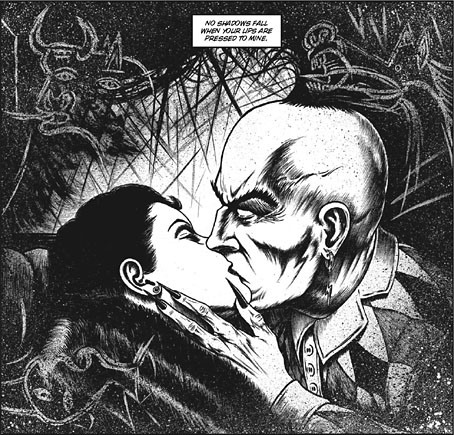
Keith Seward’s Horror Panegyric was a concise examination of David Britton’s multimedia Lord Horror project which Savoy Books published in 2007. I designed the book, the cover of which was my Arcimboldo pastiche of Lord Horror’s profile which appeared on the cover of issue 3 of Reverbstorm. The Supervert site which hosts an online copy of Horror Panegyric has this month posted my answers to some questions about Reverbstorm, the series having grown out of the first Lord Horror novel and the earlier comics:

The graphics in Reverbstorm sometimes seem more narrative than the words. How did you and David work out a scenario?

I don’t have objections per se to the usual story structures but in this series we both wanted to create something that wasn’t following familiar adventure narrative lines. The precedents for me were the European comic artists from Métal Hurlant who often favoured art over story; also Burne Hogarth whose work was a great influence on the style I used to draw Lord Horror. Hogarth’s Tarzan strips are adventure narratives but in his later books it’s the art that’s paramount. James Joyce is one of the characters in Reverbstorm, and you can also find a precedent in Ulysses where the story is overwhelmed by the surface detail.

Reverbstorm began with Paul Temple’s lyrics for the Reverbstorm song and a brief Lord Horror film treatment that Dave and Mike had put together for a production company. I don’t recall much about the treatment — I only looked at it once in the office — but it concerned Horror and Jessie Matthews in New York City, opening with a sequence where his Lordship kills some policemen in an alleyway. That vague outline can be seen in the first few pages of Reverbstorm with NYC changed to Torenbürgen. Other elements taken from the film treatment included the name Blue Blaze Laudanum — the actual robotic character came later — and the Souls which likewise became more substantially developed as the comic progressed.

Once we’d introduced all the characters things developed along thematic lines rather than strictly narrative ones. So the second part introduces the Ether Jumpers, the third part has the Apes, the fourth part the Ononoes, the fifth part Picasso and T.S. Eliot, and so on. Musical structure is an obvious parallel, and I consider some of the recurring background material to be visual leifmotifs which can indicate or imply one of the three main characters even if they aren’t present on the page. This musical analogy is an important one for appreciating the series as a whole. The entwined themes and references work in a manner that’s a lot closer to musical works than to the mechanics of an adventure narrative. (more)

Previously on { feuilleton }
Reverbstorm in print
Reverbstorm update
James Joyce in Reverbstorm
A Reverbstorm jukebox
Reverbstorm: Bauhaus Horror
Reverbstorm: an introduction and preview

Weekend links 148

lanna.jpg

Quantum Entanglement by Duda Lanna.

An hour-long electronica mix (with the Düül rocking out at the end) by Chris Carter for Ninja Tune’s Solid Steel Radio Show.

• “…a clothes-optional Rosicrucian jamboree.”: Strange Flowers on the paintings of Elisàr von Kupffer.

• A Paste review of volume 2 of The Graphic Canon has some favourable words for my contribution.

It is an entertaining thought to remember that Orlando, all sex-change, cross-dressing and transgressive desire, appeared in the same year as Radclyffe Hall’s sapphic romance The Well of Loneliness. The two novels are different solar systems. The Well is gloomy, beaten, defensive, where women who love women have only suffering and misunderstanding in their lonely lives. The theme is as depressing as the writing, which is terrible. Orlando is a joyful and passionate declaration of love as life, regardless of gender. The Well was banned and declared obscene. Orlando became a bestseller.

Jeanette Winterson on Virginia Woolf’s androgynous fantasia.

Jim Jupp discovers the mystical novels of Charles Williams.

Michael Andre-Driussi on The Politics of Roadside Picnic.

Les Softs Machines: 25 August 1968, Ce Soir On Danse.

• At 50 Watts: Illustrations and comics by Pierre Ferrero.

Soviet posters: 1469 examples at Flickr.

Oliver Sacks on drugs (again).

• At Pinterest: Altered States.

• Farewell, Kevin Ayers.

Darkest London

Why Are We Sleeping? (1969) by The Soft Machine | Lady Rachel (1969) by Kevin Ayers | Decadence (1973) by Kevin Ayers

Weekend links 147

kalynovych.jpg

Bestia Apocalypsi (2000) by Konstantin Kalynovych.

A funding page for Better Things: The Life and Choices of Jeffrey Catherine Jones, Maria Paz Cabardo’s documentary film about the late comic artist and illustrator.

• Phantasmaphile’s Pam Grossman has declared 2013 to be the Year of the Witch.

• At WFMU: The Space Ghost Coast To Coast Sonny Sharrock Tribute Episode.

I think that mass culture is idiotic. I always have. Even things that are the sort of trendy new whatevers, it’s always about money and sex and nothing else.

Laurie Anderson on music for dogs and Obama.

• It’s that…thing…again. Clive Hicks-Jenkins on his new Mari Lwyd designs.

• Rick Poynor’s Dictionary of Surrealism and the Graphic Image.

• “Why do gay porn stars kill themselves?” asks Conner Habib.

scarfolk.jpg

If you’re staycationing in Scarfolk this year you’ll be pleased to hear the town now has 20% less rabies. Above: The 1972–73 prospectus for scarecrow and wicker man biology at Scarfolk Technical College. Related: A Day At The Seaside. I guessed the source even without the cryptic comments. Can you?

Laurie Spiegel designed a T-shirt for The Wire magazine.

Julia Holter covers Chiamami Adesso by Paolo Conte.

Strange Attractor has two new Austin Spare prints.

Forgotten Women Designers and Illustrators.

• RIP Alan Sharp, a sharp screenwriter.

• “Can You Pass the Acid Test?

Sonny and Linda Sharrock live at WKCR 03/21/74 | Many Mansions (1991) by Sonny Sharrock | Ghost Planet National Anthem (1993) by Sonny Sharrock