The Use and Abuse of Books

savoy.jpg

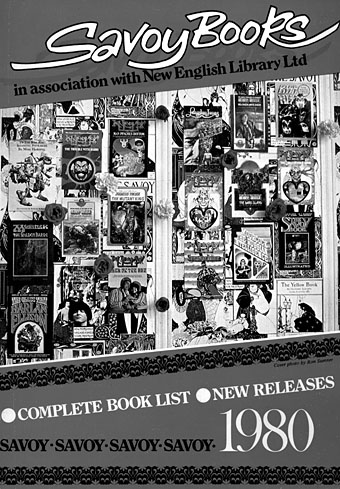
Savoy • Savoy • Savoy: The first wave of book covers pinned to the Beardsley wallpaper of the Deansgate office.

I often feel I’m in a minority in never having been desperate to see my work in a gallery. We are, after all, living in the Age of Mechanical Reproduction (thanks, Walter), and the idea of having to visit a physical location in order to see a work of art can seem like a rather antiquated affair. (Plenty of arguments counter this, of course, but I don’t create anything that needs to be experienced in situ, and I’m also not enmeshed in the art market.) So it’s been surprising this month to realise that examples of my work are currently on display in Monterey, California (the Tentacles exhibition), London (Comics Unmasked: Art and Anarchy in the UK at the British Library which ends today) and in Manchester (The Exhibition Centre for the Use and Abuse of Books at the International Anthony Burgess Foundation). If all goes according to plan, some of my steampunk book covers will also be exhibited in Beijing next month; more about that later.
dbmb.jpg

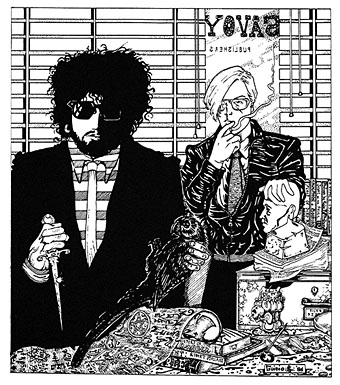
Britton & Butterworth by Kris Guidio (1986).

The Use and Abuse of Books is a necessarily brief overview of the 40-year history of Savoy Books, a notable moment in the life of the company since this is the first time any Manchester institution has acknowledged the existence of a local publisher with such a long, varied and often controversial history. In part this is a result of the cultural histories of Manchester concentrating almost exclusively on the music scene. Many of the books and features written about Manchester arts have been produced by DJs or ex-musicians who appear tone-deaf to literary culture despite the existence of Carcanet Press (established 1969), Savoy Books, and other more recent publishers who are happy to operate outside London. (The venerable Jon Savage gets a pass here.) Carping aside, The Use and Abuse of Books describes itself thus:

Featuring text, images and rare promotional content from Savoy’s infamous 1989 publication Lord Horror, the exhibition tackles the question of whether the depiction and description of horrific acts is justified in satire. In 1992 Lord Horror was declared by Judge Gerrard Humphries as ‘a glorification of racism and violence’ whereas writer Michael Moorcock believed the book to belong to ‘a tradition of lampoon, of exaggeration. Its purpose is to show up social evils, and the evils within ourselves.’ Displaying artwork from Sinister Legends and Meng and Ecker alongside other panels from rare comics and graphic novels (including Reverbstorm), The Use and Abuse of Books also examines the relationship between text and imagery within Savoy’s publications, revealing how artwork from John Coulthart, Kris Guidio and James Cawthorn supplements and enhances the storytelling through visual references to architecture, cultural figures or specific works of art. The exhibition will be open 10am–4pm weekdays and in the evenings during events from Friday 15th August until Friday 5th September. (more)

Some of my pages from Lord Horror: Reverbstorm have been printed large-size for the walls, and there’s also a life-size cardboard figure of my Beardsley-style Lord Horror. Savoy publications past and present are on display, including some of my book designs. It’s fitting that this should be taking place under the aegis of the Anthony Burgess Foundation; Burgess was a great Joycean and a champion of two Savoy favourites: William Burroughs and JG Ballard. I can’t imagine him getting too enthusiastic about many of Savoy’s publications but I’d hope he might have appreciated the spirit of Mancunian bloody-mindedness in which they were produced.

Intertextuality

cthulhu17.jpg

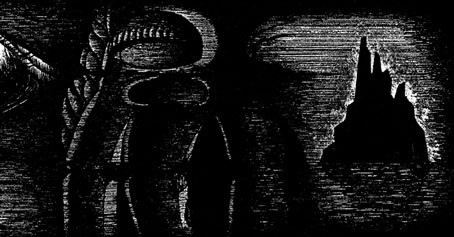
The Call of Cthulhu (1988): in the upper half there’s the big sun from Bob Peak’s poster for Apocalypse Now, in the lower half a radical reworking of Arnold Böcklin’s The Isle of the Dead.

In 1990, shortly after the first season of Twin Peaks had finished showing in the US, Video Watchdog magazine ran a feature by Tim Lucas which attempted to trace all the various cultural allusions in the character names and dialogue, references to old TV shows, song lyrics and the like. This was done in a spirit of celebration, with Lucas and other contributors welcoming the opportunity to dig deeper into something they’d already enjoyed. This week we’ve had a similar unravelling of textual borrowings in a TV series, only now we have the internet which, with its boundless appetite for accusing and shaming, can often seem like something from the grand old days of the Cultural Revolution.

cthulhu01.jpg

The Call of Cthulhu (1988): a more subtle allusion to Apocalypse Now.

The latest culprit ushered to the front of the assembly for the Great Internet Struggle Session is Nic Pizzolatto whose script for True Detective has indeed been celebrated for its nods to Robert Chambers and The King in Yellow. It’s also in the process of being condemned for having borrowed phrases or aphorisms from Thomas Ligotti’s The Conspiracy Against the Human Race (2011). See this post for chapter and verse.

cthulhu02.jpg

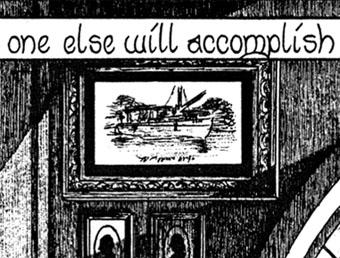
The Call of Cthulhu (1988): It’s not very clear but that’s a boat from The Creature from the Black Lagoon.

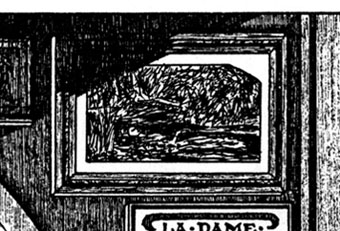
If I find it difficult to get worked up over all this pearl-clutching it’s because a) it shows a misunderstanding of art and the way many artists work; b) True Detective was an outstanding series, and I’d love to see more from Pizzolatto and co; and c) I’ve done more than enough borrowing of my own in a variety of media, as these samples from my adaptation of The Call of Cthulhu demonstrate, a 33-page comic strip where there’s a reference to a painting, artist or film on almost all the pages, sometimes several on the same page.

cthulhu03.jpg

The Call of Cthulhu (1988): Ophelia by Millais.

Cthulhu is a good choice here since Pizzolatto’s story edged towards Lovecraft via the repeated “Carcosa” references. You’d think a Lovecraft zine of all things would know better than to haul someone over the coals for borrowing from another writer when Lovecraft himself borrowed from Robert Chambers (and Arthur Machen and others), while “Carcosa” isn’t even original to Chambers’ The King in Yellow but a borrowing from an Ambrose Bierce story, An Inhabitant of Carcosa (1886). Furthermore, Lovecraft famously complained about his own tendencies to pastiche other writers in a 1929 letter to Elizabeth Toldridge: “There are my ‘Poe’ pieces and my ‘Dunsany pieces’—but alas—where are any Lovecraft pieces?”

Continue reading “Intertextuality”

Weekend links 219

balbusso.jpg

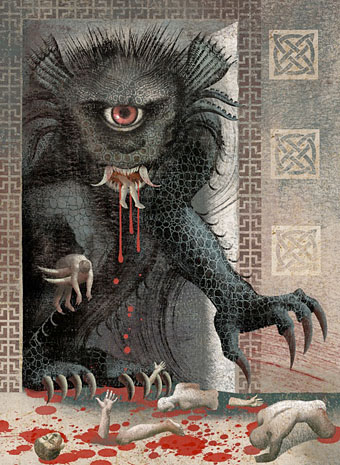
Grendel Monster (2013) by Anna & Elena Balbusso.

Rick Poynor looks at the Guide de la France mystérieuse (1964), a fantastic (in every sense) doorstop of a volume whose collage alphabet by Roman Cieślewicz can be seen on the cover of Carnival In Babylon (1972) by Amon Düül II.

• Boolean mathematics, Charles Howard Hinton, The Voynich Manuscript, and the effects of surveillance on the political process: Adam Curtis firing on all cylinders as usual.

• At Strange Flowers: The Picture of John Gray, remembering the minor fin de siècle figure who gave Oscar Wilde a surname for his most famous creation.

In “32 Cardinal Virtues of Dennis Cooper,” Wayne Koestenbaum remarks: “Cooper’s quest for the unseeable is virtually religious. I mean: sedulous, abstract, perpetual, unrewarded, unreasonable.” There’s much more to be said of Gone, its power, its pain, its odd intrigues, but perhaps it will suffice to say that it is revealing: unlike Burroughs’ scrapbooks hidden away by some private collector, never to see the light of day, Gone (and its sister texts at the Fales Library) illuminate in perpetuity Cooper’s obscure quest for the unseeable.

Diarmuid Hester looks at Dennis Cooper’s scrapbooks

The Sallow Tree, a single by Lutine. More music: An hour of Julia Holter‘s St John’s Sessions performance.

• At Dangerous Minds: Christian televangelists listen to Stairway To Heaven forwards.

• Cathy Camper reviews Fearful Hunter, a graphic novel by Jon Macy.

• Mix of the week: FACT mix 452 by Claude Speeed.

Roman Cieślewicz at Pinterest.

The Adobe Illustrator Story

The House of Julian

Unofficial Britain

• Amon Düül II singles: Rattlesnakeplumcake (1970) | Between The Eyes (1970) | Light (1971) | Lemmingmania (1971)

Du Tac au Tac: Druillet, Hogarth and Buscema

tacautac.jpg

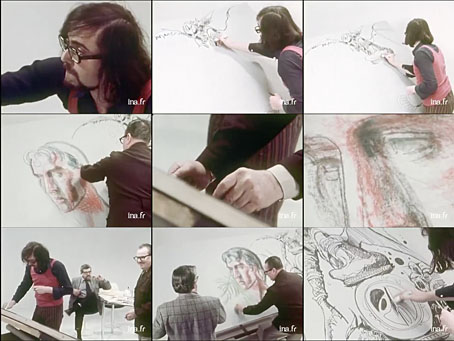
I thought I was done with Druillet for this week but no, there’s more. I hadn’t come across Du Tac au Tac before, a French TV show from the early 70s in which three (sometimes four) different comic artists are given a total of 15 minutes to improvise a drawing on a single board. The list of contributors is a who’s who of comic talent from France, Belgium, America and elsewhere. French TV site Ina.fr (which is pay-to-view) has 130 episodes in their archive, many of which have found their way onto YouTube. Druillet was a regular contributor, as was Moebius.

I’ve singled out this episode from 1972 for the astonishing conjunction of Druillet with Burne Hogarth, two artists with a considerable influence on my own comics work. Without the example of Heavy Metal magazine in general, and Druillet in particular, I might not have bothered trying to adapt Lovecraft’s stories into comics in the 1980s; at one point I was prepared to put together a book of stories-plus-illustrations along the lines of Berni Wrightson’s Frankenstein. Burne Hogarth, meanwhile, casts a Tarzan-shaped shadow over the darker shadows of the Reverbstorm series, his work being quoted throughout, especially in the appropriation of the bizarre and sinister Ononoes from the Tarzan Sunday strips. The third artist present, John Buscema, is notable if only for representing the comics creation that I like the least: the over-muscled, flat-groined, stupidly-costumed, always-fighting, corporate superhero. As it is, Buscema doesn’t fare too well in this exchange, sketching a half-hearted Silver Surfer while Hogarth (who was left-handed; don’t think I knew that) draws a profile of Tarzan in pastels, and Druillet works furiously with markers to create a typical melange of bat-winged demon, alien glyph and screaming head. I’ve not watched any of the other episodes yet but for those interested there are two channels of the things here and here.

Previously on { feuilleton }
Sorcerer: Druillet and Friedkin
Ô Sidarta: a film about Philippe Druillet
Lovecraft: Démons et Merveilles
Heavy Metal, October 1979: the Lovecraft special
Philippe Druillet album covers
Druillet’s vampires
Salammbô illustrated
Druillet meets Hodgson

Sorcerer: Druillet and Friedkin

sorcerer1.jpg

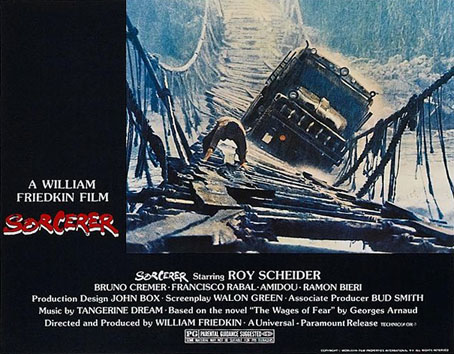
Earlier this week I finally got my hands on the recent Blu-ray reissue of William Friedkin’s Sorcerer (1977). Having only ever seen the film on the travesty of a DVD that appeared in 1998 I’m going to enjoy watching this at the weekend. Brits ought to know that (for now) the only edition available seems to be the US version although it is region-free, and if you buy from a UK film dealer on eBay you won’t get hit with import duties.

sorcerer2.jpg

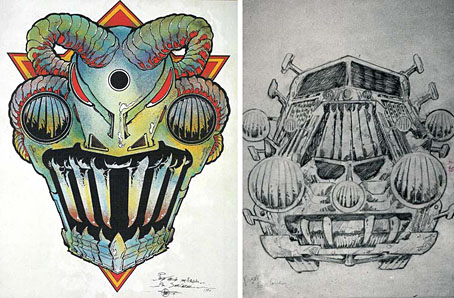
Sorcerer designs by Philippe Druillet.

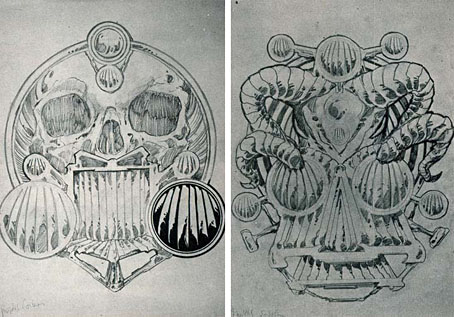
By coincidence, Sorcerer has a minor connection with Philippe Druillet, although his contribution was so minimal that there’s not even a mention of his name on the obsessively detailed Sorcerer film blog. If you’ve seen the film (or Henri-George Clouzot’s equally good earlier version, Wages of Fear), or even read George Arnaud’s novel, you’ll know that the crucial part of the story concerns a potentially suicidal expedition by four men in two trucks, each of which are carrying crates of nitroglycerine through hazardous terrain to the site of an oil-well fire. Friedkin and writer Walon Green expand the story without aping any of Clouzot’s set-pieces (something few directors today would resist), while Friedkin adds some details of his own, notably in the design of the trucks which have distinct “faces” and their own names—”Lazaro” and “Sorcerer”—hence the film’s title which also nods misleadingly to The Exorcist. The truck design was Druillet’s contribution although there’s very little of this apparent on-screen, understandably so when his sketches show fantastic designs that would have no place in the dishevelled jungle town where much of the film takes place. Later sketches by production designer John Box can be found at Wikipedia.

sorcerer3.jpg

Sorcerer designs by Philippe Druillet.

What interests me most about this connection is its being another example of the surreptitious influence of French comics on American cinema during the 70s and 80s. Moebius is the most obvious example of this but it’s also there in the influence of Métal Hurlant/Heavy Metal on the look of Blade Runner, and in Enki Bilal’s design of Molasar in Michael Mann’s The Keep. Since the 1980s we’ve seen a greater industrialisation of conceptual art for the cinema, as a result of which directors are less inclined to look outside Hollywood for their stylists. And now that the treadmill of superhero franchises is grinding away relentlessly, Continental comics and their creators are even less visible than before.

Probably the oddest thing about the Sorcerer/Druillet connection is that the commercial failure of the film in 1977 has often been laid at the door of Star Wars, the advent of George Lucas’s dismal saga being regarded, with some justification, as the opening of the gate to the barbarian hordes. (Friedkin’s film might also have fared better had it not been titled as though it were an Exorcist sequel.) The irony here is that George Lucas happened to be a big Druillet enthusiast, although there’s little evidence of this in his films; in addition to writing an appreciation for Les Univers de Druillet in 2003, he also commissioned Druillet to create a one-off piece of Star Wars art in the late 70s. Knowing this it’s tempting to imagine Lucas creating a very different kind of science-fiction film in 1977, one with some Continental weirdness at its core. But when the world has already been deprived of Jodorowsky’s Dune it’s best not to dwell too much on might-have-beens.

Previously on { feuilleton }
Ô Sidarta: a film about Philippe Druillet
Lovecraft: Démons et Merveilles
Heavy Metal, October 1979: the Lovecraft special
Philippe Druillet album covers
Druillet’s vampires
Salammbô illustrated
Druillet meets Hodgson