Weekend links 358

higuchi.jpg

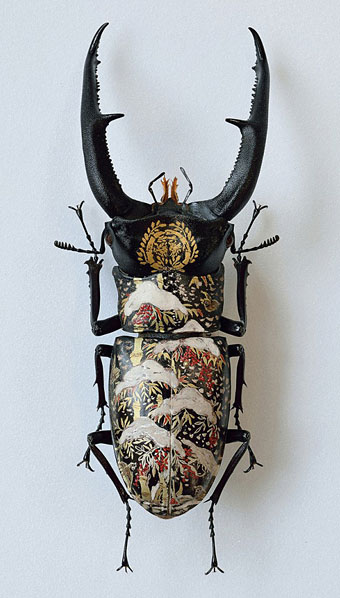
Painted beetle (2016) by Akihiro Higuchi.

David Horbury: The Tate’s Queer British Art exhibition ignores the pioneering scholarship of Emmanuel Cooper, author of The Sexual Perspective: Homosexuality and Art in the last 100 years in the West (1986).

L’Androgyne Alchemique is an exhibition at the Azzedine Alaïa Gallery, Paris, by pascALEjandro, a collaboration between Pascale Montandon-Jodorowsky and Alejandro Jodorowsky.

• At Strange Flowers: an interview with DJ Sheppard, biographer of poet Theodore Wratislaw (1871–1933), one of the models for Max Beerbohm’s hapless Enoch Soames.

Eloise or, the Realities is a new 122-page comic book by Ibrahim R. Ineke “inspired in part by Children of the Stones and The Owl Service“.

• Cormac McCarthy hasn’t published a novel for over ten years now but this new piece of writing addresses the mysterious origin of language.

• “…she invented a kind of symbolic code that channelled the occult and the Renaissance masters”. Yo Zushi on Leonora Carrington.

John O’Reilly on the Samuel Beckett cover designs created by Russell Mills and Gary Day-Ellison for Picador.

Porter Ricks (Thomas Köner & Andy Mellwig) have announced their first album in 18 years.

• At The Daily Grail: Alan Moore on science, imagination, language and spirits of place.

• All 66 issues of Performance Magazine (1979–1992) are now available online.

• The Throbbing Gristle catalogue is being reissued (again).

Lost Soul In Disillusion (1967) by The Power Of Beckett | Liquid Insects (1993) by Amorphous Androgynous | Biokinetics 2 (1996) by Porter Ricks

Weekend links 353

tuke.jpg

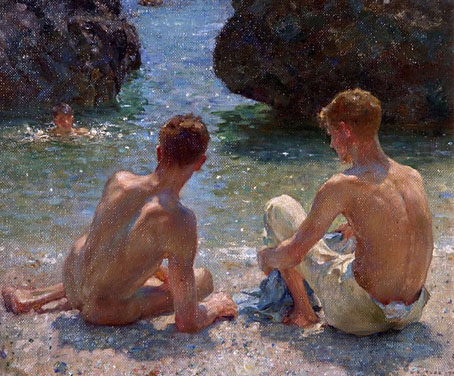
The Critics (1927) by Henry Scott Tuke.

• Geeta Dayal talks to ambient musician Midori Takada about Through The Looking-Glass (1983), an album being reissued this month by Palto Flats/We Release Whatever The Fuck We Want Records.

Jacob Brogan reviews The Abominable Mr. Seabrook by Joe Ollmann, a graphic biography of writer, occultist, explorer and determined cannibal, William Seabrook.

• More from the usual suspects (on these pages at least): Jonathan Meades on his new cookbook and a recent bout of heart surgery; and Iain Sinclair on The Last London.

The law only applied to men, but that didn’t mean same-sex relationships between women were immune to opprobrium. Dorothy Todd was hired as the editor of British Vogue in 1922. Under her visionary stewardship, the magazine became a bastion of high modernist style, swapping petticoats and corsets for Picasso, Cocteau, Man Ray and Woolf. Todd lived with her lover, the fashion editor Madge Garland. Sacked in 1926 because of declining circulation, she planned to sue the magazine, but was silenced when the publisher Condé Nast threatened to publicly expose her “morals”.

In such an inimical climate, it’s not surprising that art became a zone of enchantment as well as resistance. The plenitude of camp aesthetics, the lush excess, the cross-pollination of high and low forms might be conceived as a direct response to the paucity and hostility of the culture at large. From the mannered decadence of Aubrey Beardsley’s naughty woodcuts, to Cecil Beaton’s portraits of Stephen Tennant as a radiant boy prince, to the cabaret high jinks of Danny La Rue, to the wickedly doctored library book covers made by the playwright Joe Orton (a crime for which he received a jail sentence), camp offered a way of remaking the world, cutting it down to size and reassembling it in richly strange and strangely rich new forms.

Olivia Lang on the British artists working in defiance of iniquitous laws prior to the (partial) decriminalisation of homosexual acts in 1967.

• Due for publication later this year, You Should Come With Me Now, a new collection of short fiction by M. John Harrison.

Daniel Marner reviews Scarred For Life Volume One: The 70s, a book about the dark side of British pop culture.

Jay Babcock talks to Erik Davis about the end of Arthur magazine and his new life in the Californian desert.

• The nature photography of Nobuyuki Kobayashi and the ruin photography of Gina Soden.

Jon Forss of design team Non-Format on his time designing The Wire magazine.

Mac McClelland on how doctors treat mental illness with psychedelic drugs.

• Mix of the week: Secret Thirteen Mix 216 by WSR.

Hisham Matar on Jorge Luis Borges.

London Boys (1976) by T. Rex | Last Train To London (1979) by Electric Light Orchestra | London (2004) by Patrick Wolf

Weekend links 349

burgess.jpg

• Before Stanley Kubrick fixed an image of Alex and his droogs in the popular imagination, artists could get away with playing on the threat of biker gangs as Wilson McLean does in this vaguely psychedelic cover from 1969. (McLean’s interpretation may possibly derive from a 1965 edition.) LibraryThing has a collection of Clockwork Orange covers from around the world which run the gamut of cogs, orange hues and variations on David Pelham’s famous Penguin design from 1972. Meanwhile, AL Kennedy celebrates 100 years of Anthony Burgess by examining the writer’s career as a whole, although the web feature still manages to get a photo of Malcolm McDowell in there.

• “Even bad books can change lives,” says Phil Baker reviewing The Outsider by Colin Wilson and Beyond the Robot, a Wilson biography by Gary Lachman. I wouldn’t call The Outsider a bad book but Wilson’s more wayward opinions (and later works) are best treated with scepticism.

• “Murtaugh refers to his subject’s ‘pervasive sense of doom’ and Welch himself speaks of ‘the extraordinary sadness of everything.'” David Pratt reviewing Good Night, Beloved Comrade: The Letters of Denton Welch to Eric Oliver, edited by Daniel J. Murtaugh.

• At The Quietus this week: Tinariwen bassist Eyadou Ag Leche is interviewed by Richie Troughton, Jane Weaver unveils a new song from her forthcoming album, Modern Kosmology, and Danny Riley explores the strange world of Ben Chasny.

• “A micro-history of cultural gatekeeping: once told by the censors what we may read, then by critics what we should, we are now told merely what we can read.” Ben Roth writing against the use of “readability” as a literary value.

• Yayoi Kusama’s amazing infinity rooms are at the Hirshhorn Museum and Sculpture Garden, Washington DC, until May. For the rest of us, Peter Murphy’s panoramic photo is still online.

• More music: my friends Watch Repair have become visible enough to be interviewed by an Argentinian website. The group’s Bandcamp page recently made three new releases available.

• Yet more music: They Walk Among Us, a new song and video by Barry Adamson, and Anymore, a new song and video by Goldfrapp.

• Earth and The Bug announce Concrete Desert, a collaborative album inspired by Los Angeles and the fiction of JG Ballard.

• Bad Books for Bad People: Episode 7: The Incal – Epic French Space-Opera Comics.

• Mixes of the week: FACT Mix 589 by Aisha Devi, and Secret Thirteen Mix 212 by Qual.

Eduardo Paolozzi‘s forays into fashion and furnishings.

Cooking with Vincent [Price]

Moroccan Tape Stash

• Tin Toy Clockwork Train (1986) by The Dukes Of Stratosphear | Clock (1995) by Node | Clockwork Horoscope (2009) by Belbury Poly

L’outrageant Lord Horror

shoah1.jpg

Cover art by Enki Bilal.

Arriving in the post this week was the catalogue for the Shoah et bande dessinée exhibition which is currently running in Paris at Mémorial de la Shoah. I’ve mentioned previously that the exhibition includes some of my pages from my first collaboration with David Britton/Savoy, the death-camp issue of the first Lord Horror series, Hard Core Horror, but until the catalogue arrived I wasn’t sure how that work would be presented. Consequently, I’m surprised to find the comic and Britton’s wider Lord Horror project given a section of its own in the catalogue, with a lengthy appraisal by British comics historian Paul Gravett. The text is French throughout so I can’t follow Gravett’s piece very well but it looks to be an expansion of earlier pieces he’s written about the Savoy comics and their troubled history.

shoah2.jpg

The book itself is a solid production that I’m pleased to find following the hardback “album” format used by Continental comics. Denoël Graphic, a publisher of bandes dessinées, is the publisher. Among the other artists represented are Will Eisner and Art Spiegelman (of course), plus many French artists whose work I hadn’t seen before. The exhibition runs throughout the year to 30th October, 2017.

shoah3.jpg

shoah4.jpg

Previously on { feuilleton }
Exhibitionism

Isles of the Dead

iod_leipzig.jpg

The Isle of the Dead (version five, 1886) by Arnold Böcklin, Leipzig, Museum der bildenden Künste.

Reading old comics recently turned up the page below by Philippe Druillet which I didn’t remember having seen before. The drawing is from Gail, one of Druillet’s Lone Sloane stories (but not one included in the Six Voyages of Lone Sloane), and shows the entrance to a typically sinister Druillet city modelled on one of Arnold Böcklin’s Isle of the Dead paintings. (Druillet’s original was in black-and-white but was later coloured.) This derivation manages to keep all of Böcklin’s details while cleverly turning the cypresses into a fanged mouth.

isle1.jpg

Philippe Druillet (1976).

isle2.jpg

Böcklin’s cemetery isle has been the subject of several posts here, being one of my favourite paintings and also an object of fascination for its continuing influence in a variety of media: novels, films, music and, of course, comics. Druillet quotes from other artists in his Lone Sloane stories—notably Escher and Grandville—so the Böcklin quotation wasn’t too much of a surprise. Toteninsel.net, the website devoted to works influenced by The Isle of the Dead, turned up a few more comic-related examples, some of which are featured below. What’s notable about the examples at Toteninsel is that they’re all from European artists; that’s not to say there isn’t an example to be found in American comics but European comic art seems much more aware of Symbolist painting.

Continue reading “Isles of the Dead”