Weekend links 49

ceranic1.jpg

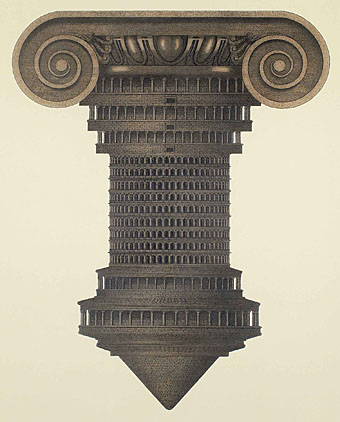
Star City by Tomislav Ceranic.

• Noted in the blogosphere this week: A Journey Round My Skull underwent a transmutation into 50 Watts; a blog devoted to artist, designer & illustrator Jessie M King; “The arts and musicks of the supranatural” at Secret Lexicon; From the Farm, Railroads, Sewing Machines & Beyond, lengthy reminiscences from a long life in America.

• Barney Bubbles in Wonderland, in which the designer and his chums indulge in some Carrollian shenanigans somewhere in the 1960s. The resulting footage is now a promo video for Balloon Race by Bear Driver.

• HP Lovecraft’s favourite words, the desert island books of Jorge Luis Borges, a profile of Christopher Isherwood, and Edward Gorey again.

[Arthur] Machen explicitly talks about the strength of London, as opposed to Paris, in that London is more chaotic. Although he doesn’t put it in these words, I think what partly draws him to London is this notion that, in the absence of a kind of unifying vision, like Haussmann’s Boulevards, and in a city that’s become much more syncretic and messy over time, you have more room to insert your own aestheticizing vision.

China Miéville in a great interview at BLDGBLOG.

• Matryomin is “the unique, original erectronic [sic] musical instrument invented by Masami Takeuchi in 2000”. Yes, a theremin inside a Russian doll. The Mable ensemble playing Duke Ellington’s Caravan is, well…I’m still speechless. And there’s also this.

• Conductor turns the New York subway system into an interactive string instrument.
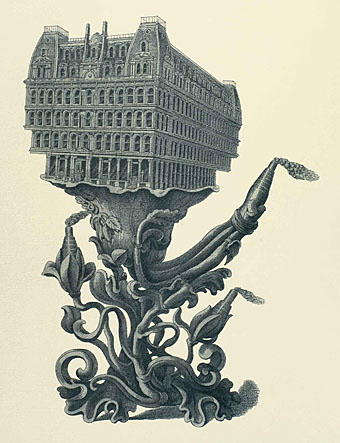
ceranic2.jpg

Discordia by Tomislav Ceranic.

Amazingly enough, prostitution was legal during the Victorian period. There were tons of brothels all over the major cities of England, and of all different kinds. There were lots of flagellation brothels; these were places where primarily men would go to be whipped by women or by men. There were also gay male brothels. You could go to a park in London at night, pick up what were called the “park whores” and give them a very small amount of money to have sex openly in the park. I also write about gay “cruising,” which was quite common. If you knew the right place to go and knew the right signals, you could pick up a man on the street and have sex in an alley.

Deborah Lutz is interviewed about her book Pleasure Bound: Victorian Sex Rebels and the New Eroticism.

• Cult-ure: Ideas can be dangerous, a book by Rian Hughes.

• Chernobyl: Europe’s strangest wildlife refuge.

• The Eadweard Muybridge Online Archive.

• Aubrey Beardsley at Tumblr.

• Caravan (1959) by Martin Denny | Caravan (1961) by 80 Drums Around The World | Caravan (1962) by Sir Julian | Caravan (1965) by The Ventures | Caravan (1973) by Enoch Light & The Light Brigade | Caravan (1997) by Jimi Tenor (I could go on and on, yes I could…)
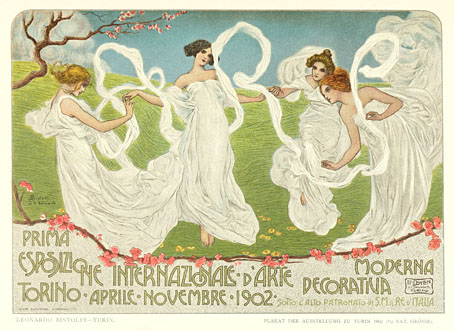
Deutsche Kunst und Dekoration #10: Turin and Vienna

dkd10-18.jpg

Turin exposition poster by Leonardo Bistolfi.

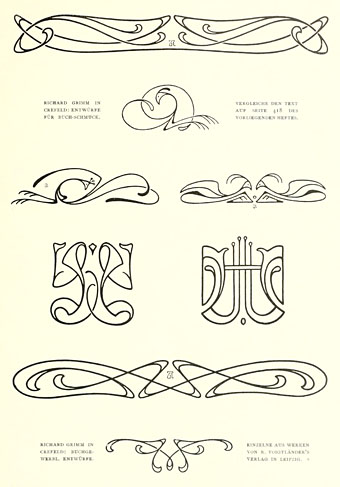
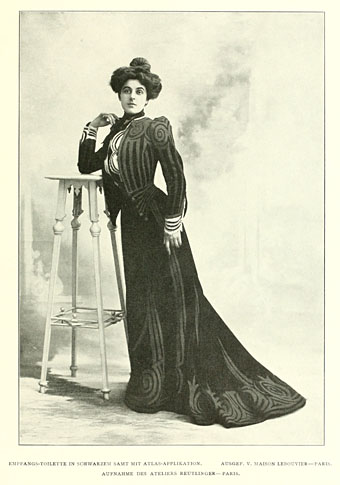
Part two of a two-part skate through the contents of volume 10 of Deutsche Kunst und Dekoration, the German periodical of art and decoration. In addition to the Heinrich Vogeler feature which was the subject of yesterday’s post, this edition includes articles on the Prima Esposizione Internazionale d’Arte Decorativa Moderna in Turin—another international showcase for the Art Nouveau style—and a feature on the Viennese Secession exhibition of the same year. This latter piece was especially fascinating when seeing such a notable event reported for the first time. There’s more about that below. This volume also includes a piece on the Glasgow Arts and Crafts movement but the photos for that piece are poor quality. As before, anyone wishing to see these samples in greater detail is advised to download the entire volume at the Internet Archive. There’ll be more DK&D next week.

dkd10-19.jpg

A feature on dress design shows some rare examples of Art Nouveau style being applied to clothing.

dkd10-20.jpg

Continue reading “Deutsche Kunst und Dekoration #10: Turin and Vienna”

Void City

hawkwind.jpg

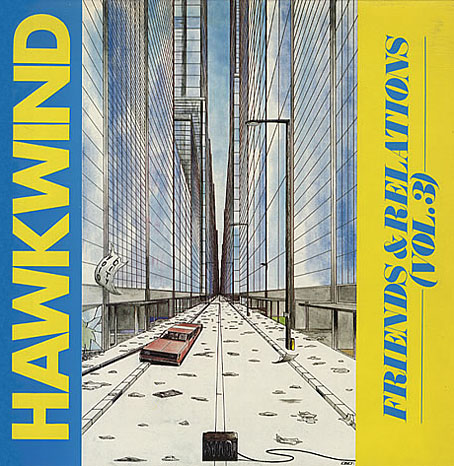
Friends & Relations Vol. 3 (1985) by Hawkwind.

Unless you assiduously collect everything you’ve ever worked on—which I don’t—you occasionally have to rely on the web to remind you of something you created years ago. This Hawkwind album is a good example, being one of the last releases by the band to use a piece of my artwork. (And I’ll quickly note that the accompanying type design was nothing to do with me; my design suggestions were always ignored, hence a growing frustration at that time with album cover work.) The album itself was the third in a series of odds and ends compilations gathering stray tracks by, yes, friends and relations of Mr Brock and co. Subsequent CD reissues used different packaging so the original vinyl is the only place you’ll see this illustration.

The reason I don’t have a copy is that the record label never sent me anything so unless Dave Brock put something in the post I had to buy them myself. (This happens more often than you’d expect.) I evidently didn’t think this one was worth it even though I much prefer the artwork to many of the earlier things of mine that were used. The drawing was a couple of years old, being inspired by the track Void City on the Choose Your Masques album from 1982. Void City is an atypical piece of electronica which I liked for its resemblance to some of the higher level synth pop and industrial music that was around in the early 1980s. 1982 to ’84 was the height of my JG Ballard obsession so Ballard is also a slight influence here. I had in mind his 1981 novel Hello America, which takes place in a post-apocalypse United States. And there’s also a trace influence from one of my early pieces of writing, a mercifully unpublished splurge of intense prose influenced by the New Worlds school of speculative fiction in which someone wanders around a vast and almost completely depopulated city. Looking at this drawing now it seems emblematic of my loss of interest in doing any kind of science fiction art; it also no longer seems futuristic. I produced my last album cover for Hawkind, The Chronicle of the Black Sword, in 1985; in January 1986 I started adapting HP Lovecraft’s The Haunter of the Dark. This took me out of the public eye for a few years but it was a more rewarding place to be for many other reasons.

Elsewhere on { feuilleton }
• The album covers archive

Previously on { feuilleton }
• Hawk things
• The Sonic Assassins
• New things for July

Weekend links 46

finalprogramme.jpg

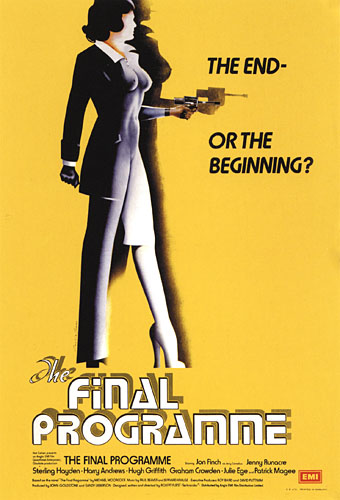
The Final Programme (1973). Philip Castle’s poster art implied the androgynous finale of Moorcock’s novel which the film itself evaded.

They were musty-smelling 10p messages from the futuristic past, complete with cover designs (and content) that were unlike anything I’d seen before. I’m fairly certain that this was how I first came across Michael Moorcock, in an early-70s Mayflower paperback, with a psychedelic cover by Bob Haberfield.

(…)

Moorcock steered New Worlds towards a set of concerns that chimed with the times; this was the period ruled by Marshal McLuhan and RD Laing, and the exploration of “inner space” seemed just as interesting as the “outer space” of satellites and moonshots. This turn was controversial, not just with die-hard pulp fans, but, surprisingly, with people such as the pop artist Richard Hamilton, another denizen of the London scene. “He thought we were turning science fiction into something namby-pamby, losing its roots,” Moorcock says. “He wanted explosions and spaceships and robots.”

• When Hari Kunzru met Michael Moorcock, a major feature on a great writer and cultural catalyst. Kunzru posted the full transcript of their conversation here. Jovike’s Moorcock Flickr set has many of the lurid Mayflower covers.

• Moorcock is among the contributors to the forthcoming Thackery T. Lambshead Cabinet of Curiositities. io9 posted a list of contents (and one of my pics) while co-editor Jeff VanderMeer added some detail.

• So long to The White Stripes whose dissolution was announced earlier in the week. We know they’ll be back one day. Jay Babcock gave them their first major interview for the LA Weekly in 2000 which he’s reposted here.

• Mister Blues (1962) by Lasry-Baschet aka Structures Sonores, a rare 7″ single showcasing the unique glass-and-metal sounds of the Cristal Baschet. Young Teddy Lasry on clarinet was playing in prog-jazz outfit Magma a few years later. Related: John Payne on Magma and The Mars Volta.

Here’s one thing that changed me: a close reading of Flannery O’Connor’s Mysteries and Manners. In it, she says that, “it is the business of fiction to embody mystery through manners,” manners being those concrete details — depictions of the real — in story. “Mystery through manners…” I had never heard a modern author seeking deep metaphysical mystery through realism before. Well, sure, Robert Musil, Bruno Schulz, Robert Walser, and a handful of other personal faves. By deep mystery I mean, mystery about our relationship with the planet, not anthropocentric mystery. I get sick of thinking about humans quickly, as we only constitute about 1% of what’s happening in our universe, if that much, and it was refreshing to me to hear O’Connor critiquing Henry James’ idea that modern people should aspire to know nothing of mystery, to be completely rooted in humanity. That notion makes me feel like hurling myself off a cliff. In her opinion, great literature seeks to embrace and express mystery through its mimicry of actual mannerisms. Mystery — fantasy — through the real. And with that, the borders between fantasy and realism were completely transgressed in my brain. Suddenly, I saw them as two good means to the same end. This made me excited to write real human situations again.

Trinie Dalton is interviewed here.

• And speaking of mystery through the real, there’s London Intrusion, a sequence of metropolitan adumbrations by China Miéville. Am I the only person to spot an intrusion of a different kind in the presence there of one of Eugène Atget’s Parisian views? There’s a doorway to Viriconium in that curious wedge of buildings but nobody can tell you where.

• Rupert Murdoch—A Portrait of Satan. Adam Curtis on top form looking at the Dirty Digger’s career and a reminder of why some of us have always called one of his rags The Scum. A key point for me: Murdoch’s insecure railing against “elites”, a favourite term of aspersion on his Fox News network.

• Rick Poynor asks What Does JG Ballard Look Like? Related: “…only two people in Bucharest are going to read this.” Eduardo Paolozzi in conversation with JG Ballard and Frank Whitford, 1971.

• How many days does Bill Murray’s character really spend reliving Groundhog Day?

• Silent Porn Star explores The Translucent Beauty of Androgyny.

• Ballets Russes brought back to life on film, and also here.

• Dewanatron Electronic Music Instruments.

• RIP Tura Satana. Remember her this way.

• Warm Leatherette (1978) by The Normal | Warm Leatherette (1982) by Grace Jones | Warm Leatherette (1998) by Chicks On Speed.

Arcades panoramas

arcade6.jpg

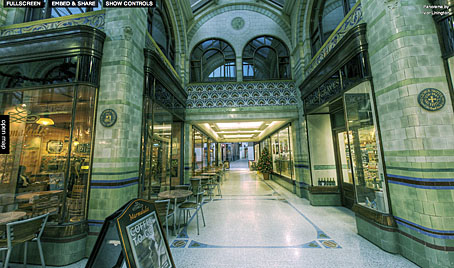
Norwich Royal Arcade.

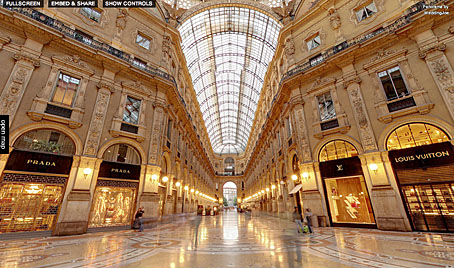
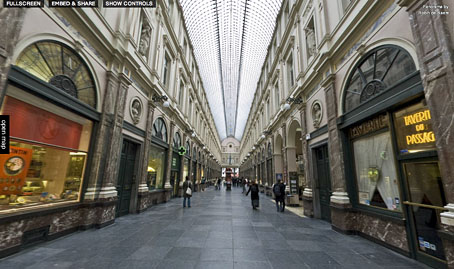
More arcades and more panoramas from that favourite haunt of mine, 360 Cities. The Norwich Royal Arcade is an Art Nouveau-styled affair by George Skipper which features the inevitable coffee shop among its offerings. The Milan Galleria, meanwhile, is probably the most ostentatious arcade in the world but its expensive fashion houses have to deal with a McDonald’s in their midst. 360 Cities regularly updates its views so this may become an ongoing series.

arcade7.jpg

Galleria Vittorio Emanuele II, Milan.

arcade8.jpg

Galerie de la Reine/Koninginnegallerij, Brussels.

Elsewhere on { feuilleton }
• The panoramas archive

Previously on { feuilleton }
• Arcades