Tony Grubhofer’s Exposition Universelle sketches

grubhofer01.jpg

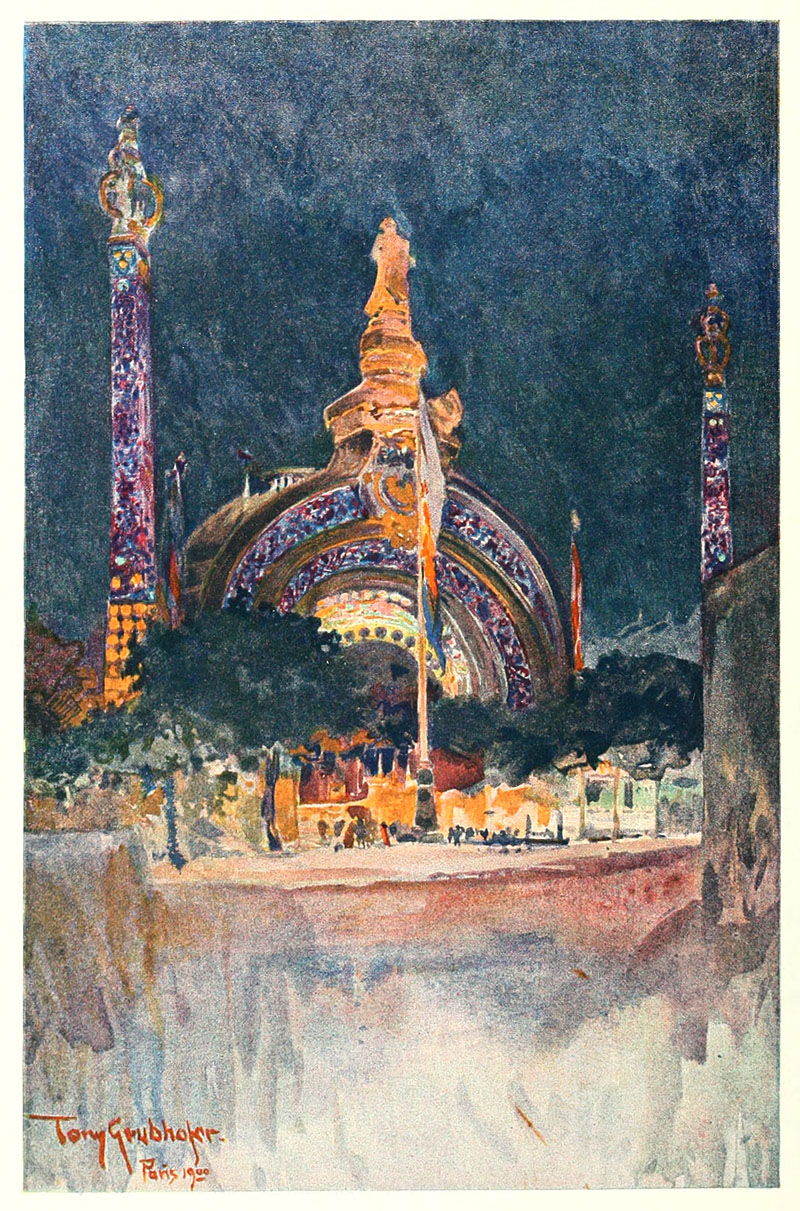
The Exposition gateway.

In a blizzard of work this month I finished another project with a Victorian theme (not more Steampunk!) which I won’t reveal just yet as I dislike spoiling the surprise for publishers. Part of the preparation involved yet more trawling through scanned volumes at the Internet Archive, looking this time at British art magazines from the 1890s. As with the German magazines of the period, some of these are more interesting than others: The Magazine of Art, for example, has its moments but for the most part it’s a champion of the stodgily dull, conservative fare which no one would ever want to revive today. Their columnists also hated the Decadents; I found a wonderful rant against Aubrey Beardsley’s art from 1897 which suggested that the artist and others like him ought to stop poisoning the soul of the nation and emigrate to France. Poor Aubrey only had a year to live, and, as things turned out, ending up dying in that iniquitous nation. I think it’s fair to say he’s had the last laugh.
grubhofer02.jpg

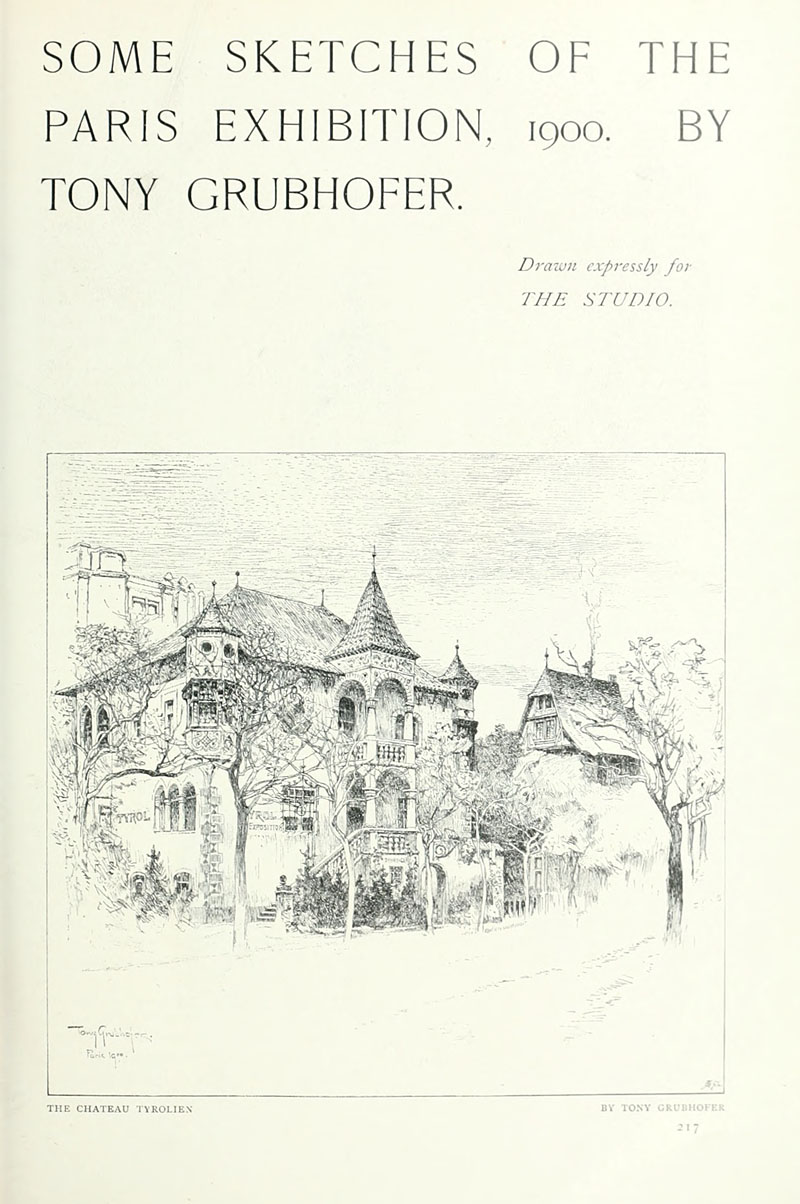
The Chateau Tyrolien.

The Studio magazine, on the other hand, was very sympathetic to the Decadents and Symbolists in general, and to Beardsley in particular, who had his work featured in the first number of the magazine in 1893. The drawings in this post are a surprise find in one of the numbers for 1900, and concern that locus of everything The Magazine of Art loathed: Paris! We’re back again at the Exposition Universelle, a subject which has been explored here on so many occasions I’m surprised I keep finding anything new that’s worthy of mention.

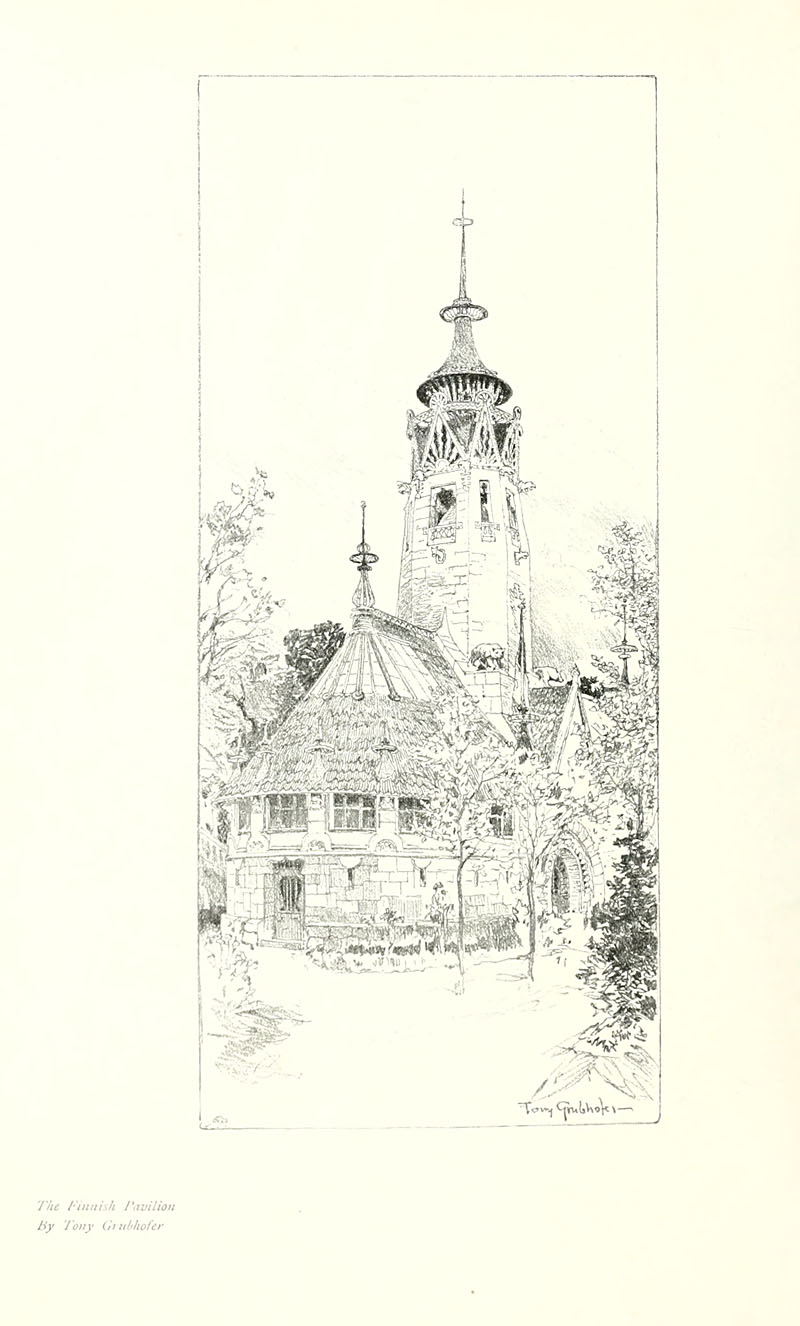
Tony Grubhofer (1854–1935) was apparently an Austrian artist who in these drawings manages to crop his views so selectively that many of them don’t look like they’re part of an exposition in one of the world’s capital cities. Of interest for me are his watercolour of René Binet’s monumental gate, which gives an idea of how the structure would have looked at night illuminated by the novelty of electric light, and his view of Eliel Saarinen’s Finnish pavilion which he renders as though it was a provincial church. This was Saarinen’s first major commission (he was 27 at the time), and Philippe Jullian in his book about the exposition declares this design to have been the most interesting and successful of all the national pavilions that year. It’s certainly better than Edwin Lutyens’ pastiche of an Elizabethan manor for the British pavilion. Eliel Saarinen had a very successful career, as did his more well-known son, Eero Saarinen, one of the major architects of the 20th century.

Volumes 20 to 22 of The Studio can be downloaded here.
grubhofer03.jpg

The Finnish Pavilion.

Continue reading “Tony Grubhofer’s Exposition Universelle sketches”
Weekend links: Apocalypse not now

apocalypse.jpg

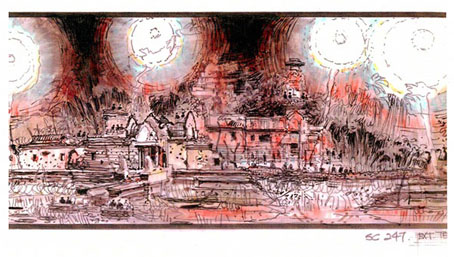
The Kurtz compound prior to destruction. An Apocalypse Now storyboard, one of a number which will be included among the extras on the Blu-Ray release of Francis Coppola’s film when it appears in the UK next month. The film is given a new cinema release on May 27th.

Radio broadcaster Harold Camping, a man denounced by fellow Christians as a false prophet, achieved one thing at least this week by making himself and his followers a global laughing-stock after the Rapture failed to materialise. I would have put money on him blaming those terrible gays somewhere along the way, such complaints being so common among a certain brand of American fundamentalist that you could write their sermons for them. Sure enough, here’s the old fool blathering about “lespianism” and describing the beautiful city of San Francisco as a cesspool. Shall we chalk this up as another victory for the gays, Harold? Related: No dogs go to heaven.

The internet has always been a home for ridicule but occasions like this bring out the wags in droves. The Oatmeal showed us how God is managing the Rapture using a Windows Install Wizard, and also pointed to a selection of sarcastic tweets. Meanwhile, this page has a comprehensive catalogue of previous apocalypse dates; the biggy is next year, of course.

Burroughs himself was no stranger to prosecution. In 1962 he was indicted on grounds of obscenity. Naked Lunch was not available in the US until 1962 and in the UK until 1964. The writer Norman Mailer and the poet Allen Ginsberg had to defend the book in court before the ruling could be reversed. In Turkey, it is now our turn to stand up for the novel.

Turkish writer Elif Shafak criticising the paternalism of the Turkish state in trying to protect its people from troubling novels. Related: William Burroughs publisher faces obscenity charges in Turkey.

• An A–Z of the Fantastic City by Hal Duncan. “This guidebook leads readers and explorers through twenty-six cities of yore (Yore, while included, is one of the shorter entries).” Illustrated by Eric Schaller.

• The creepiest Alice in Wonderland of all, Jan Švankmajer’s semi-animated Alice (1988), receives a very welcome re-issue on DVD this month. With Brothers Quay extras and other good things.

smith.jpg

Robert E Howard’s sinister magus from the Conan stories, Thoth-Amon, as depicted by Barry Windsor-Smith. From a portfolio of five Robert E Howard characters, 1975.

• What is computer music (or does it matter)? Related: A History of Electronic/Electroacoustic Music (1937–2001), 511 (!) downloadable pieces.

• Unearthly Powers: Surrealism and SF: Rick Poynor explores the Tanguy-like strangeness of Richard Powers.

• Magic Trip: Ken Kesey’s search for a kool place.

• The Library of Congress National Jukebox.

• Vladimir Nabokov’s butterflies.

• Amy Ross’s Wunderkammer.

• Rapture (1981) by Blondie | Apocalypse (1990) by William Burroughs | Rapture (2000) by Antony and the Johnsons.

L’Hôtel, Paris

lhotel1.jpg

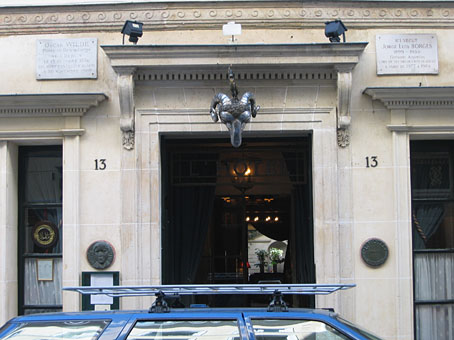
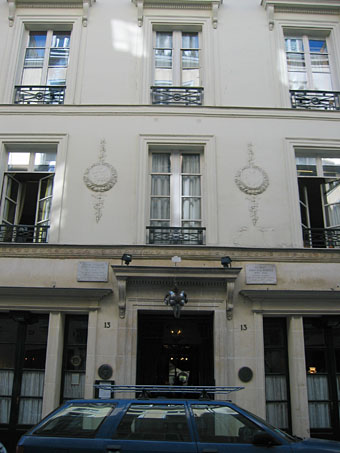
The London broadsheets have been in a ferment for the past few days over a forthcoming exhibition at the V&A, The Cult of Beauty: The Aesthetic Movement 1860–1900 which opens on April 2nd. The Guardian‘s Jonathan Jones wrote a piece pointing out the French associations of the British Aesthetes in which he mentions the Hôtel d’Alsace at 13 Rue des Beaux-Arts, Paris, the place where Oscar Wilde spent his last few months in 1900 prior to expiring in room no. 16. By coincidence I’d been looking at my own photos of the hotel only the day before so here they are, little more than snapshots but they give an idea of the building at least.

lhotel2.jpg

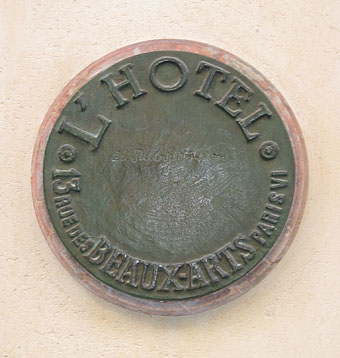
The hotel is now merely L’Hôtel, and I had a couple of surprises when I went to find the place the last time I was in Paris. The first is that the Rue des Beaux-Arts is some distance away from any main thoroughfares, although this perhaps isn’t so surprising given Wilde’s straitened circumstances. The second was seeing a plaque to Jorge Luis Borges (see below) on the wall opposite the one for Oscar Wilde with its incorrect year of birth. Borges had a lifelong fascination with Wilde, the first piece he had published was a translation into Spanish of The Happy Prince (and The Modern Word has a short essay by Borges about Wilde). I knew that Borges had stayed in the hotel (there’s a famous photo of him standing in the atrium) but didn’t expect his patronage to be commemorated in this way; once again, Paris has a respect for writers that puts many other cities to shame. Wilde is celebrated with two plaques—there’s another beside the door which can be seen here—but what these pictures don’t show is the atrium itself, a small space in the centre of the building which gives the hotel a distinction Wilde might have appreciated even if he would have preferred to spend his final hours in one of the more luxurious establishments.

There are more views of the narrow Rue des Beaux-Arts at Google Maps while the hotel has a website here.

lhotel3.jpg

Continue reading “L’Hôtel, Paris”

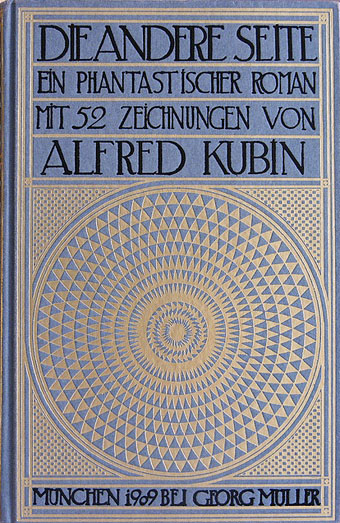
Die Andere Seite by Alfred Kubin

kubin1.jpg

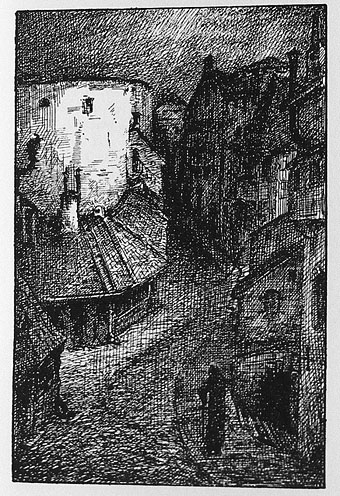
Re-reading Alfred Kubin’s strange fantasy novel Die Andere Seite (The Other Side) this week, I found myself suffering the same frustration as when I bought the book, namely that the illustrations in the Dedalus edition are very poor reproductions. When this new translation appeared in 2000 there wasn’t any convenient way to see better copies of Kubin’s drawings unless you had the earlier (and for me, elusive) Penguin edition. Thanks to Flickr we can now see reproductions from the first printing of 1909 in this set of photos. Not all the drawings are featured but the ones present are better than those in my volume. The illustrations are often rather perfunctory, and they lack the finesse and erotic weirdness of Kubin’s better known works, but a couple are as macabre as one would expect. And I love the cover design.

kubin2.jpg

As to the story, it concerns an unnamed narrator who receives a request from an old school friend, Claus Patera, to leave Munich and go with his wife to live in the city of Pearl, a newly-built metropolis in a nation known as “The Dream Realm” which Patera has founded in the Far East. Having travelled there the couple find themselves in a city filled with other displaced Europeans which is at first eccentric then increasingly nightmarish. It’s the kind of book you might expect an artist like Kubin to have written, in other words, and since the narrator is a thinly-veiled counterpart of the author we can occasionally glimpse the man behind the works. Anyone interested in Kubin the artist is advised to seek it out.

• Alfred Kubin at Weimar

Elsewhere on { feuilleton }
• The illustrators archive

Previously on { feuilleton }
• The Hourglass Sanatorium by Wojciech Has
• Kafka’s porn unveiled
• Hugo Steiner-Prag’s Golem