The most unusual magazine ever published: Man, Myth and Magic

mmm1.jpg

Collect the set!

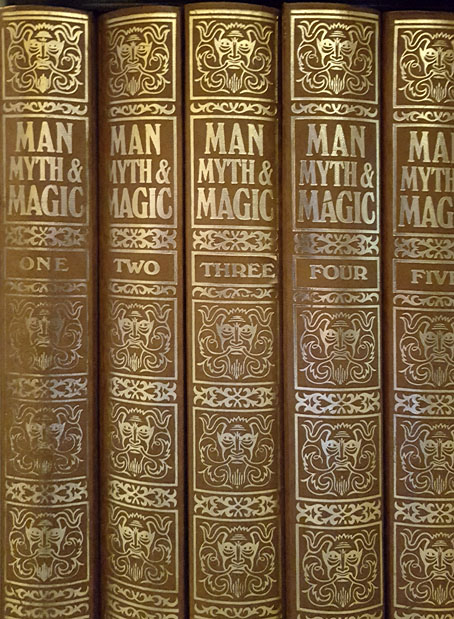
I don’t really need a digital copy of Man, Myth and Magic—I’ve been the fortunate owner for many years of the bound set of original magazines you see above—but I imagine a few readers of this post will welcome a download of all 3144 pages of the 1995 edition. For the impatient I’ll put the link up front: go thou here.
mmm2.jpg

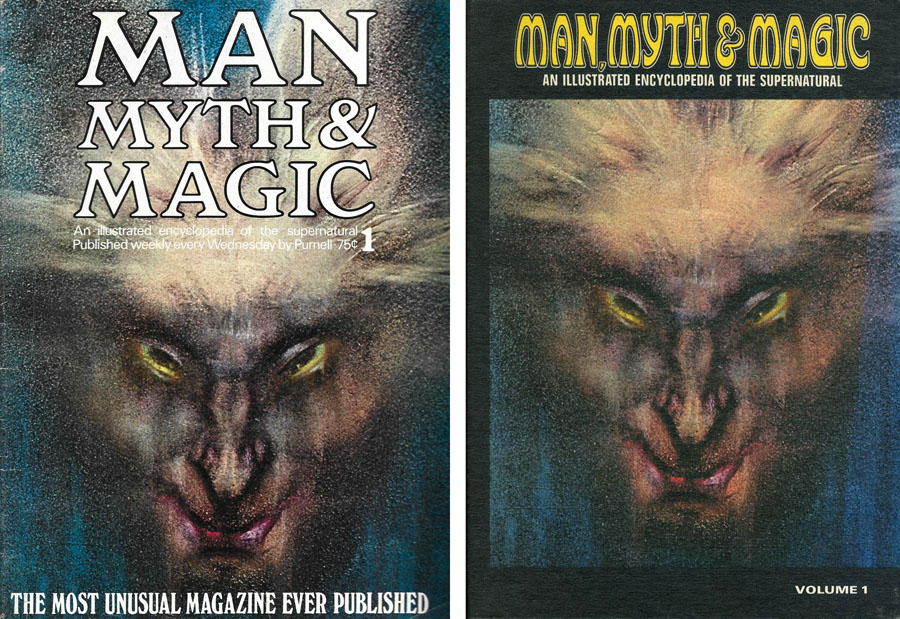
The world goes Spare: A US copy of issue no. 1 and the first volume of the 24-volume set. Austin Spare’s cover art is known either as The Elemental or The Vampires are Coming.

Man, Myth and Magic exists in several different versions along with a number of spin-off books which mined its texts for information and reused its picture archive. The first edition was the “Illustrated Encyclopedia of the Supernatural” which appeared in the UK each week from 1970 to 1971 as 112 magazine-sized issues, a series that built eventually into a collection of seven volumes. The first issue famously used a detail of a picture by Austin Osman Spare on its cover, giving Spare and his art a prominence unlike anything he received during his lifetime. The same part-work was published a couple of years later in the USA with an accompanying TV ad. Magic and the supernatural was the selling point but the encyclopedia was as much about religion and general anthropology as the occult, with the editorial stance being unsensational, factual and neutral. The seven-volume set was later republished in book form as 24 hardcover volumes, then revised in 1995 as a new set of 21 volumes with a different subtitle, “The Illustrated Encyclopedia of Mythology, Religion and the Unknown”. In the early 1970s you could also find a hardback collection of the first six issues bearing the subtitle “The most unusual book ever published”, a rather unrealistic claim. My mother bought one of these, giving me my first encounter with the encyclopedia itself and many other things besides, not least the Austin Spare drawings in Kenneth Grant’s piece of borderline cosmic horror about Spare and “resurgent atavisms”.

mmm3.jpg

Richard Cavendish was Editor-in-Chief of all the editions of Man, Myth and Magic, with Brian Innes acting as picture editor and subsequently co-editor for the 1995 edition. Cavendish had been the author of The Black Arts in 1967, a book which I still rate as one of the best general introductions to Western occultism. The Black Arts may have a title designed to grab the attention of Dennis Wheatley readers but it was a serious study that set the tone for the encyclopedia. The editorial board of Man, Myth and Magic was composed of heavyweight academics, together with John Symonds (Aleister Crowley’s literary executor and biographer), while the group of special consultants included Katharine Briggs (folklore), William Gaunt (art) and Francis Huxley (anthropology). Symonds brought Kenneth Grant on board. Grant at this time was the official head of Crowley’s Ordo Templi Orientis, and his presence gave the editorial team access to his large collection of Austin Spare artwork.
mmm4.jpg

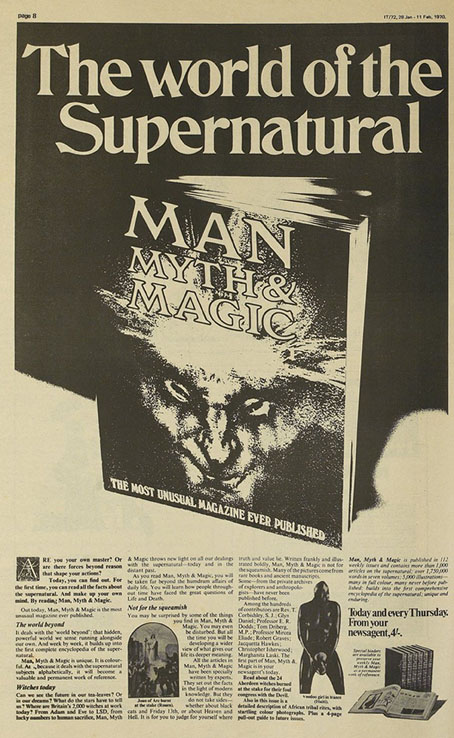
“From Adam and Eve to LSD, from lucky numbers to human sacrifice…” International Times, Jan 28, 1970.

Among the never-to-be-repeated list of contributors were Geoffrey Ashe, Robert Baldick, Robert Graves, Celia Green, Douglas Hill, Christina Hole, Christopher Isherwood, Patrick Moore, Kathleen Raine and JB Rhine. Kenneth Grant and John Symonds weren’t the only contributors who’d known Aleister Crowley, there was also Tom Driberg MP, a man whose promiscuous homosexuality and alleged treachery made him one of the more notorious members of Parliament. The other British politician among the contributors was the comparatively prosaic John Selwyn Gummer, a future government minister and current member of the House of Lords. (I wish I could tell you which article was Gummer’s but he’s listed in the contributor section without a credit. I’d have to hunt through the volumes to find out.) Elsewhere you’ll find entries by both Francis Kings—confusingly listed without their identifying initials—in what may be the only time the pair appeared together in the same publication. Francis H. King, writing here about Japan, was a well-regarded author whose novels included a number of gay romances; Francis X. King was an occultist and author of non-fiction books whose research was packaged under lurid titles such as Sexuality, Magic and Perversion, and Satan and Swastika. The contents of Man, Myth and Magic have long been rendered superfluous by the internet but the contributor list gives the encyclopedia a curiosity value if nothing else. All of the entries are unique pieces of writing which are unavailable outside these pages.

I confess that I hadn’t known that Man, Myth and Magic had been revised and reprinted until I discovered this scanned edition, I’d always thought the encyclopedia was too much of its time to be republished. Richard Cavendish in the editorial preface for the 1995 edition says that some of the articles were amended or expanded to take account of new researches and developments. So they have been, although at first glance the page layout looks very much as it did in the original printing. Closer examination reveals that some of the more dated pictures have been replaced, like the photo of a typical hippy girl in the entry about bells. Dated pictures aside, what you see here is still 95% the original “illustrated encyclopedia of the supernatural”.
mmm5.jpg

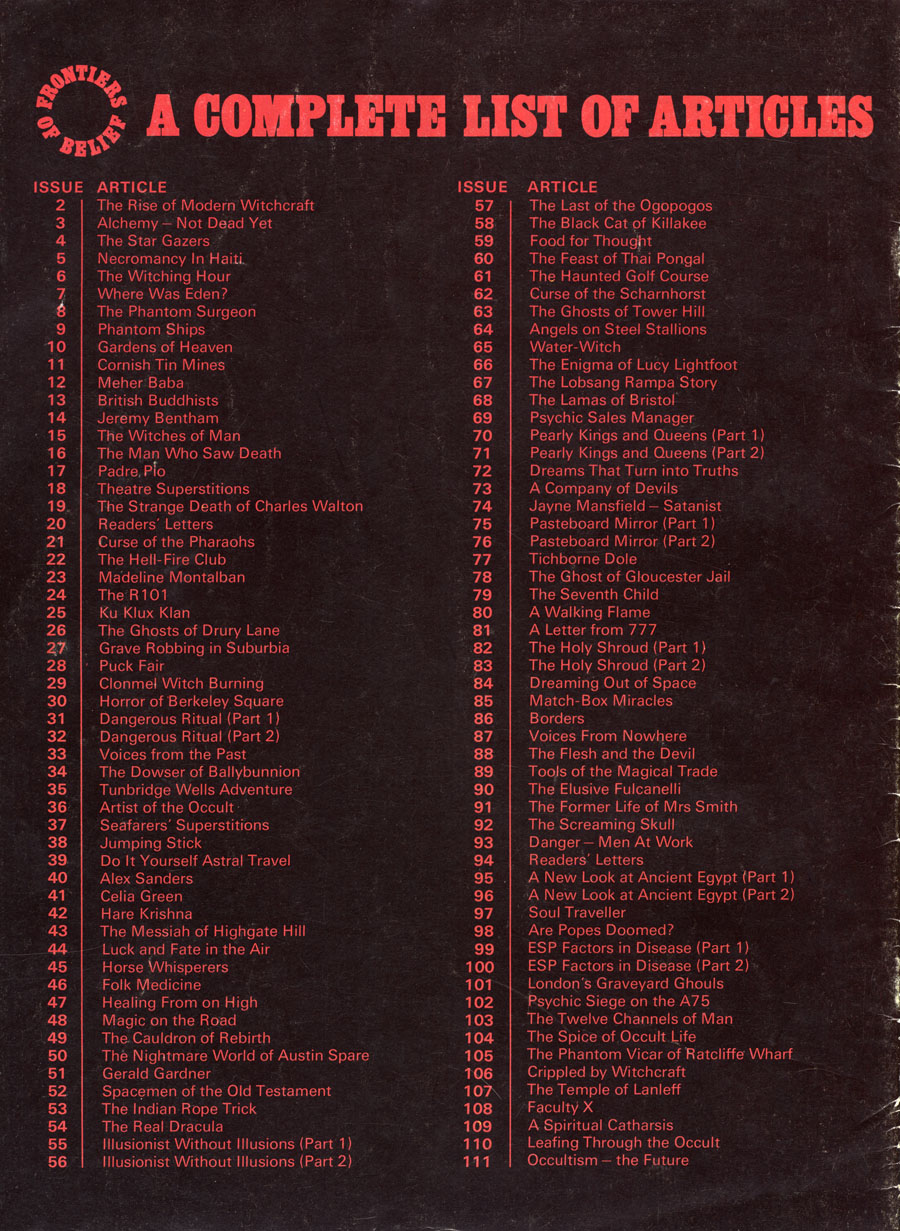
Frontiers of Belief.

The most substantial change in the later reprintings was the absence of the “Frontiers of Belief” section, a series of mostly topical essays which ran each week across the inside back cover and the back of the magazine. Collectors of the volume binders could also purchase an additional binder to store the issue covers and the FoB supplements. Whoever compiled my own volumes failed to do this, but I did once own a partial set of the magazine as separate issues, and still have the FoB articles from those issues. Two of these pieces—a profile of artist Wilfried Sätty and Kenneth Grant on HP Lovecraft—have appeared here in the past. As far as I know none of the FoB pieces have ever been officially reprinted. The very last piece was “Occultism—The Future”, in which a number of writers were asked for their prognostications. The ubiquitous Dennis Wheatley—who, for once, didn’t contribute to the previous pages— delivered a typically ominous warning against involvement in the Black Arts. A more sober final word was provided by Colin Wilson:

In science a new cycle has begun, a revolt against the old rigid reductionism, a recognition that ‘materialism’ leaves half the universe unexplained. Biologists, psychologists, even physicists, are cautiously trying to feel their way into new worlds. They are acknowledging at last that they are dealing with a living universe, a universe full of strange forces. The magic of the past was an intuitive attempt to understand and control these forces: the science of the future will be a fully conscious attempt. Magic will be the science of the future, or should we say that science will be the magic of the future?

Previously on { feuilleton }
Jan Parker’s witches
Typefaces of the occult revival
Dreaming Out of Space: Kenneth Grant on HP Lovecraft
MMM in IT
The Occult Explosion
Wilfried Sätty: Artist of the occult
Owen Wood’s Zodiac

Weekend links 689

cossard.jpg

Salammbô (1899) by Adolphe Cossard.

• At Unquiet Things: “A mystery that no longer exists: Wrinkle in Time cover artist revealed”. S. Elizabeth explains. I did a little research of my own into this enigma without success. Good to know that it’s been resolved.

• James Balmont’s latest guide to Japanese cinema is an examination of the transcendental oeuvre of Yasujiro Ozu.

• At Spoon & Tamago: Trains intersect with everyday life in nostalgic illustrations by Shinjiro Ogawa.

• DJ Food discovered a set of Zodiac posters by Bruce Krefting from 1969.

• At Wormwoodiana: John Howard on looking for misplaced Machens.

• At Vinyl Factory: Discovering Mort Garson with Hilary Wood.

• At Dennis Cooper’s: More Ozu in Yasujiro Ozu Day.

• New music: Multizonal Mindscramble by Polypores.

• Mix of the week is a mix for The Wire by Aho Ssan.

• Ioneye in conversation with Bill Laswell.

Train Song (1969) by Pentangle | Love On A Real Train (1984) by Tangerine Dream | Tokyosaka Train (2002) by Funki Porcini

Weekend links 688

horna.jpg

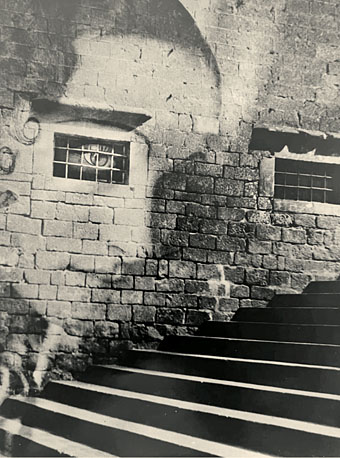
Ascending to the Cathedral, Barcelona (1938/1960) by Kati Horna.

The rise and fall of Kowloon Walled City, Hong Kong’s infamous urban monolith. Related: a four-and-a-half-hour walkthrough of Stray, a game in which you help a cat escape from a deteriorated robot-filled housing complex.

• Quote of the week: “The true master requires the precision of a poet and the imagination of a scientist.” Thus Vladimir Nabokov at Lawrence Weschler’s Wondercabinet.

• New music: Orion Nebula by Christian Wittman, and Chthonic by Lawrence English & Lea Bertucci.

Chapter by chapter, Flaubert lampoons his poor pair, who fail at discipline after attempted discipline: landscape architecture, anatomy, history, literature, phrenology, religion, even love, and on and on. In each pursuit, they never lose the optimism or the hubris of thinking they can put their knowledge to work in the world. When they become interested in pedagogy, they adopt a pair of abandoned children who are at turns mystified by and contemptuous of their efforts to improve their well-being. The fruit trees fail, the novel is abandoned, a cat is boiled alive, the children cause scandals.

David Schurman Wallace explores the hazards of distraction with a detour through Flaubert’s Bouvard and Pecuchet

• At AnOther: Peter De Potter’s new book explores the erotic performance of social media.

• At Dennis Cooper’s: Hobart LaRoche presents…15 experimental video games.

Take a look at a book chronicling the albums of Island Records.

• At Colossal: Gabriel Schama’s laser-cut plywood reliefs.

Orion (1986) by Metallica | Shades Of Orion (1993) by Shades Of Orion | Orion (2001) by Jah Wobble and Bill Laswell

More Harry Clarke online

clarke1.jpg

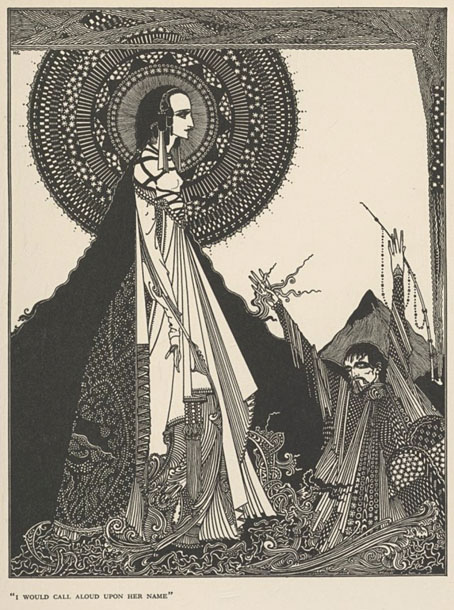
A while back I put together a list of links to freely-available online copies of Harry Clarke’s illustrated books. The list didn’t have any notable omissions but was unsatisfying if you’re like I am and prefer to see scans of an entire book rather than collections of pictures or home-made creations. This illustration of Ligeia is from a 1936 US edition of Clarke’s illustrated Poe which is archived in the digital collection at Poland’s Biblioteka Narodowa. This is the edition for which Clarke created eight new full-page pieces in colour, all of which are happily intact in the Polish copy which may be downloaded as a PDF. A good test of the scanning (and print) quality of this book is the illustration for The Facts in the Case of M. Valdemar, a drawing where Clarke tested the limits of ink reproduction with his closely-hatched lines and speckle effects. I was hoping the Polish library might have more books like this but so far nothing has appeared.

clarke2.jpg

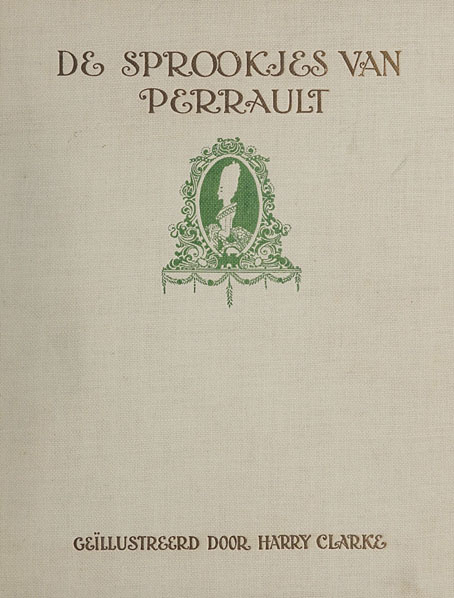
Following this discovery I tried another Clarke search at the Internet Archive where I found this recent upload of a Dutch edition of his illustrated Perrault. The same source has had an English edition of this title for some time but the copy is missing one of the colour plates, plate theft being a perennial problem for library books. Or even non-library books… I own a rather battered first-edition of Clarke’s illustrated Swinburne from which two of the full-page pictures have been carefully removed by a previous owner with a razor blade. And speaking of Swinburne, Clarke’s edition of the Selected Poems is the one I keep hoping to find as an online edition, together with his Faust, even though I own a reprint of the latter book. I suspect the contentious “obscene” drawings in these two volumes have kept copies away from library collections. You can at least find the illustrations for the books easily enough. Still unavailable unless you’re a collector of rare magazines is The Golden Hind, the short-lived arts magazine edited by Clifford Bax and Austin Osman Spare which contained unique contributions from Harry Clarke and many similar artists of the 1920s. That’s one I’ll continue to search for.

Elsewhere on { feuilleton }
The illustrators archive

Previously on { feuilleton }
Harry Clarke online
Harry Clarke record covers
Thomas Bodkin on Harry Clarke
Harry Clarke: His Graphic Art
Harry Clarke and others in The Studio
Harry Clarke’s Fairy Tales of Charles Perrault
Harry Clarke in colour
The Tinderbox
Harry Clarke and the Elixir of Life
Cardwell Higgins versus Harry Clarke
Modern book illustrators, 1914
Illustrating Poe #3: Harry Clarke
Strangest Genius: The Stained Glass of Harry Clarke
Harry Clarke’s stained glass
Harry Clarke’s The Year’s at the Spring
The art of Harry Clarke, 1889–1931

Weekend links 687

crane.jpg

The Peacock Garden (1898) by Walter Crane.

• “The trio [Remedios Varo, Leonora Carrington & Kati Horna] became known as the ‘three witches’ for their exploration of the supernatural and metaphysical—which ranged…’from tarot readings to shamanic psychedelics to attempts to stop or slow time.'” Teresa Nowakowski on Remedios Varo: Science Fictions, an exhibition of Varo’s paintings at the Art Institute of Chicago which includes the one that Thomas Pynchon singled out for description in The Crying of Lot 49.

Philip K. Dick giving a lecture on “orthogonal time” to a small audience at the Festival International de la Science-Fiction, Metz, in 1977. Dick’s talks and interviews aren’t exactly scarce, but this one was of interest for me since I recently designed an edition of John Crowley’s Great Work of Time, a novella which involves a similar concept. If you were at the Metz Festival in 1977 you could also see a live performance by Cluster. Lucky you.

• “Our minds remain open when the LSD wears off.” Steve Paulson on psychedelic drugs and their usefulness as therapeutic tools.

• At Cartoon Brew: Stephen Irwin’s animated films “combine the influences of David Lynch, Struwwelpeter, and the Brothers Grimm.”

• Steven Heller looked at NB3, the third book about Neville Brody’s graphic design. Elsewhere, Heller’s font of the month is Scusi.

The glowing, prismatic nervous system of a sea star wins the Scientific Image of the Year.

• At Unquiet Things: Forgotten worlds and wonderlands from The Art of Fantasy.

• “Don’t waste my time with blood-free monster movies,” says Anne Billson.

• At Aquarium Drunkard: King Tubby And Soul Syndicate — Freedom Sounds In Dub.

• Mix of the week is DreamScenes – August 2023 at Ambientblog.

Time Machine (1970) by Stray | Time Captives (1973) by Kingdom Come | The Existence Of Time (2012) by Monolake