Weekend links 47

beksinski1.jpg

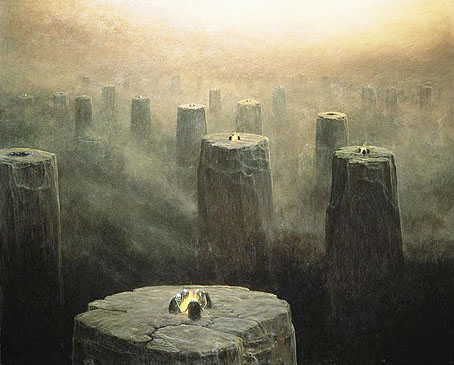
DG-2499 (1975) by the fantastic (in every sense of the word) Zdzisław Beksiński (1929–2005). See the Dmochowski Gallery for a comprehensive collection of the artist’s work. Thanks to BibliOdyssey for the tip.

• More ICA events: From Animism to Zos: Strange Attractor Salon will be “a series of weekly events, consisting of a talk and a film, exploring some lesser-known intersections of culture, history, mind and nature” running from 10 March–12 May, 2011.

• And on May 10, the London Word Festival presents a Dodgem Logic evening with entertainment provided by contributors to that magazine:

Alan Moore’s reinvigoration of the underground fanzine, Dodgem Logic, comes alive in the non-conformist surroundings of Hackney’s Round Chapel. A night of art, comedy, comment and put-something-back localism. (…) With Robin Ince heading up a colossal stand-up bill, artists Steve Aylett, Savage Pencil, Melinda Gebbie and Kevin O’Neill panel-up to talk about their comic work, while music comes from hyperactive racketeers The Retro Spankees. With an exhibition of artwork from the magazine, and conducted by editor-in-chief Alan Moore.

• Taschen publishes a collection of Dennis Hopper’s photographs this week. The Independent has a small selection here. Also new from Tachen, Alex Steinweiss, The Inventor of the Modern Album Cover.

Bass Notes: The Film Posters of Saul Bass at the Kemistry Gallery, London.
beksinski2.jpg

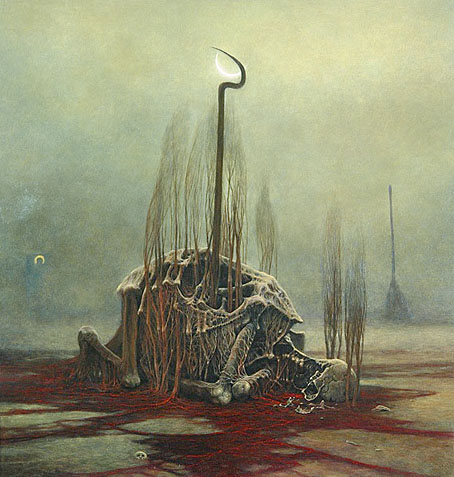
DG-2507 by Zdzisław Beksiński.

While riding through the bustling streets of London from 1603 to 1621, one was liable to hear the shout “Long live Queen James!” King James I of England and VI of Scotland was so open about his homosexual love affairs that an epigram had been circulated which roused much mirth and nodding of the heads: Rex fuit Elizabeth: nunc est regina Jacobus—”Elizabeth was King: now James is Queen.”

There’s more about the private life of the man who gave his name to the King James Bible here.

Addams and Evil, a Tumblr devoted to the great Charles Addams.

Hannes Bok again at Golden Age Comic Book Stories.

Caravaggio’s crimes exposed in Rome’s police files.

Deserted City, photographs by Kim Høltermand.

• The blue sand dunes of the planet Mars.

• A map of the ghost signs of Chicago.

The movie title stills collection.

The pitfalls of e-book buying.

Life On Mars? (1971) by David Bowie | Uncle Sam’s On Mars (1979) by Hawkwind | Eyes On Mars (1980) by Chrome | Cache Coeur Naif (1997) by Mouse on Mars.
ICA talks archived

ica.jpg

I’ve linked to the British Library’s sound archive before but it was only recently that I had a browse through their collection of talks from the Institute of Contemporary Arts, London. The public discussions cover the period 1981–1994, and while there’s a wide range of contributors the lion’s share of interviewees are writers. Most of the talks run from 60–90 minutes. The following is a selection from some of the contents:

JG Ballard and Matthew Hoffman in conversation, 1984. Ballard discussing his latest novel, Empire of the Sun.

Derek Jarman and Ken Campbell in conversation, 1984. Jarman discussing his autobiography, Dancing Ledge which was also published that year. (A revised edition appeared in 1991.) If Ken Campbell seems an unusual interviewer it should be recalled that he appeared in Jarman’s 1979 film, The Tempest.

Alan Moore and Charles Shaar Murray in conversation, 1987. Mr Moore caught in the year when the world at large became aware of comics in general and his work in particular.

Whose Fantasy? Hosted by Neil Gaiman (uncredited) with M. John Harrison, Terry Pratchett, Geoff Ryman & Diana Wynne Jones, 1988. One of a series of events examining British genre fiction. Neil Gaiman was the host of each discussion but is uncredited on the site for several of the talks. This one concerns fantasy and science fiction.

Whose Fantasy? Hosted by Neil Gaiman (uncredited) with Clive Barker, Ramsey Campbell, Roz Kaveney & Garry Kilworth, 1988. The following day’s discussion was oriented more towards horror.

Laurie Anderson and Sarah Kent in conversation, 1990. Laurie Anderson’s latest album (and one of hers I like a great deal) Strange Angels is discussed.

Victorian typography

type1.jpg

“Victorian” isn’t really the correct term for the products of 19th century America but then “19th century” covers rather a lot of ground. Mr BibliOdyssey’s most recent post is a stunning collection of title pages from fire insurance maps of the late 19th and early 20th century. Rather than repost any you ought to go and see them for yourself, they’re excellent examples of the best and worst of “Victorian” graphic design, insanely and pointlessly ornate yet often very inventive in their elaborations and stylised letterforms. Being a typophile I’d often feel frustrated when looking at 19th century documents and seeing type designs in use for which there were no contemporary equivalents. There was such a profound reaction against ornamented design in the 20th century that it’s only relatively recently that typography of this period has been reappraised and, in some cases, resurrected. The book from which these examples are taken dates from 1897, and it fascinates for putting names to some of those neglected designs. This is a big catalogue of 740 pages so I’ve been sparing in my selection. Anyone wishing to see more can download the whole thing here.

type2.jpg

Despite my affection for curvilinear Art Nouveau, when it comes to typography I’m often drawn to the spikier styles. Atlanta was digitised by P22 in a style they call Victorian Gothic. Their accompanying ornament set replicated that curious shape from Victoria below.

type3.jpg

type4.jpg

This typeface, or ones which resemble it, is a common one in 19th century newspaper and advertising design but I’d never seen it given a name until now. The catalogue pages have a number of variations which is no doubt an indicator of its popularity. A bold weight of the design was digitised by Scriptorium as a font they call Mephisto.

type5.jpg

Rubens is my favourite of all the designs in this catalogue, probably because I always liked the way it looked when it enjoyed a surprising flush of popularity in the 1960s and 1970s. The narrow style made it very useful for book covers (as with the examples here) while those spiky serifs made it popular with art directors looking for a typeface that said “horror”. Wooden Type Fonts recently digitised a version of Rubens but their version lacks the elegance of the original. Anyone else want to have a go?

type6.jpg

Lastly the catalogue has many pages of clip art figures and decorations including the pointing hands which people always associate with 19th century design. I’d wondered a few times whether these jagged decorations were meant to be electrical or not. Electricity was a new thing in 1897 so these would have seemed distinctly modern.

Previously on { feuilleton }
Steampunk overloaded!
Penguin Labyrinths and the Thief’s Journal
Masonic fonts and the designer’s dark materials

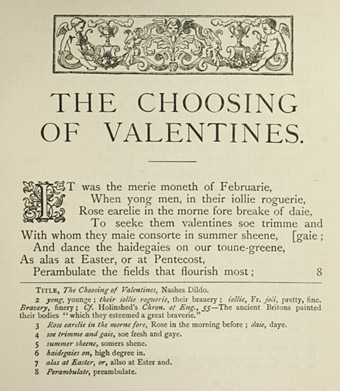
The Choise of Valentines, Or the Merie Ballad of Nash His Dildo

nash.jpg

My little dilldo shall suply their kinde:
A knaue, that moues as light as leaues by winde;
That bendeth not, nor fouldeth anie deale,
But stands as stiff as he were made of steele;

A salacious post for chocolate-and-roses day. There’s a degree of confusion around this work and its author, an Elizabethan poet, playwright and pamphleteer. The poem, which was distributed privately, dates from around 1593 and has a variety of titles, while its author is variously credited as Thomas Nashe or Thomas Nash. Despite the bawdy reputation of the Elizabethan era Nash’s contemporaries were sufficiently scandalised by the poem for it to remain unpublished, with the result that it survives imperfectly in a few handwritten copies. It’s a lengthy piece so let’s go to Wikipedia for a précis:

It describes the visit of a young man named “Tomalin” to the brothel where his girlfriend Frances (“Frankie”) is employed. Having paid ten gold pieces for her favours, Tomalin is embarrassed to find that merely lifting her skirts makes him lose his erection. She perseveres in arousing him however and they make love, but to her disappointment he has an orgasm before her. Frankie then decides to take matters into her own hands: hence the informal title by which the poem was known, Nashe’s Dildo.

The Oxford English Dictionary credits Nash with the first appearance in English of the word “dildo”, a term “of obscure origin” we’re told, whose usage here predates John Florio’s Worlde of Wordes (1598), Ben Jonson’s The Alchemist (1610), and Shakespeare’s A Winter’s Tale (1611). Nash’s achievement is something of a cheat since his poem wasn’t actually published until 1899, and then in a private edition. As usual the Internet Archive has the book in question, and it’s their version which follows, albeit without the copious footnotes.

The Renaissance English Literature site has more about Thomas Nash (or Nashe), his life and his work.

Continue reading “The Choise of Valentines, Or the Merie Ballad of Nash His Dildo”

Weekend links: fifth anniversary edition

demuth.jpg

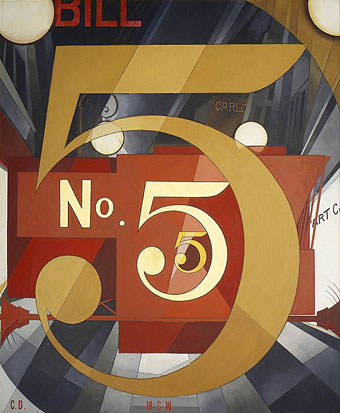
The Figure 5 in Gold (1928) by Charles Demuth.

It’s a little surprising to find I’ve been doing this for five whole years yet here we are. Having seen a number of blogs call it quits at the five-year point I should note that I don’t feel quite that exhausted although maintaining a discipline of daily posting can be a chore at times, especially when you’re pressured by work. On the whole the advantages continue to outweigh the disadvantages. Some of the discoveries here have fed back into things I’ve been working on or opened avenues for future exploration. Researching something for an audience (however slight that audience or the resulting post) encourages you to look more deeply into a given subject; sometimes you learn more as a result and occasionally make surprising discoveries. Obsessions are teased out which might otherwise have lain dormant. Yes, it’s an extra bout of work but I’ve spent much of my life saying to people “if you like that, you may like this”, and that’s all many of these posts are doing.

This year promises to be an interesting one so watch this space. And, as always, thanks for reading!

John x

On to the links…

Cathedral Scan translates the architectural plans of Gothic cathedrals into open-ended musical scores via custom software. There’s more at Blake Carrington‘s website.

Forty-three William Burroughs recordings (tape experiments and readings) at the Ubuweb archives.

• The opening scene of Deadlock (1970), an obscure German film with a theme by the mighty Can.

Strange Lands: A Field-Guide to the Celtic Otherworld, a new book by Andrew L Paciorek.

• The enduring nature of Frankenstein, currently on stage at the National Theatre, London.

shimojo.jpg

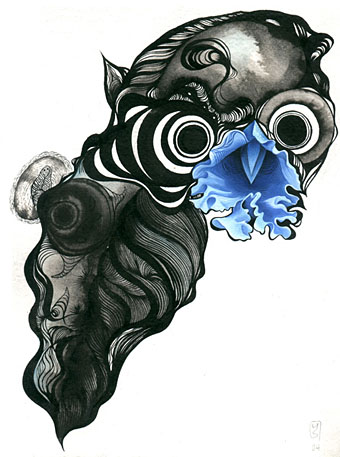
Owl One (2004) by Yuri Shimojo.

¡Activista! by Sonny Smith: Drag Queens, Borders, Rivers, Death and Transformation.

• Estonian sculptor Mati Karmin makes furniture out of Russian anti-submarine mines.

Alan Moore’s contribution to the Save Our Libraries campaign.

• Innsmouth Free Press is raising funds for their running costs.

A history of queer street art (Facebook link, unfortunately).

Illuminated book design for Heston’s Fantastical Feasts.

Physica Sacra, an engraving set at Flickr.

Egypt (1985) by Tuxedomoon | Egyptian Basses (1998) by Coil | Soleil D’Egypte (2001) by Natacha Atlas.