The Horse of the Invisible

carnacki1.jpg

Can Carnacki make any claim to be taken seriously as a detective? If he solves anything it is by force of will, rather than the application of deductive powers. He is no Sherlockian ironist, no high-domed mental traveller. He stands as close to Holmes as Mike Hammer does to Philip Marlowe. His methods are enthusiastic but basic: good old-fashioned head-in-the-door stuff. He is not so much a “ghostbuster” as a self-starting lightning rod for psychic phenomena that has not yet been housebroken.

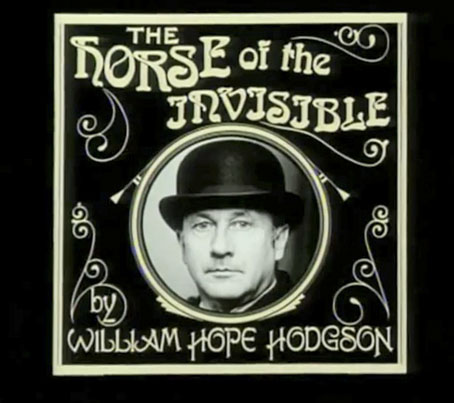
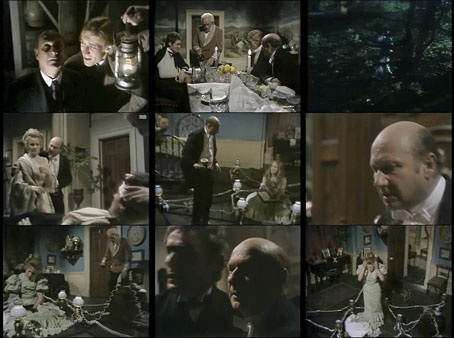
Thus Iain Sinclair in a typically acerbic afterword to the 1991 Grafton paperback of Carnacki, the Ghost-Finder by William Hope Hodgson. Holmes would indeed look askance at Carnacki’s methods but that didn’t prevent the occult investigator being drafted as one of The Rivals of Sherlock Holmes in the first television series of that name in 1971. I was reminded of this dramatisation following last week’s discussion of Hodgsonian cinema; I’ve known about the episode for years—notable for having Donald Pleasence in the role of Thomas Carnacki—but hadn’t watched it until this week courtesy of YouTube.

Philip Mackie wrote the script for The Horse of the Invisible, and Alan Cooke was the director. Their adaptation is interesting mostly for seeing a Hodgson story dramatised; as a piece of television the presentation is serious and well-acted but looks rather creaky today, suffering from the over-lit artificiality that always blighted studio-shot productions attempting to create any kind of atmosphere. Donald Pleasence is his typical lugubrious self which doesn’t really suit Carnacki’s bull-headed enthusiasm but I don’t mind that, Pleasence was a good actor so it’s a treat to see him play the part. And we do get to see Carnacki’s “electric pentacle” in action (Carnacki enjoys his Edwardian gadgets) in the midst of which the beleaguered Michele Dotrice is forced to spend the night. The most successful Carnacki stories are those that play to Hodgson’s strengths as a writer of supernatural dread, stories such as The Gateway of the Monster or The Hog. The Horse of the Invisible doesn’t attain the heights of those tales but then it would be a doomed venture trying to conjure Hodgson’s cosmic horrors on a limited budget. With this story you get a taste of the supernatural, which no doubt sets it apart from the other “Rivals”, whilst staying within the bounds of credibility.
carnacki2.jpg

There’s one curious detail worth mentioning: in both the story and the dramatisation the character of the fiancé is named “Charles Beaumont”. There was a real Charles Beaumont, a screenwriter responsible for many scripts for The Twilight Zone TV series, as well as for some of the superior American horror films of the 1960s, including Night of the Eagle, The Haunted Palace (Roger Corman’s adaptation of The Case of Charles Dexter Ward) and The Masque of the Red Death. In last week’s discussion I mentioned John Carpenter’s The Fog as a good example of Hodgsonian cinema on account of its ghost pirates. My memory may be playing tricks but I’m sure that Carpenter has a reference to a “Charlie Beaumont” in either The Fog or Halloween, both films being littered with significant character names. (There’s a “Mr Machen” in The Fog). Donald Pleasence was in Halloween, of course, playing a doctor with a name lifted from Psycho. I’ve searched in vain for the Beaumont reference; does this ring a bell for any Carpenter-philes?

Both series of The Rivals of Sherlock Holmes are available from Network DVD.

Previously on { feuilleton }
Tentacles #2: The Lost Continent
Tentacles #1: The Boats of the ‘Glen Carrig’
Hodgson versus Houdini
Weekend links: Hodgson edition
“The game is afoot!”
Druillet meets Hodgson

Weekend links 128

wrongeye.jpg

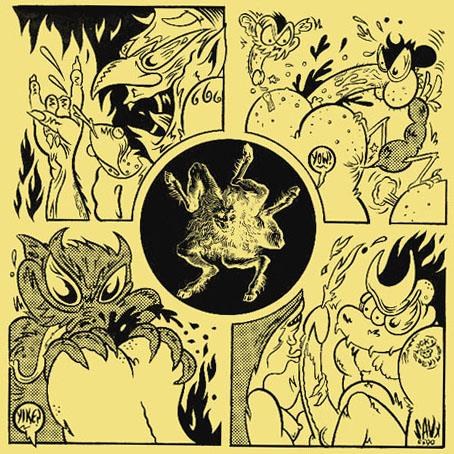
Seven-inch sleeve design by Savage Pencil for Wrong Eye (1990) by Coil.

• “Can you use sensory deprivation to explore ESP? And then make music from the process?” Drew Daniel and MC Schmidt of Matmos decided to find out for their new EP. Related: Occult Voices—Paranormal Music, Recordings of Unseen Intelligences, 1905–2007 at Ubuweb. Details of the original CD release can be found here.

Gorgeous Gallery: The Best in Gay Erotic Art is a new book by David Leddick featuring the work of contemporary gay artists. Howard G. Williams has a review at Lambda Literary.

Trip or Squeek by Savage Pencil, a book collection of the artist’s comic strips for The Wire magazine, forthcoming from Strange Attractor Press.

The novels of the middle period are Burgess’s most vital because it was in these that he forged what we might now recognize as the Burgessian – the antic puns and wordplay, the etymological digressions, the opacity, the glamorous pedantry, the tympanic repetitions, and an alliterative, assonantal musicality that makes every sentence seem vivid and extrovert: “Seafood salt with savour of seabrine thwacking throat with thriving wine-thirst”; “the lucent flawlessness of the skin, of the long fleshly languor that flowered into visibility”; “he was in a manner tricked, coney-caught, a court-dor to a cozening cotquean”. This is Burgess’s description of an Elizabethan brothel: “He entered darkness that smelled of musk and dust, the tang of sweating oxters, and, somehow, the ancient stale reek of egg after egg cracked in waste, the musty hold-smell of seamen’s garments, seamen’s semen spattered, a ghost procession of dead sailors lusting till the crack of doom”.

Ben Masters on A Clockwork Orange and its creator, fifty years on

• A streaming album for the beginning of autumn, the self-titled debut by Eraas, available in a range of formats at Bandcamp.

• “How Collecting Opium Antiques Turned Me Into an Opium Addict.”

Ted Hughes reads from Crow. Related: Raptors by Leonard Baskin.

• Janitors of Lunacy: Jonny Mugwump remembers Coil.

equus.jpg

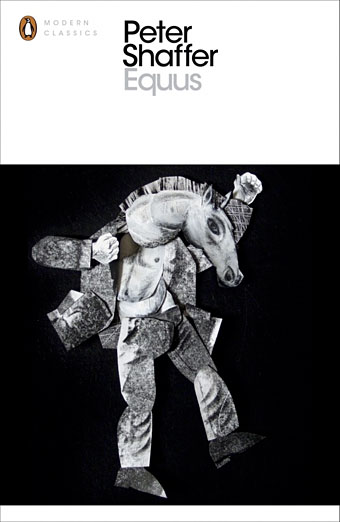
Back in June I suggested Clive Hicks-Jenkins’ paintings as potential artwork for Penguin’s Modern Classics series. Last week Clive revealed that Penguin will be using one of his painted maquettes for a new edition of Equus next year.

150 Years of Lesbians and Other Lady-Loving-Ladies

Color Sound Oblivion: a Coil/TG/related Tumblr.

Tune in, psych out: the new black psychedelia.

The Hills Are Alive (1995) by Coil | QueenS (2012) by THEESatisfaction | Goldblum (2012) by Oddience.

Tentacles #4: Cthulhu in Poland

vesper1.jpg

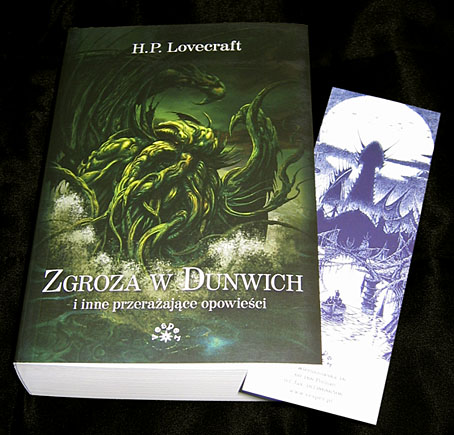
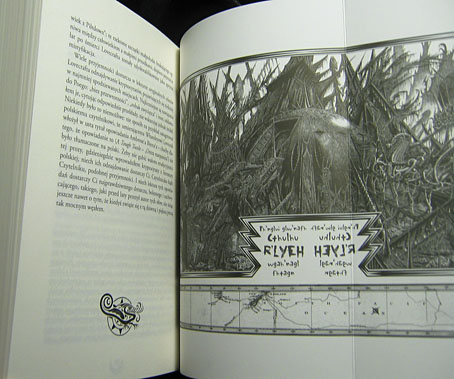
Several months ago Polish publisher Vesper asked to use some of my Lovecraft art for a Polish collection of the author’s work. Their weighty paperback just happened to arrive during this tentacle-themed week, an event which also gives me an opportunity to mention again (how could I not?) that two of these pieces can be found in the new Cthulhu Calendar. An ideal Halloween gift! Breaks the ice at eldritch parties! Etc. By coincidence I also received a book this week about vampire squid but I’ll say more about that after I’ve had a chance to read it.

vesper4.jpg

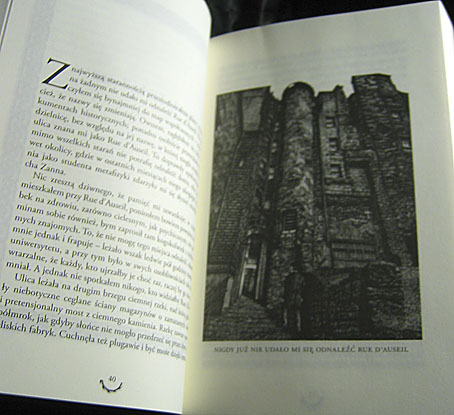
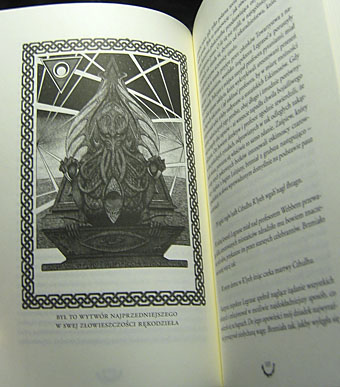
Despite Cthulhu being on the cover, the title of the book is (according to Google) The Dunwich Horror and Other Scary Stories which is no doubt a better sell with “horror” being up front. There are only fifteen stories but the page count runs to 792 since most of them are the later, longer works, including the entirety of At the Mountains of Madness and The Case of Charles Dexter Ward. A number of my illustrations are used within, one of which—the drawing of Advocates’ Close in Edinburgh which first appeared in The Haunter of the Dark—gets repurposed as an illustration for The Music of Erich Zann (above). Quite a fitting use, I think.

vesper2.jpg

In addition you also get my widescreen view of R’lyeh as a spread on the inside of the French flaps. And my copy came with a nice R’lyeh bookmark. Those interested can order the book here.

vesper3.jpg

Elsewhere on { feuilleton }
The Lovecraft archive

Tentacles #3: Dwellers in the Mirage

dwellers01.jpg

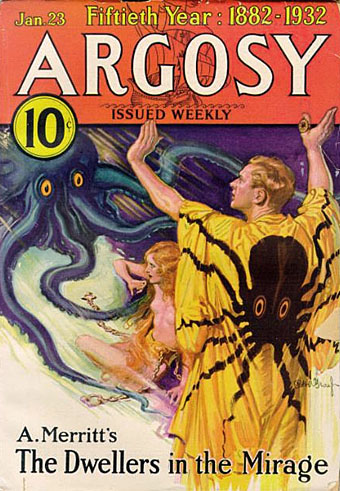
Illustration by Robert A. Graef (1932).

If the predatory octopuses of the Sargasso Sea are too mundane for you, how about an extra-dimensional Kraken named Khalk’ru which has to be placated with human sacrifice? This creature is the prime menace in A. Merritt’s Dwellers in the Mirage (1932), a novel I’m afraid I haven’t read despite its quite evident tentacular delirium. The story is a Lost Race adventure with the unlikely setting of a warm valley in Alaska where the usual heroic outsider encounters the diabolical Kraken worshippers. Merritt’s work is out of copyright in Australia so the text of the book can be found at the Australian Project Gutenberg. There you’ll discover that chapter four is entitled Tentacle of Khalk’ru.

A handful of covers and illustrations follow.

dwellers06.jpg

Virgil Finlay (1941).

Continue reading “Tentacles #3: Dwellers in the Mirage”

Tentacles #2: The Lost Continent

lost4.jpg

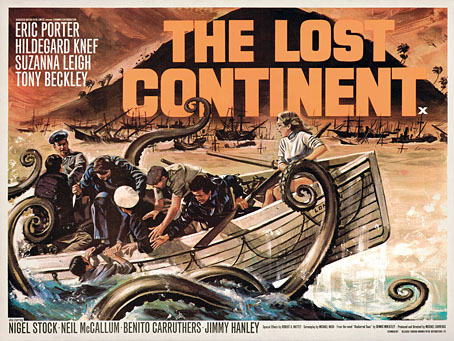
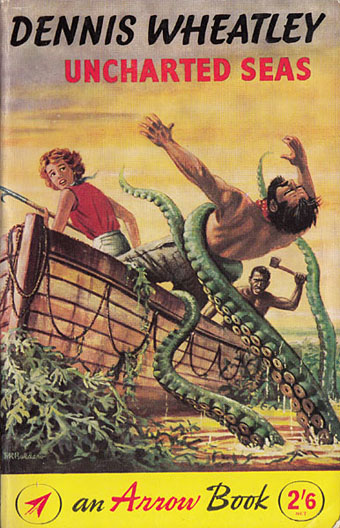
If William Hope Hodgson’s The Boats of the ‘Glen Carrig’ represents the Sublime of tentacular sea fiction then The Lost Continent, a 1968 Hammer film based on Dennis Wheatley’s 1938 novel Uncharted Seas, is the correspondingly Ridiculous end of the subgenre. The Lost Continent is an irritating film for Hodgson enthusiasts since it’s still the most Hodgsonian film out there, at least where the Sargasso side of things is concerned.

uncharted1.jpg

Illustration by SR Boldero (1960).

Despite its Wheatley origins the similarities to Hodgson’s sea stories are no coincidence: Wheatley chose two Hodgson titles—Carnacki, the Ghost-Finder and The Ghost Pirates—for the Dennis Wheatley Library of the Occult series that Sphere Books published in the 1970s. In the introductions Wheatley notes that Hodgson was a favourite writer whose work he discovered in the 1920s; he also mentions having collected a set of Hodgson first editions. Wheatley could have justifiably claimed that the “Weed-World” as a location wasn’t unique to Hodgson but Uncharted Seas also features the giant crabs, marauding octopuses and besieged castaways familiar from The Boats of the ‘Glen Carrig’ and the short stories.

Continue reading “Tentacles #2: The Lost Continent”