
Weekend links 138

durette.jpg

Heartsick (2011) by Kelly Durette.

• Now that Scott Walker’s Bish Bosch album is out and causing the usual consternation, the spotlight-shy singer/composer has been doing a surprising amount of promotional interviews. Simon Hattenstone talked to him for the Guardian at the end of last month; this week it was John Doran’s turn at The Quietus. One quote from the latter piece stood out in the light of this week’s posts: “…the music we’re making is meant to be an aural version of the HR Giger drawings for Alien. It always sounds to me like those look.”

Satanica is a limited-edition publication curated by Gio Black Peter & Christopher Stoddard “for anyone who rejects societal norms, for those dedicated to a life of pleasure, excess and self-reflection”.

• Sci-Fi-O-Rama has put five years’ worth of blog pictures onto Pinterest. I don’t really need to do that, there’s already a diverse crowd of Pinterest users compiling their own selection of things posted here.

As Susan Sontag once observed, pornography is practical. It was designed as a marital aid, and its vocabulary should follow natural biological rhythms and stick with hot-button words in order to produce a predictable climax. It is not about sex but is sex. Whereas the great sex writers (Harold Brodkey, DH Lawrence, Robert Gluck, David Plante, the Australian Frank Moorhouse) have a quirky, phenomenological, realistic approach to sex. They are doing what the Russian formalists said was the secret of all good fiction – making the familiar strange, writing from the Martian’s point of view.

Edmund White on writing about sex in fiction

• When pirate DVDs of films by Cocteau, Bresson and Pasolini are on sale in a Mexican market, life in the 21st century increasingly resembles a William Gibson novel. Joanne McNeil investigates.

• Copies of City Fun, Manchester’s premier music fanzine/alt culture mag (founded 1978), can now be read online at the Manchester District Music Archive.

• Linked everywhere during the past few days, the astonishing map of bomb hits on London during the Blitz (October 1940 to June 1941).

• At 50 Watts: 30 Vintage Magazine Covers from Japan and Alfred Kubin’s illustrations for Lesabéndio: An Asteroid Novel (1913) by Paul Scheerbart.

• Earlier this year for Frieze Magazine Geeta Dayal talked to musical collaborators of the great German producer Conny Plank.

Invisible Ink by Christopher Fowler, “the extraordinary stories of over one hundred forgotten authors”.

Cynthia Carr talks about Fire in the Belly, her biography of American artist David Wojnarowicz.

• “Blasphemy, Filth, And Nonsense” More Aleister Crowley ephemera at Front Free Endpaper.

• At Strange Flowers: Surrealist art by Jindrich Heisler (1914–1953).

Vladimir Nabokov wrote to Alfred Hitchcock in 1964.

• Scott Walker’s four tracks from the Nite Flights album (1978): Shutout | Fat Mama Kick | Nite Flights | The Electrician.

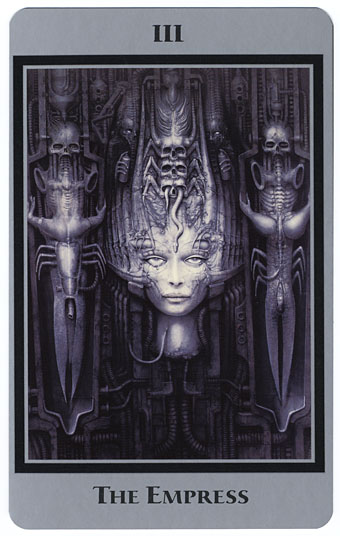
Giger’s Tarot

giger13.jpg

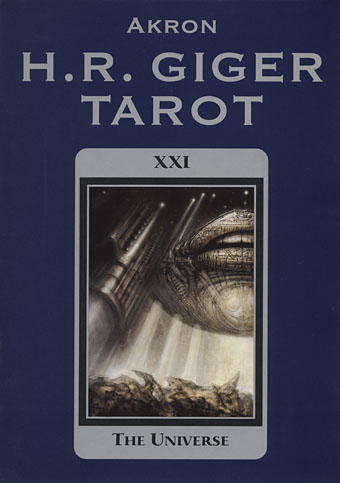
This week’s posts reminded me that I have a copy of the HR Giger Tarot set published by Taschen under their Evergreen imprint in 2000. The set is Taschen’s reworking of Giger & Akron’s Baphomet Tarot der Unterwelt set from 1994, and I recall this being one of the last things Taschen created with Giger after spending the previous decade producing a run of books, diaries and posters featuring his paintings. Inside a box you find a set of 22 oversize Tarot trumps presenting some of Giger’s works against metallic silver surrounds. There’s also a poster-size sheet for card readings printed with his pentagram design plus a 224-page paperback book by Swiss Tarot scholar Akron, aka CF Frey, which interprets the paintings as they relate to the Major Arcana. (The Baphomet set had a hardback book and the pentagram design printed on the back of each card.)

giger12.jpg

The design on the back of the cards, printed in black on metallic silver.

If you’re familiar with Tarot symbolism you don’t have to use these cards to find the correspondences intriguing. The trump ordering is an odd mix of the Crowley scheme with the more traditional designations. Two of the trumps have also been given new names: The Hanged Man is now The Hanged Woman while Crowley’s Art (formerly Temperance) has become Alchemy, an association which works since the card in the Crowley deck depicts the Androgyne of alchemical symbolism. I can imagine some Tarot collectors finding these cards far too dark and nasty, but when so many Tarot designs today are various degrees of garish or twee there’s plenty of room for a Giger or two to harsh the New Age mellow.

The card set has been out of print for years but Abebooks still carries copies at reasonable prices. A few examples of the cards follow.

giger14.jpg

Continue reading “Giger’s Tarot”

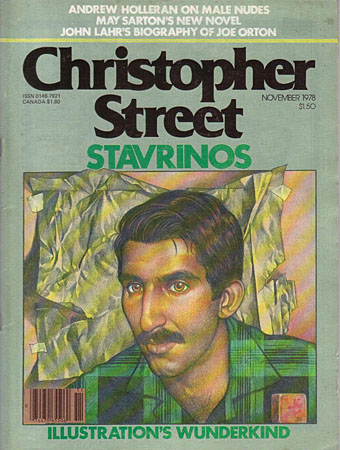
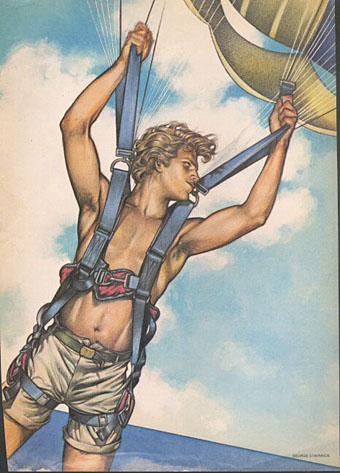
The art of George Stavrinos, 1948–1990

stavrinos1.jpg

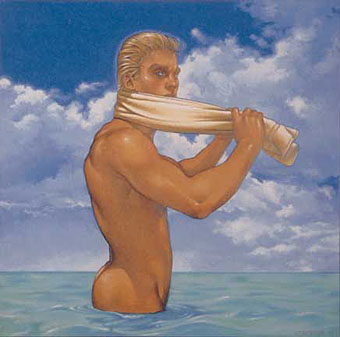
I’m still playing catch-up with the generation of gay artists who came to prominence in the 1970s or early 1980s. Many of them worked for American magazines which were seldom seen over here: both Mel Odom and George Stavrinos provided illustrations for Blueboy while Stavrinos was popular enough to be given the cover treatment from Christopher Street in 1978. Stavrinos is rightly remembered for his stunning Art Deco-styled fashion illustrations but there was enough work in the gay press for him to be regarded as an important artist in that sphere. There’s more at The Advocate and Decoy.

stavrinos2.jpg

stavrinos3.jpg

stavrinos4.jpg

Bather (1977).

stavrinos5.jpg

Elsewhere on { feuilleton }
The gay artists archive

Joseph Cornell: Worlds in a Box

cornell1.jpg

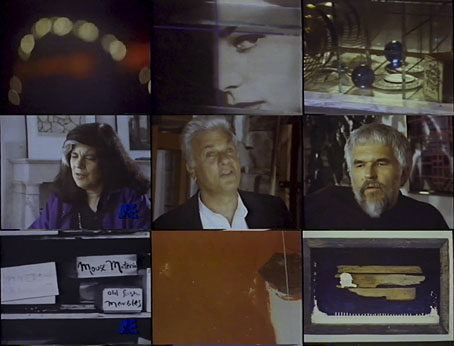
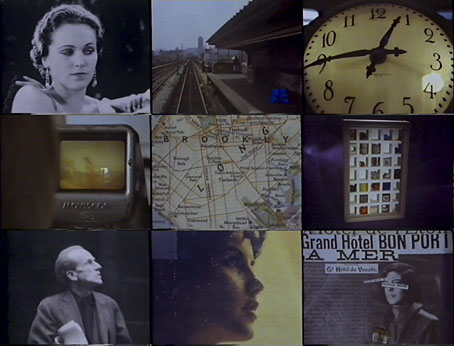
Susan Sontag, Tony Curtis and Stan Brakhage all shared an appreciation for the work of American artist Joseph Cornell (1903–1972), and all appear in a 51-minute documentary Joseph Cornell: Worlds in a Box directed by Mark Stokes for the BBC in 1991. Susan Sontag was also the subject of one of Cornell’s collages, something she discusses here. Tony Curtis collected many of Cornell’s boxes and used to visit the artist when he was in New York; in Stokes’s film he discusses their relationship and reads from Cornell’s writings.

cornell2.jpg

I’ve had a tape of this for years courtesy of Kerri Sharp who worked on the film (hi Kerri!) but it’s taken a while to turn up on YouTube. The value of films such as this isn’t so much the view they give of the works themselves—all of which are better judged in books or museums—but the way they function as mini-biographies which give a sense of the environment from which the art emerged. You can read in detail about Cornell’s life in Deborah Solomon’s Utopia Parkway: The Life and Work of Joseph Cornell (1997) but a text description of his home lacks the immediacy of the views Stokes gives us of the Cornell house, and the room where he created so much of his work. The film also follows Cornell’s train journeys into New York City, and visits the locations of his short films. Extracts of the latter appear throughout the documentary but you can see them in full at Ubuweb.

If you’re looking for an arty (and costly) Christmas present this year, Thames & Hudson have just published Joseph Cornell’s Manual of Marvels: How Joseph Cornell reinvented a French Agricultural Manual to create an American Masterpiece; two books in a box with a CD, edited by Analisa Leppanen-Guerra and Dickran Tashjian. The NYT reviews it here.

Previously on { feuilleton }
Joseph Cornell, 1967
Rose Hobart by Joseph Cornell
View: The Modern Magazine

Weekend links 137

jacobsen.jpg

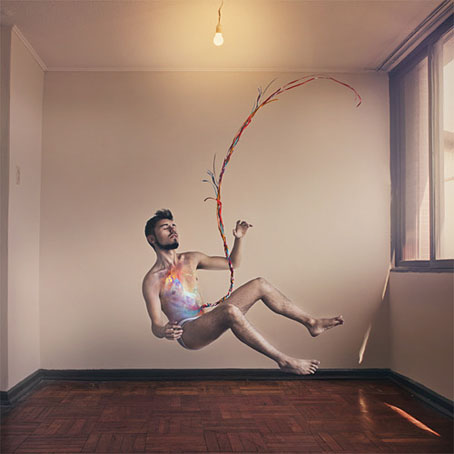
Self-portrait by Jon Jacobsen from his Home series.

Steven Arnold: Cabinet of Curiosities is “a retrospective exhibition of this groundbreaking yet under-recognized queer artist at the ONE Archives Gallery & Museum in West Hollywood. The exhibition celebrates Arnold’s radical imagination, presenting many of his tableaux vivant photographs alongside never before exhibited drawings, sketchbooks, paintings and original poster art. In conjunction with the exhibition, ONE will screen Arnold’s four films, including Luminous Procuress (1970), which featured The Cockettes and was lauded by Salvador Dalí.” The exhibition runs to  January 12, 2013.

• “The boundary-pushing techno/sound design duo Emptyset will transform London’s cavernous industrial space Ambika P3 into an immersive sound installation for one night only—and here’s how they’re going to do it”.

• “At one time he was a well-known figure in Montparnasse, where he had a reputation as a master of the occult sciences.” Aleister Crowley is interviewed about his expulsion from France in 1929.

Our normal waking consciousness, rational consciousness as we call it, is but one special type of consciousness, whilst all about it, parted from it by the filmiest of screens, there lie potential forms of consciousness entirely different. We may go through life without suspecting their existence; but apply the requisite stimulus, and at a touch they are there in all their completeness… No account of the universe in its totality can be final which leaves these other forms of consciousness quite disregarded… [T]hey forbid our premature closing of accounts with reality.

William James (1842–1910) quoted in What Should We Do With Our Visions of Heaven—and Hell? by John Horgan at Scientific American.

Screws is an album of piano music by Nils Frahm that’s currently available as a free download (inc. aiffs).

• At Pinterest: Art Visonnaire. Related: Ain’t We Got Fun: The magical surrealism of Jen Ray.

Rowan Somerville “challenges the purpose and legitimacy” of the Bad Sex Awards.

Jimmy’s End: the website for the film by Alan Moore & Mitch Jenkins.

Douglas Rushkoff in conversation with Genesis Breyer P-Orridge.

• Linda Rodriguez McRobbie explores The History of Boredom.

• Recreating the sounds of the BBC Radiophonic Workshop.

Alchemical Emblems, Occult Diagrams, and Memory Arts.

Rocaille: A Blog about Decadence, Kitsch and Godliness.

• A new video for Goddess Eyes II by Julia Holter.

• The complete audio recordings of Jean Cocteau.

The Rumpus interview with Russ Kick.

Forgotten Bookmarks

• RIP Spain Rodriguez

Astradyne (1980) by Ultravox (produced by Conny Plank) | Biomutanten (1981) by Les Vampyrettes (Conny Plank & Holger Czukay) | Never Gonna Cry Again (1981) by Eurythmics (feat. Holger Czukay, produced by Conny Plank).