Weekend links 127

whirlpool.jpg

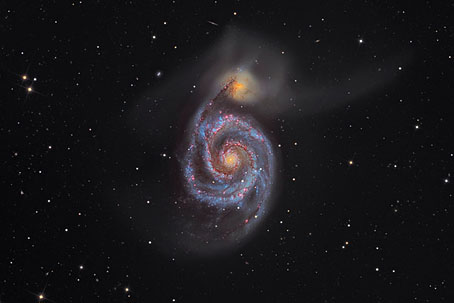
M15, The Whirlpool Galaxy photographed by Martin Pugh. The overall and deep space winner of Astronomy Photographer of the Year, 2012.

The Final Academy, the series of William Burroughs-themed events that took place in London and Manchester in 1982, will be celebrated at the Horse Hospital, London, on 27th October. Academy 23, a publication edited by Matthew Levi Stevens, will include my report on the Manchester Haçienda performances.

• “Architects are the last people who should shape our cities,” says the thrillingly pugnacious Jonathan Meades in a piece from his new writing collection Museums Without Walls. Andy Beckett reviews the book here.

• Ex-Minimal Compact singer/bassist Malka Spigel talks about her new album, Every Day Is Like The First Day, which can be streamed in full here.

What’s new about the current acknowledgments page is that it’s unsolicited—it appears like an online pop-up ad, benefiting no one but the author and his comrades. This is surely why these afterwords are often so garrulously narcissistic and strewn with clichés. The most radical experimentalist adheres to the most mindless acknowledgments-page formula; the most stinging social critic suddenly becomes Sally Field winning an Oscar.

Sam Sacks at the New Yorker on the blight of novelists’ acknowledgments pages. DG Myers at Commentary Magazine piles on.

• Another streaming album: Composed by Jherek Bischoff. Try Insomnia, Death & The Sea featuring Dawn McCarthy.

• Film of Lindsay Kemp being interviewed in 1977 about his production of Salomé.

Electronic Performers (2004): a video by Machine Molle for the song by Air.
djuna.jpg

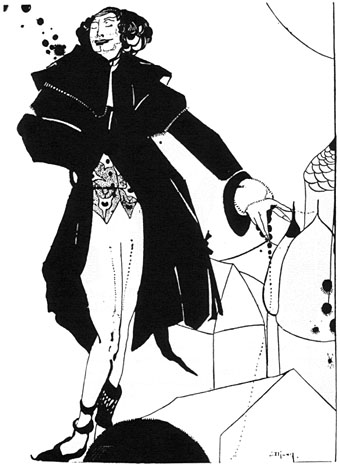
One of a series of Beardsley-like drawings by Djuna Barnes posted at Strange Flowers. The resurgent Ms. Barnes is mentioned three times in this Terry Castle review of All We Know: Three Lives by Lisa Cohen.

Fictitious Dishes, meals from novels photographed by Dinah Fried.

• Life, the Dinosaurs & Everything: Cosmicomics by Italo Calvino.

The Baby Died: Morbid Curiosities found in Old Newspapers.

• Portishead’s Adrian Utley gives a tour of his synth collection.

• Minimal Compact: Babylonian Tower (1982) | Not Knowing (1984) | When I Go (1985) | Nil Nil (1987).
Weekend links 117

lux1.jpg

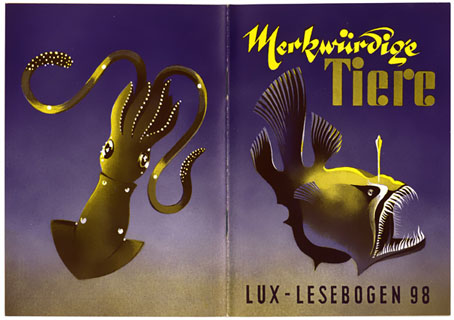
Illustration and design by Karlheinz Dobsky.

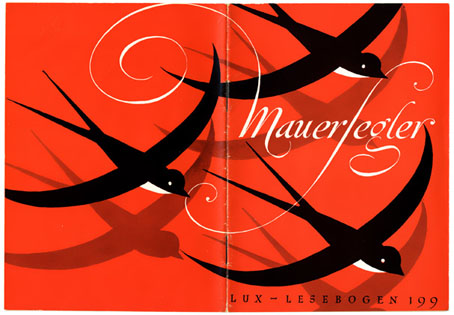
Above and below: samples from Die Lux-Lesebogen-Sammlung, an exhibition of booklets for young people published by Sebastian Lux from 1946–1964. All were designed and illustrated by Karlheinz Dobsky.

• At The American Scholar: “Vladimir Nabokov’s understanding of human nature anticipated the advances in psychology since his day,” says Nabokov biographer Brian Boyd, and An Unquenchable Gaiety of Mind: “On visits to Cambridge University late in life, Jorge Luis Borges offered revealing last thoughts about his reading and writing,” says George Watson.

• The British Library releases The Spoken Word: “A rare collection of recordings featuring the American writer William S Burroughs and the British-born artist Brion Gysin.” Related: Interzone – A William Burroughs Mix by Timewriter.

• Charting the Outlaws: Christopher Bram (again) talking to Frank Pizzoli about his recent study Eminent Outlaws: The Gay Writers Who Changed America.

• The BBC asks “Where are you on the global fat scale?” I’ve always been thin but was still surprised to find my BMI at the very bottom of the scale.

The “otherness” of Ballard, his mesmeric glazedness, is always attributed to the two years he spent in a Japanese internment camp in Shanghai (1943–45). That experience, I think, should be seen in combination, or in synergy, with the two years he spent dissecting cadavers as a medical student in Cambridge (1949–51). Again the dichotomy: as a man he was ebulliently social (and humorous), but as an artist he is fiercely solitary (and humourless). The outcome, in any event, is a genius for the perverse and the obsessional, realised in a prose style of hypnotically varied vowel sounds (its diction enriched by a wide range of technical vocabularies). In the end, the tensile strength of The Drowned World derives not from its action but from its poetry.

Martin Amis on The Drowned World by JG Ballard.

The Chickens and the Bulls: “The rise and incredible fall of a vicious extortion ring that preyed on prominent gay men in the 1960s.”

• It’s that Zone again: Jacob Mikanowski on Andrei Tarkovsky’s Stalker and Geoff Dyer’s Zona.

• Scans of the rare film programme for London screenings of Fritz Lang’s Metropolis.

lux2.jpg

Illustration and design by Karlheinz Dobsky.

• “The web is a Library of Babel that could go the way of the Library of Alexandria.

Fila Arcana: alchemy- and occult-themed embroidery by Mina Sewell Mancuso.

A Very Edgy Alice In A Very Weird Wonderland: illustrations by Pat Andrea.

Malka Spigel reveals a new track from her third solo album.

John Martin and the Theatre of Subversion.

Olafur Eliasson: Little Sun at Tate Modern.

• Meanwhile, back in 1972: Mahavishnu Orchestra live at the BBC (30 mins), and the complete performance of the MC5 on Beat Club (29 mins).

Weekend links 114

bowie.jpg

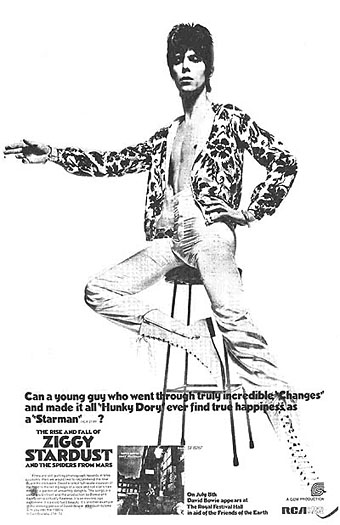
David Bowie’s cigaretted fingers and bulging silver crotch point the way to the future. This summer sees the fortieth anniversary of the Ziggy Stardust album’s release. The Melody Maker ad above can be found with a wealth of other Ziggy-related material at the very thorough Ziggy Stardust Companion site. For me the definitive artefact isn’t the album itself but DA Pennebaker’s film of the final concert from the 1973 tour; the songs really come alive and Bowie’s performance is overwhelmingly electric. Related: Cracked Actor, the BBC documentary from 1975 about Bowie’s post-Ziggy life on and off the stage.

• The week in books: Amanda Katz described the remarkable history of a single copy of The War of the Worlds by HG Wells then asked “Will Your Children Inherit Your E-Books?” | Bosnian novelist Aleksandar Hemon in The Browser’s FiveBooks interview put Blood Meridian on his list. | “Call me the greatest American novel”: Christopher Buckley on Moby-Dick. | The Brit Lit Map.

• For another anniversary, the Alan Turing centenary, there’s The Strange Life and Death of Dr Turing (part two here) and Breaking the Code (1996), Derek Jacobi playing the tragic genius in a biographical drama.

Commissioner of Sewers (1991) a William Burroughs documentary by Klaus Maeck in which the author reads some of his work and endures a Q&A session with surprising equanimity.

• Music, flesh and fantasy: When Mati Klarwein’s hyperactive paintings stole the psychedelic show.

• Move Over Casio: Teenage Engineering’s OP-1 Portable Synth Looks Cool, Does Everything.

• A retrospective of art by Madge Gill (1882–1961) at The Nunnery, London.

• “Art is unavoidably work”: Terre Thaemlitz interviewed.

• A trailer for Document: Keiji Haino.

WB Yeats, Magus

Pathétique 1 (1994) by Fushitsusha | Pathétique 2 (1994) by Fushitsusha.

Weekend links 112

venus.jpg

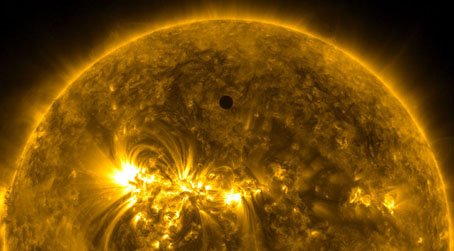
“Venus moves across the Sun in this image captured by Japan’s satellite Hinode, on June 6, 2012.” Via.

The imagery in Ah Pook covered a wide range of ideas. A train full of Mayan Gods for instance travelled through various time zones to end up alongside a carnival in a red brick town outside St Louis. Then they got out…out of the books Mr. Hart was reading on the train. Fact also alternated with fiction. We could be chugging along with Lizard boys in a Mayan City one moment then switch to a history of Immigration Laws in the US or the development of tape recorders and Speech Scramblers. Then switch to a bright red Shrew boy with a hard-on on a bicycle in Palm Beach at the end of the world. Time was what the book was about: defining it, controlling it and moving back and forth within it.

Malcolm McNeill

Malcolm McNeill talks to The White Review about working with William Burroughs on Ah Pook Is Here. Related: Jan Herman as Publisher of Nova Broadcast Press. Reality Studio has all the Nova Broadcast publications as downloadable PDFs.

• More Graphic Canon news: design historian Steven Heller reports on the project while at Nashville Scene editor Russ Kick talks to Joe Nolan about the books.

• There’s still a couple of days left to hear Martyn Wade’s Blue Veils and Golden Sands, a BBC radio drama about electronic composer Delia Derbyshire.

venus2.jpg

“Venus in silhouette, seen between the Earth and Sun, from NASA’s orbiting Solar Dynamics Observatory, on June 5, 2012.” Via.

• From 2010: Video of an hour-long lecture by Alberto Manguel at Yale University on “Borges and the Impossibility of Writing”.

• Bauhaus reflections: Frank Whitford on the design school and the exhibition currently running at the Barbican, London.

• “It’s easier to be gay in the US army than it is to be gay in hip-hop.” Zebra Katz, Mykki Blanco and the rise of queer rap.

• Back at the event site: Another extract from M. John Harrison’s forthcoming novel Empty Space.

• Rare 1959 audio: Flannery O’Connor reads A Good Man is Hard to Find.

Venus Transit 2012 – Ultra-high Definition View (NASA/ESA).

• The kitties just don’t care: Indifferent cats in amateur porn.

What happened to Dorothy Parker’s ashes?

Space Teriyaki 5 at 50 Watts.

Venus/Upper Egypt (1991) by Sonny Sharrock | Venus (1996) by Funki Porcini | Venus (2003) by Air

Ah Pook Is Here

pook1.jpg

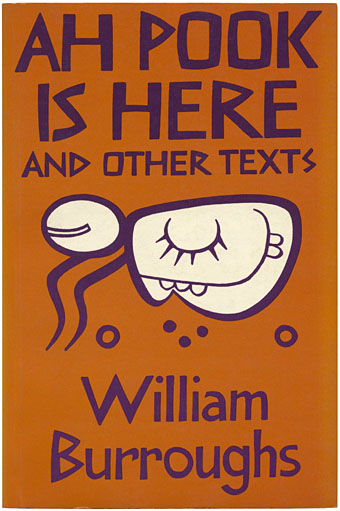
John Calder edition (1979). Design by Brian Paine incorporating a glyph of Ah Pook from the Dresden Codex.

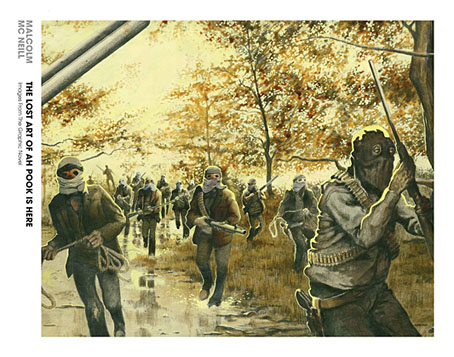
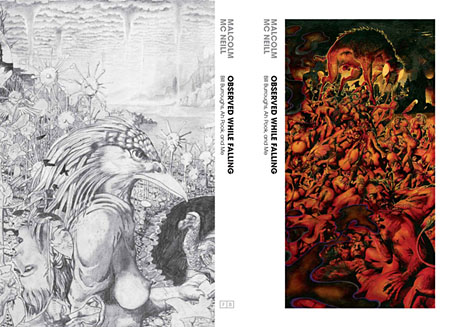
It would have been tempting to write “Ah Pook is finally here” but that’s not quite the case. Artist Malcolm McNeill sent Savoy Books the following preview images last week. What was originally going to be the long-awaited publication of McNeill’s collaboration with William Burroughs, Ah Pook Is Here, will now be two separate volumes published by Fantagraphics Books later this year: The Lost Art of Ah Pook Is Here which will comprise McNeill’s art without the accompanying text (apparently the Burroughs estate objected to its inclusion), and Observed While Falling—Burroughs, Ah Pook and Me, a memoir of the project’s creation. The loss of the text is an annoyance but not the end of the world, at least if you’re fortunate enough to own the scarce Calder book above which comprises a 40-page story that I imagine (and hope) may be read whilst viewing McNeill’s meticulous artwork. Amazon’s listing shows the two books scheduled for October 2012, and there’s now a website for the two books with further preview images.

pook2.jpg

pook3.jpg

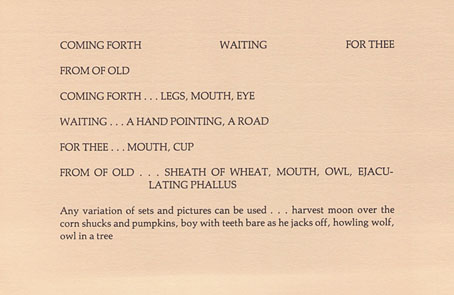
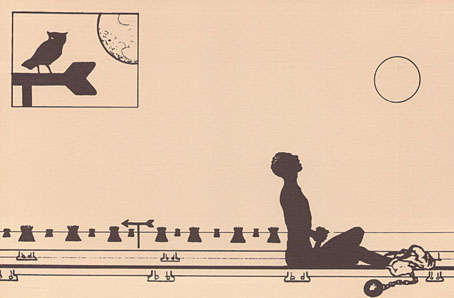
The 1979 Ah Pook Is Here is a fascinating collection, not least for the title piece which fits with the Wild Boys/Port of Saints narratives that Burroughs worked on during the 1970s. It’s also one of the better Burroughs anthologies so it’s always seemed odd that it’s remained resolutely out of print. Burroughs mentions McNeill’s artwork in a preface but doesn’t show any examples of his work. There is other artwork, however: in addition to some uncredited line drawings of figures like those in the Mayan codices there’s the whole of The Book of Breeething, a collaboration with artist Robert F. Gale from 1974. The latter concerns Burroughs’ interest in hieroglyphic communication, and attempts to show how one might convey short sentences through visual images alone, as in the pages below.

breeething1.jpg

The Book of Breeething (1974).

breeething2.jpg

The final piece in the book is The Electronic Revolution, an essay about using technology for guerilla purposes which was an inspiration for Cabaret Voltaire and others. All of this is choice and unusual material so it’s surprising that it’s been out of print for so long. In the case of Ah Pook Is Here it’s even more surprising to find it being prevented from republication despite Burroughs’ hope in his 1978 preface that the text would eventually be published along with the artwork. I’m sure the Burroughs estate have their own reasons for these manoeuvres but you can’t help but feel that this is another example of best intentions acting posthumously against the wishes of the artist they represent. A final irony can be found on the first page of Ah Pook Is Here where we see several mentions of a predatory agency that Burroughs warned against throughout his career, the thing he called CONTROL.

Elsewhere on { feuilleton }
The William Burroughs archive