Weekend links 353

tuke.jpg

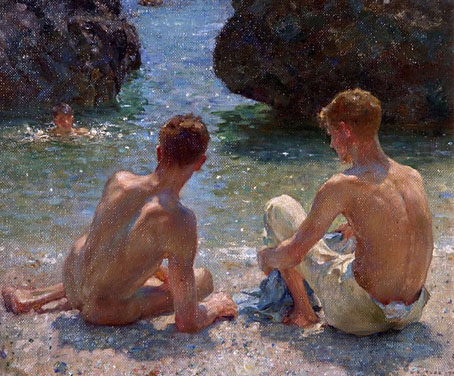
The Critics (1927) by Henry Scott Tuke.

• Geeta Dayal talks to ambient musician Midori Takada about Through The Looking-Glass (1983), an album being reissued this month by Palto Flats/We Release Whatever The Fuck We Want Records.

Jacob Brogan reviews The Abominable Mr. Seabrook by Joe Ollmann, a graphic biography of writer, occultist, explorer and determined cannibal, William Seabrook.

• More from the usual suspects (on these pages at least): Jonathan Meades on his new cookbook and a recent bout of heart surgery; and Iain Sinclair on The Last London.

The law only applied to men, but that didn’t mean same-sex relationships between women were immune to opprobrium. Dorothy Todd was hired as the editor of British Vogue in 1922. Under her visionary stewardship, the magazine became a bastion of high modernist style, swapping petticoats and corsets for Picasso, Cocteau, Man Ray and Woolf. Todd lived with her lover, the fashion editor Madge Garland. Sacked in 1926 because of declining circulation, she planned to sue the magazine, but was silenced when the publisher Condé Nast threatened to publicly expose her “morals”.

In such an inimical climate, it’s not surprising that art became a zone of enchantment as well as resistance. The plenitude of camp aesthetics, the lush excess, the cross-pollination of high and low forms might be conceived as a direct response to the paucity and hostility of the culture at large. From the mannered decadence of Aubrey Beardsley’s naughty woodcuts, to Cecil Beaton’s portraits of Stephen Tennant as a radiant boy prince, to the cabaret high jinks of Danny La Rue, to the wickedly doctored library book covers made by the playwright Joe Orton (a crime for which he received a jail sentence), camp offered a way of remaking the world, cutting it down to size and reassembling it in richly strange and strangely rich new forms.

Olivia Lang on the British artists working in defiance of iniquitous laws prior to the (partial) decriminalisation of homosexual acts in 1967.

• Due for publication later this year, You Should Come With Me Now, a new collection of short fiction by M. John Harrison.

Daniel Marner reviews Scarred For Life Volume One: The 70s, a book about the dark side of British pop culture.

Jay Babcock talks to Erik Davis about the end of Arthur magazine and his new life in the Californian desert.

• The nature photography of Nobuyuki Kobayashi and the ruin photography of Gina Soden.

Jon Forss of design team Non-Format on his time designing The Wire magazine.

Mac McClelland on how doctors treat mental illness with psychedelic drugs.

• Mix of the week: Secret Thirteen Mix 216 by WSR.

Hisham Matar on Jorge Luis Borges.

London Boys (1976) by T. Rex | Last Train To London (1979) by Electric Light Orchestra | London (2004) by Patrick Wolf

Weekend links 352

taggart.jpg

Table-Tipping Workshop at Rev. Jane’s House, Erie, Pennsylvania, 2014 by Shannon Taggart.

• Canadian electronic musician Sarah Davachi talks to Erik Davis about analogue synthesizers, reverberating cathedrals, attention spans, and her ambient drone album All My Circles Run.

• Orson Welles’ The Other Side of the Wind may now be released by Netflix. (I’m restraining my excitement for the moment since this one has been a long time arriving.)

• Mixes of the week: VF Mix 86: Jah Shaka by Roly Porter, Secret Thirteen Mix 215 by Twins, and What Good Is God? (1:11:11.111 Melon Collie Mix) by Gregg Hermetech.

• Making sense of The Weird and the Eerie: Roger Luckhurst reviews the final book from the late Mark Fisher.

• Pye Corner Audio has been very productive this year (I’m not complaining); the latest release is The Spiral.

• “I don’t like acceptance,” says Cosi Fanni Tutti, “it makes me think I’ve done something wrong.”

• Jon Brooks on the Continental inspiration for his next album, Autres Directions.

Séance: Spiritualist Ritual and the Search for Ectoplasm by Shannon Taggart.

• Corny and clichéd: Matthew Bown on bad painting in the twentieth century.

• At Wormwoodiana: Douglas A. Anderson on Borges and a forgotten book.

• At the BFI: Samuel Wigley chooses 10 great films set in the jungle.

Jungle Flower (1951) by Les Baxter | Jungle Fever (1973) by The Upsetters | The Jungle Dream (1973–1980) by Patrick Cowley

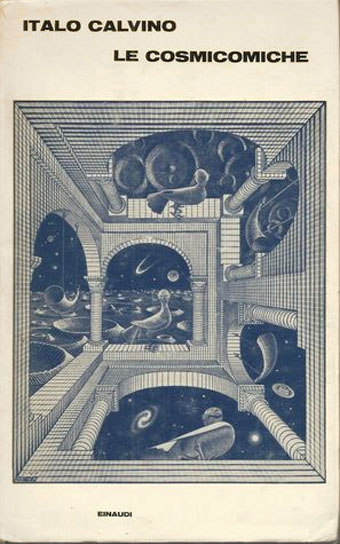
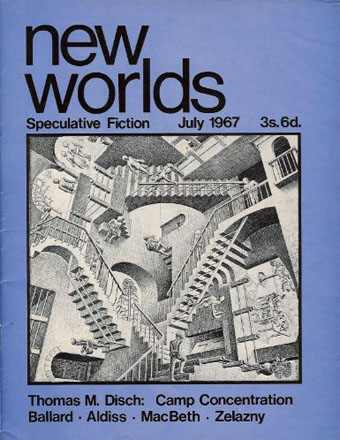
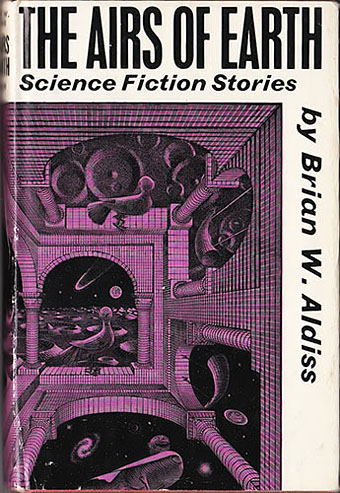
MC Escher book covers

escher08.jpg

1963. Art: Other World (1947).

MC Escher’s prints have been touring the UK this year: a few months ago they were in Scotland, this month they can be seen at the Dulwich Picture Gallery in London. The renewed attention prompted the BBC to produce a documentary, The Art of the Impossible: MC Escher and Me, in collaboration with Professor Roger Penrose. One of the programme researchers saw my earlier post about the use of Escher’s work on album covers, and asked if I wanted to appear on camera talking about this, something I politely refused to do. I’m happy to hold forth from a keyboard, however, so here’s a post about some of the books that have used Esher’s work to decorate their covers. Most of these are fiction but there must be many more non-fiction titles—especially in the fields of science and mathematics—that borrow Escher’s prints.

escher09.jpg

The first edition of Calvino’s comic stories from 1965.

escher10.jpg

Art: Relativity (1953).

Not a book but editor Michael Moorcock has claimed that this was the first UK magazine to print any of Escher’s work.

Continue reading “MC Escher book covers”

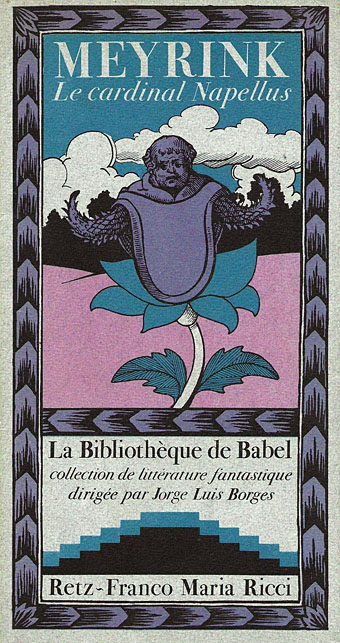
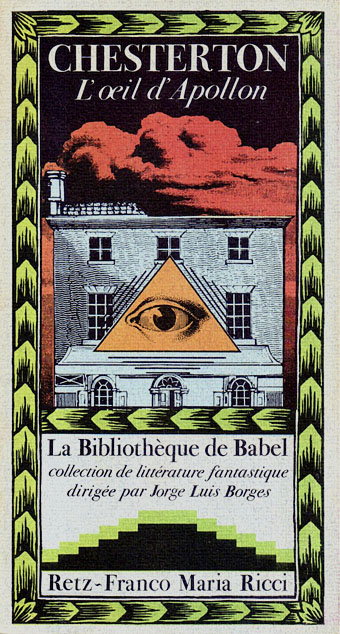
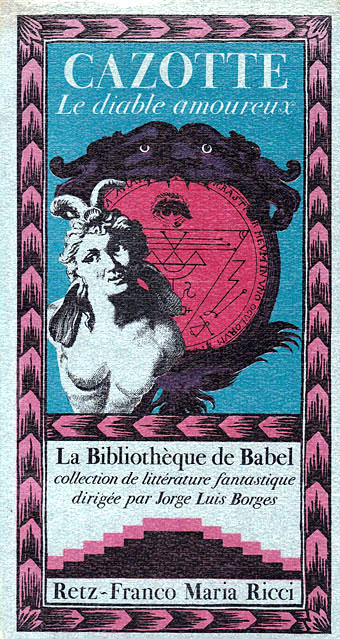
La Bibliothèque de Babel

babel01.jpg

It was perhaps inevitable that this small collection of works of fantastic fiction was named after its director’s most famous creation, the Library of Babel. Jorge Luis Borges chose the titles, and also wrote introductions for each of the books. The series was published in France by Retz–Ricci, with 4000 numbered copies of each title appearing from 1977 to 1981.

Many of the selections will be familiar to Borges aficionados, others seem obscure as a result of the vagaries of translation: Jack London’s Les Morts Concentriques is The Minions of Midas, a story that Borges had earlier translated into Spanish as Las Muertas Concéntricas (The Concentric Deaths). The story of linked deaths apparently influenced the writing of Death and the Compass. I’ve never seen Borges discuss Arthur Machen at length so the inclusion of Machen in the selection is a welcome sight. In addition to The Shining Pyramid, the Machen volume also contained The Novel of the Black Seal and The Novel of the White Powder, two of the oft-anthologised sections of The Three Imposters.

The only detail that’s defeated me  is the identity of the illustrator of the series. If anyone knows who was responsible then please leave a comment.

Update: the covers are credited to publisher/designer Franco Maria Ricci and Marcella Boneschi. Thanks to herr doktor bimler and Al Diniz.

babel02.jpg

babel03.jpg

Continue reading “La Bibliothèque de Babel”

Donald Cammell and Kenneth Anger, 1972

cinema.jpg

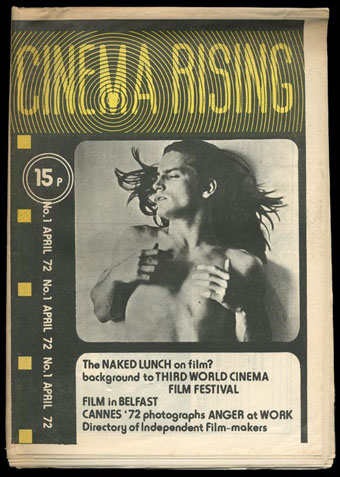
Another resurrected article. Cinema Rising was a short-lived newsprint film magazine that ran for three issues in the UK in 1972. I have a few pages from the rare first issue that was part of a batch of old underground newspapers I was given a few years ago. (The Frendz Hawkwind strip is from the same haul.) Cinema Rising was edited by Simon Hartog and Tony Rayns, the latter being a long-time Kenneth Anger aficionado which would explain both the magazine title and the presence of a photo feature about Anger’s Lucifer Rising. The bulk of this post is a short interview with Donald Cammell that’s of interest for his comments about the gender roles in Performance and his opinion of Jorge Luis Borges whose recurrence as both signifying text and presiding magus in Performance is never really explained.

Cammell’s next film after Performance would have been Ishtar (no relation to the notorious Warren Beatty flop), the themes of which Cammell discusses at the end of the piece. The Cammell biography describes a script concerning a film star and Hollywood producer who want to make a film in Morocco. While there they get involved with a woman who embodies various mystical/mythological feminine attributes; there’s also a sub-plot about the pair kidnapping an American judge. Mick Jagger was down for the role of the film star while William Burroughs was slated to play the judge. Given how wayward Cammell’s later films became it’s difficult to say whether this would have been good or not. Performance could very easily have been terrible but that film also had Nicolas Roeg on board.

After the Cammell piece there are photos from Cinema Rising‘s Kenneth Anger feature which show the director at work on the new version of Lucifer Rising. I’ve not seen any of these stills or the two black actors before—what happened to their parts? Note that some of the captions are misspelled: the photos should be credited to Diarmid Cammell—Donald’s brother—while the Adept (not “Lucifer”) is Haydn Couts.

dc1.jpg

DONALD CAMMELL: PERFORMANCE TO ISHTAR, Cinema Rising, no. 1, April 1972

Donald Cammell’s first movie was Performance, made in collaboration with Nicolas Roeg; the most unexpected British movie of recent years, and one of the very few products of the British industry capable of holding its own in an international context. Cammell’s new script is Ishtar, originally written with Mick Jagger in mind for the lead again, but possibly to be made without him; Cammell is currently in America to raise the backing for the film.

In the following extracts from a conversation with John du Cane (recorded last year), Cammell speaks of his background and interests…matters that inform his new script at least as much Performance.

Collaboration

“In the recent past, reverence for the director of a film as sole creator has been vastly exaggerated, through critical efforts. I’m thinking particularly of the Cahiers du Cinema ‘author’ concept—I’ve been living in Paris, and have been quite aware of it for a long time. The kind of theory of creativity that’s arisen there (and in related worlds in New York) is, succinctly, crap. It’s a way of trying to demonstrate the view that cinema is an artform, and that therefore there must be a single creative mind controlling the artefact, through to its ultimate form. It’s a way of justifying movie-making, socially and culturally.

“But leaving aside the reasons for the concept, I think it’s contradicted by the facts. I think that many of the greatest artefacts things that have moved people most throughout history—have been collectively produced. You don’t even have to look for examples: the whole of Egyptian culture, arcane cultures generally. Today in tribal cultures, the vast majority of the products are collectively produced. The hangup is the concept of one ego necessarily controlling the production in order for that ego to be expressed; the notion that the expression of an ego is the final goal of any artwork, that this is what it’s for. I think that an artwork expresses itself, that the creators involved will all see in it their own egos, each one individually satisfied when looking at the final work. My analogy is with contemporary music, where people go into it collectively, and their egos are satisfied collectively and individually. Look at Mick and Keith and their confreres: they see in their work as The Rolling Stones what they each wanted to say. Working in the film medium is ideally suited to interaction of different heads; it’s the ideal medium for all the good functions of collective work.”

Continue reading “Donald Cammell and Kenneth Anger, 1972”