The Art Nouveau dance goes on forever

nouveau1.jpg

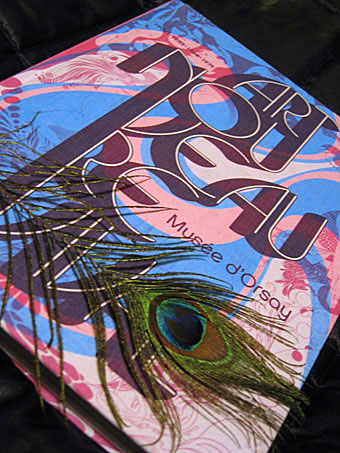
Catalogue for Art Nouveau Revival 1900 . 1933 . 1966 . 1974. Peacock feather not included.

Regular readers may recall my mention of the Musée d’Orsay exhibition Art Nouveau Revival which was launched late last year. I didn’t get to see the exhibition, unfortunately, but this week I finally ordered a copy of the catalogue, an expensive cloth-bound volume with essays (in French) by Philippe Thiébaut, Stephen Calloway, Irene de Guttry, Thierry Taittinger and Philippe Thieryre. Despite the ruinous postal charges incurred by the book’s weight this was worth every euro, it being the kind of polymorphous production which in solipsistic moments one can choose to believe was created solely for your own benefit.
nouveau3.jpg

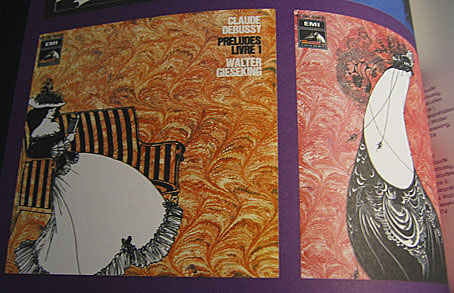
Aubrey again, album covers from 1974.

Much of the subject matter has been explored here in various small ways, with the curators following the influence of Art Nouveau through Surrealism (mainly Dalí) to the psychedelic art of the 1960s and on into the Pop Nouveau (for want of a better term) which flourished in the first half of the 1970s. Among the familiar Aubrey Beardsley graphics and psychedelic posters there are also some pleasantly surprising inclusions, including illustrations by Philippe Jullian (yes, I’m still intending on writing about him at some point), yet more Beardsley album covers, film posters, and even some of the sillier films of the late-60s such as Casino Royale. Being a French exhibition there’s a section devoted to comic strips which includes work by Moebius, Philippe Druillet and Guido Crepax.
nouveau2.jpg

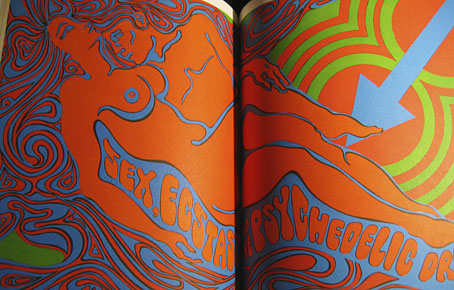
Sex and LSD, a spread from Playboy, 1967.

It’s common to see parallels drawn between the 1890s and the 1960s but the strange blooms of vulgarised fin de siècle style which burgeoned in the wake of psychedelia are seldom given much attention. One of the great things about this catalogue is the amount of ephemera the curators chose to include such as magazine ads and trend-chasing album sleeves. It was precisely this blend of 1890s + 1960s + 1970s I sought to capture in my recent cover for Dodgem Logic. As I said, it’s an expensive book but for anyone drawn to this aesthetic hothouse it’s also an essential purchase. Art Nouveau Revival can be ordered direct from the museum shop. Further samples follow.
Continue reading “The Art Nouveau dance goes on forever”

Weekend links 26

library.jpg

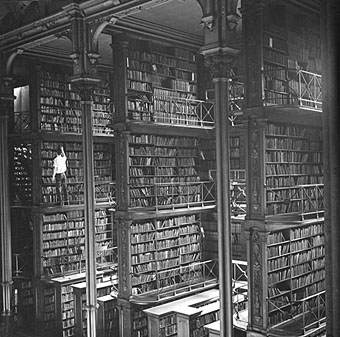
The interior of the Public Library of Cincinnati and Hamilton County “Old Main” Building, 1874. Reblogged over the past few days on numerous Tumblr postings, none of whom had bothered to find out any details about the picture. I’m with Silent Porn Star on the contextless reblogging issue.

Keith Richards et Mick Jagger à Londres, TV interviews with the Glimmer Twins from 1968 with some remarkable footage in the second half of Jagger filming the penultimate shot of Performance. That French video site requires further exploration. Also there is a short film from 1961 with Jacques Lasry demonstrating the Cristal Baschet. Related: Jacques Doyen & Jacques Lasry play their Cristals while Arlette Thomas and others read French poetry. I wrote something about the mystery of the Cristal two years ago this week.

• Two great album cover blogs from Jive Time Records: Project Thirty-Three is “a shrine to circles, dots, squares, rectangles and triangles, and the designers that make them come to life on album covers” while Groove Is In The Art “celebrates the era when psychedelic graphics and pop art met the mainstream”.

• At A Journey Round My Skull: Night Hallucinations: illustrations by Jaroslav Šerých for Tales of the Uncanny (Prague, 1976); Snark, Strangeness and Charm, Mahendra Singh’s illustrations for Lewis Carroll and others.

chaves.jpg

Laurence Chaves illustrates De Quincey’s Confessions of an English Opium-Eater at Golden Age Comic Book Stories.

Austin Osman Spare: Fallen Visionary at the Cuming Museum, Southwark, London in September, “will be the largest showcase of [Spare’s] work in a public museum since his death in 1956.” Jerusalem Press are publishing an expensive monograph to accompany the exhibition.

Freeing “Pale Fire” From Pale Fire; “the next big Nabokov controversy”. Probably not but the thesis is an interesting one.

Quintessential ‘topiary’ in Gandalf’s Garden: Barney Bubbles, head shops and Op Art graphic design.

• Monster Brains discovered some more paintings by Thomas Häfner.

• Spaceweather’s Northern Lights gallery.

The passion of Krzysztof Penderecki.

• More Bookshelf porn.

White peacocks.

Sussan Deyhim: Daylaman | Desert Equations (for Brion Gysin) (with Richard Horowitz) | An interview at WorldStreams.

Several links this week via Adrian Shaughnessy’s Twitter feed. Thanks!

Dalí’s Elephant

burman.jpg

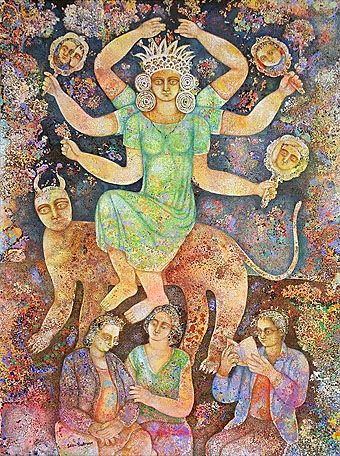
Madhav Reading Stories of Devi (2007) by Sakti Burman.

Dalí’s Elephant is a group exhibition at London’s Aicon Gallery that “traces the echoes of Surrealism in modern and contemporary art from the Indian Subcontinent.” The exhibition title refers to the gift ashtray which Salvador Dalí designed for Air India in 1967:

In 1967 Air India commissioned Salvador Dali to produce a limited edition ashtray which was to be given to a select group of lucky first-class passengers. Dali produced a small unglazed porcelain ashtray composed of a shell-shaped centre with a serpent around its perimeter. This was supported by three stands, two of which point in the same direction and resemble an elephant’s head. The third stand was inverted so that it resembled swan’s head. Dali was initially paid no more than a few hundred dollars for his design but when they received the design the airline bosses were so delighted that they made Dali the surprise gift of an elephant. Dali lived with the elephant for a few days at his Portligat home before donating the beast to the local zoo. (More.)

The Surrealist element is very much a trace in some of the works which seems surprising given the distinctive heritage of India’s religious imagery, as was demonstrated recently at A Journey Round My Skull. But I like the Sakti Burman paintings, especially the example shown here. Dalí’s Elephant runs to September 4th, 2010.

Previously on { feuilleton }
Marsi Paribatra: the Royal Surrealist
Dalí in Wonderland
Bollywood posters
Impressions de la Haute Mongolie revisited
Dalí and Film
The persistence of DNA
Salvador Dalí’s apocalyptic happening
Dalí Atomicus
Impressions de la Haute Mongolie

Weekend links 24

early.jpg

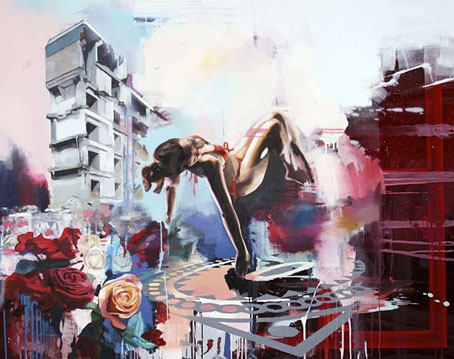
Delta-Wing (2009) by Chloe Early.

• “Feted British authors are limited, arrogant and self-satisfied, says leading academic”. Stating the bleeding obvious but it still needs to be said, apparently, especially when the announcement of the Booker list this year caused the usual confusion when Amis Jr. and McEwan weren’t included, as though the mere existence of their novels makes them prize-worthy. And as someone pointed out, the word “male” is missing from that headline.

Hero of Comic-Book World Gets Real: Alan Moore again, in the NYT this time. Related: a review of Unearthing live.

• Announcing The Hanky Code by Brian Borland & Stephen S Mills, a 40-poem book to be published next year by Lethe Press. For an explanation of the Hanky Code there’s this, and there’s also an iPhone app.

Folk—the ‘music of the people’—is now hip again, says (who else?) Rob Young who can also be heard on the archived podcast here. Related: the folk roots of Bagpuss. Related to the latter: The Mouse Mill.

zvorykin.jpg

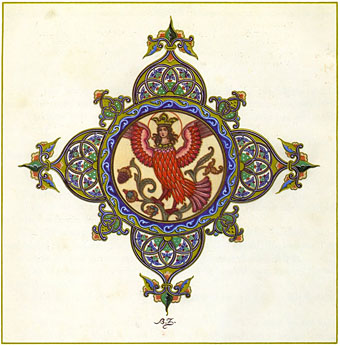
An endpiece from The Firebird and other Russian Fairy Tales by Boris Zvorykin.

‘Yes’ to Catastrophe: Roger Dean, Prog and SF. A lengthy and thoughtful analysis of Roger Dean’s early work.

Into the Media Web, the enormous Michael Moorcock book which I designed, is officially published this week.

Cassette playa: in praise of tapes. I’ve complained about tapes in the past but people continue to find them useful. Some technologies die harder than others.

Boy BANG Boy: “Quiet moments made suddenly very loud with the attitude and opinion of what it means to be a young male in an impossibly diverse world.” An exhibition opening at Eastgallery, London, on August 5th.

Empty your heart of its mortal dream: Alfred Kubin’s extraordinary novel, The Other Side.

Ghostly and Boym Partners devise a new way to deliver digital music.

Besti-mix #27: a great selection by producer Adrian Sherwood.

Agnostics are troublemakers. Amen to that.

• RIP Harry Beckett.

Acousmata.

Let Us Go In To The House Of The Lord by Pharoah Sanders (live, 1971): Part 1 | Part 2

Schloss Falkenstein

falkenstein.jpg

Proposal for Schloss Falkenstein (c. 1883).

A slight return to Ludwig II. Schloss Falkenstein would have been another beetling edifice in the manner of Schloss Neuschwanstein had it ever been built, and judging by this view it might have been even more grandiose. The painting is one of the proposals by stage designer Christian Jank whose plans had already been used for Neuschwanstein. Philippe Jullian makes some scathing remarks about the Gothic interior of the earlier castle but he may have had more patience for the Byzantine interiors planned for Falkenstein. I’m not sure how these would be reconciled with Jank’s exterior, however, the style being Gothic enough to satisfy Viollet-le-Duc. Ludwig’s untimely death in 1886 drew a line under his architectural schemes but Bavaria’s loss eventually became Walt Disney’s gain as Jank’s fantasias provided the inspiration for the castle in Sleeping Beauty (1959) and all of the Disney theme park castles. What Ludwig would have made of this we can only guess. I suspect he’d be entranced by the fantasy but appalled by the vulgarisation. He was an elitist, after all, and the castles were always for him alone, not hordes of T-shirted proles.

Previously on { feuilleton }
Schloss Linderhof
Schloss Neuschwanstein
Pite’s West End folly
Viollet-le-Duc