Weekend links 50

selski1.jpg

Invisible Light by Margo Selski.

The Glass Garage Fine Art Gallery has an online collection of paintings by Margo Selski, many of which feature her cross-dressing son, Theo. Coilhouse profiled artist and model earlier in the week. Some of these paintings mix oil with beeswax which is something I’ve not come across before.

• The Periwinkle Journal‘s first issue will be available online, free, from March 22nd until mid-June, featuring work by filmmaker and artist Hans Scheirl (Dandy Dust), artwork and collages by Genesis Breyer P-Orridge, a 7-page colour comic by Mavado Charon, artwork by Timothy Cummings, artwork and installations by Cody Chritcheloe/SSION, photos by Megan Mantia, Science-Heroes by Peter Max Lawrence, an illustration portfolio by Diego Gómez, selections from the queer photography pool on Flickr, reviews and other stuff. More later.

• The Quietus wanted to remind us that this year is the 25th anniversary of the NME‘s C86 compilation tape, a collection that sought to capture a moment of ferment but which inadvertently inspired too much dreary sub-Velvet Underground pop. I’d rather celebrate the 30th anniversary of the NME‘s C81 compilation, a far more diverse collection and musically superior. If you want to judge for yourself, both tapes can be downloaded here.

selski2.jpg

Machine in the Garden — Our Island Shall Know Abundance Without End by Margo Selski.

• Rick Poynor continues his exploration of Ballardian graphics with a piece about the paintings of Peter Klasen. Related: Where Will It End? JG Ballard interviewed by V. Vale & introduced by Michael Moorcock (Arthur No. 15/March 2005).

In his autobiography, Miracles of Life, JG Ballard suggested that illustrated versions of The Arabian Nights helped prepare him for surrealism.

Robert Irwin, author of The Arabian Nightmare, on the illustrators of The Arabian Nights.

• Another Coulthart cult movie surfaces, Jerzy Skolimowski’s Deep End (1970), out of circulation for many years but newly restored by the BFI. A re-release is scheduled for May so I’m hoping now that a DVD release will follow soon after.

Thom Ayres’ photostream at Flickr, and more long-exposure photos.

Fuck You, A Magazine of the Arts, number 5, volume 8.

Nicolas Roeg: “I don’t want to be ahead of my time.”

• MetaFilter looks at the films of René Laloux.

• The Eerie covers of Frank Frazetta.

Indie Squid Kid.

Requiem (for String Orchestra) by Toru Takemitsu.
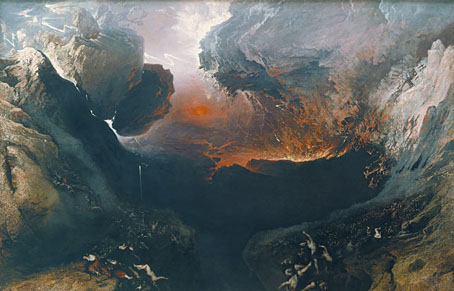
John Martin: Heaven & Hell

martin1.jpg

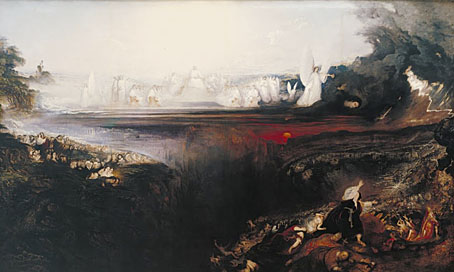
The Great Day of His Wrath (1851) by John Martin.

I’ve written on a couple of occasions about having been a precocious youth when it came to art appreciation. My first visit to the Tate Gallery (now Tate Britain) when I was 13 was of my own volition during one of our annual school visits to London. I wanted to see Modern Art (capital M and capital A), and especially my favourite Surrealist and Pop artists. Those works were present, of course, and it was a thrill to discover artists I hadn’t heard of such as Brâncusi and Moholy-Nagy, but the greatest shock came in the room reserved for the enormous canvases filled with apocalyptic scenes by Francis Danby and John Martin.

martin2.jpg

The Last Judgement (1853) by John Martin.

Some of these paintings have become more visible over the years, especially Martin’s startling chef-d’oeuvre, The Great Day of His Wrath, which has found a new lease of life decorating various music releases. Yet for a long time these works were never seen in art histories, being dismissed as a kind of religious kitsch, interesting perhaps for their Romantic connections (he also depicted scenes from Milton and Byron) but with Martin regarded as deeply inferior compared to his contemporary JMW Turner. If you only look at painting as being about the surface of the canvas then Martin is inferior to Turner whose nebulous works contain the seeds of Impressionism and much 20th century art. But there’s more to art than the surface. What I saw was an astonishing audacity—this artist had dared to paint the end of the world!—and three deeply strange paintings, two of which feature deliberately confused perspectives which are almost Surrealist in their effect and quite unlike any other work produced in the 19th century.

martin3.jpg

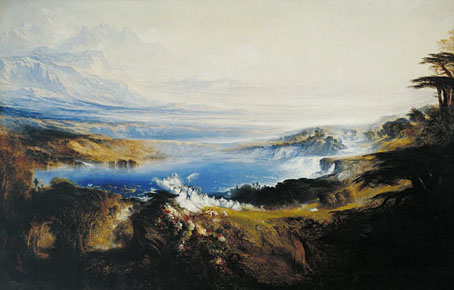
The Plains of Heaven (1851) by John Martin.

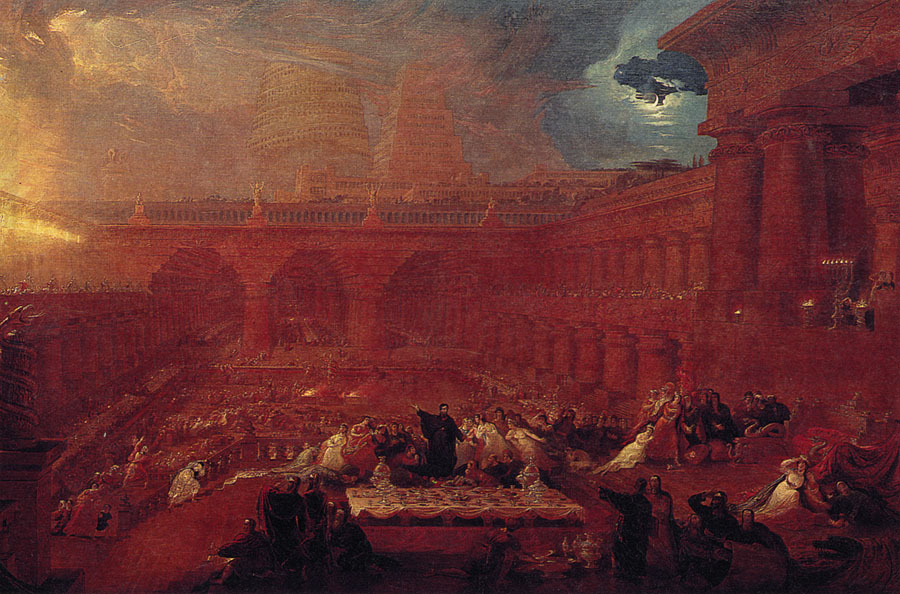
Well things change, not least critical opinion, and with the emergence in recent years of (for want of a better term) Pop Surrealism, and also the current vogue for crappy disaster movies and apocalyptic chatter, Martin’s paintings have been deemed interesting enough to warrant an exhibition at the Laing Art Gallery, Newcastle, which has been the permanent home of other Martin works for many years. The show will run there until June then travel to Sheffield (where I may pay it a visit) and Tate Britain. Of note for Martin enthusiasts will be the emergence from a private collection of the vast and lurid Belshazzar’s Feast, the painting which inspired some of the set designs in DW Griffith’s Intolerance. I once read that if the insanely huge banqueting hall in that picture had been a real construction it would have extended for at least a mile. Visitors to the new exhibition will be able to judge for themselves in close-up. And speaking of close-ups, Google’s Art Project has the three paintings above in their Tate collection; click the pictures for links.

martin4.jpg

Belshazzar’s Feast (1820) by John Martin.

Derided painter John Martin makes a dramatic comeback

Previously on { feuilleton }
Darkness visible
Death from above
The apocalyptic art of Francis Danby

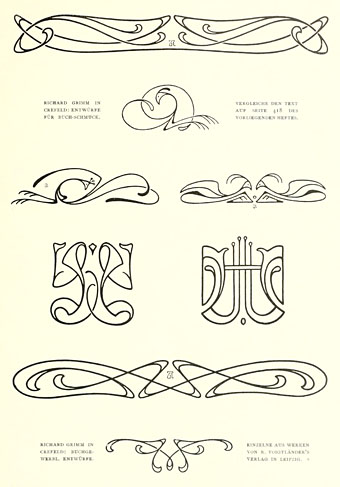
Deutsche Kunst und Dekoration #10: Turin and Vienna

dkd10-18.jpg

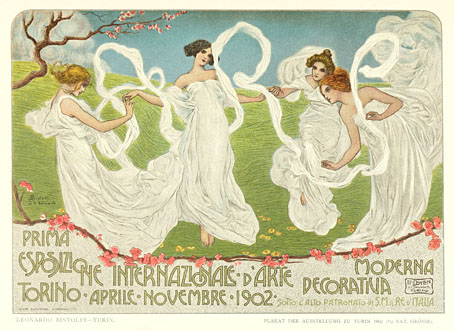
Turin exposition poster by Leonardo Bistolfi.

Part two of a two-part skate through the contents of volume 10 of Deutsche Kunst und Dekoration, the German periodical of art and decoration. In addition to the Heinrich Vogeler feature which was the subject of yesterday’s post, this edition includes articles on the Prima Esposizione Internazionale d’Arte Decorativa Moderna in Turin—another international showcase for the Art Nouveau style—and a feature on the Viennese Secession exhibition of the same year. This latter piece was especially fascinating when seeing such a notable event reported for the first time. There’s more about that below. This volume also includes a piece on the Glasgow Arts and Crafts movement but the photos for that piece are poor quality. As before, anyone wishing to see these samples in greater detail is advised to download the entire volume at the Internet Archive. There’ll be more DK&D next week.

dkd10-19.jpg

A feature on dress design shows some rare examples of Art Nouveau style being applied to clothing.

dkd10-20.jpg

Continue reading “Deutsche Kunst und Dekoration #10: Turin and Vienna”

Deutsche Kunst und Dekoration #9

dkd09-01.jpg

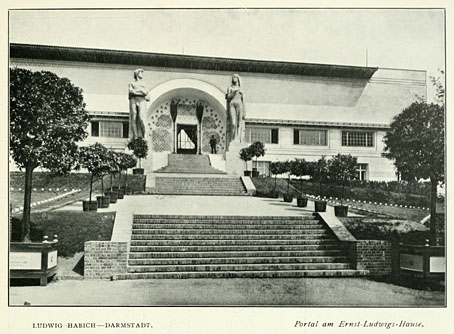
The Ludwig Habich building, Darmstadt.

Continuing the delve into back numbers of Deutsche Kunst und Dekoration, the German periodical of art and decoration. Volume 9 covers the period from October 1901–March 1902. This edition continues the examination of the Darmstadt Artists’ Colony begun in the previous number. Despite the colony being very much an Art Nouveau venture the pictorial content is largely photographic, with many views of the show-homes built by the colony artists. Much of the other content is a disappointment compared to what’s gone before, the featured painters being the conservative types who were crowding Jugend magazine at this period with generic depictions of stolid German farmers. Unlike Jugend, however, this isn’t the end of the line. As usual, anyone wishing to see these samples in greater detail, or the rest of the edition, is advised to download the entire volume at the Internet Archive. There’ll be more DK&D next week.

dkd09-02.jpg

Continue reading “Deutsche Kunst und Dekoration #9”

Weekend links 47

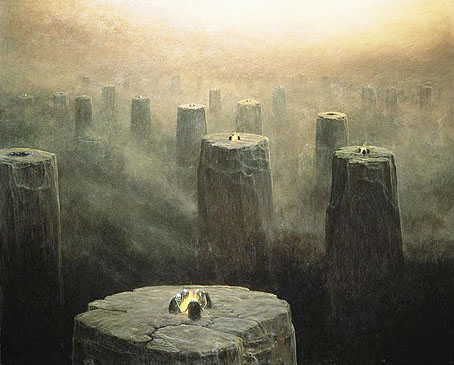
beksinski1.jpg

DG-2499 (1975) by the fantastic (in every sense of the word) Zdzisław Beksiński (1929–2005). See the Dmochowski Gallery for a comprehensive collection of the artist’s work. Thanks to BibliOdyssey for the tip.

• More ICA events: From Animism to Zos: Strange Attractor Salon will be “a series of weekly events, consisting of a talk and a film, exploring some lesser-known intersections of culture, history, mind and nature” running from 10 March–12 May, 2011.

• And on May 10, the London Word Festival presents a Dodgem Logic evening with entertainment provided by contributors to that magazine:

Alan Moore’s reinvigoration of the underground fanzine, Dodgem Logic, comes alive in the non-conformist surroundings of Hackney’s Round Chapel. A night of art, comedy, comment and put-something-back localism. (…) With Robin Ince heading up a colossal stand-up bill, artists Steve Aylett, Savage Pencil, Melinda Gebbie and Kevin O’Neill panel-up to talk about their comic work, while music comes from hyperactive racketeers The Retro Spankees. With an exhibition of artwork from the magazine, and conducted by editor-in-chief Alan Moore.

• Taschen publishes a collection of Dennis Hopper’s photographs this week. The Independent has a small selection here. Also new from Tachen, Alex Steinweiss, The Inventor of the Modern Album Cover.

Bass Notes: The Film Posters of Saul Bass at the Kemistry Gallery, London.

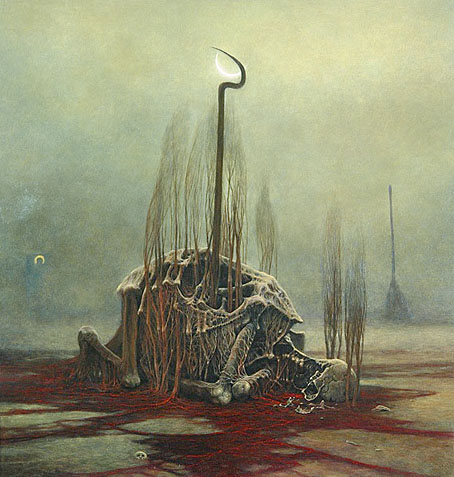
beksinski2.jpg

DG-2507 by Zdzisław Beksiński.

While riding through the bustling streets of London from 1603 to 1621, one was liable to hear the shout “Long live Queen James!” King James I of England and VI of Scotland was so open about his homosexual love affairs that an epigram had been circulated which roused much mirth and nodding of the heads: Rex fuit Elizabeth: nunc est regina Jacobus—”Elizabeth was King: now James is Queen.”

There’s more about the private life of the man who gave his name to the King James Bible here.

Addams and Evil, a Tumblr devoted to the great Charles Addams.

Hannes Bok again at Golden Age Comic Book Stories.

Caravaggio’s crimes exposed in Rome’s police files.

Deserted City, photographs by Kim Høltermand.

• The blue sand dunes of the planet Mars.

• A map of the ghost signs of Chicago.

The movie title stills collection.

The pitfalls of e-book buying.

Life On Mars? (1971) by David Bowie | Uncle Sam’s On Mars (1979) by Hawkwind | Eyes On Mars (1980) by Chrome | Cache Coeur Naif (1997) by Mouse on Mars.