Leonardo’s warrior

leonardo.jpg

Bust of a warrior in profile (c. 1475–80) by Leonardo da Vinci.

A recent interview question reminded me of this splendid Leonardo piece when I was discussing early artistic influences. One crucial influence for me was the example of my mother who’d been an art student during the 1950s specialising in ceramics and textile design. From an early age I was fascinated by her student sketchbooks, and by one drawing in particular, a very careful copy of this work by the young Leonardo. The British Museum has the original, about which they tell us:

The drawing shows Leonardo studying the art of his teacher, Andrea Verrocchio. Giorgio Vasari’s biography of Verrocchio in his Lives of the Artists (1550 and 1568) mentions two metal reliefs with profile portraits of Alexander the Great, leader of the Greeks, and Darius, the Persian king. They were sent by Lorenzo ‘il Magnifico’ (‘the Magnificent’) de’ Medici, ruler of Florence (1469–92), as gifts to the king of Hungary. This drawing is probably based on one of these lost works by Verrocchio.
desmazieres.jpg

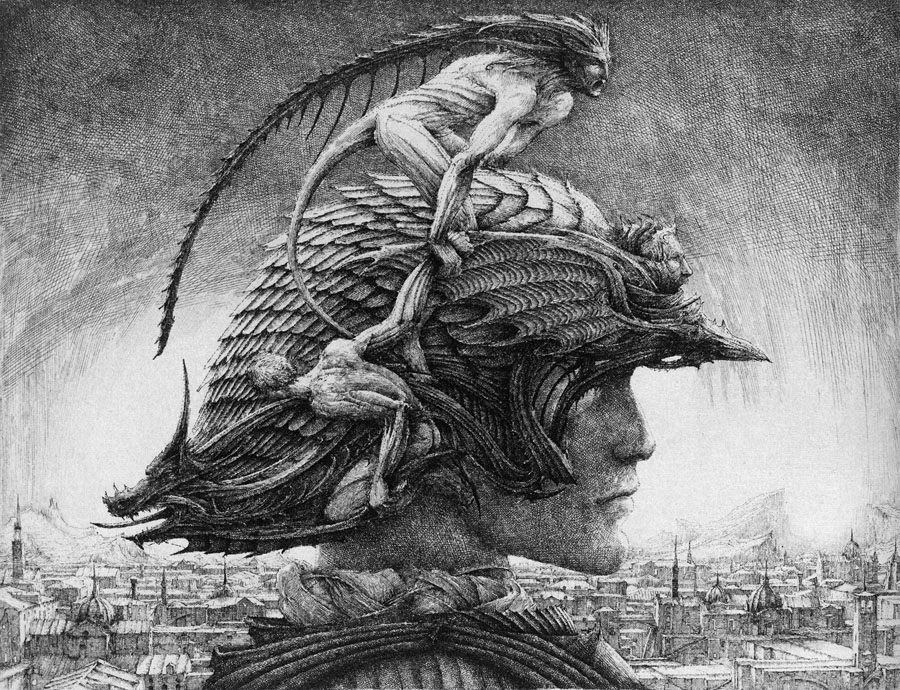
Casque d’apparat (1981) by Erik Desmazières.

Memories of the Leonardo drawing always follow the exaggerated logic of childhood and inflate its splendour and detail; I’d never seen anything like it and for years used to hope that Leonardo had produced many similar works. He hadn’t, of course, so it’s to other artists we have to turn for more of the same. French artist Erik Desmazières has produced a number of etchings depicting elaborately helmeted figures which are perhaps inspired by Leonardo’s warrior. Of the three in Imaginary Places, a 2007 collection of his work, the one above is my favourite. I have a feeling I’ve seen derivations by other artists but nothing is coming to mind. As usual, if anyone knows of further examples, please leave a comment. Elsewhere there’s Leonardo’s Diary (1972), a short film by Jan Švankmajer in which the haughty figure is subject to some typical Švankmajerian distortions.

• See also: Erik Desmazières at the Fitch-Febvrel Gallery.

Previously on { feuilleton }
Les lieux imaginaires d’Erik Desmazières
Jan Švankmajer: The Complete Short Films
The art of Erik Desmazières

Weekend links: fifth anniversary edition

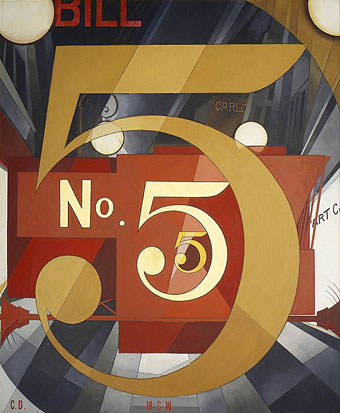
demuth.jpg

The Figure 5 in Gold (1928) by Charles Demuth.

It’s a little surprising to find I’ve been doing this for five whole years yet here we are. Having seen a number of blogs call it quits at the five-year point I should note that I don’t feel quite that exhausted although maintaining a discipline of daily posting can be a chore at times, especially when you’re pressured by work. On the whole the advantages continue to outweigh the disadvantages. Some of the discoveries here have fed back into things I’ve been working on or opened avenues for future exploration. Researching something for an audience (however slight that audience or the resulting post) encourages you to look more deeply into a given subject; sometimes you learn more as a result and occasionally make surprising discoveries. Obsessions are teased out which might otherwise have lain dormant. Yes, it’s an extra bout of work but I’ve spent much of my life saying to people “if you like that, you may like this”, and that’s all many of these posts are doing.

This year promises to be an interesting one so watch this space. And, as always, thanks for reading!

John x

On to the links…

Cathedral Scan translates the architectural plans of Gothic cathedrals into open-ended musical scores via custom software. There’s more at Blake Carrington‘s website.

Forty-three William Burroughs recordings (tape experiments and readings) at the Ubuweb archives.

• The opening scene of Deadlock (1970), an obscure German film with a theme by the mighty Can.

Strange Lands: A Field-Guide to the Celtic Otherworld, a new book by Andrew L Paciorek.

• The enduring nature of Frankenstein, currently on stage at the National Theatre, London.

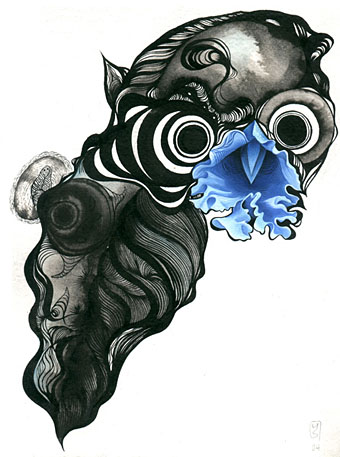
shimojo.jpg

Owl One (2004) by Yuri Shimojo.

¡Activista! by Sonny Smith: Drag Queens, Borders, Rivers, Death and Transformation.

• Estonian sculptor Mati Karmin makes furniture out of Russian anti-submarine mines.

Alan Moore’s contribution to the Save Our Libraries campaign.

• Innsmouth Free Press is raising funds for their running costs.

A history of queer street art (Facebook link, unfortunately).

Illuminated book design for Heston’s Fantastical Feasts.

Physica Sacra, an engraving set at Flickr.

Egypt (1985) by Tuxedomoon | Egyptian Basses (1998) by Coil | Soleil D’Egypte (2001) by Natacha Atlas.

Deutsche Kunst und Dekoration #7

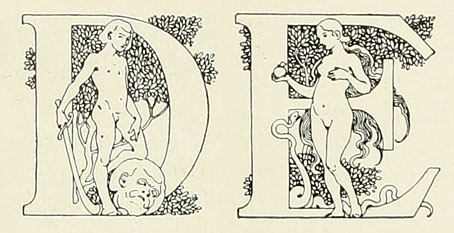
dkd07-01.jpg

Continuing the delve into back numbers of Deutsche Kunst und Dekoration, the German periodical of art and decoration. Volume 7 covers the period from October 1900 to March 1901 and features a set of ornamental capitals throughout this edition designed by Karl Lürtzing, part of a presentation of typefaces in the Art Nouveau style. The figures in Lürtzing’s alphabet all seem to be Biblical or mythological (as with David and Eve above) although some are easier to decipher than others. Volume 6 paid a visit to the Exposition Universelle in Paris and there’s a few more examples from that event here, along with further examinations of the best in German art and design. As usual, anyone wishing to see these samples in greater detail is advised to download the entire volume (which comprises over 300 pages) at the Internet Archive. There’ll be more DK&D next week.

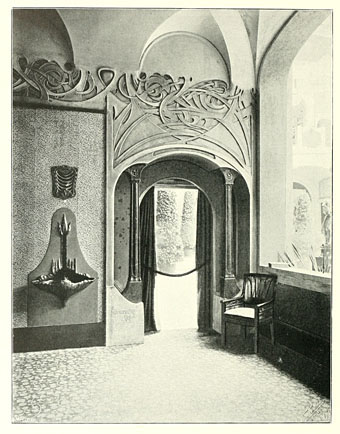
dkd07-02.jpg

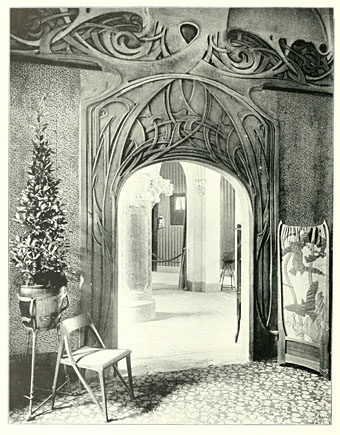
Remarkable interiors by Richard Riemerschmid.

dkd07-03.jpg

Continue reading “Deutsche Kunst und Dekoration #7”

The writhing on the wall

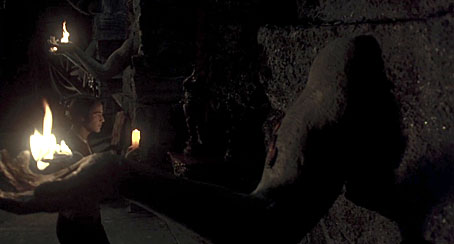
hands9.jpg

Dracula (1992).

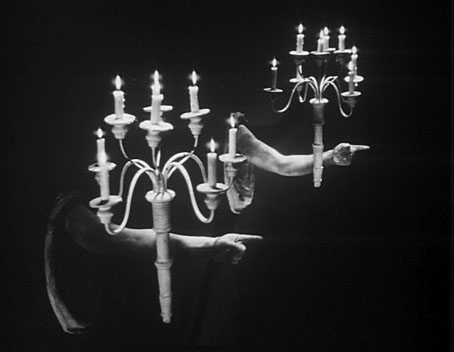
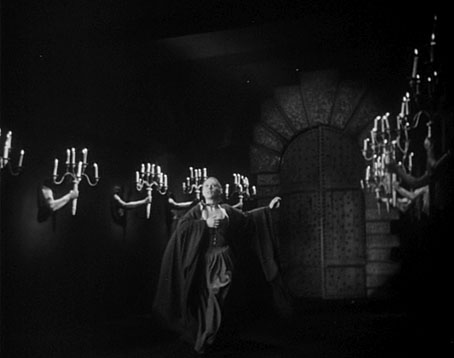
This is the closest you’ll get to a guest post here even though it’s been done remotely and I’ve changed things around a little. Following my mention yesterday of the Cocteau-derived lantern-arms in Francis Coppola’s Dracula, Jescie sent me an abandoned blog post which collected similar examples of the arms-through-the-walls motif. I’ve done this kind of thing here in the past so it’s good {feuilleton} material. Almost all these examples are fantasy- and horror-related which isn’t too surprising, and I’m sure there’ll be other examples in films I haven’t seen. If anyone has any suggestions just remember that hands grasping through doors and windows don’t count with this, it’s through the wall or not at all.

hands1.jpg

La Belle et la Bête (1946).

Jean Cocteau sets things off in 1946, a perfect piece of fairytale Surrealism and one of the many memorable aspects of this film.

hands2.jpg

La Belle et la Bête (1946).

Continue reading “The writhing on the wall”

Symbolist cinema

dracula1.jpg

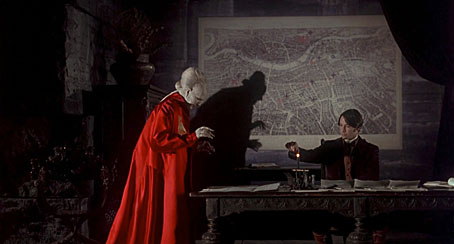
Symbolist? Arguably. Decadent? Certainly. Watching Francis Ford Coppola’s Dracula (1992) again this weekend I thought it worth making note of some of these resonances. The real age of Symbolist cinema was the Silent Era from around 1910 onwards, something I discussed in more detail here. That being so, several films made since can be taken as Symbolist (more usually Decadent) productions even if this was never their original intention. Kenneth Anger‘s Magic Lantern Cycle comes immediately to mind, so too Sergei Parajanov’s The Colour of Pomegranates.

dracula3.jpg

Bram Stoker’s novel was published in 1897 at the ebbing of the fin de siècle but vampires and vampirism were already recurrent Symbolist themes. Aesthetic magus Walter Pater wrote of the Mona Lisa in 1893, “She is older than the rocks among which she sits; like the vampire, she has been dead many times, and learned the secrets of the grave…” Dracula almost demands a Symbolist interpretation, and for now Coppola’s production is the closest we get. I’ve found this makes the film more satisfying in a way: you can ignore the shoddy performances by secondary characters and concentrate on the decor and details (and the tremendous score by Wojciech Kilar). Some of the following screen grabs argue my point.

dracula2.jpg

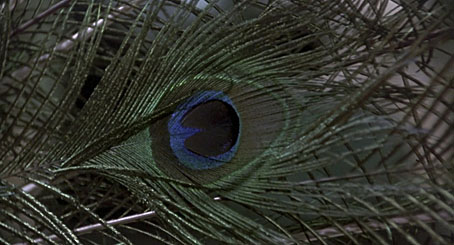
Oh look, peacock feathers. I loved the artificiality of this film, the excessive palette, the obvious models and miniatures, the layering of images. The dissolve from a peacock feather to Jonathan Harker’s infernal train journey is a great moment.

Continue reading “Symbolist cinema”