Manuel Orazi’s Fleurs du Mal

orazi01.jpg

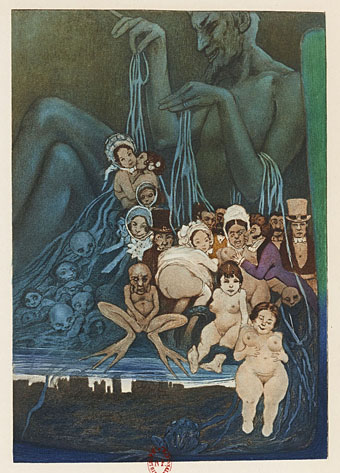
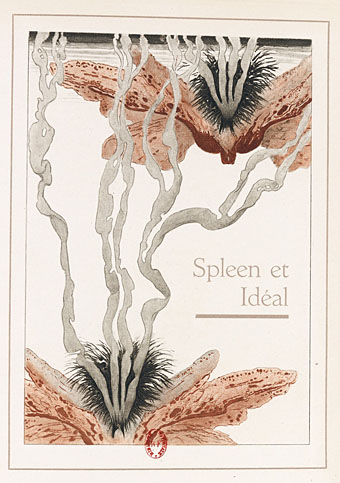
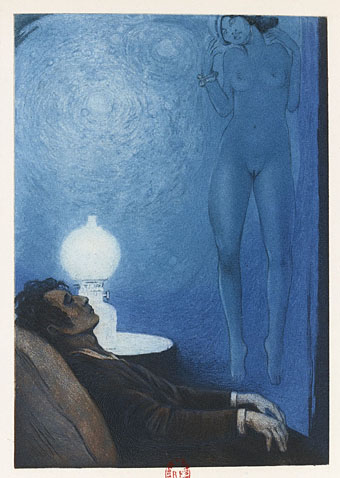
This collection of Baudelaire’s poems with illustrations by French artist Manuel Orazi (1860–1934) didn’t turn up when I was searching for illustrated editions a few years ago. With over 50 full-page drawings or vignettes it’s more profusely illustrated than most. It’s also more determinedly erotic than most, concentrating on depictions of female flesh at the expense of the poet’s other themes; Orazi’s fleurs on the title pages are a succession of priapic or vaginal orchids and fungi. The book was published in 1934, which means it was probably the last thing that Orazi worked on, but it resembles something from the fin de siècle, especially the work of Félicien Rops. Browse it or download it here.

orazi02.jpg

orazi03.jpg

orazi04.jpg

orazi05.jpg

Continue reading “Manuel Orazi’s Fleurs du Mal”

Rooms with a paranormal view

room1.jpg

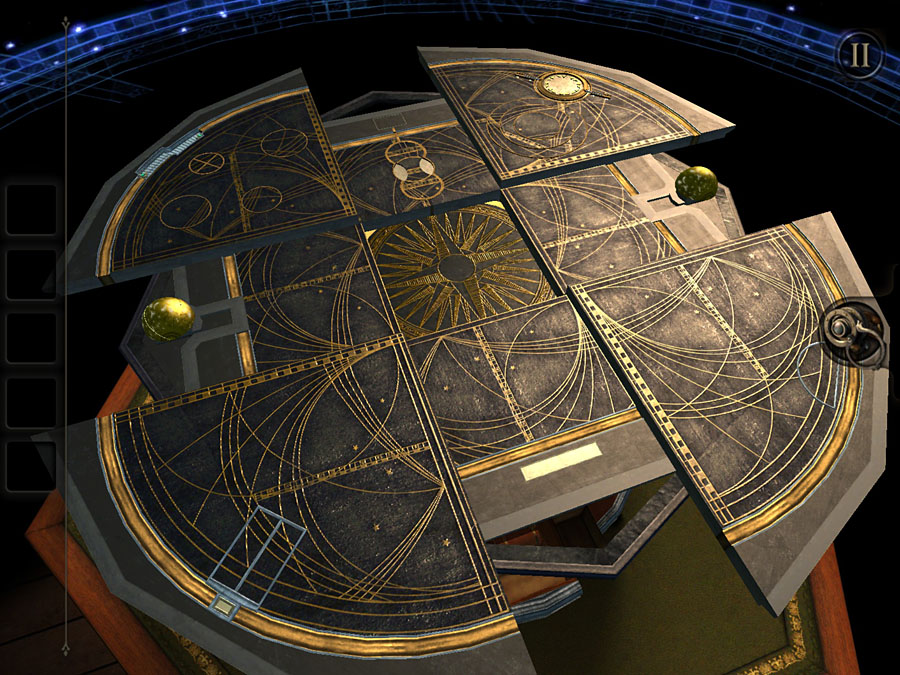
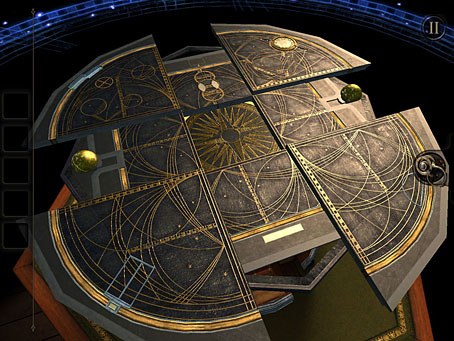
The Room: the cosmic tabletop.

A few words of praise for the Room series from Fireproof Games. I don’t play many computer games, and I think this may be my first post dedicated to such a thing, but I maintain an interest in the medium. The Room and its sequels only came to my attention a couple of weeks ago when I was wondering if there was anything Myst-like available for the tablet. I never got to play the original Myst but enjoyed its follow up, Riven, although the enjoyment was mostly for the graphics, the music and the island environments. The game itself was less satisfying, requiring pen and paper to keep track of its complexities, and involving a great deal of fruitless journeying from one location to another in the search for new clues.
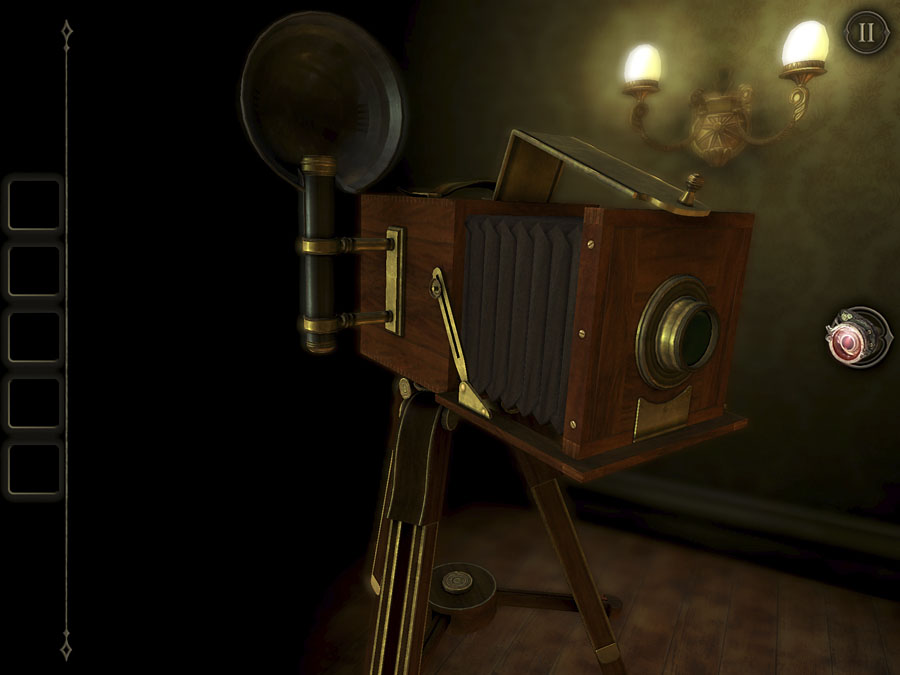
room2.jpg

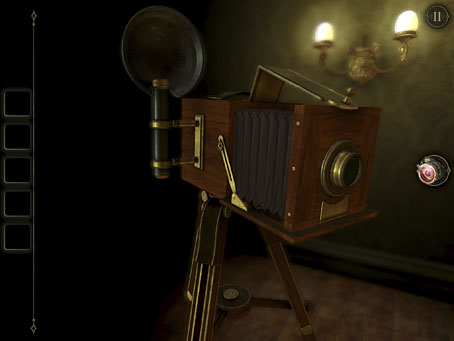
The Room 2: the camera.

The Room follows the template established by Myst in presenting you with a number of mechanical artefacts, all of which have to be examined and opened or operated before you can proceed to the next stage. The dominant aesthetic is 19th-century-mechanical—there’s a lot of wood and brass to these devices—but to call it steampunk would be a mistake; there’s little steam involved, and most of the cogs are kept inside their cases. There is a hint of Jules Verne, however, in the notes from an absent inventor whose initials, “A.S.”, may be a nod to Journey to the Centre of the Earth. As the title suggests, the location is a single room, while in the sequels, The Room 2 and The Room 3, you’re presented with a series of connected spaces. The third installment is the closest to the original Myst with a central hub that leads to other areas of a rambling complex of buildings, not all of which are revealed at the outset. The main structure is based on William Beckford’s Fonthill Abbey which pushes things into Gothic territory even without the developments outlined below.
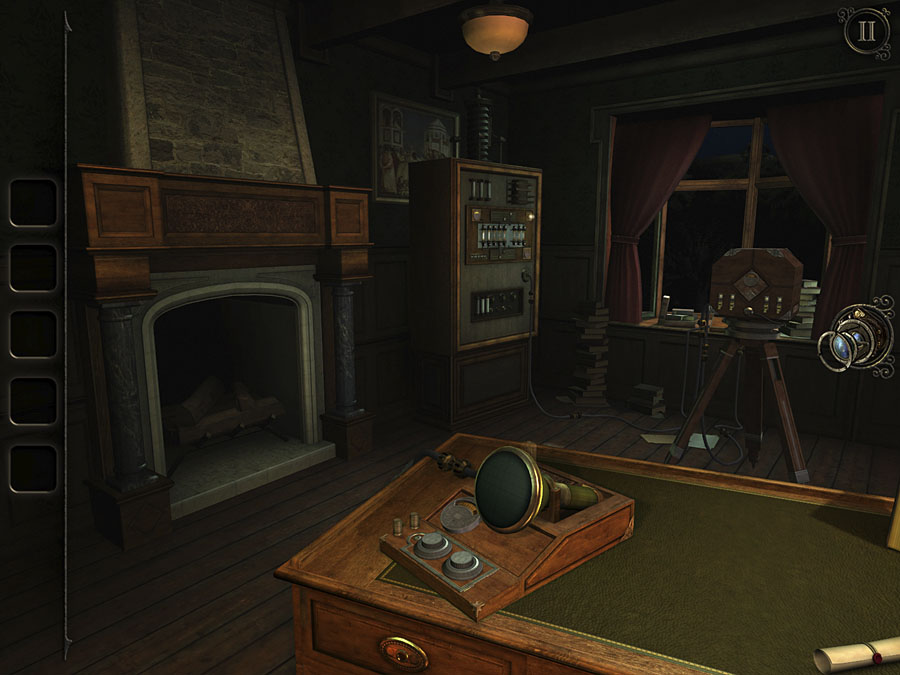
room3.jpg

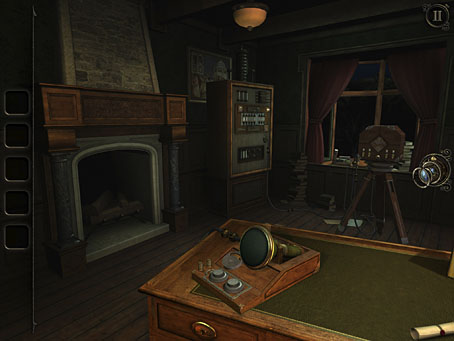
The Room 3: the oscilloscope is one of several which need to be powered up and manipulated in order to open the Null portals.

The MacGuffin for all the games is a new element, the Null, whose discovery and potential obsesses the creators of the games’ devices, and whose manipulation of space creates many of the portals that lead to new rooms. As the series progresses, the Null becomes a growing menace that leads to full-on cosmic horror, with oil-slick Tentacles From Beyond writhing around the interdimensional portals you have to travel through. This development was surprising and, for this player, very welcome, turning the games from a series of eleborate puzzles into something much more sinister. The aesthetic evolves accordingly, with an increasing profusion of occult sigils and pentacles, and, in The Room 2, Tarot cards and séance devices. (Fireproof have a set of their Tarot designs available as a free download.) In the second game there’s a further requirement to piece together mundane machines—a camera or a typewriter, say—before they will function properly. This process reaches a peak in The Room 3 where you’re faced with a succession of increasingly complex tasks, from woodworking and metal forging to electro-mechanical engineering and astronomy. As with the Myst universe, there are no monsters here (although there is the occasional ghost), nothing needs to be fought with weapons, it’s just you, a room full of objects and a continual background murmur of unnerving whispers and distant sounds. The gameplay in The Room 3 is sufficiently non-linear to lead to a variety of different endings, not all of which may be survivable. I managed to escape the Tentacles From Beyond when they finally destroyed the house but I also missed finding an important artefact. I’ll be returning, wiser and, I hope, more attentive to the half-hidden details.
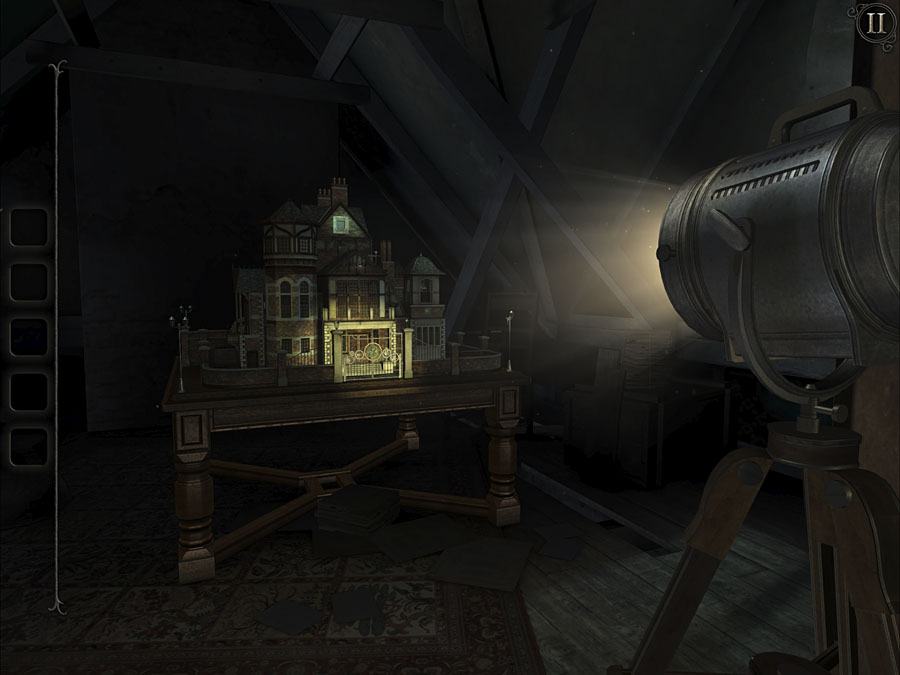
room4.jpg

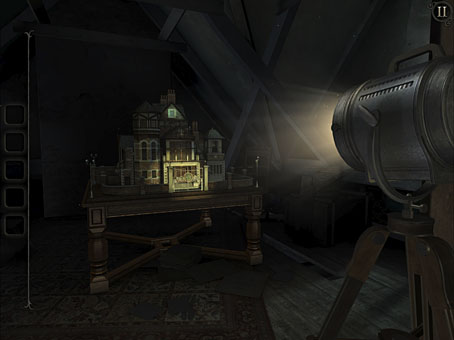
The Room—Old Sins: the haunted doll’s house as seen at the beginning of the game.

I’m currently playing the fourth game in the series, Old Sins, which returns you to a single room but plays with scale via a large doll’s house. The exterior of the building is all detailed model work, while the interiors—accessed through Null physics—are scaled-down replicas of the rooms in a house where another Null investigator and his wife have gone missing. It’s not clear yet whether the attic where the toy house is stored is also the attic of the real house the model is based upon but having dealt with a similar model in The Room 3 this seems likely.

While I enjoyed the surface details of Riven I was never very interested in the fantasy background of the Myst universe. The Room series is much closer to my own core preoccupations, a beguiling blend of antique technology with borderline occultism and those Tentacles From Beyond, a scenario that wouldn’t be out of place in an issue of Weird Tales. Just the thing for the darkening days of October.
Weekend links 538

greenaway.jpg

The Elf Ring by Kate Greenaway.

• “Is it possible that the Victorian fairy tradition, beneath its innocent exterior, operated as a conduit for a hidden tradition of psychedelic knowledge?” Just in time for the British mushroom season, Mike Jay explores the connections between psychedelic mushrooms, folklore and fairy tales.

• “This second coming of Prince’s greatest album is the immaculate execution of a flawed conception: the belief that you can never have too much of a good thing.” Simon Reynolds on Prince and the expanded, multi-disc reissue of Sign O’ The Times.

• “An extraordinary stash of more than 400 erotic drawings by Duncan Grant that was long thought to have been destroyed has come to light, secretly passed down over decades from friend to friend and lover to lover.” Mark Brown on a trove of gay erotica.

• New art exhibitions: Wessel + O’Connor celebrates 35 years of homoerotic exhibitionism with 35 works by different artists; “masks a must”. And New Framing at Museum More includes a great painting by Jan Ouwersloot of trams manoeuvring at night.

• There is no Prog, only Zeuhl: A guide to one of rock’s most imaginative subgenres by Jim Allen. I recommend the Weidorje album.

The Power (Of Their Knowledge), another preview of the forthcoming album by Cabaret Voltaire (or Richard Kirk solo).

• RIP Eddie Van Halen. Annie Zaleski selects 10 of his best songs (really 9 plus an instrumental…).

• At Dennis Cooper’s: Spotlight on…Leonora Carrington The Hearing Trumpet (1976).

• Mix of the week: Autumn and Wise (The Fall) by The Ephemeral Man.

Abandoned Isle of Wight

Dark Side Of The Mushroom (1967) by Chocolate Watch Band | Mushroom (1971) by Can | Growing Mushrooms Of Potency (2011) by Expo ’70

Alphonse Mucha et Son Oeuvre

mucha01.jpg

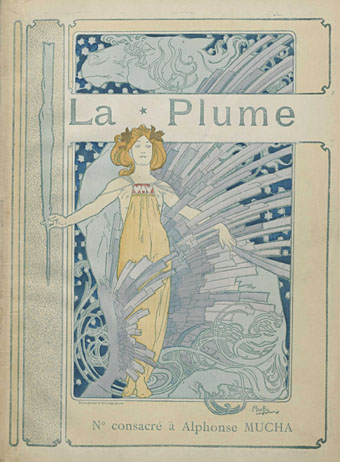
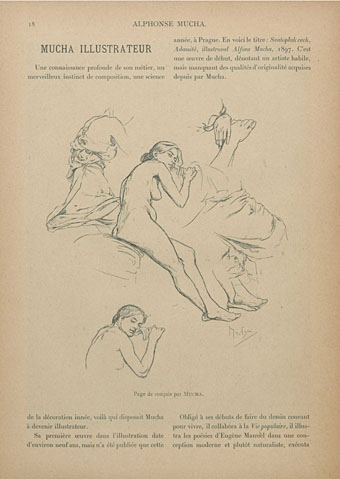
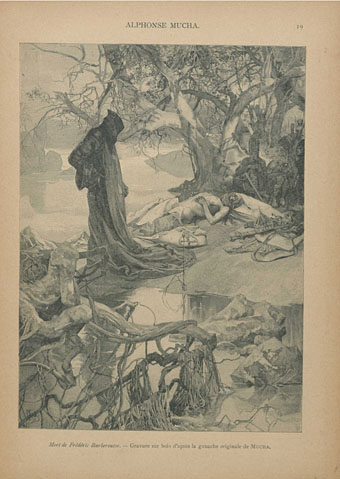
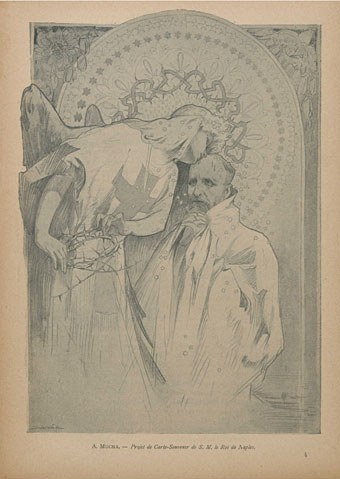
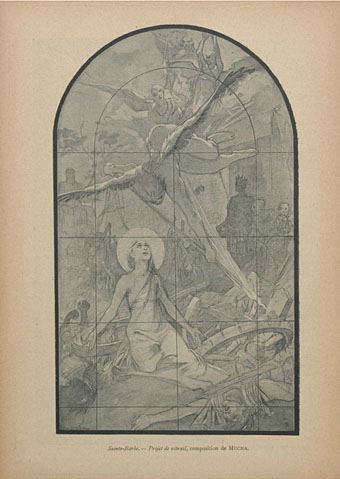
Alphonse Mucha was so wildly prolific, and his work maintained such a consistently high standard, that book collections tend to focus on the popular Art Nouveau prints and posters to the exclusion of everything else. This short study of Mucha’s career was published in 1897 when the Nouveau style was becoming a dominant trend in Continental Europe, thanks in part to the promotion of art journals like La Plume, as well as to Mucha himself. The reproductions are all monochrome halftones but they include many sketches, illustrations and smaller works that are either never seen elsewhere or are marginalised by his advertising graphics and the designs for Sarah Bernhardt. Browse the book here or download it here.

mucha02.jpg

mucha03.jpg

mucha04.jpg

mucha05.jpg

Continue reading “Alphonse Mucha et Son Oeuvre”

Weekend links 537

clarke.jpg

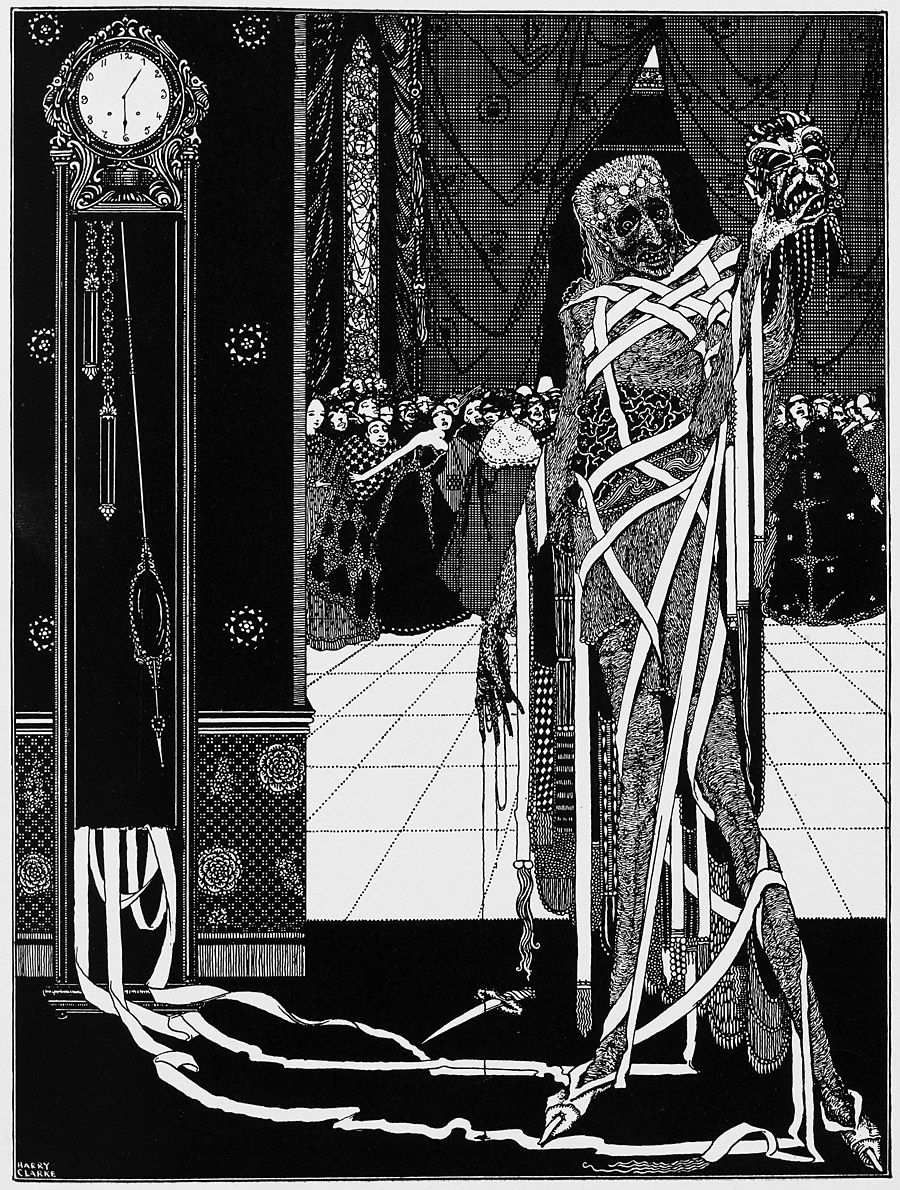
“The dagger dropped gleaming upon the sable carpet.” The Masque of the Red Death illustrated by Harry Clarke, 1919.

• 2020 is the year of enormous pink lady faces on book covers, apparently. As someone who spends little time following cover trends, the identification of a new variety of herd behaviour among designers or their art directors is always fascinating and bizarre.

Tomoko Sauvage plays her porcelain and glass instruments inside a disused water tank in Berlin for a new album, Fischgeist. The Wire has previews.

• At The Paris Review: Craig Morgan Teicher on the later work of Dorothea Tanning, and Daniel Mendelsohn on the rings of Sebald.

Unlike many of the rapidly forgotten [Nobel] “winners”, and despite the occasional sniffy critic wondering “who still reads it?” Durrell’s Alexandria Quartet has never been out of print since he published it in 1957. The centenary of his birth in 2012 raised a flurry of revived interest in Durrell. Indeed the whole Durrell family has been popping up regularly in reprints of Lawrence’s novels and poetry, in his brother Gerald’s popular tales of his “family and other animals,” and in several TV series about their life in Greece on Corfu island in the late 1930s. A BBC interviewer once asked Lawrence about the difference between his writing and brother Gerald’s. He replied: “I write literature. My brother writes books that people read.”

I’ve read Gerald and I’ve read Lawrence; I prefer Lawrence, thank you. Thomas O’Dwyer examines the chef d’oeuvre of the elder Durrell, The Alexandria Quartet

• Dark Entries shares Patrick Cowley’s cover of Chameleon by Herbie Hancock. The original is here.

• Saunas, sex clubs and street fights: how Sunil Gupta captured global gay life.

• Inside the Grace Jones exhibition at Nottingham Contemporary.

Rob Walker on how dub reggae’s beats conquered 70s Britain.

• Who invented the newspaper? John Boardley reports.

Spread The Virus (1981) by Cabaret Voltaire | Cut Virus (2003) by Bill Laswell | The Unexclusive Virus ~even our invincible religion “Technology” cannnot~ (2006) by Kashiwa Daisuke