Weekend links 180

andrew.jpg

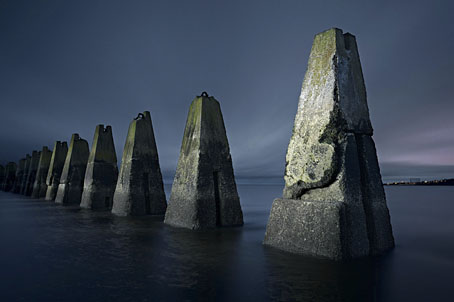
One of Jonathan Andrew‘s photos of coastal bunkers and concrete defences from the Second World War. In 2006 JG Ballard looked at the way these structures embody the functional nature of Modernist architecture.

• “Utamaro, whose prints of famous courtesans were regarded as the very models of sober beauty by 19th-century Western collectors, in fact produced more Shunga books and albums than non-erotic works.” Adrian Hamilton on the Shunga: Sex and Pleasure in Japanese Art exhibition.

• “…in Samoa, as in many traditional cultures around the world, androphilic males occupy a special transgendered category.” Alice Dreger on gay male couples and evolution.

• Robert Fuest’s film of Michael Moorcock’s first Jerry Cornelius novel, The Final Programme (1973), is out on (Region 2) DVD this month.

Masked by reticence and cloaked in tweeds, [Herbert] Read was the unexpectedly ardent and frighteningly prolific champion of nearly everything that was radical in the first half of the twentieth century: Imagism, Surrealism, abstraction, the Bauhaus, Marxism, anarchism, Freud and Jung, progressive education, Gandhian nonviolent resistance. Though now somewhat dimly remembered, he was, for decades, the Victoria Station of the arts, England’s primary explainer of the modern.

Eliot Weinberger introduces Herbert Read’s strange fantasy novel, The Green Child (1935).

• KW Jeter’s steampunk novel Fiendish Schemes is published (with my cover art) by Tor on the 15th. There’s an extract here.

• Mix of the week: An early Halloween mix (and interview) from Joseph Stannard of The Outer Church.

• At Dangerous Minds: Codex Seraphinianus: A New Edition of the Strangest Book in the World.

A trailer for the forthcoming Blu-ray release of Murnau’s Nosferatu: A Symphony of Horror.

• Kenneth Halliwell: lover, killer… artist? Philip Hoare on the collages of Joe Orton’s partner.

• Clive Hicks-Jenkins looks back at Cocteau’s La Belle et la Bête here, here and here.

Anastasia Ivanova‘s photo portraits of lesbian couples in Russia.

Christopher Fox on electronic music’s sound of futures past.

• At Strange Flowers: Melchior Lechter’s book designs.

Vaughan Oliver‘s favourite 4AD album covers.

Swinging Sixties Japanese film posters.

John Foxx’s favourite albums

Beauty And The Beast (1977) by David Bowie | Slow Motion (1978) by Ultravox | I Am The Green Child (2000) by Coil
Weekend links 179

tomaselli.jpg

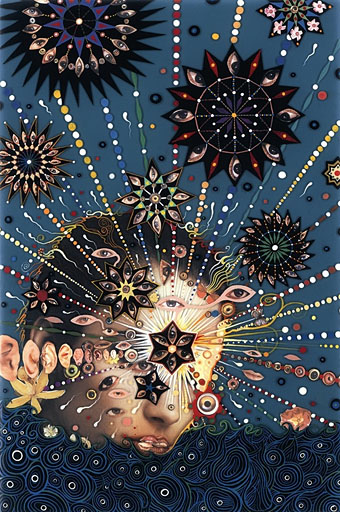
Summer Swell (2007) by Fred Tomaselli. The artist is interviewed at AnOther.

• Mixes of the week for the season of mists and mellow fruitfulness: Forever Autumn Mixtape by The Outer Church, and celebrating what would have been Trish Keenan’s 45th birthday: Trish’s Toys & Techniques Birthday Tape (with cover art by Julian House).

Jirí Kolár: His Life, Work and Cultural Significance to the Czech Republic. Leah Cowan looks into the life and work of this influential Czech artist. Related: Jirí Kolár: poet and collage artist, and collages, rollages and prollages by Jirí Kolár.

• “Name any well-known poet from any age, any country. He or she wrote at least one poem about death, most likely several poems.” Russ Kick introduces his new book, Death Poems.

[M]any pictures in the splendid exhibition at the British Museum show men having sex with men. One of the earliest erotic handscrolls, from the 15th century, shows a Buddhist priest casting longing glances at his young acolyte. Indeed, among some samurai, male love was considered superior to the heterosexual kind. Women were necessary to produce children, but male love was purer, more refined.

The question is why were Japanese – compared not just with Europeans, but other Asians, too – so much more open to depicting sex? One reason might be found in the nature of Japanese religion. The oldest native ritual tradition, Shinto, was, like most ancient cults, a form of nature worship, to do with fertility, mother goddesses, and so forth. This sometimes took the form of worshipping genitals, male as well as female.

Ian Buruma on The joy of art: why Japan embraced sex with a passion. Shunga: Sex and Pleasure in Japanese Art is a forthcoming exhibition at the British Museum.

Harold Offeh on how the cosmic life and music of Sun Ra inspired the artwork decorating the Bethnal Green, Notting Hill Gate and Ladbroke Grove Tube stations in London.

• Fearful symmetry: Roger Penrose’s tiling by Philip Ball. Related: Penrose Tiles Visualizer, and lots more Penrose tiling links at The Geometry Junkyard.

Masculine / Masculine. The Nude Man in Art from 1800 to the Present Day, a new exhibition at the Musée d’Orsay.

• Into the Croation Zone: more derives from Christina Scholz here, here, and here.

Stephen Eskilson on Heteronormative Design Discourse.

Applied Ballardianism

The Zero of the Signified (1980) by Robert Fripp | The League of Gentlemen (Fripp/Lee/Andrews/Toobad, 1981): Minor Man (with Danielle Dax) | Heptaparaparshinokh

Weekend links 178

bantjes.jpg

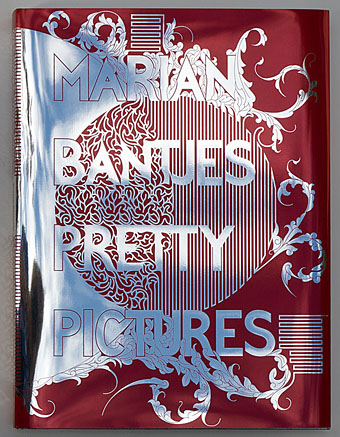
Pretty Pictures, a new book by designer Marian Bantjes, is out on October 1st.

• A writer admired by Angela Carter, Michael Moorcock, Harlan Ellison, Anthony Burgess, Jonathan Meades and Iain Sinclair; a “writer’s writer…[whose] best stories bear comparison with the Ficciones of Jorge Luis Borges”; a writer with an “unsettling quality to his writing, a whiff of brimstone that links him to fin-de-siècle occult figures such as HP Lovecraft—and even, at a further remove, Aleister Crowley”. David Collard explains why you may want to read something by Gerald Kersh (1911–1968), four of whose books are being republished.

• The Eccentronic Research Council and Maxine Peake pay homage to Delia Derbyshire’s The Dreams project with a new single out at the end of the month (Pye Corner Audio and Carol Morley appear on the flip). Ms Peake’s barm-cake reverie may be heard here.

• “Applying for grants, writing artist statements, showing up to openings—artists have to do far more than just make art if they want to find an audience for it.” Jen Graves on lies and deception in the art world.

The material does not make the work. The life does not make the art. Exactly the opposite. The work creates the material. The art creates the life. Did Trinidad exist before Naipaul? Did cargo ships exist before Joseph Conrad? Did Newark and the New Jersey suburbs exist before Philip Roth? Did women in playgrounds in New York City exist before Grace Paley? See how the writer invents the material? These places did not exist as literary subjects. They were invisible to literature. The magic of a great book is that it makes its own subject seem inevitable. The danger is, it makes the subject seem like the source of power in the work.

Phyllis Rose on life and literature.

• Mix of the week: Secret Thirteen Mix 087, 40 minutes of original electronic music by Geistform (Rafael Martinez Espinosa).

• “You’ve Got This“, an It Gets Better-style video support campaign for people recently diagnosed with HIV.

• At Dangerous Minds: Babalon Working: Brian Butler’s trippy occult odyssey with Paz de la Huerta.

Manfred Mohr‘s computer-created artwork, from the 1960s to the present.

Robert Macfarlane on the strange world of urban exploration.

Rick Poynor on Bohumil Stepan’s Family Album of Oddities.

• Oli Warwick talks to Martin Jenkins, aka Pye Corner Audio.

• The 384-page BUTT calendar for 2014 is now on sale.

• Pye Corner Audio: We Have Visitors (2010) | Toward Light (2011) | The Mirror Ball Cracked (2012)

The art of James Gleeson, 1915–2008

gleeson1.jpg

Funeral Procession in a Wounded Landscape (1945).

James Gleeson was an Australian Surrealist painter whose work I don’t think I’d seen before. The early pictures tend towards the post-Dalí school that crowds the second and third generation of Surrealist painting. More interesting for me are the later landscapes (if they can be labelled such) produced by a combination of collage and painting techniques. Some of HR Giger’s work in the 1970s explored similar organic terrain but this period didn’t last very long before he was into his biomechanical territory.

gleeson3.jpg

Locus Ganesa (1985).

gleeson2.jpg

Sky Techtonics (2002).

Elsewhere on { feuilleton }
The fantastic art archive

Weekend links 174

ikuma.jpg

Dress (2012) by Nao Ikuma.

• Two of my Cthulhu artworks can currently be seen in the Ars Necronomica exhibition at the Cohen Gallery, Brown University, Providence, RI. The exhibition is part of NecronomiCon, and runs to September 13th. In related news, my steampunk illustration has been nominated in the Visual category of this year’s Airship Awards. Winners will be announced at Steamcon V in October.

• “…the story of how a small cabal of British jazz obsessives conducting a besotted affair with the style arcana of Europe and America somehow became an army of scooter-borne rock fans…” Ian Penman looks back at the culture of Mod for the LRB.

• “What is it about the writer in the First World that wants the Third World writer to be nakedly political, a blunt instrument bludgeoning his world’s ills?” Gina Apostol on Borges, Politics, and the Postcolonial.

If someone had designed a work regime perfectly suited to maintaining the power of finance capital, it’s hard to see how they could have done a better job. Real, productive workers are relentlessly squeezed and exploited. The remainder are divided between a terrorised stratum of the, universally reviled, unemployed and a larger stratum who are basically paid to do nothing, in positions designed to make them identify with the perspectives and sensibilities of the ruling class (managers, administrators, etc) – and particularly its financial avatars – but, at the same time, foster a simmering resentment against anyone whose work has clear and undeniable social value. Clearly, the system was never consciously designed. It emerged from almost a century of trial and error. But it is the only explanation for why, despite our technological capacities, we are not all working 3–4 hour days.

On the Phenomenon of Bullshit Jobs by David Graeber

Ron Rosenbaum talks to Al Pacino about all the usual stuff, and reveals some detail about the actor’s obsessive interest in Oscar Wilde’s Salomé.

• More queer history: The Brixton Fairies and the South London Gay Community Centre, Brixton 1974–6.

• At Dangerous Minds: Anthony Burgess and the Top Secret Code in A Clockwork Orange

• Every day for 100 days, Jessica Svendsen redesigned a Josef Müller-Brockmann poster.

LondonTypographica: Mapping the typographic landscape of London.

• Mix of the week: Secret Thirteen Mix 083 by Demdike Stare.

• At Strange Flowers: Alfred Kubin the writer.

Derek Jarman’s sketchbooks.

Rick Poynor on Collage Now.

• Thomas Leer: Private Plane (1978) | Tight As A Drum (1981) | Heartbeat (1985)