Weekend links 285

graphic.jpg

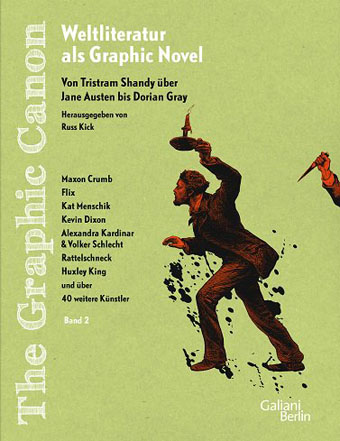
Some of the art from my collage adaptation of The Picture of Dorian Gray appears on the cover of The Graphic Canon: Volume 2, published this month in a German edition by Verlag Galiani. Out next month (although possibly available now) is the same book in a Brazilian edition from Boitempo Editorial. One of the disappointments this year was having to abandon plans to contribute to Russ Kick’s forthcoming graphic canon of crime fiction. I was overstretched during the summer, and what with projects slipping their deadlines and the trip to Providence there wasn’t any time left for other things.

• For those who missed the first edition, a second and final expanded edition of the Penda’s Fen study/celebration The Edge Is Where The Centre Is.

• Whipping up a storm: how Robert Mapplethorpe shocked America; Kevin Moore on the photographer’s Perfect Moment exhibition.

In the best scenario, metaphysical art distributes the work of understanding among cultural traditions and symbolic systems, and it is along these lines that Carrington’s work has been described as a productive combination of Mexican, Egyptian, Hebrew, Celtic, Greek, and Mesopotamian elements. Her paintings, plays, and stories mix the symbols of alchemy, astrology, Tarot, herbalism, magic, witchcraft, and a personal iconography.

Leif Schenstead-Harris on the life, art and fiction of Leonora Carrington

• Mixes of the week: Hieroglyphic Being collects favourite cosmic jazz of the 1970s; NTS Radio presents an hour of Annette Peacock.

• At Kill Your Darlings: Alexandra Heller-Nicholas enthuses about Dario Argento’s delirious masterwork, Suspiria.

Pye Corner Audio releases a new album (only limited vinyl at the moment—boooo!) and remixes Stealing Sheep.

• The Trip Planners: Emily Witt meets the founders behind Erowid, the online drug encyclopedia.

Woven Processional (1985), music on the Long String Instrument by Ellen Fullman.

• “The Paris attacks prove Charlie Hebdo’s critics wrong,” says Dorian Lynskey.

• Photographs by Danila Tkachenko of abandoned Soviet technology.

Come Wander With Me / Deliverance by Anna von Hausswolff.

• The collages of Guy Maddin.

CAN HALEN

Let’s Take A Trip (1965) by Godfrey | Trip On An Orange Bicycle (1968) by The Orange Bicycle | Last Trip (1968) by We Who Are
Weekend links 284

molinier.jpg

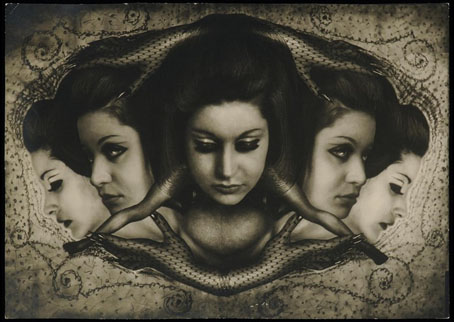
Les Hanel I by Pierre Molinier. There’s more at The Forbidden Photo-Collages of Pierre Molinier.

• Western anti-hero Josiah Hedges, better known as Edge, was the creation of prolific British author Terry Harknett. The famously violent Edge novels, credited to “George G. Gilman”, were ubiquitous on bookstalls in the 1970s. They were Harknett’s most successful works, and are still collectible today; if you’re interested there are 61 of them to search for. Amazon Originals have just launched Edge as a new TV series although anything for a mass audience is unlikely to retain the exploitative qualities of novels that often sound like pulp precursors of Blood Meridian.

Related: Terry Harknett discusses the creation of the Edge series at Drifter’s Wind; Ben Bridges on Harknett’s career, including a look at the writer’s many other Western and thriller novels; Bill Crider on Edge, Harknett and the British group of Western novelists known as “The Piccadilly Cowboys”.

• Boyd McDonald’s queer-eye film guide, Cruising the Movies: A Sexual Guide to Oldies on TV (1985), has been republished by Semiotext(e) in an expanded edition. Related: True Homosexual Experiences: Boyd McDonald and Straight to Hell by William E. Jones.

• “…a film that plumbs the dark recesses of all our imaginations: dangerous, glorious, absurd, vivid and terrifying by turns.” Charlotte Higgins on her favourite film, The Red Shoes (1948).

Art Forms from the Abyss, a new collection of illustrations by Ernst Haeckel for the report of the HMS Challenger expedition (1872–76). Related: Silentplankton.com

• “The biggest kick I ever get is to find myself pursuing some group of images without knowing why,” says M. John Harrison in conversation with Tim Franklin.

• “Plots didn’t interest him much. They were just pegs on which to hang characters and language.” Barry Day on Raymond Chandler.

• “Zdeněk Liška’s music thrived in unrealities,” says David Herter in a lengthy appraisal of the great Czech film composer.

• At Dirge Magazine: S. Elizabeth delights in the dark decor of Dellamorte & Co.

• Nabokov scholar Brian Boyd selects his ten favourite Nabokov books.

• Mix of the week: The Ivy-Strangled Path Vol. XIII by David Colohan.

Take me to the cosmic vagina: inside Tibet’s secret tantric temple.

• Pour Un Pianiste (1974) by Michèle Bokanowski | 13’05” (1976) by Michèle Bokanowski | Tabou (1992) by Michèle Bokanowski

Weekend links 283

wassmann.jpg

Behind by Lisa Wassmann.

• “Without space art, nobody would know what Mars would look like.” Artist David A. Hardy talking to Nadja Sayej about a life spent painting the cosmos and—briefly—working for Hawkwind. Visions of Space, an exhibition of astronomical art, is at the Wells & Mendip Museum throughout November.

• Mixes of the week: Something Beautiful Happened by Cafe Kaput; Autumn Vybes: Mist, Mystery and Motion by Abigail Ward; and Secret Thirteen Mix 166 by Ron Morelli.

• More Ghost Box: Two new singles in the Other Voices series will be released next month. And the label is profiled in the latest issue of Electronic Sound magazine.

It breaks my heart when one writer tells another what she can or cannot do. I once knew a woman, a professor of literature, who said that Flaubert had no right to write Madame Bovary because he was a man. Such dangerous foolishness! This is just another form that dogmatic thinking takes. And it seems to me that the imagining mind—which is also a profoundly human mind—must be unfettered, boundless. To write from the perspective of another’s world demands a generous and a rigorous leap of the spirit; it demands empathy and mindfulness. Writing is so much about subverting dogmatisms of all kinds, above all the ones that insist you cannot go there! You must not say that! Writers need to go anywhere, to take anything on. And the only rule is to do it well.

Rikki Ducornet in a retrospective feature at Dennis Cooper’s blog

• “Horror at its best has always existed outside the mainstream,” says Brian Ennis in another celebratory piece about Thomas Ligotti.

• Alan Clarke & David Rudkin’s Penda’s Fen receives another cinema screening next week at the Sallis Benney Theatre, Brighton.

• “[David] Lynch’s films abound with gnomic pronouncements and incantations,” says Dennis Lim.

Stars of the Lid play a tremendous hour-long set at St. Agnes Church in Brooklyn.

Drawn in Stereo: a book of music-related art and illustration by Michael Gillette.

• At Dangerous Minds: Only the coolest people get to sit in the wicker peacock chair.

Everything Is Erotic Therefore Everything Is Exhausting by Johanna Hedva.

Moon Mist (1961) by The Out-Islanders | River Mist (1989) by Brian Eno | Black Mist (Long Version) (2013) by Pye Corner Audio

Metzengerstein

satty.jpg

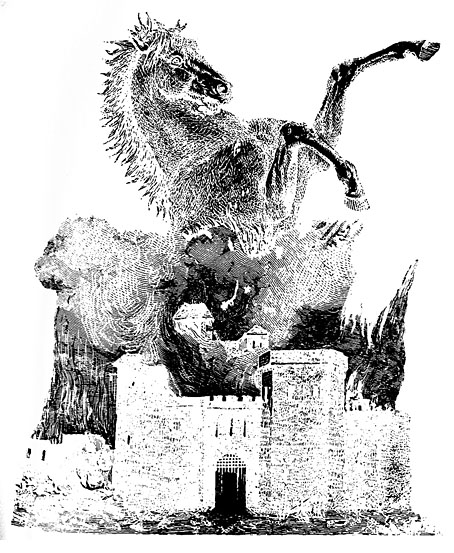
Metzengerstein by Wilfried Sätty.

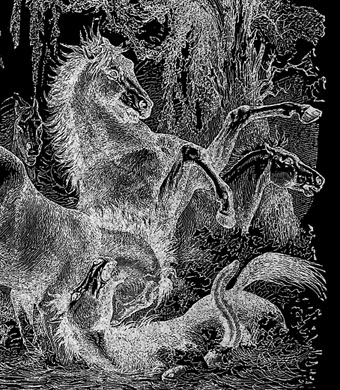
One of the horses in yesterday’s post seemed familiar until I realised it had been used by Wilfried Sätty for his final Metzengerstein illustration in The Illustrated Edgar Allan Poe (1976). This has been happening a lot since I started delving into the book scans at the Internet Archive, Sätty’s collage sources leaping abruptly from old engravings. The horse is a good example of Sätty’s evolved approach to collage which often reversed the printing of assembled artwork, or used a printing press (or PMT process) to duplicate and mirror his collage elements.

Not all Poe illustrators bother with this Gothic pastiche, and those that do don’t always provide an effective rendering of the climax when the clouds of smoke above a smouldering castle assume the form of a colossal horse. Byam Shaw’s illustration is typical, with the horse standing inertly above the flames. Sätty’s picture only occupies half a page but is much more successful, as are many of the other illustrations in a volume that remains one of the very best Poe collections, and the finest of Sätty’s books.

horses3.jpg

Previously on { feuilleton }
The original Gandharva
The Occult Explosion
Wilfried Sätty album covers
Nature Boy: Jesper Ryom and Wilfried Sätty
Wilfried Sätty: Artist of the occult
Illustrating Poe #4: Wilfried Sätty
Gandharva by Beaver & Krause

The original Gandharva

gandharva1.jpg

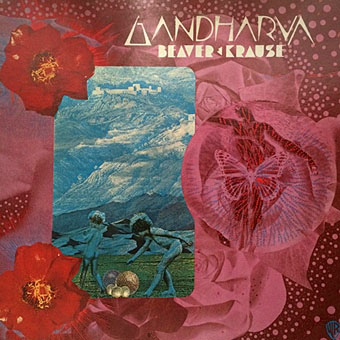
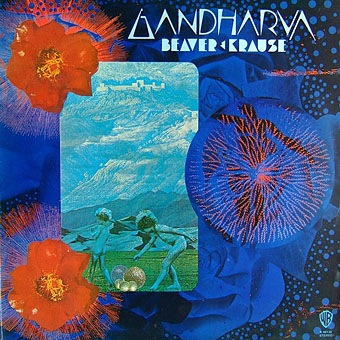
Cover art by Wilfried Sätty. Lettering by David Singer.

Collage artist Wilfried Sätty has been in my thoughts this month, it being ten years ago that Jay Babcock, Richard Pleuger and I drove up to San Francisco and Petaluma to talk to Walter Medeiros and David Singer about Sätty’s life and work. Looking today at the Sätty cover art for Gandharva (1971) by Beaver & Krause reminded me that the original pressing of this album came with the sleeve in a predominantly pink colouration rather than the more familiar blue. I have three copies of the album—vinyl and two CDs, one of which pairs it with Beaver & Krause’s In A Wild Sanctuary (1970)—but I’ve never seen one of the pink variations, and didn’t even know they existed until they started appearing on the web. The CD reissues favour the blue version, as do I, although this may only be a result of familiarity. I’ve enthused about Sätty’s cover a couple of times already but the music is worth hearing for its connections backwards to Cammell & Roeg’s Performance (for which B&K provided the ominous synthesizer tones), and forwards to Robert Fuest’s The Final Programme. Fuest asked Gerry Mulligan to score his film after hearing the Gandharva suite (described in the sleeve notes as “a score from a non-existent film”) which occupies side two of the album.

gandharva2.jpg

Elsewhere on { feuilleton }
The album covers archive

Previously on { feuilleton }
The Occult Explosion
Wilfried Sätty album covers
Nature Boy: Jesper Ryom and Wilfried Sätty
Wilfried Sätty: Artist of the occult
Illustrating Poe #4: Wilfried Sätty
Gandharva by Beaver & Krause