The poster art of Josef Vyleťal

vyletal11.jpg

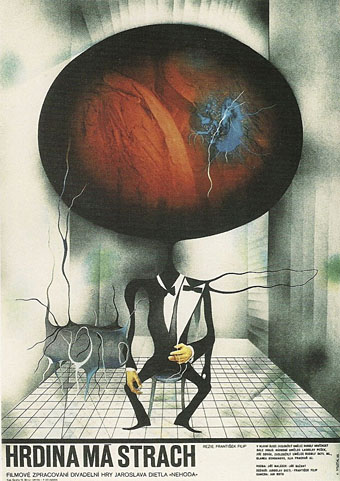
The Hero is Afraid (1965).

Film posters by Czech artist Josef Vyleťal (1940-1989) have appeared here in the past, but after watching Juraj Herz’s gloomily Gothic Beauty and the Beast (1978) at the weekend—a film for which Vyleťal not only created a poster but also provided the title sequence and paintings seen within the film—I thought the artist deserved a post of his own.

Josef Vyleťal was a prolific poster artist and designer—the Terry Posters website states that he created 115 designs for the cinema—who also worked as a book illustrator. Between commercial assignments he produced paintings in a macabre Surrealist style that filtered into his commercial work, the Herz titles included. The absence of barriers between private obsessions and commercial imperatives is what makes the film posters created by Czech and Polish artists so attractive, as well as so surprising to Anglophone viewers. There’s no sense of these works being produced by committee, of a gaggle of marketing executives fretting over details behind the scenes. Some of Vyleťal’s interpretations are so extreme and uncompromising by Hollywood standards it’s impossible to imagine even an adventurous chain like Alamo Drafthouse commissioning them, never mind a risk-averse studio. One of the designs I singled out for an earlier post is an ideal example, a poster for Alfred Hitchcock’s The Birds which dispenses with any visual reference to the film in favour of a liberal borrowing of the bird-headed figures from Max Ernst’s The Robing of the Bride. It’s a commonplace when discussing the films of Jan Švankmajer to situate the director in the history of Czech Surrealism which remained a clandestine movement during the Communist years. But Vyleťal’s paintings demonstrate a confidence that the average Czech filmgoer could accept Surrealist imagery when being tempted by the latest fare from Hollywood.
vyletal07.jpg

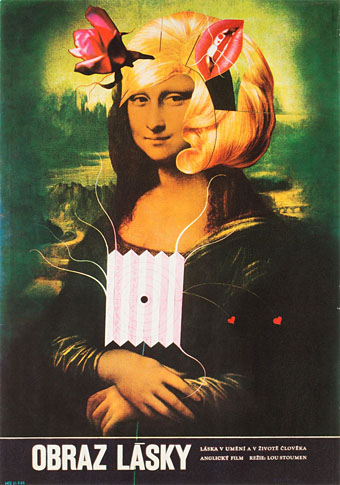
The Naked Eye (1966).

Given my own tastes for Surrealist imagery many of the examples shown here tend in this direction. Vyleťal was a versatile artist who utilised a number of different styles, including collage and a bold graphic style of black shapes on coloured backgrounds. In addition to borrowing from Ernst he also borrowed (or swiped) figures from Aubrey Beardsley on at least two occasions (see below). Most of the examples here are collages augmented by or combined with paint, collage being a quicker solution when faced with deadlines. Terry Posters has many more examples.
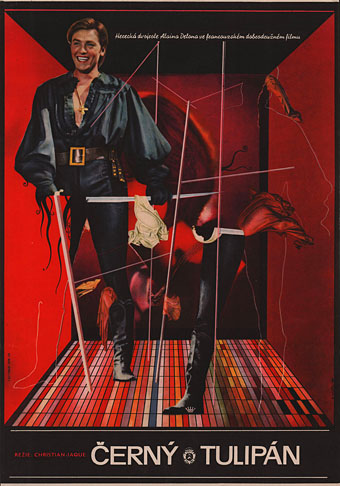
vyletal13.jpg

The Black Tulip (1967).

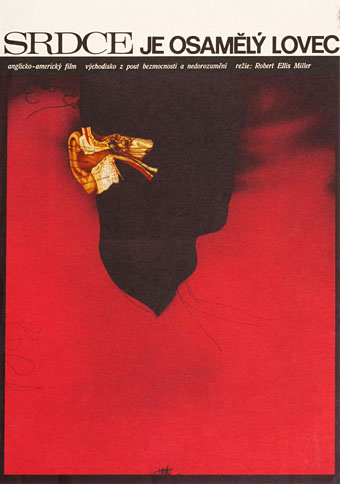
vyletal01.jpg

The Heart is a Lonely Hunter (1968).

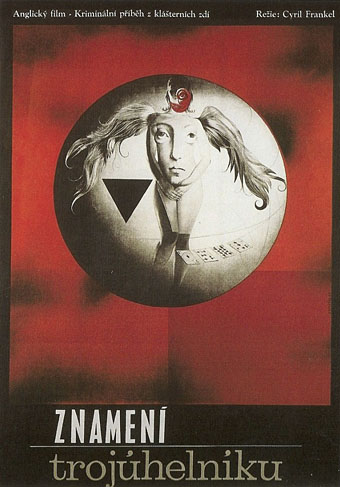
vyletal12.jpg

The Trygon Factor (1968).

Continue reading “The poster art of Josef Vyleťal”

Weekend links 503

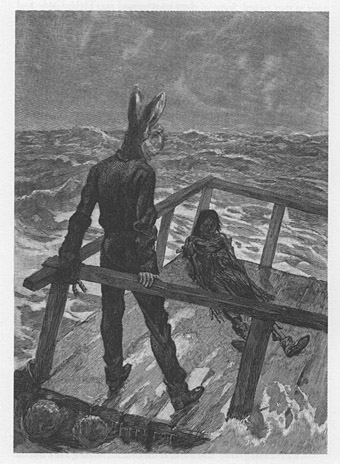
kausch.jpg

Rabbit Man with Skull Lady (1998) by Allan Kausch.

• “They were the first generation that said, ‘Fuck it, we’re not going to be intimidated.’ They weren’t going to make specifically pro-gay statements, but they were the first generation to really live that out. If you look at the Alternative Miss World, it’s a kind of gender-fuck, it’s almost like the English version of the Cockettes.” Jon Savage speaking in a piece by Alex Petridis about “Them” (Kevin Whitney, Luciana Martinez de la Rosa, Duggie Fields, Derek Jarman, Zandra Rhodes, Andrew Logan et al). Related: Andrew Logan in Andrew’s Adventures in Loganland.

• Sex, Satanism, Manson, Murder, and LSD: Kenneth Anger tells his tale. “Anger rarely if ever veers from the script as he is a man who has carefully controlled his myth and reputation for decades,” says Paul Gallagher.

• “Don’t even think about operating heavy machinery while listening to this mix.” The latest Dave Maier collection of recent ambient drift, drone-works and beatless atmospherics.

It is by no means easy to track or trace relationships between women, past or present. Women’s relationships with other women are often disguised: by well-documented marriages to men, by a cultural refusal to see what is in full view or even to believe such relationships exist. In a world built by and for men and their pursuits, a woman who loves women does not register—and is not registered, i.e., written down. Reasons for this layer one upon the other: A lesbian purposely hides her identity and remains closeted. A lesbian refuses to call herself a lesbian, disidentifying from the term and its associations for reasons personal or political. A woman does not know she is a lesbian—because she does not ever have a relationship with another woman, or because she is not aware that the relationships she engages in could be called lesbian. I didn’t call myself one for several years. Or, as in Carson’s case, her own self-understanding and identification are difficult to determine because of the efforts of those who outlived her and pushed her into the closet.

Jenn Shapland on the closeting of Carson McCullers

• At The Paris Review: The Collages of Max Ernst. Related: Kolaj: A directory of collage books.

Adam Scovell on the deathly hinterlands of Georges Franju’s Eyes without a Face.

• When Dorothy Parker got fired from Vanity Fair, by Jonathan Goldman.

• At Dennis Cooper’s: The Proto-Psychedelic Art of CG Jung’s Red Book.

• The abstract, single-stroke paintings of Daigoro Yonekura.

Adam Gopnik on the seriousness of George Steiner.

Caligula MMXX

The Ballad Of Dorothy Parker (1987) by Prince | Lotus Collage (1979) by Laraaji | Death Collage (1992) by Snakefinger & The Residents

Weekend links 491

beatty.jpg

The Weirdness is Coming, an illustration by Robert Beatty for an NYMag feature about the near future.

• I’m slightly late to this news, but better late than never: The Doll’s Breath is a 22-minute animated film by the Brothers Quay, shot on 35mm film and with a soundtrack by Michèle Bokanowski. It may take a while before it’s available to view outside the festival circuit but it’s good to know it’s in the world. Related: Filip Lech on the Polish inspirations of the Brothers Quay.

• More from Swan River Press: Joseph Sheridan Le Fanu’s disturbing horror tale, Green Tea, is published in a 150th anniversary edition, with an introduction by Matthew Holness, two essays and a CD containing a theatrical adaptation of the story by the Wireless Mystery Theatre.

• Luca Guadagnino, Olivia Laing and Sandy Powell, Tilda Swinton and John Waters choose favourite pieces of writing by Derek Jarman. Related: Protest!, a Jarman exhibition at the Irish Museum of Modern Art.

Fairport [Convention]’s revolutionary impact came in doing precisely the opposite of what the folklorists had intended when they began collecting the songs. By taking the old songs and setting them down on paper, they had largely believed they were preserving them in the form in which they must remain, ignoring the fact that songs passed through generations orally will always evolve. Fairport, though, played extremely fast and loose with the source material, matching tunes from one source with lyrics from another. As Rob Young put it in his book Electric Eden: “It threw into question the spurious ‘authenticity’ of the folk versions studiously set in stone by the Victorian and Edwardian collectors. Fairport’s electrifying act preserved and restored the guts and spontaneous vigour to the folk continuum.”

Michael Hann on the 50th anniversary of Fairport Convention’s Liege & Leaf

• More Patrick Cowley: PC’s megamix of Hills Of Kat Mandu by Tantra. And the mix of the week: a Patrick Cowley tribute from 1981 by DJ Jim Hopkins.

• The seventh edition of Wyrd Daze—”The multimedia zine of speculative fiction + extra-ordinary music, art & writing”—is out now.

5 Mishaps: A 32-page hardbound handmade book of short stories by Tamas Dobozy, with collage illustrations by Allan Kausch.

• At Dangerous Minds: Lovely Bones: The transfixing skeletons and dreamlike nudes of Belgian painter Paul Delvaux.

• From 1979: a very early TV appearance by Virgin Prunes (their first?) on Ireland’s The Late Late Show.

• Fists of fear: Anne Billson on 10 films featuring severed (and frequently vengeful) hands.

Adrian Curry at MUBI selects his favourite film posters of the 2010s.

Tea For Two (1956) by Duke Ellington | Tea For One (1976) by Led Zeppelin | Tea In The Sahara (2001) by Simon Shaheen & Qantara

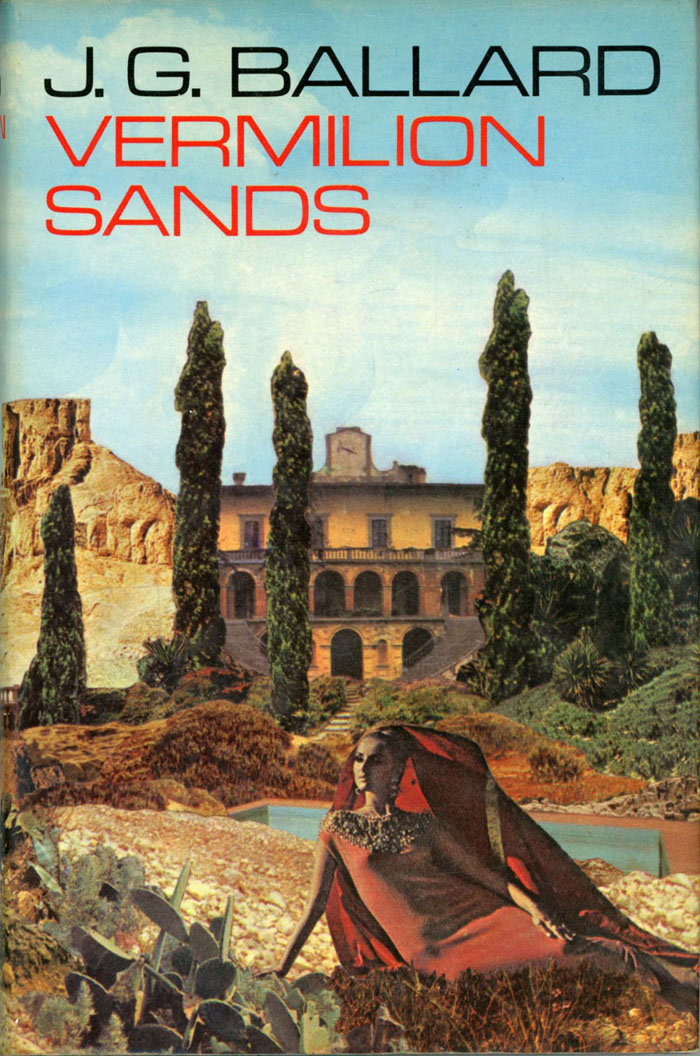
Picturing Vermilion Sands

knight2.jpg

First UK edition, 1971. Art by Brian Knight.

Vermilion Sands (1971) is a story collection by JG Ballard which maintains a cult reputation despite being overshadowed by its author’s more popular (and notorious) novels. Most of the stories were written in the 1960s—a couple of them are among Ballard’s earliest works—but where many of his other short stories can read like the work of a writer with bills to pay, the tales of Vermilion Sands are much closer to Ballard’s core interests, filled with symbolic resonance and literary allusion.

Vermilion Sands, the place, is a near-future resort with a desert climate and an unspecified location; a locale where the Côte d’Azur meets Southern California but the ocean is a sea of sand. While each story has a different artistic or cultural theme, all the stories are populated by the idle midde-class types found in the rest of Ballard’s work. Ballard was more receptive to visual art, especially painting, than many authors, particularly the SF writers of his generation for whom art was less interesting than science and technology. There is science and technology in these stories (some of the latter is now inevitably dated) but it doesn’t dominate the proceedings. The stories derive less from scientific speculation than from Ballard’s desire to create a future he would have been happy to inhabit himself, an alternative to the grim dystopias which proliferate in science fiction. The background furnishings also reflect the author’s ideal, owing much to the Surrealist landscapes of Salvador Dalí and Max Ernst, a pair of artists whose works are often referenced in Ballard’s fiction. Given all of this you’d expect that cover artists might have risen to the challenge more than they have. What follows is a look at the most notable attempts to depict Vermilion Sands or its population, only a few of which are covers for the book itself.

Continue reading “Picturing Vermilion Sands”

Weekend links 471

maclean.jpg

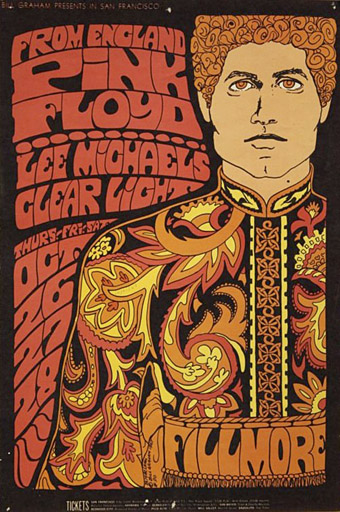
Pink Floyd, Lee Michaels, Clear Light (1967) by Bonnie MacLean.

• Electronic musician Mort Garson has been subject to a revival of interest recently, with reissues of his works as Ataraxia (The Unexplained), and Lucifer (Black Mass). The latest reissue is Mother Earth’s Plantasia (1976), an album released under Garson’s own name, and one of several works of plant mysticism from the 1970s (see Stevie Wonder’s Journey Through The Secret Life Of Plants, and Green by Steve Hillage).

• “It is striking how much of this work sounds like a missing link from the art world to the popular groups of the time, such as the Detroit techno pioneers Cybotron and the Japanese electro legends Yellow Magic Orchestra.” Geeta Dayal on the reconfigured Speak & Spell machinery of Paul DeMarinis.

The cost of free love and the designers who bore it: Madeleine Morley meets the women of psychedelic design.

For the transhumanist anarchist Wilson, the neurological relativism revealed by his own learning and personal deprogramming experiments called for a form of ‘guerrilla ontology’ that lampooned, rejected and transmitted much needed interference into the ‘reality tunnels’ that attempt to control much of contemporary society and individual behaviour. In the Schrödinger’s Cat Trilogy, characters are repeatedly placed in positions of cognitive dissonance, where they are forced to reevaluate their own belief systems due to experiences that they are unable to accommodate.

Sean Kitching on the 40th anniversary of Robert Anton Wilson’s Schrödinger’s Cat Trilogy

• They said books were dead, they were wrong: Adrian Shaughnessy on a decade of Unit Editions.

• Mixes of the week: Xianedelica by Jesús Bacalão, and Kosmische Mix By Tarotplane.

• Swinging 60s surrealist Penny Slinger: “Collectors thought I came with the art”.

• Cabaret Voltaire: Chance Versus Causality (Teaser).

Luc Sante on postcards of American violence.

• At Dennis Cooper’s: Peter Whitehead Day.

Computerwelt (1981) by Kraftwerk | Speak And Spell (1984) by Christina Kubisch | Time Space Transmat (1985) by Model 500