Weekend links 329

vyletal.jpg

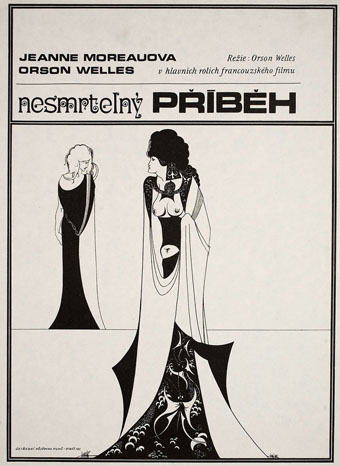
Josef Vyletal borrows figures from Aubrey Beardsley’s Salomé for a Czech poster promoting The Immortal Story (1969) by Orson Welles. Vyletal’s own paintings were often strange and surreal.

• Pale Fire is Nabokov’s “great gay comic novel,” says Edmund White. A surprising but not inappropriate reappraisal. White has noted in the past that Nabokov “hated homosexuality” despite having a gay brother and uncle. The portrayal of Charles Kinbote in Pale Fire isn’t unsympathetic if you overlook his being delusional, and possibly insane…

• At Folk Horror Revival: details of the charity donations raised by sales of the Folk Horror Revival books, the first of which featured my David Rudkin essay. A one-day Folk Horror Revival event takes place later this month at the British Museum, London.

• Mixes of the week: The Bug presents Killing Sound Chapter 2: Inner Space, a 2-hour blend of “sci-fi scores, expansive atmospheres and synthesized psychedelia”; Decoded Sundays presents Scanner; Secret Thirteen Mix 197 is by LXV.

• Stars Of The Lid unveil a James Plotkin remix of their Music For Twin Peaks Episode #30 Pt. 1. Related: the hype for the new Twin Peaks series gets into gear with a teaser.

• Robert Aickman’s only novel, The Late Breakfasters (1964), is being given its first US publication by Valancourt Books.

• “Don’t dream it, bet it.” Evan J. Peterson on 40 years of The Rocky Horror Picture Show.

• Anna von Hausswolff’s sister, Maria, directs a video for Come Wander With Me / Deliverance.

• RIP Michael O’Pray, film writer and curator of many festivals of experimental cinema.

• Oli Warwick talks to electronic musicians about the influence of the late Don Buchla.

• Breakfast In Bed (1969) by Dusty Springfield | Alan’s Psychedelic Breakfast (1970) by Pink Floyd | Another Breakfast With You (2001) by Ladytron
Weekend links 314

alderslade.jpg

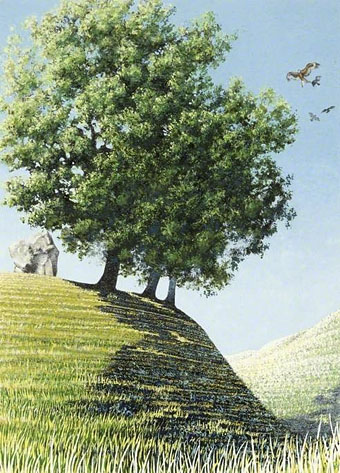
Avebury Kite (2006) by David Alderslade.

• “Klaus Mann, son of Thomas Mann, author of Mephisto, was one of the first in Germany to write gay novels and plays.” Walter Holland reviews Cursed Legacy: The Tragic Life of Klaus Mann by Frederic Spotts.

• The Pale Brown Thing, a shorter/alternate version of Fritz Leiber’s supernatural masterwork, Our Lady of Darkness, is given a limited reprinting by Swan River Press next month.

• “Not only is metal not directly harmful to adolescent minds, as the thinking goes, it may actually be helpful.” Christine Ro on the reappraisal of a once-suspect musical genre.

Something of that tension between past and future is visible in Beardsley’s work. It is the art of a dying era peering, with a mixture of excitement and trepidation, into the next. For all the prancing and bravado, Beardsley’s art was really about finding something in which to believe—and if Beardsley came to believe in anything it was the deep black line. Shading held little interest for Beardsley, and color fascinated him not at all. The black line and white space were all he needed.

Morgan Meis on Aubrey Beardsley

• More of my art for Bruce Sterling’s forthcoming Dieselpunk novella, Pirate Utopia, has been revealed. Tachyon will be publishing the book in November.

• “Secretly, though, I frequent junk shops because I am wishing for some kind of transcendence,” says Luc Sante.

• Mixes of the week: Gizehcast #28 by Christine Ott, and a mix for The Wire by Asher Levitas.

• “It took centuries, but we now know the size of the Universe.” Chris Baraniuk explains.

• Barnbrook Studios creates identity for Kubrick exhibition at Somerset House.

• Watch a haunting video from Subtext Recordings and Eric Holm.

• Folklore Tapes: A Rum Music Special by Joseph Burnett.

• Brion Gysin’s Dreamachine is on sale again.

• Rhys Chatham’s favourite albums.

• A Guide to Occult London

• Skulls and Bones

• Zero Time (1979) by Chrome | Zero-Gravity (1996) by Sidewinder |  Zero Moment (2016) by Contact

Weekend links 300

goudal.jpg

Observatoire IX from the Observatoires series by Noemie Goudal.

• “Before Lady Raglan’s intervention, this figure had been anonymous. She gave him a name: the Green Man.” Josephine Livingstone on the persistence of a supposed figure from pagan folklore.

• Ben Wheatley: “Financing a film as crazy as [High-Rise] takes good casting”. Related (in a Ballardian sense): the abandoned hotels of the Sinai Desert.

• “We were in danger of becoming full-time, paid up musicians…” Drew Daniel and Martin “MC” Schmidt of Matmos look back over their career.

Fahey didn’t make many new friends with his scything dismissal of the folk revival. He distrusted the way that folkies regarded music as a carrier for the correct political messages of the moment. As Lowenthal puts it: “To him, the student idealists had naïve worldviews and dreamed of unrealistic political utopias,” whereas Fahey “attempted to channel darkness and dread through his music.” For Woody Guthrie and Pete Seeger devotees, the ideological message came first, with musical tone or trickery a distant second. As Fahey saw it, the dizzyingly strange source music they borrowed from and then built their careers on emerged as little more than a scrubbed-up ventriloquist’s doll, all the coarse grain and troubling metaphysic of its original voices jettisoned. He also detected high condescension and low reverse racism in how the folk-revival people preferred their old blues guys barefoot and wearing dungarees—even if they now usually dressed in sharp suits and often preferred to play amplified, electric urban blues.

Ian Penman on John Fahey

• “It’s amazing how quickly a sound can lose its moorings and float off into this kind of unchartered territory,” says Robin The Fog.

• Mixes of the week: FACT Mix 540 by Via App, and Secret Thirteen Mix 178 by BlackBlackGold.

• Oliver Wainwright on Edward Johnston, designer of the typeface for the London Underground.

• At Dennis Cooper’s: DC’s: Spotlight on…The Free-Lance Pallbearers (1967) by Ishmael Reed.

• Each drop of Hennessy X.O is an Odyssey: Nicolas Winding Refn makes an alcohol ad.

• Wayne Shorter & Herbie Hancock pen an open letter to the next generation of artists.

• Japan’s scariest manga artist (Junji Ito) loves Japan’s creepiest cosplayer (Ikura).

• “He was a sexual outlaw.” Jack Fritscher‘s love affair with Robert Mapplethorpe.

• Peter De Rome: the RAF pilot who became “the grandfather of gay porn”.

• The Strange Case of Mr William T. Horton

• RIP Big George Martin and Ken Adam.

• Shortwave Radio World

• Viriconium FAQ

• Nine Feet Underground (1971) by Caravan | Green Bubble Raincoated Man (1972) by Amon Düül II | Betyárnóta (Outlaw Song, 1989) by Muzsikás

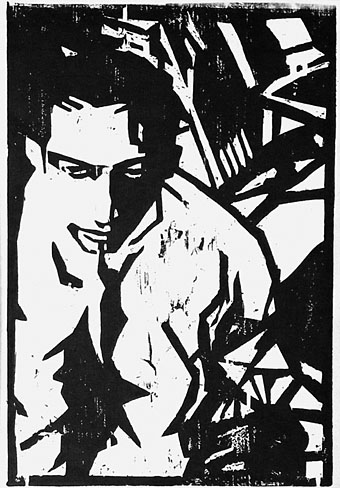
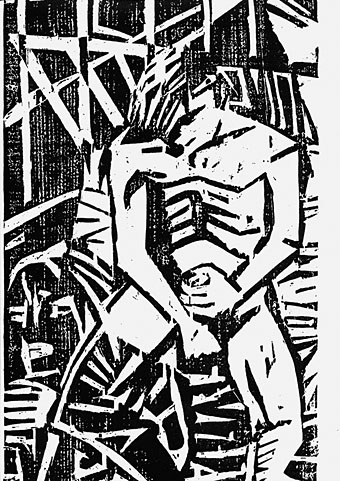
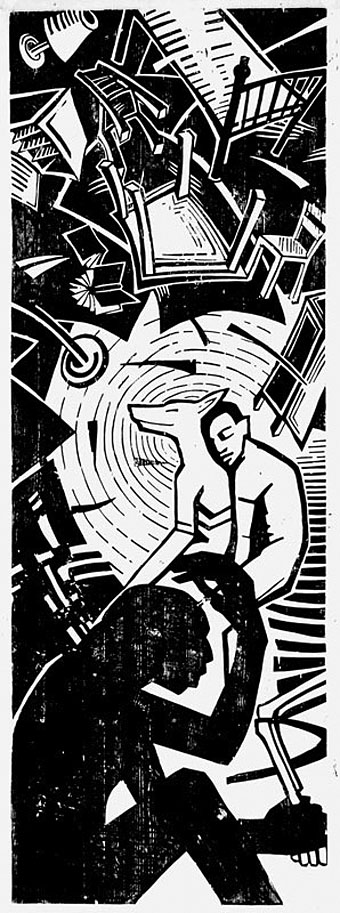
The art of Peter Knoch

knoch1.jpg

Junger Mann.

You don’t often see woodcuts like these by German artist Peter Knoch which combine a homoerotic quality with a jagged graphic style familiar from Expressionism. Some were for an AIDS-themed series for which a harsh visual treatment might be thought fitting although the first two here are from a separate series. Knoch’s work encompasses paintings, ceramics, detailed puppet environments, theatre design and graphic design. There’s more to see at his website, and at B-E-A-S-T. (Thanks to Callum for the tip!)

knoch2.jpg

Jean.

knoch3.jpg

Traum.

Elsewhere on { feuilleton }
• The gay artists archive

Foreign appearances

steam1.jpg

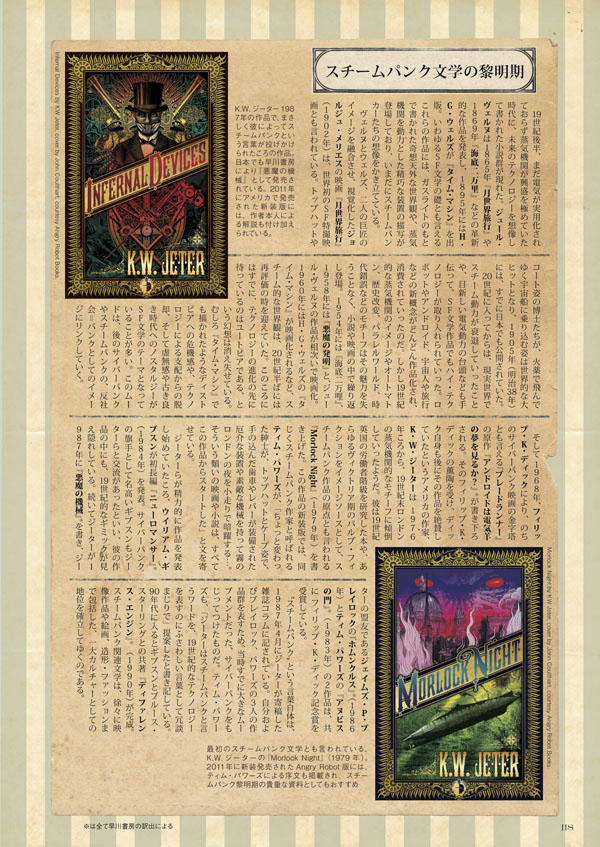
My work has appeared in a couple of foreign collections recently, each approaching popular culture from very different directions. The volume above is called Steampunk Japan Fashion Book according to a German bookseller although the title may read differently to Japanese speakers. This was published at the end of last year, and features my ever-popular covers for the Angry Robot editions of two steampunk novels by KW Jeter, Infernal Devices and Morlock Night. The book is the work of a collective who call themselves The Japanese Steampunkers.

steam2.jpg

popculture1.jpg

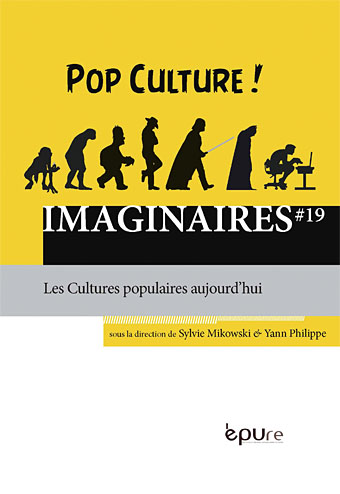
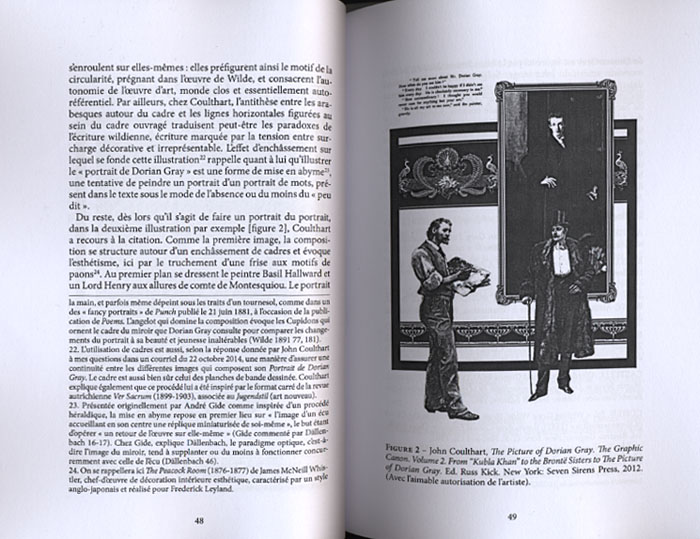
Meanwhile in France, Imaginaires #19: Les cultures populaires aujourd’hui is a collection of academic pieces about popular culture published by ÉPURE, Éditions et Presses universitaires de Reims. Inside there’s an essay by Xavier Giudicelli (University of Reims Chamapgne-Ardenne), The Picture of Dorian Gray et la culture populaire: du texte à la bande dessinée, which compares Wilde’s novel to various graphic adaptations. Xavier wrote to me some time ago about my Dorian Gray adaptation for the Russ Kick-edited Graphic Canon (2012) so the piece includes some of my remarks about my interpretation together with two of the pages.

popculture2.jpg

Previously on { feuilleton }
• Picturing Dorian Gray