Weekend links 457

tanaka.jpg

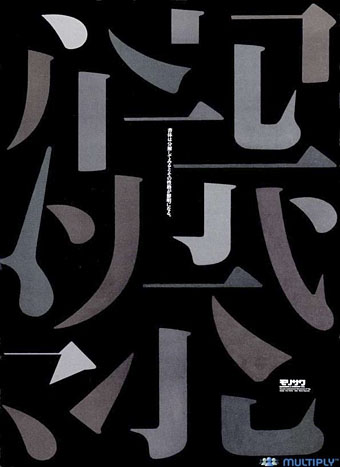
Imagination of Letters by Ikko Tanaka.

Kankyo Ongaku: Japanese Ambient, Environmental & New Age Music 1980–1990 is the latest compilation from Light In The Attic, and another excellent package both musically, physically and design-wise. The album was compiled by Spencer Doran of Visible Cloaks who talked to The Quietus a couple of years ago about his favourite Japanese (and other) music. Simon Reynolds reviewed Kankyo Ongaku last month, and drew attention to Spencer Doran’s Fairlights, Mallets and Bamboo mixes which may be heard here and here.

Michael O’Shea playing his home-made musical instrument (an old door, paintbrushes, etc) on RTÉ in 1980. Shea’s one-and-only album has been deleted for years but was reissued in January. The story of O’Shea’s surprising involvement with Bruce Gilbert and Graham Lewis of Wire (which led to the recording of his album) is recounted here.

Lou Thomas suggests five reasons to watch Shinya Tsukamoto’s Tetsuo: The Iron Man on its 30th anniversary.

…Topor generates a world in which the great unsaid realities of human life are painfully laid bare, amplified through a series of confrontations with “le sang, la merde et le sexe” (“blood, shit, and sex”). While few of his texts have been made available in English, they are nevertheless representative of his wider body of work, in which the reader constantly trips over these same themes as if stumbling upon a naked corpse in a darkened room. They predicate an oeuvre of carnivalesque and necrophilic eroticism, and draw out the pungent, animalistic core hidden within the norms of our everyday existence. Topor’s narratives are shot through with macabre irony, orgiastic scatology, and physical and psychological cruelty, which constitutes a fundamental reframing of the characteristics of human interaction with others.

Andrew Hodgson on Roland Topor’s neglected writings

An anciente mappe of Fairyland: newly discovered and set forth (1920) by Bernard Sleigh.

Maggot Brain: an impromptu Funkadelic cover by Albatross Project.

Anne Billson on purr evil: cinematic cats with hidden agendas.

Sayonara: one of the most Japanese words in the dictionary.

• Painting the Beyond: Susan Tallman on Hilma af Klint.

• RB Russell on bookseller’s labels: part one & part two.

Christopher G. Moore on The Immortals and Time.

• Fuck the Vessel,” says Kate Wagner.

• Japanese Farewell Song (Sayonara) (1957) by Martin Denny | Sayonara: The Japanese Farewell Song (1976) by Haruomi Hosono | Sayonara (1991) by Ryuichi Sakamoto
Weekend links 456

tanning.jpg

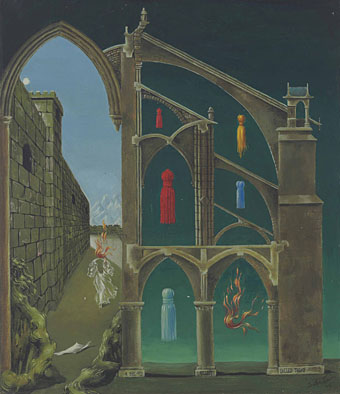
A Mrs Radcliffe Called Today (1944) by Dorothea Tanning.

Darran Anderson on how the Bauhaus kept things weird. “Many imitators of the famous art school’s output have missed the surreal, sensual, irrational, and instinctual spirit that drove its creativity.”

• Notes on the Fourth Dimension: Hyperspace, ghosts, and colourful cubes—Jon Crabb on the work of Charles Howard Hinton and the cultural history of higher dimensions.

• “[Edward] Gorey is slowly emerging as one of the more unclubbable American greats, like Lovecraft or Joseph Cornell,” says Phil Baker.

The label “homosexual writer” stuck for the rest of his career, with Purdy confined to what Gore Vidal called “the large cemetery of gay literature…where unalike writers are thrown together in a lot, well off the beaten track of family values”. In later years, Purdy moved further off the beaten track, as much by intention as circumstance. “I’m not a gay writer,” he would tell interviewers. “I’m a monster. Gay writers are too conservative.”

Speaking to Penthouse magazine in 1978, Purdy said being published was like “throwing a party for friends and all these coarse wicked people come instead, and break the furniture and vomit all over the house”. He added that, in order to protect oneself, “a writer needs to be completely unavailable”.

Andrew Male on writer James Purdy

• The Necessity of Being Judgmental: Roger Luckhurst on k-punk: The Collected and Unpublished Writings of Mark Fisher.

Faunus: The Decorative Imagination of Arthur Machen, edited by James Machin with an introduction by Stewart Lee.

• More James Purdy: “His poetry displays a softness that readers of his fiction might not expect,” says Daniel Green.

Drag Star! is a 150,000-word interactive novel/text adventure by Evan J. Peterson.

• At Dangerous Minds: Dave Ball discusses his years as the other half of Soft Cell.

Daisy Woodward on the story of radical female Surrealist Dorothea Tanning.

• Inside the bascule chamber: photos of Tower Bridge, inside and out.

Tim Smith-Laing on the meaning of Miró’s doodles.

• Galerie Dennis Cooper presents…Emma Kunz.

rarecinema: a shop at Redbubble.

Apollo Press Kits

The Fourth Dimension (1964) by The Ventures | Dimension Soleils (1983) by Gilles Tremblay | Into The Fourth Dimension (1991) by The Orb

Sundial and Mile End Purgatorio

blacktower.jpg

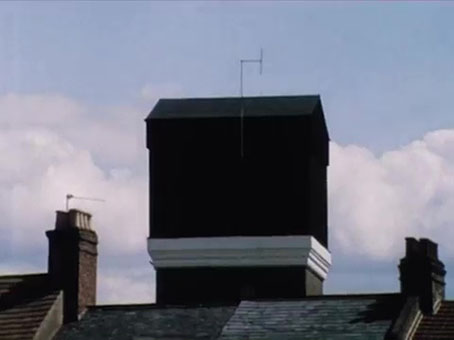
The Black Tower.

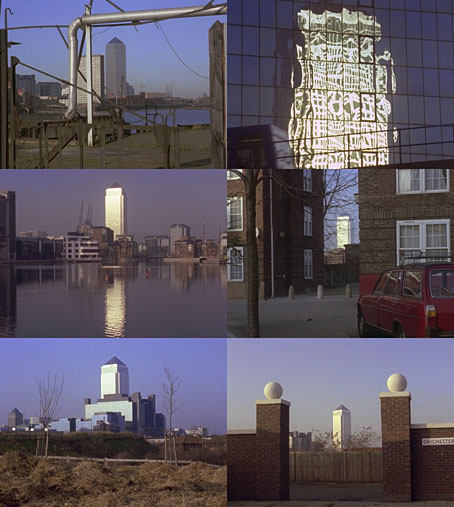
I ought to have devoted this post to The Black Tower (1987), John Smith’s short and sinister film which I linked to at the weekend. It was good to watch it again after seeing a TV screening (no doubt the only one) on the UK’s Channel 4 in 1988. It also reminded me of the two shorter films linked here, both of which were also shown on Channel 4 a few years later in Benjamin Woolley’s excellent Midnight Underground series. All three films are linked by their London locations and their different solutions to the perennial problem of the micro-budget filmmaker looking to make the most of limited resources.

sundial.jpg

Sundial.

Smith’s film is the more substantial work, and of particular interest to those looking for examples of weird (or horror) cinema that avoids Hollywood cliches. The Black Tower combines static views of an unusual building with voiceover and sound effects to turn a mundane piece of architecture into a growing menace. Using a voiceover to craft a narrative from unrelated shots has always been a useful and flexible technique, especially if money is limited; Peter Greenaway did this with all of his early films, and it’s an approach also favoured by Patrick Keiller and Terrence Malick.

mileend.jpg

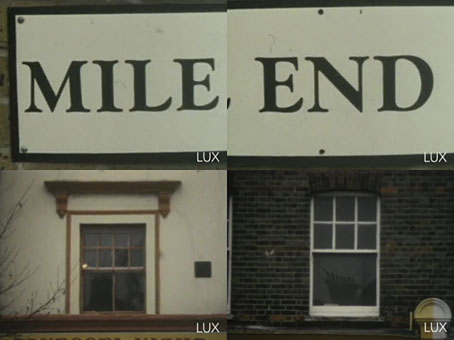
Mile End Purgatorio.

Guy Sherwin uses the same technique for Mile End Purgatorio (1991), an East-End riff on Dante, Hamlet and the Bible, with words by Martin Doyle. William Raban’s Sundial (1993) has no voiceover but it follows The Black Tower in making the Canary Wharf tower the centre of its attention, the fixed point in the passing of a single day. Sherwin and Raban also show how much can be done with a single minute of film.

Weekend links 455

brocken.jpg

• At Expanding Mind: Tarot expert Mary Greer talks with Erik Davis about Tarot artist Pamela Colman Smith, the Golden Dawn, the art of illustration, Jung’s active imagination, Smith’s musical visions, and the recent study of Smith’s life and work, Pamela Colman Smith: the Untold Story.

• Almost five years have passed since the last album from Earth (if you discount the Bug vs. Earth collaboration Concrete Desert) but the band will release a new album, Full Upon Her Burning Lips, in May. Cats On The Briar is a taster.

Charles Bramesco on Sergei Bondarchuk’s astonishing 7-hour adaptation of War and Peace. I watched the whole thing last weekend: all superlatives are justified.

• The History of the Future: James Conway on leaving Australia for a life in Berlin and publishing. Related: Where is Rixdorf?

• At Spoon & Tamago: Keisuke Aiso‘s artworks, including the Ubume sculpture that became the face of the Momo Challenge hoax.

• Mixes of the week: Secret Thirteen Mix 282 by Tourist Gaze, and Big Sister’s Scratchy Singles Vol 1 by radioShirley.

Alexander Rose on the 26,000-Year Astronomical Monument Hidden in Plain Sight.

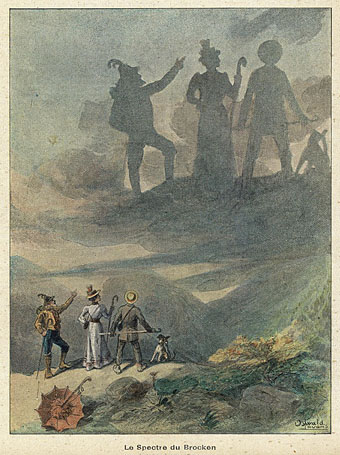
Rebecca Cole and Janise Elie go in search of the Brocken spectre on Burley Moor.

M. John Harrison: Critical Essays, edited by Rhys Williams and Mark Bould.

Forest of Resonating Lamps – One Stroke, Cherry Blossoms by teamLab.

• Tour de France: Jonathan Meades selects 13 exercise-bike Classics.

• At Greydogtales: The Cthulhu Mythos for Beginners.

The Black Tower (1987), a short film by John Smith.

• At Dennis Cooper’s: Jean Rollin Day.

Ishmael Reed doesn’t like Hamilton.

Babylonian Tower (1982) by Minimal Compact | The Tower (Black Advance) (2007) by Mordant Music | The Tower (Empty Fortress) (2007) by Mordant Music

Weekend links 452

nordine.jpg

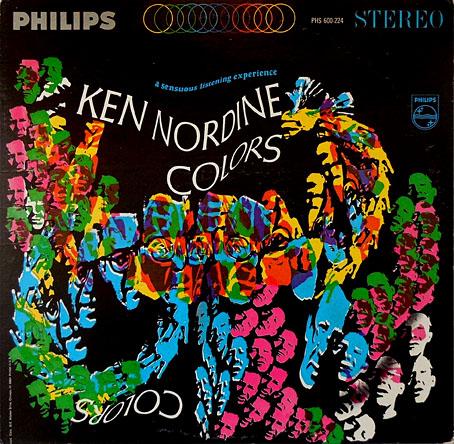
Colors (1967) by Ken Nordine.

• “The Do was the thing”: a lengthy chat with Chuck Gould of the San Francisco Diggers. The second interview from Jay Babcock’s oral history of the Diggers.

Sticking it to the Man: Revolution and Counterculture in Pulp and Popular Fiction, 1950–1980 edited by Andrew Nette and Iain McIntyre.

Adrian Shaughnessy‘s Krautrock Top Ten. (People who know me well won’t be surprised to hear that I own everything on this list.)

See “queer” as a term has become an umbrella that accommodates not only the type of sex you have and with whom, but also how you identify the sex you have, how you identify your personality, your aura, the ineffable je ne sais queer that may or may not be related in any way to your sexuality, or even the way you present yourself to the world, but simply some deeply held, internal feeling. You don’t actually need to share a common oppression or a common romantic or sexual behavior.

[…]

The reason I mind is because queer, in functioning as a catchall, serves to obscure what it is about my life, my community, my partners, that I needed to learn to be proud of in the first place. Because for me and all the other lesbians I know, figuring out your sexuality is hard enough, but the real work is in accepting yourself, demanding acceptance from others, being willing to walk away when that acceptance is denied.

Lesbians are women, and women are taught that we’re supposed to be sexually available objects of public consumption. So we spend a lot of time saying “No.” No, we won’t fuck or partner with men; no, we won’t change our minds about this; no, this body is a no-man’s land. Lesbian, straight or bi, women are punished whenever we try to assert a boundary. Queer as a catchall term makes it really hard for lesbians to assert and maintain this boundary, because it makes it impossible to name this boundary.

Jocelyn Macdonald on how the increasing dilution and commodification of “queer” as a label does little to serve the interests of the people to whom it was applied in the first place

• Two sets of live electronica from last year: Pye Corner Audio at The State51 Factory, and Tangerine Dream at Dekmantel.

• “LSD can get deep down and reset the brain—like shaking up a snow globe,” says Amanda Fielding.

• Ewan Wilson on the impossible architecture of video games.

• Mix of the week: Secret Thirteen Mix 279 by Marcos Cabral.

• RIP Betty Ballantine, Bruno Ganz and Ken Nordine.

• At Dennis Cooper’s: They will never exist.

Cosi Fanni Tutti‘s favourite records.

She Comes In Colors (1967) by Love | Colors (1969) by Pharoah Sanders | Balthus Bemused By Color (Mix II) (1988) by Harold Budd