Gerald Metcalfe’s illustrated Coleridge

metcalfe01.jpg

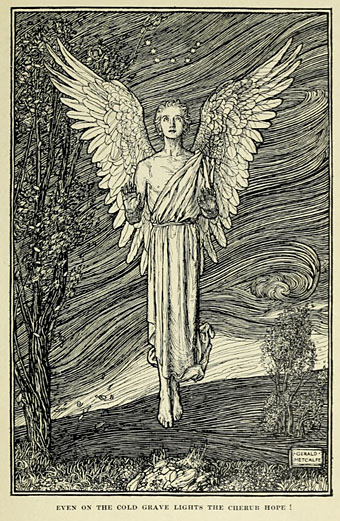
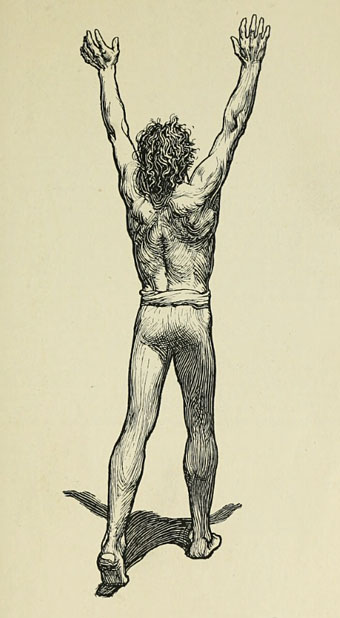
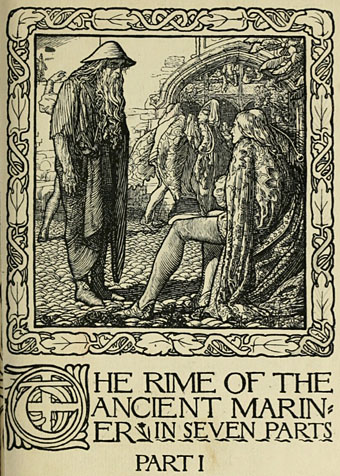
This angel figure appeared here just over a year ago in a selection from Modern Book Illustrators and Their Work (1914). Subsequent searching at the Internet Archive turned up a well-used copy of The Poems of Coleridge (1907) from which the drawing originates. Gerald Metcalfe (1894–1929), was a British artist whose ink renderings often resemble woodcut engravings. Some of the drawings seem a little perfunctory but he does a decent enough job with The Rime of the Ancient Mariner, a poem whose wealth of incident is more suited to illustration than many of Coleridge’s shorter pieces.

metcalfe02.jpg

metcalfe03.jpg

Continue reading “Gerald Metcalfe’s illustrated Coleridge”

Colour photography, 1908

colour01.jpg

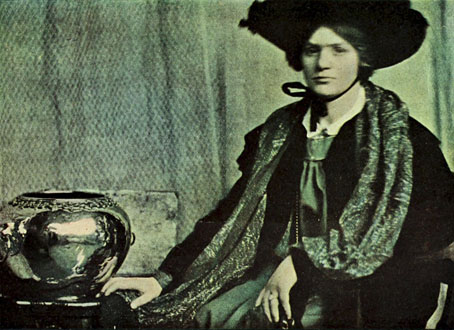
Portrait of Jessie M. King by J. Craig Annan (autochrome).

I don’t recall having seen a photo of artist Jessie M. King prior to this so it’s an additional surprise to find one in colour. All these examples are from Colour Photography: and other recent developments of the art of the camera (1908), one of the many books edited by Charles Holme from features in The Studio magazine. Needless to say, not all the entries are colour but a number of the monochrome plates have their own qualities, such as that painterly effect which so many early photographers were eager to cultivate. Anyone familiar with Gertrude Käsebier’s very painterly The Crystal Gazer, famous for its appearance on the cover of a Cocteau Twins sleeve, may like to know that two more portraits by Ms Käsebier are included in Holme’s selection. For a look at more recent attempts to match the effects of painting with the camera, see this piece by Rick Poynor about the remarkable work of Saul Leiter.

colour02.jpg

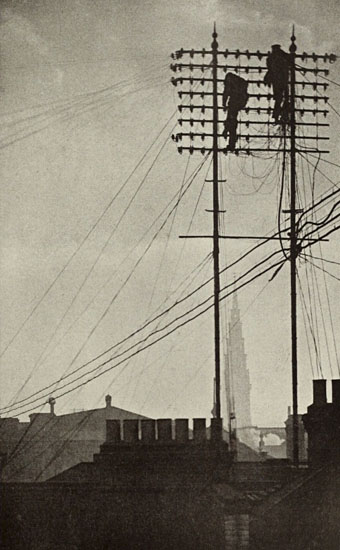
A Tangle After a Storm by Walter Bennington.

colour03.jpg

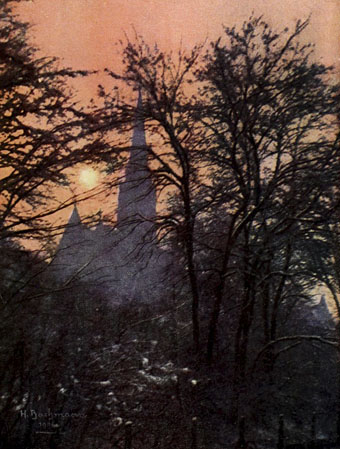
A Late Winter Sun by Dr. H. Bachmann (gum print).

Continue reading “Colour photography, 1908”

Weekend links 89

gnoli.jpg

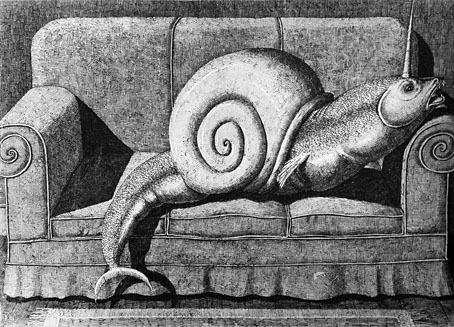
A drawing from Bestiario Moderno by Domenico Gnoli (1933–1970).

RIP Russell Hoban. Nina Allan celebrates a favourite writer while David Mitchell, writing in 2005, pays tribute to Riddley Walker. For me the gulf between Hoban and many of his contemporaries could be measured by his entry in the Writer’s Rooms feature the Guardian Review was running for a couple of years: Hoban’s room was the only one that admitted to being cramped and chaotic.

A wristwatch could be “a tiny flowering hell, a wreath of roses, a dungeon of air” and still tell time. A short story could take the shape of an instruction manual for the most routine of tasks (crying, singing, winding said dungeon, killing ants in Rome), or a compendium of tales about fantastical but oddly familiar species. A novel didn’t have to progress from the first page to the last, hung on a rigid skeleton of plot: it could proceed in oblong leaps and great steps backward, like a game, say, of hopscotch. “Literature is a form of play,” said Cortázar. […] It is perhaps because he so stubbornly resists categorization, as much as for the ludic complexity of his work, that Cortázar is in these parts more admired than he is read. The Anglophone literary imagination (or perhaps just its material substrate: the market) appears to have room for only one Latin American giant per generation—Borges, García Márquez, the freshly beatified San Bolaño. Cortázar was too weird, too difficult, too joyously slippery to make the cut.

Eels Über Alles: Ben Ehrenreich on Julio Cortázar

• Alfred Jarry is another writer the Anglophone world has often found “too weird, too difficult”. Jarry has been dead for over a century but Alastair Brotchie’s recently-published full-length biography is the first such work in English. Mark Polizzotti reviews a life of “the poster boy for literary cult figures” at Bookforum.

• “A Beautiful Trip”: Frances Morgan interviews David Lynch about music and sound. And Robert Wyatt talks for 95 minutes to Tony Herrington about his favourite music.

• Twilight Science: Paul Schütze presents solo musical work and various collaborative projects in new digital editions.

occupy.jpg

Jonathan Barnbrook‘s logo design for Occupy London.

• Winter reads: Myths of the Norsemen by Roger Lancelyn Green. Related: What became of illustrations in fiction?

The White People and Other Weird Stories by Arthur Machen is a new Penguin Classic out in January.

• “This Christmas, why not give Viriconium, city of sex, syphillis & consubstantiation?”

• The Casual Optimist announces its Favourite Book Covers of 2011.

The Collect Call of Cthulhu

Living with Burroughs

Function (2011) by Emptyset | Aftertime (2011) by Roly Porter with Cynthia Miller on the Ondes Martenot.

The Weird Questionnaire

peacock.jpg

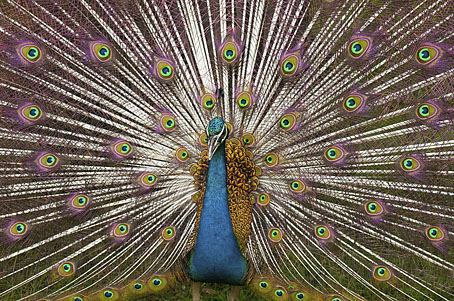
A peacock. Photograph by Vidhya Narayanan.

Posted at the Weird Fiction Review in the past week, The Weird (or Étrange) Questionnaire is Éric Poindron’s Weird (or Étrange) riposte to the Proust Questionnaire. I’d read the post, and seen Jeff VanderMeer’s answers to the questions, but wasn’t planning on answering it myself until Neddal Ayad wrote asking whether I’d be willing to do so for a future WFR assembly of responses. So here we are. The rules are as follows:

…there are sixty questions (twice as many as most versions of the Proust Questionnaire). Spend no more than a minute on each, and an hour in total. However, don’t keep checking your watch: “let writing define time.”

In the end I took longer than an hour but the time limit is a good idea, otherwise I’d have spent far too long pondering, revising, qualifying remarks, unqualifying the qualifications, and so on. Deadlines have their uses.


The Weird Questionnaire

1: Write the first sentence of a novel, short story, or book of the weird yet to be written.

The first night of winter moonlight revealed a pattern of tiny runic figures etched inside the window glass.

2: Without looking at your watch: what time is it?

01:15

3: Look at your watch. What time is it?

01:20

4: How do you explain this—or these—discrepancy(ies) in time?

It’s always later than you think.

5: Do you believe in meteorological predictions?

“Believe” seems the wrong word in this context since the question concerns a conjecture based on scientific study. Short-range forecasts are fine, long-range ones seldom seem to be.

6: Do you believe in astrological predictions?

If this refers to newspaper columns, they’re always so vague they may as well be computer-generated. Maybe they are.

7: Do you gaze at the sky and stars by night?

Yes, when I’m out of the city.

8: What do you think of the sky and stars by night?

My bad eyesight (the stars are always a blur), the length of time the light has taken to reach us, how the familiarity of the few stars we do manage to see shields us from the true immensity of the stellar gulfs.

9: What were you looking at before starting this questionnaire?

A guest post by Clive Hicks-Jenkins on Kathe Koja’s blog.

10: What do cathedrals, churches, mosques, shrines, synagogues, and other religious monuments inspire in you?

Further appreciation of the values of art, architecture and related crafts. In the case of cathedrals: astonishment at the feats of labour required to build them in a pre-industrial age; their presence as sites of accumulated history.

Continue reading “The Weird Questionnaire”
Athanasius Kircher’s Tower of Babel

babel1.jpg

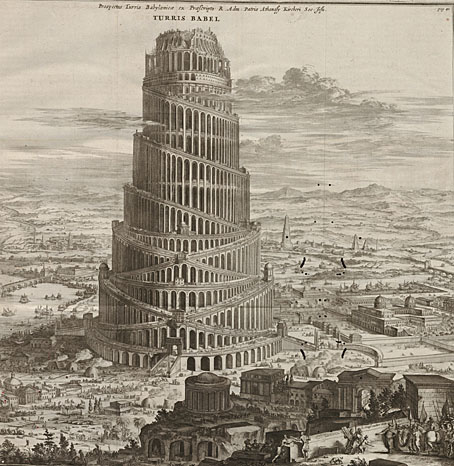
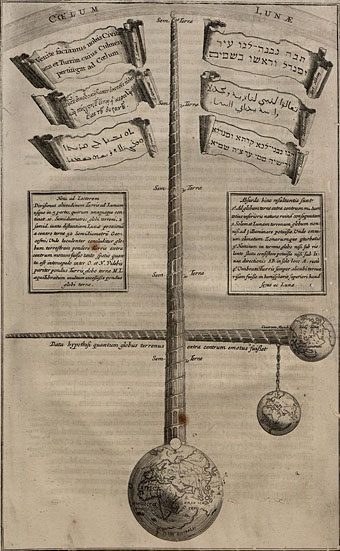
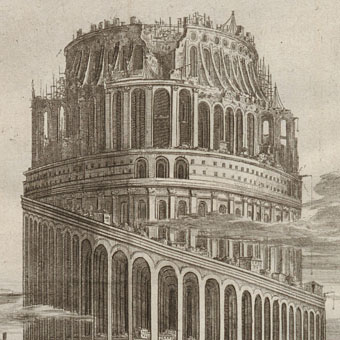
Here’s a picture whose myriad details I’ve wanted to scrutinise for many years. Lieven Cruyl was the draughtsman and Coenraet Decker the etcher while the picture itself appears as an illustration in Athanasius Kircher’s (deep breath) Turris Babel, Sive Archontologia Qua Primo Priscorum post diluvium hominum vita, mores rerumque gestarum magnitudo, Secundo Turris fabrica civitatumque exstructio, confusio linguarum, & inde gentium transmigrationis, cum principalium inde enatorum idiomatum historia, multiplici eruditione describuntur & explicantur. The book was published in 1679 and, among other speculations, features Kircher’s eye-popping illustration (below) showing how tall the Tower of Babel would have to be in order to reach the Moon. I used part of the big illustration in a cover design for metal band Melechesh in 2006.

babel6.jpg

The copies here are from a scanned volume at the University of Heidelberg where the pages have suffered slightly from bookworm. But the resolution is high enough to explore a picture crawling with tiny details, from the bristling scaffolding at the top of the structure, and the houses (for the workers?) built on the ramps lower down, to a procession of camels and other beasts being led towards the main entrance. In the background there are smaller towers and a few pyramids (Kircher explored the latter elsewhere in the book), and also a harbour with beast-headed sailing ships. The full-size picture may be explored here.

babel2.jpg

Continue reading “Athanasius Kircher’s Tower of Babel”