Weekend links 12

archigram.jpg

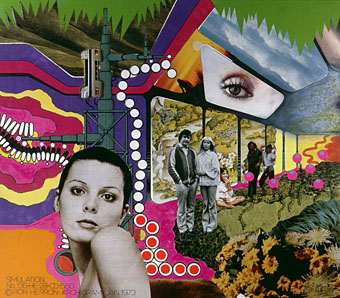
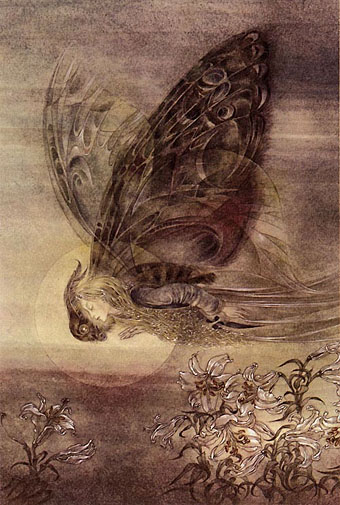
Simulation No. 136 (1973); From the Archigram Revival Project.

Scientific American looks at DMT: “the only psychedelic known to occur naturally in the human body”. Related: Hofmann’s Elixir: LSD and the New Eleusis, a book from the Beckley Foundation Press.

• “People weren’t quite sure what this guy was doing.” Colin Marshall talks to Eno biographer David Sheppard.

• LA FAN presents its debut group show, Eve in the Garden of Lost Angels, curated by Milla Zeltzer, at Optical Allusion Gallery, downtown Los Angeles, from May 15 to June 12, 2010.

Masturbation: literature’s last taboo. The words “last” and “taboo” should never be used together; taboos don’t vanish, they migrate.

Announcing the Text: Development of the Title Page, 1470–1900.

The Anachronism is an award-wining Steampunk short about two children who discover the wreck of a giant squid submarine on a beach near their home.

Out There is a brand new, bi-annual, international magazine for gay men and their friends.

The Big Picture looks at the eruption of Eyjafjallajokull.

Expo 2010 opens in Shanghai on May 1st.

• (Walter) Benjamin in Extremis.

Nathalie returns to Bomarzo.

• Acronymic songs of the week: Lucy In The Sky With Diamonds (1967) by The Beatles; The Stars That Play With Laughing Sam’s Dice (1967) by The Jimi Hendrix Experience; London Social Degree (1968) by Billy Nicholls; Love’s Secret Domain (1991) by Coil.

The Dukes declare it’s 25 O’Clock!

dukes1.jpg

25 O’Clock (1985). Andy Partridge’s great cover design.

The DUKES say it’s time…it’s time to visit the planet smile…it’s time the love bomb was dropped…it’s time to eat music…it’s time to kiss the sun…it’s time to drown yourself in SOUNDGASM and it’s time to dance through the mirror. The DUKES declare it’s 25 O’CLOCK.

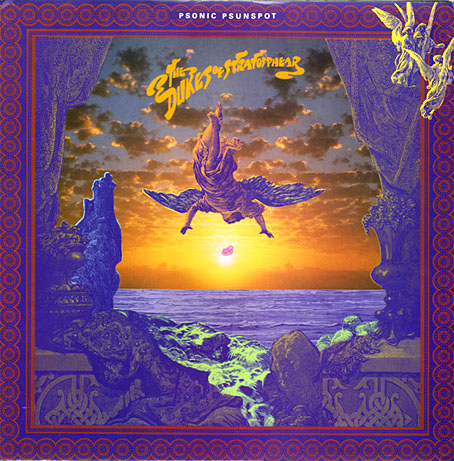
It was twenty-five years today—April 1st, 1985—that Virgin Records released what was supposed to be a reissue of a lost psychedelic album from the late 1960s, 25 O’Clock by The Dukes of Stratosphear. The catalogue number was WOW 1 and the vinyl label was printed with the old black-and-white Virgin logo by Roger Dean even though Virgin Records wasn’t founded until 1972. No one was supposed to know that the album was really a pastiche project by XTC but I don’t recall anyone actually being fooled by this, all the reviews acknowledged XTC as the originators, and band members Andy Partridge and Colin Moulding were happy to give interviews enthusing about their musical obsessions. As well as being incredibly successful artistically the album was a surprising commercial success which led the bemused record label to ask for a sequel. Psonic Psunspot followed two years later, and the Dukes’ vibe infected XTC’s own work for a while, with their 1988 album, Oranges & Lemons, pitched somewhere between the pastiches and XTC’s more usual sound .

dukes2.jpg

Psonic Psunspot (1987). Design by Dave Dragon and Ken Ansell.

Continue reading “The Dukes declare it’s 25 O’Clock!”

Beardsley at the V&A

abva.jpg

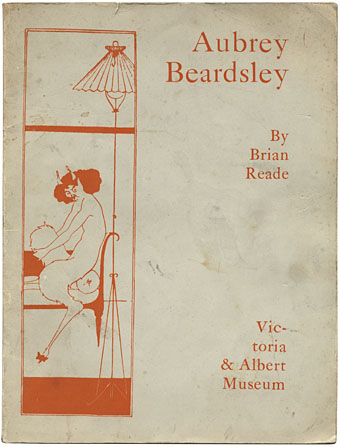
This battered item is my copy of the V&A guide to the landmark Aubrey Beardsley exhibition held at the museum from May to September 1966. That exhibition introduced Beardsley to a new public and made his work very trendy for a while, helped by the Beardsley-styled sleeve of the Beatles’ Revolver album which was released the same year, and a general resurgence of interest in fin de siècle style. Aside from a rare unfinished drawing, there isn’t anything in the booklet which hasn’t been reprinted many times elsewhere but it does contain an excellent overview of the artist’s career by Beardsley scholar Brian Reade.

abva2.jpg

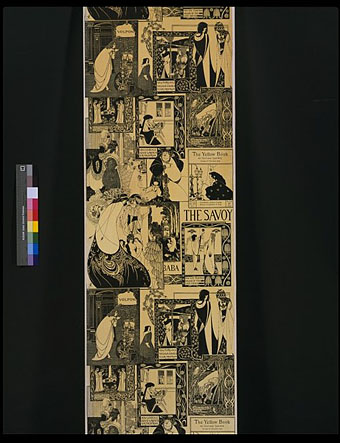
The V&A website has gained a new feature recently which allows you to search their collections with either a specific search or a random browse. The results don’t give the kind of high-resolution results which I’d like (unlike the British Museum) but the Beardsley works can now be seen in something like their actual condition, edge of the paper and all. Also present is the above piece of Beardsley trivia, a yellowed sheet of wallpaper manufactured by Arthur Sanderson & Sons Ltd in 1967. The Deansgate office of Savoy Books was once covered in this stuff but had unfortunately been papered over by the time I arrived on the scene.

Elsewhere on { feuilleton }
The Aubrey Beardsley archive

A Journey Into Vision & Sound

bev1.jpg

The Million Volt Light & Sound Rave (1967).

More psychedelia as Paul Gorman at The Look alerts me to an exhibition of work by Pop artist Dudley Edwards running this month at 3345 Parr St, Liverpool. Edwards was a part of the Binder, Edwards & Vaughan design collective in the 1960s, renowned for their light shows and psychedelic murals. BEV were Beatles favourites for a while, the photo below shows Edwards painting the piano upon which Paul McCartney wrote Getting Better. They also painted vehicles, including a Cobra sports car for doomed Guinness heir Tara Browne whose crash death was immortalised in A Day in the Life. And their Million Volt Light & Sound Rave event at the Roundhouse was distinguished by a unique Beatles sound collage, Carnival of Light, which McCartney was talking up last year, saying it ought to be given a proper release.

A Journey Into Vision & Sound will focus on Edwards artistic output from this halcyon period and will feature a selection of images that have been archived for over forty years including photography by Lord Snowdon and the mural Edwards painted for Ringo Starr in 1967. (More.)

A Journey Into Vision & Sound runs until November 30, 2009. There’s more about the work of Dudley Edwards and BEV at The Look.

bev2.jpg

Dudley Edwards painting Paul McCartney’s piano.

Previously on { feuilleton }
Through the Wonderwall
Psychedelic Life
Psychedelic vehicles