HR Giger’s Passagen

giger1.jpg

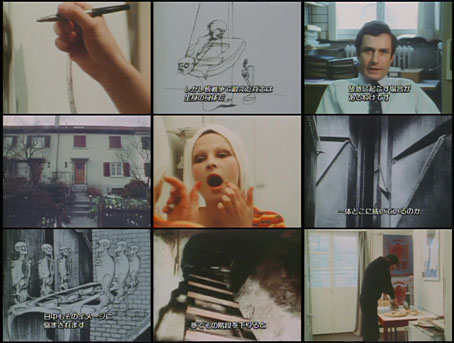
HR Giger’s art books were always very thorough in detailing all the media manifestations of the artist’s work, including film and television appearances. For years this presented tantalising questions, especially regarding the lengthy pre-Alien documentaries that were listed there: what were these films, and when would we get to see them? Giger’s Necronomicon (1976) did finally appear on YouTube a few years ago, and now here’s the second of the pair thanks to an upload of what appears to be a Japanese laserdisc.
giger2.jpg

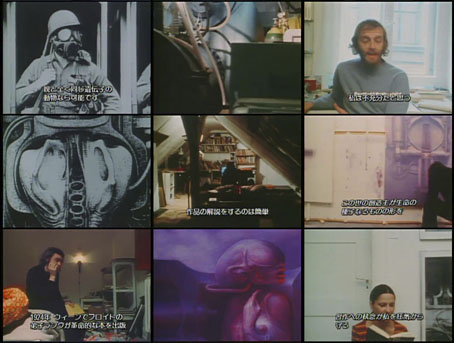
Passagen was made in 1972 by Giger’s friend Fredi M. Murer, their third film collaboration after Heimkiller and High (1967) and Swiss Made 2069 (1968). The latter (which Giger co-directed) is still frustratingly absent from the web, and similarly tantalising for being a 45-minute piece of underground science fiction which features Giger’s first production designs for cinema. Passagen was less ambitious, a 50-minute documentary about Giger’s work made for the German TV station, WDR. As a documentary it functions as a companion to Giger’s Necronomicon, while both films complement the subsequent art books, especially Giger’s Necronomicon (the book) which features many of the paintings seen in the films, together with anecdotes about their origins and inspiration. One of these anecdotes, about the nightmares induced in the young Hans Rudi by a stairway in the hotel next door to the Giger family home, is recounted in Passagen alongside the vertiginous drawings the nightmares inspired. It’s impossible to consider this piece of child psychology, and to watch the artist walking up and down stairs and stepladders, without recalling that Giger died after falling down a flight of stairs in 2014.

giger3.jpg

Giger’s Necronomicon is the more interesting of the two documentaries, especially now that the life and work is so well known; the art is taken more for granted, and we also get to see Giger at work on one of his big airbrush paintings. Passagen spends much of its time attempting to contextualise Giger’s drawings and paintings for an unwitting television audience, so a great deal of the running time is given over to newsreel footage of wars, riots, terrorism, atomic explosions and so on. A geneticist discusses the effects of atomic mutation while Giger’s earliest series of pictures, Atomkinder, is shown; psychoanalysts examine his paintings from a psychosexual angle.

Of more interest for Giger aficionados is the presence of his partner at the time, Li Tobler, the subject of several memorable portraits from this period. Among the working shots, the best shows Giger improvising a drawing with the same speed as Philippe Druillet in the Ô Sidarta film. Giger only started using an airbrush in 1972 so most of the works seen here are either early drawings or the paintings in the Passagen and Alptraum series, the style and colouring of which is much closer to the art world of 1972 than anything which would follow. For me the greatest revelation comes early on when Giger picks out a record to play while he’s working. The disc he chooses is just identifiable as Universal Consciousness by Alice Coltrane, an album which had been released the year before. (This isn’t the music heard on the soundtrack, however.) Alice Coltrane’s brand of ecstatic, pan-religious jazz would seem remote from Giger’s own universe but the choice isn’t so surprising if you know that he’d been a jazz enthusiast since the 1950s; in The Book of Alien (1979) his list of influences includes HP Lovecraft, John Coltrane and Miles Davis.

As is evident from the screen grabs, the film is hard-coded throughout with Japanese subtitles. Unlike Giger’s Necronomicon there’s no English overdub either, the soundtrack is in German throughout. I can’t complain when I’ve been waiting so long to be able to see this at all. For those who watched the later film divided into four YouTube clips there’s now a complete version (also Japanese but with English overdub) here.

Previously on { feuilleton }
Heimkiller and High
The Man Who Paints Monsters In The Night
Hans by Sibylle
HR Giger album covers
Giger’s Necronomicon
Dan O’Bannon, 1946–2009
Alejandro Jodorowsky’s Dune
The monstrous tome

Weekend links 397

escher.jpg

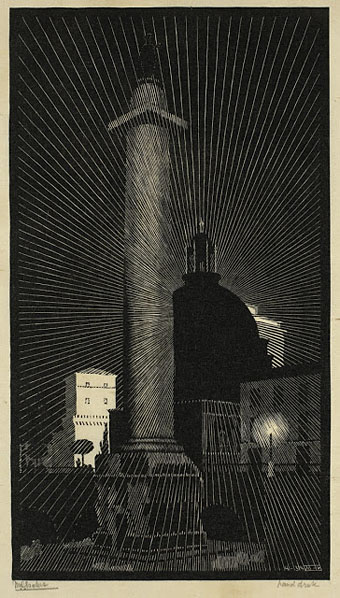
Nocturnal Rome — Trajan’s Column (1934) by MC Escher.

• Many eulogies this week for the late, great Mark E Smith. Strangers to the abrasive splendour of The Fall could do worse than begin with Geeta Dayal‘s list of ten best albums. At YouTube there’s a playlist of The Fall’s Peel Sessions, from 1978 to 2004, while The Fall Quote Generator provides fragments of lyrics and interviews. “Use it like the I Ching.”

• Books with poisoned pages are usually the stuff of fiction but Shadows from the Walls of Death: Facts and Inferences Prefacing a Book of Specimens of Arsenical Wall Papers (1874) by RC Kedzie presents a serious health hazard to would-be readers.

• Man Ray: “There was more surrealism rampant in Hollywood than all the surrealists could invent in a lifetime.” Kimberly Lindbergs looks at Albert Lewin’s 1951 fantasy, Pandora and the Flying Dutchman.

• At Towleroad: “The Most Dangerous Gay Man In America Fought Violence with Violence” Eric Markowitz on the Reverend Raymond Broshears, founder in 1973 of the Lavender Panthers.

• Coming in April from Strange Attractor: All in the Downs: Reflections on Life, Landscape and Song by Shirley Collins.

• Mixes of the week: Secret Thirteen Mix 244 by Daniel O’Sullivan, and XLR8R Podcast 526 by Jamaica Suk.

• At Dennis Cooper‘s this week, a post I might have made myself (but, er, didn’t) about mirrored works of art.

• A preview of Strange Stars: David Bowie, Pop Music and the Year Sci-Fi Exploded by Jason Heller.

• “We live in Philip K Dick’s future, not George Orwell’s or Aldous Huxley’s,” says Henry Farrell.

• Was For Your Convenience (1937) by Paul Pry the first queer city guide?

Fall (1967) by Miles Davis | Fall (2011) by The Haxan Cloak | Fall (2014) by The Bug feat. Inga Copeland

Weekend links 366

kashiki.jpg

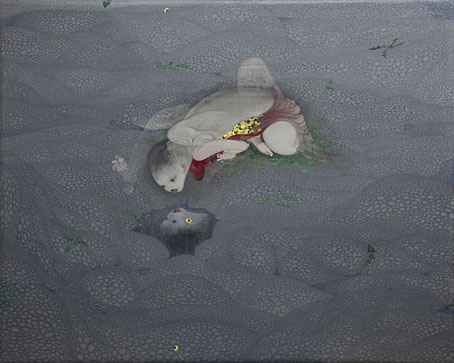
Dandelion (2009) by Tomoko Kashiki.

• “Standard Ebooks takes ebooks from sources like Project Gutenberg, formats and typesets them using a carefully designed and professional-grade style guide, lightly modernizes them, fully proofreads and corrects them, and then builds them to take advantage of state-of-the-art ereader and browser technology.”

Obscenity and the Arts, a previously unpublished essay by Anthony Burgess, will appear in book form later this year via Pariah Press.

• Mixes of the week: VF Mix 97: Talk Talk by The Last Dinosaur, and Secret Thirteen Mix 225 by Janek Schaefer.

Rub any two writers together and similarities will show. No two writers, however different, are completely different. Here’s a crucial instance: Lovecraft and Ballard both put architecture at the heart of their fiction, even though neither had the slightest formal training in the subject. And it is via this interest that the two intersect in an unexpected way. They are connected, through time and space, by that most humble of architectural events: the corner, the junction between two walls. What Lovecraft and Ballard did was to make the corner into a place of nightmares — and in doing so, they reveal its secret history.

Will Wiles in a long and rewarding essay, The Corner of Lovecraft and Ballard

• Dungeons Deep, Forests Dark – A beginner’s guide to Dungeon Synth by Daniel Pietersen.

Alex Ross on Joséphin Péladan, the Symbolists and the occult roots of Modernism.

• Cooling the Tube: engineering heat out of the [London] Underground by IanVisits.

Caroline on the mysteries of Pye Corner: Flames, poltergeists and bodysnatchers.

• The Saint of Sin City – Tony Kail Visits Las Vegas’ Santuario de la Santa Muerte.

• Photographs of Art Nouveau architecture by Keiichi Tahara.

• A stream of the new Porter Ricks album, Anguilla Electrica.

Jasper Sharp on 100 years of Japanese animation.

• At Dennis Cooper’s: 197 clocks.

On The Corner [Take 4] (1972) by Miles Davis | Corner Crew Dub (1976) by Augustus Pablo | Empty Avenues And Dark Corners (Pye Corner Audio Mix) (2013) by John Foxx and the Belbury Circle

Weekend links 351

burgkmair.jpg

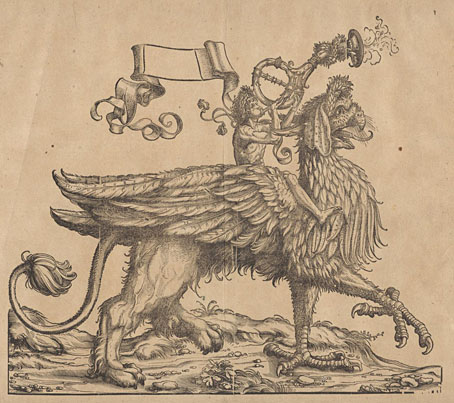
Herald on Griffin (1516-1518) from The Triumphal Procession of Emperor Maximilian I series by Hans Burgkmair the Elder.

• My design and illustration work for Pirate Utopia by Bruce Sterling continues to gain favourable comments, a novelty when reviewers often pass over the visual component of the books under their consideration. One of the most recent examples is in the latest edition of Locus Magazine; this can only be read in full by subscribers but the Tachyon Tumblr has an extract.

Paul La Farge on the complicated friendship of HP Lovecraft and Robert Barlow. Related: The Night Ocean, a short story by Barlow & Lovecraft. Meanwhile, Lovecraft enthusiasts are still raising money for a Providence statue (spot my art and design work in the photo of the Lovecraft Art and Sciences Council).

• At The Quietus this week: Children Of Alice talk to Patrick Clarke about audio collage and English Surrealism, Lottie Brazier enters The Strange World of Annette Peacock, and Manuel Göttsching tells Robert Barry how Ash Ra Tempel became the loudest band in Berlin.

• “Mind the doors!” Eight reviewers pick ten films featuring the London Underground. Not a bad list but choosing a Doctor Who film while ignoring the great Quatermass and the Pit (1967) is an error.

• Mixes of the week: Swedenborgian Hobos by acephale, Secret Thirteen Mix 214 by Fabio Perletta, and a mix for NTS by Six Organs Of Admittance.

• More Surrealism: Leonor Fini, Surrealist Sorceress, a lecture by Dr Sabina Stent, will take place at Treadwell’s Bookshop, London, on 19th May.

• “Michael Chapman’s road-weary guitar resonates with a new generation,” says Joel Rose.

A Journey Round my Room (1794), a book by Xavier de Maistre.

Lyrical Nitrate (1991), a film by Peter Delpeut.

The Sorcerer (1967) by Miles Davis | Impressions Of Sorcerer (1977) by Tangerine Dream | Venom Sorcerer (2014) by Cultural Apparati

Weekend links 328

jamison.jpg

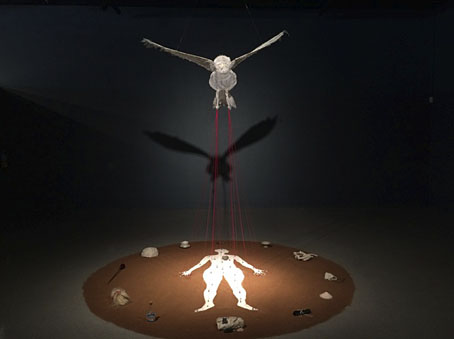
Feathers and Weights (2016) by Susan Jamison.

• The latest release from A Year In The Country is No More Unto The Dance, “a reflection of nightlife memories and the search for the perfect transportative electronic beat”.

Depero Futurista (1927), the bolted book showcasing the artistic work of Fortunato Depero, returns in a facsimile edition.

• This week in the occult: Sam Kean on 21st-century alchemists, and a second volume of The Occult Activity Book.

How could so many jazz critics have overlooked Davis’s powerful trumpet playing on Bitches Brew, and its continuities with his previous work? The reason for their bewilderment was, in large part, the brew, the music’s muddy electric bottom, which bore no resemblance to the jazz they knew. Davis had never been a pure bopper, but his music had always made allusion, however oblique, to the grammar of Parker and Gillespie. On Bitches Brew, Davis decisively broke with his roots in bop. As [George] Grella argues, building on the pivotal work of Greg Tate and Paul Tingen, the more revealing points of comparison were no longer to be found in jazz but in the psychedelic guitar of Jimi Hendrix, the warbled vocals of Sly Stone, and the bass lines of James Brown.

Adam Shatz on Miles Davis

Daniel Wenger on Bob Mizer, “the obsessive photographer behind America’s first gay magazine”.

The Hauntings at Tankerton Park, a book of words and very detailed drawings by Reggie Oliver.

• A 40-minute performance by Pentangle for Norwegian television in 1968.

Maisie Skidmore on ten things you may not know about René Magritte.

• Shirley Collins is the secret queen of England, says Nick Abrahams.

Eighth Climate: ethnographic recordings from the imaginal world.

Pasquale Iannone on five ways to recognise a Pasolini film.

The greatest record sleeves, as chosen by the designers.

Cosmic Horror, new comics work by Ibrahim R. Ineke.

• Mix of the week: FACT mix 569 by S U R V I V E.

• At Dennis Cooper’s: 47 unmade films.

Cosmic Dancer (1971) by T. Rex | Cosmic Slop (1973) by Funkadelic | Cosmic Tango (1973) by Ash Ra Tempel