Nyarlathotep: the Crawling Chaos

nyarlathotep.jpg

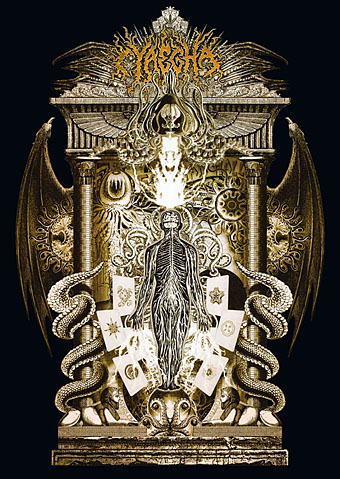
Unveiling another new piece of work, this is a T-shirt design for metal band Cyaegha whose Steps of Descent album I illustrated and designed last year. They asked for something based on HP Lovecraft’s god Nyarlathotep so I thought I’d take the opportunity to rework from scratch the version of this I created in 1999 for the first edition of The Haunter of the Dark. I always felt the earlier piece was going in the right direction but lacked somewhat in execution; this makes up for that. Lovecraft’s Nyarlathotep is one of his most curious creations, in part because the conception of the character changed over many years. In various stories, letters and dream fragments the god/entity is variously described as an Egyptian pharaoh, an itinerant showman with electrical apparatus, the “black man” of European witch cults and the more typically Lovecraftian squamous alien monstrosity. The challenge, then, is to try and represent a little of each of these elements without overly favouring one or the other.

This is one of two illustrations I’ve produced in recent months which use Photoshop to imitate the engraving collage style of Wilfried Sätty, an artist whose work I discussed in an essay for Strange Attractor #2 in 2005. Sätty’s style was derived from Max Ernst’s famous collage “novels” of the 1930s and Photoshop is the ideal tool for this, far better than the old method of scissors, paper and glue. Sätty expanded Ernst’s technique by using reverse printing and the duplication of images; Photoshop extends the technique even further, making it possible to scale images up or down instead of being limited to the size of the original reproduction. The other illustration I’ve done in this style is for a short story and I’ll reveal that closer to publication. In the meantime I should be making a slightly different version of the new Nyarlathotep suitable for the usual range of CafePress products. More about those when they’re done.

Previously on { feuilleton }
The Haunted Palace
The art of Stephen Aldrich

Ballard and the painters

tanguy.jpg

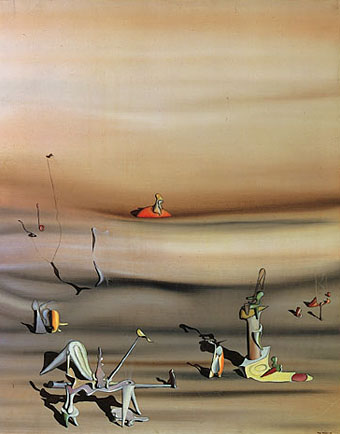
Jours de Lenteur (1937) by Yves Tanguy.

Behind it, the ark of his covenant, stood two photographs in a hinged blackwood frame. On the left was a snapshot of himself at the age of four, sitting on a lawn between his parents before their divorce. On the right, exorcizing this memory, was a faded reproduction of a small painting he had clipped from a magazine, ‘Jours de Lenteur’ by Yves Tanguy. With its smooth, pebble-like objects, drained of all associations, suspended on a washed tidal floor, this painting had helped to free him from the tiresome repetitions of everyday life. The rounded milky forms were isolated on their ocean bed like the houseboat on the exposed bank of the river.

The Drought (1965).

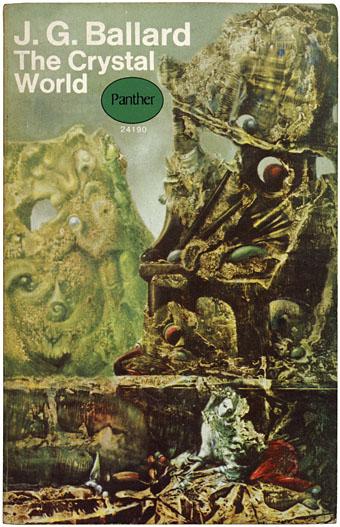
Following my observations yesterday about Ballard’s Surrealist influences, this post seems inevitable. By no means a comprehensive listing, these are merely some of Ballard’s many art references retrieved after a quick browse through the bookshelves earlier. I’d forgotten about the Böcklin reference in The Crystal World. The Surrealist influence in Ballard’s fiction is obvious to even a casual reader, less obvious is the subtle influence of the Surrealist’s precursors, the Symbolists. André Breton frequently enthused over Gustave Moreau‘s airless impasto visions and many of Ballard’s remote femmes fatales owe as much to Moreau’s paintings as they do to Paul Delvaux. The Symbolist connection was finally confirmed for me when RE/Search published their landmark JG Ballard in 1984; there among the list of books on his library shelves was that cult volume of mine, Dreamers of Decadence by Philippe Jullian.

Continue reading “Ballard and the painters”

JG Ballard, 1930–2009

crystal_world.jpg

Panther Books paperback edition, 1968; cover painting: The Eye of Silence by Max Ernst.

If I can’t remember when I first encountered JG Ballard’s work, it’s not because I was reading him at a very early age, more that a childhood enthusiasm for science fiction made his books as omnipresent in my early life as any other writer on the sf, fantasy and horror shelves. I know that when I started to read the New Wave sf writers his work immediately stood out, not only for its originality but also for the numerous references to Surrealist painting which litter his early fiction, references which meant a great deal to this Surrealism-obsessed youth. Ballard was a lifelong and unrepentant enthusiast for the Surrealists, with repaintings by Brigid Marlin of two lost Paul Delvaux pictures prominent in one of his rooms (often featured in photo portraits). I always admired the way he never felt the need to apologise for Salvador Dalí’s excesses, unlike the majority of art critics who dismiss Dalí after he went to America. The paintings of Dalí, Delvaux, Tanguy and Max Ernst became stage sets which Ballard could populate with his affectless characters.

Once I’d encountered the New Worlds writers—Ballard, Michael Moorcock, M John Harrison, Brian Aldiss and company—and their American counterparts, especially Harlan Ellison, Samuel Delany and Norman Spinrad, there was no returning to the meagre thrills of hard sf with its techno-nerdery and bad writing. Ballard and Moorcock were the gateway drug to William Burroughs, Jorge Luis Borges and countless others, and I thought enough of his work in 1984 to attempt a series of unsuccessful illustrations based on The Atrocity Exhibition. It’s been an axiom during the twenty years I’ve worked at Savoy Books that Ballard, Moorcock and Harrison were (to borrow a phrase from Julian Cope) the Crucial Three of British letters, not Rushdie, Amis and McEwan. One of the books I designed for Savoy, The Exploits of Engelbrecht by Maurice Richardson, was a Ballard and Moorcock favourite, and included appreciations of Richardson by both writers. I wish Ballard could have seen the new (and still delayed) edition of Engelbrecht but he got a copy of the earlier book. Sometimes once in a lifetime is more than enough.

Ballardian.com
Pages of obits and MM comment at Moorock’s Miscellany
Ballard interview by V Vale at Arthur with an special intro by Moorcock
Jeff VanderMeer at Omnivoracious
Guardian | Times | Independent | Telegraph

Previously on { feuilleton }
Ballard in Barcelona
1st Ballardian Festival of Home Movies
Revenant volumes: Bob Haberfield, New Worlds and others
JG Ballard book covers

The faces of Parsifal

parsifal.jpg

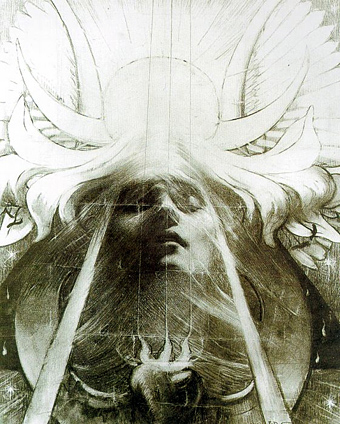
Parsifal by Jean Delville (1890).

Continuing the occasional series of posts examining the evolution of a particular design or image, this one begins with a mystical charcoal drawing by Belgian Symbolist, Jean Delville (1867–1953), our object of concern being that entranced or dreaming face.

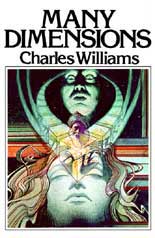
lamb.jpgMy first encounter with Delville’s image wasn’t via the original but came with this Seventies’ version produced for a Charles Williams paperback cover by illustrator Jim Lamb. (And this copy is the only one I can find, reused on a recent audiobook of Williams’ novel. If anyone has a link to a larger copy of the paperback cover then please post it in the comments.) Yes, this is tenuous but when I eventually got to see Delville’s picture it made me think immediately of Lamb’s illustration. Many Dimensions is one of my favourite books by Williams and unusually for him it deals with Islamic rather than Christian mysticism; in that case if Lamb was borrowing from Parsifal then it’s a case of the right image for the wrong book.

Jim Lamb is another illustrator from this period who now works mainly as a landscape artist.

Continue reading “The faces of Parsifal”

Mark Beard’s artistic circle

beard1.jpg

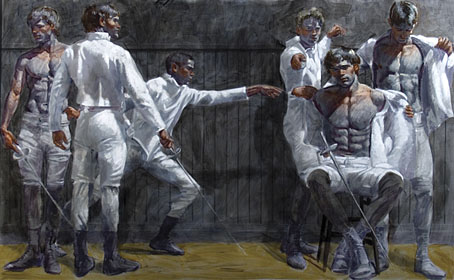
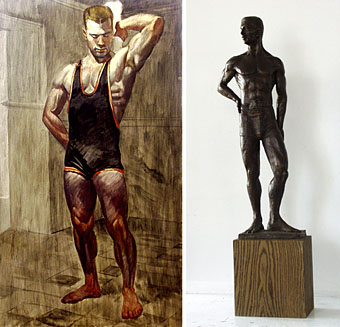
The Fencing Team by Bruce Sargeant.

Artists in the 20th century used to be multifarious in their activities, often taking their work through different stages or periods of evolution; Picasso and Max Ernst are two good examples of this. In today’s inflated art market this is no longer a wise move. As Brian Eno has noted in the case of the polymathic Tom Phillips, the pressure is there to establish yourself as a person who does one thing only, to turn yourself into a brand.

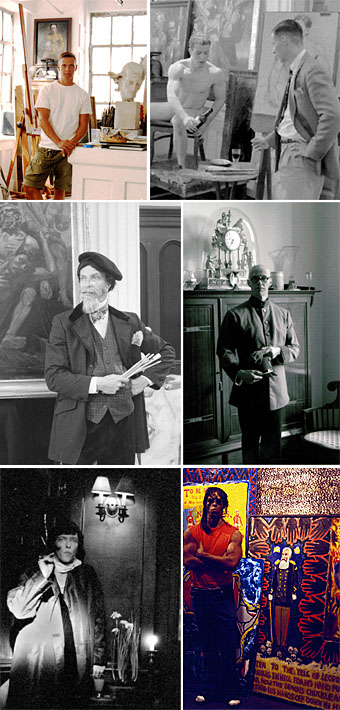
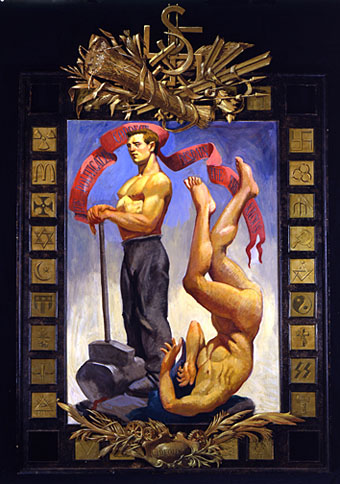
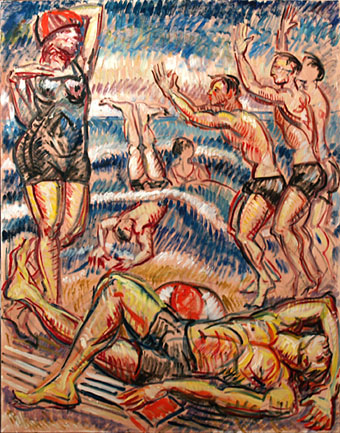
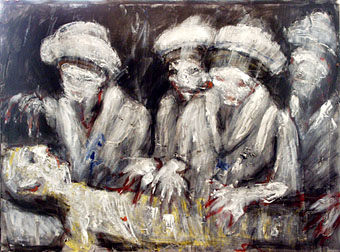
American artist Mark Beard isn’t happy with that situation. In order to satisfy a desire to create in whatever styles he chooses, he’s developed a number of distinct artist personalities, each with their own detailed biographies and even photographs (below). This isn’t entirely unprecedented, Marcel Duchamp famously had a female alter-ego named Rrose Sélavy, and was photographed by Man Ray in feminine attire, but offhand I can’t think of another artist going as far as creating six distinct personas. The painting above is one of a homoerotic sports-themed series by artist Bruce Sargeant who died, we’re told, in 1938 as a result of a wrestling accident. Examples of Beard’s other influences follow. For the complete artist biographies, see the Mark Beard pages at the Carrie Haddad gallery.

The artists

beard2.jpg

top left: Mark Beard (b. 1956); right: Bruce Sargeant and model (1898-1938)
middle left: Hippolyte-Alexandre Michallon (1849-1930); right: Brechtolt Steeruwitz (1890-1973)
bottom left: Edith Thayer Cromwell (1993-1962); right: Peter Coulter (b. 1948)

Their works

beard3.jpg

Ideology: The Politically Correct Disdain the Frivolous by Mark Beard (1989).

beard4.jpg

Avant la Fuite by Hippolyte-Alexandre Michallon (1894).

beard5.jpg

Swimmer Drying Himself, Berlin Olympics (1936), Young Athlete by Bruce Sargeant.

beard6.jpg

On the Strand by Edith Thayer Cromwell.

beard7.jpg

Das Krakenhaus by Brechtolt Steeruwitz (At the Hospital) (1923).

beard8.jpg

Cabinet by Peter Coulter.

Elsewhere on { feuilleton }
The gay artists archive