Weekend links 534

hasui.jpg

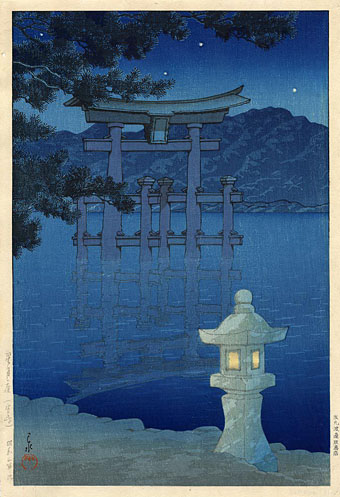
Beautiful night – moon and stars, Miyajima Shrine (1928) by Hasui Kawase.

• One announcement I’d been hoping for since last summer was the news of a second box of Tangerine Dream albums to follow the excellent In Search Of Hades collection. The latter concentrated on the first phase of the group’s Virgin recordings, up to and including Force Majeure. This October will see the release of a new set, Pilots Of Purple Twilight, which explores the rest of the Virgin period when Johannes Schmoelling had joined Froese and Franke. Among the exclusive material will be a proper release of the soundtrack for Michael Mann’s The Keep (previously a scarce limited edition), together with the complete concert from the Dominion Theatre, London. Also out in October, Dark Entries will be releasing a further collection of recordings from the recently discovered tape archive of Patrick Cowley. The new album, Some Funkettes, will comprise unreleased cover versions, one of which, I Feel Love by Donna Summer, is a cult item of mine that Cowley later refashioned into a celebrated megamix.

• “Did you know that Video Killed The Radio Star was inspired by a JG Ballard story?” asks Molly Odintz. No, I didn’t.

Casey Rae on the strange (musical) world of William S. Burroughs. Previously: Seven Souls Resouled.

• “And now we are no longer slaves”: Scott McCulloch on Pierre Guyotat’s Eden Eden Eden at fifty.

• At Dennis Cooper’s: Frank Jaffe presents…Dario Argento and his world of bright coloured blood.

• At Wormwoodiana: The Serpent Calls. Mark Valentine on a mysterious musical instrument.

• At Spoon & Tamago: Long-Exposure Photographs of Torii Shrine Gates by Ronny Behnert.

• Mix of the week: mr.K’s Soundstripe vol 4 by radioShirley & mr.K.

• Rising sons: the radical photography of postwar Japan.

• The illicit 1980s nudes of Christopher Makos.

• RIP Diana Rigg.

Garden Of Eden (1971) by New Riders Of The Purple Sage | Ice Floes In Eden (1986) by Harold Budd | Eden (1988) by Talk Talk
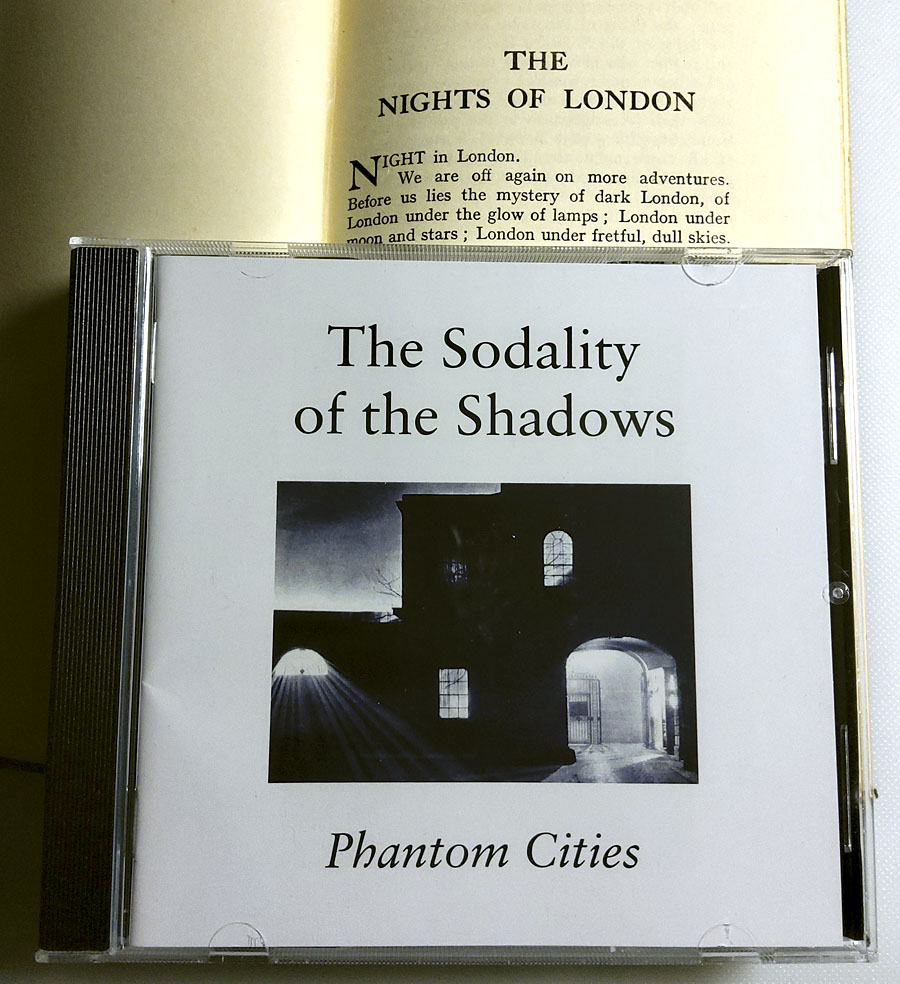
Phantom Cities by The Sodality of the Shadows

phantom.jpg

Book by HV Morton (1926) not included.

I like night music, any kind of night music, whether it be the shimmering sonorities of Béla Bartók and George Crumb, Julee Cruise exploring the dark, or the rumbling atmospheres of Thomas Köner. Phantom Cities by The Sodality of the Shadows is night music of another kind, more musically determined than the numerous purveyors of post-Köner dark ambience, with a character defined by weird fiction. The latter quality is perhaps inevitable given the people who comprise the group: Ray Russell and Rosalie Parker have been running Tartarus Press for the past 30 years; Mark Valentine is an author and editor (and occasional publisher) of many story collections, and Jon Mueller’s name has appeared here in the past via the soundtrack CD for the Swan River Press edition of The House on the Borderland that I illustrated. Phantom Cities sidesteps Robbe-Grillet’s Topology of a Phantom City for an older lineage, looking back to Arthur Machen (the group’s name is borrowed from a secret society formed by Machen and AE Waite) and the spectral metropolis of pre-war London photographed by Harold Burdekin in London Night (1934). The music is slow, sombre and reverberant; guitars pluck notes from the embracing dark while Mueller’s drums maintain a funereal pace; sporadic squalls of feedback suggest a deeper darkness, the latent possibilities of unpeopled streets. Mark Valentine had an earlier musical persona as The Mystic Umbrellas but his contribution here is textual accompaniment in the form of 12 fictional pieces, some of which are read by Rosalie Parker over and between the music. This isn’t a collection of readings, however, the album may be taken either as illustration of Burdekin’s photos and the texts or as a work that stands alone. A soundtrack for the longer nights of encroaching autumn.

Phantom Cities
Strange Houses Of Sleep

Previously on { feuilleton }
The Smoke
Two albums
Thomas Köner

Weekend links 533

calvino.jpg

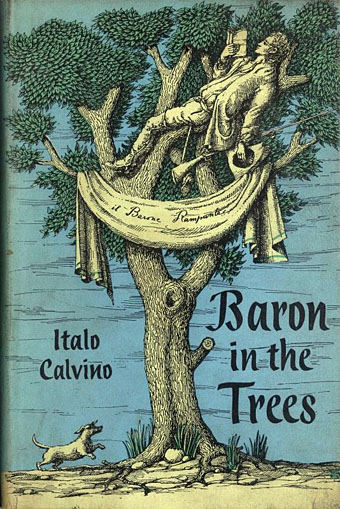
Cover art by Domenico Gnoli, 1959.

• After decades of ignoring the output of Tangerine Dream it feels strange to be interested in the group once again; musicians you’re compelled to dismiss seldom manage to recapture your attention later on. Stranger still when the group itself is now completely detached from its origins following the death of founder Edgar Froese in 2015. But it was Froese’s departure, and with it the disappearance of many years of poor aesthetic choices, that helped renew my interest. At FACT the group take up the against-the-clock challenge in which musicians are given 10 minutes to create a new piece of music.

• “We were both working at Sounds at the time and we thought that instead of listening to these terrible ’80s records like Haircut 100 we’d go off and look for Montague Summers books, so off we went!” Savage Pencil (Edwin Pouncey) on his enthusiasm for Summers, Austin Spare and Louis Wain.

• At the Paris Review: Valerie Stivers bakes pies for Italo Calvino. I’d like to see someone create a series of dishes based on every location from Invisible Cities. Elsewhere there’s William N. Copley on Joseph Cornell: “No art historian ever prophesied the coming of the box.”

• On the experimental realism of an eccentric Russian Anglophile: “For Sigizmund Krzhizhanovsky, strangeness was a matter of perspective,” says Caryl Emerson.

Nova Reperta: John Boardley on a series of 16th-century prints showing new inventions.

• RIP David Graeber. From 2014: “What’s the point if we can’t have fun?

• “Damn your blood”: John Spurr on swearing in early modern English.

• At Wormwoodiana: Mark Valentine maps the esoteric in Britain, 1920.

• At Dennis Cooper’s: Seijun Suzuki Day.

Big Fun/Holly-wuud (Take 3) (1972) by Miles Davis | Funtime (1977) by Iggy Pop | Funny Time Of Year (2002) by Beth Gibbons and Rustin Man

Foiled at last

foil.jpg

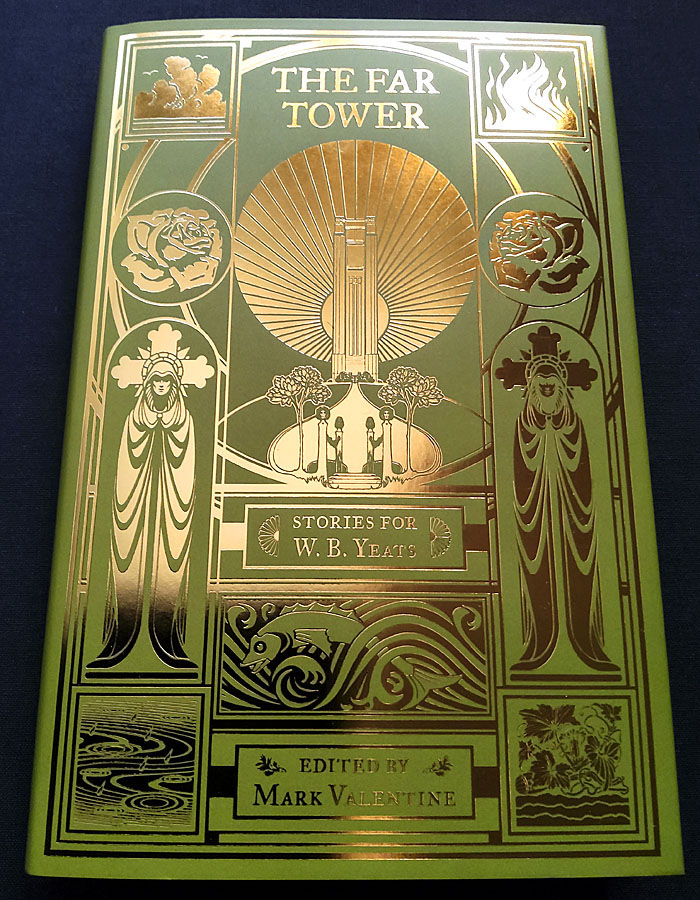
I’ve already written about the design for this story collection from Swan River Press but the gradient layout does nothing to convey the splendour of the foil-embossed printing. In the past when I’d suggested to publishers that foil printing might be an option the idea was always turned down for reasons of cost. My original intention for The Far Tower was for the design to be printed in a metallic ink so it might resemble the gold-on-green cover of the Yeats book which was the model for this volume. Metallic inks don’t always work too well, however, especially on a darkish background, so I said to Swan River “Or we could do it in gold foil…” To my surprise and delight they said “Why not?” So here’s the result. A great end to the year. The book is available here.

lansdale.jpg

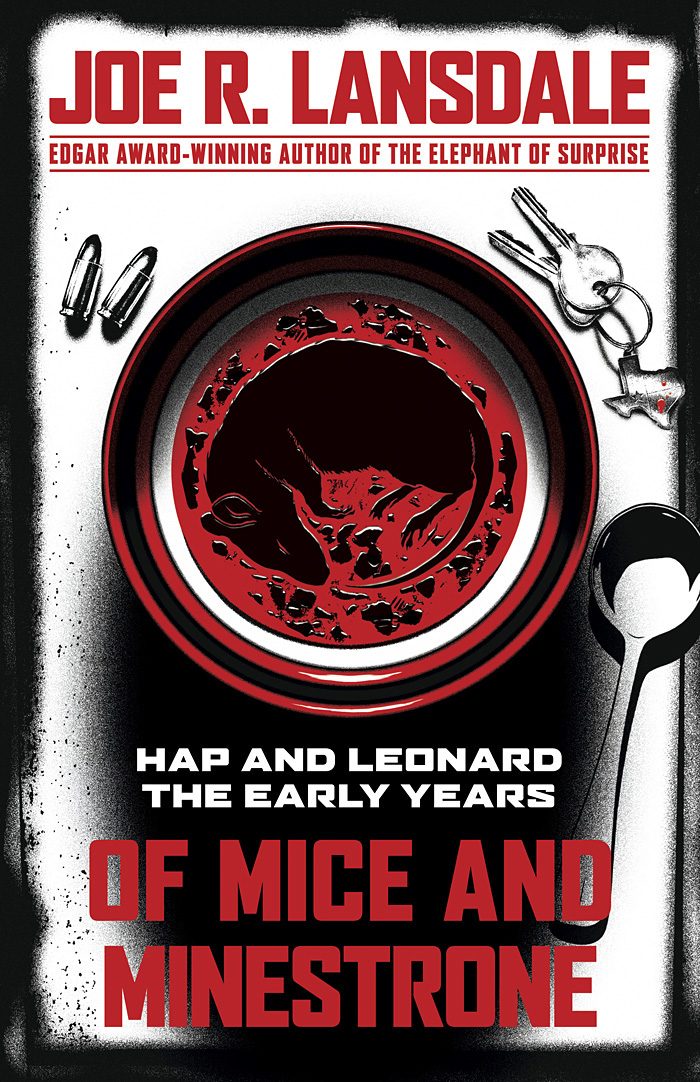
And back in October, I posted what everyone thought at the time was the final design for Of Mice and Minestrone, a new book of Hap and Leonard stories by Joe R Lansdale. The Hap and Leonard books are popular works (there was a TV series based on them a while back) so they’re subject to the demands of the marketplace which in this case required a cover more in line with the red/white/black arrangement of some of Lansdale’s related titles. I’d already done most of this as an additional draft during the work on the first design so the reworking wasn’t too time-consuming. The rodent in the soup is more visible in this version which is another point in its favour. Of Mice and Minestrone will be published by Tachyon in May next year.

Previously on { feuilleton }
The Far Tower: Stories for WB Yeats
Of Mice and Minestrone

The Far Tower: Stories for WB Yeats

tower.jpg

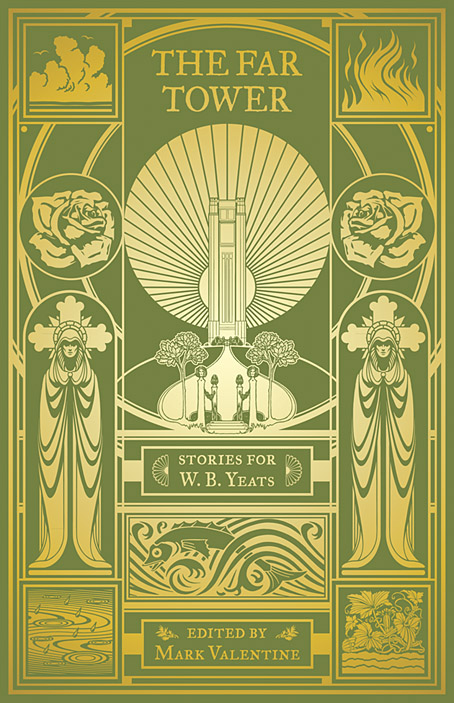
I said a couple of weeks ago that I had more cover designs waiting to be revealed, and this was one of them, arriving two years to the week after my earlier cover for The Scarlet Soul: Stories of Dorian Gray. Both books are collections of original fiction edited by Mark Valentine for Swan River Press, and both offer variations on works by Irish authors prominent during the 1890s:

“All Art that is not mere story-telling,
or mere portraiture, is symbolic…” — WB Yeats

Stories of magic and myth, folklore and fairy traditions, the occult and the outré, inspired by the rich mystical world of Ireland’s greatest poet, WB Yeats. We invited ten contemporary writers to celebrate Yeats’s contributions to the history of the fantastic and supernatural in literature, drawing on his work for their own new and original tales. Each has chosen a phrase from his poems, plays, stories, or essays to herald their own explorations in the esoteric. Alongside their own powerful qualities, the pieces here testify to the continuing resonance of Yeats’s vision in our own time, that deep understanding of the meshing of two worlds and the talismans of old magic.

Yeats had a career that extended beyond the fin de siècle, of course, and the title of The Far Tower alludes to The Tower, a collection of poems that Yeats published in 1928. (The first poem in the book, Sailing to Byzantium, is the origin of the phrase/title “no country for old men”.) Yeats’s poetry is very different to the Modernists, however, and remained infused with mystical resonances, something I tried to reflect in the cover design. In addition to the very Yeatsian symbol of the rose there are symbols for the four elements, and a pair of robed figures who can be taken as adepts of one sort or another, either the Golden Dawn (who Yeats was involved with for a time) or the various Theosophists and Rosicrucians of the period who fed his imagination.

The green-and-gold colour scheme matches the gold on green design that Thomas Sturge Moore created for the first edition of The Tower. Sturge Moore produced covers for a number of Yeats’s books but it was his splendid design for Axel by Auguste Villiers de L’Isle-Adam that gave me the nested circles and vertical division of the board. That edition happens to have a preface by Yeats so as an influence it isn’t too remote.

The Far Tower will be published in December but is available for pre-order now.

Previously on { feuilleton }
The Scarlet Soul: Stories for Dorian Gray
Form and Austin Osman Spare
Golden apples and silver apples
A Book of Images by WT Horton
The Savoy magazine