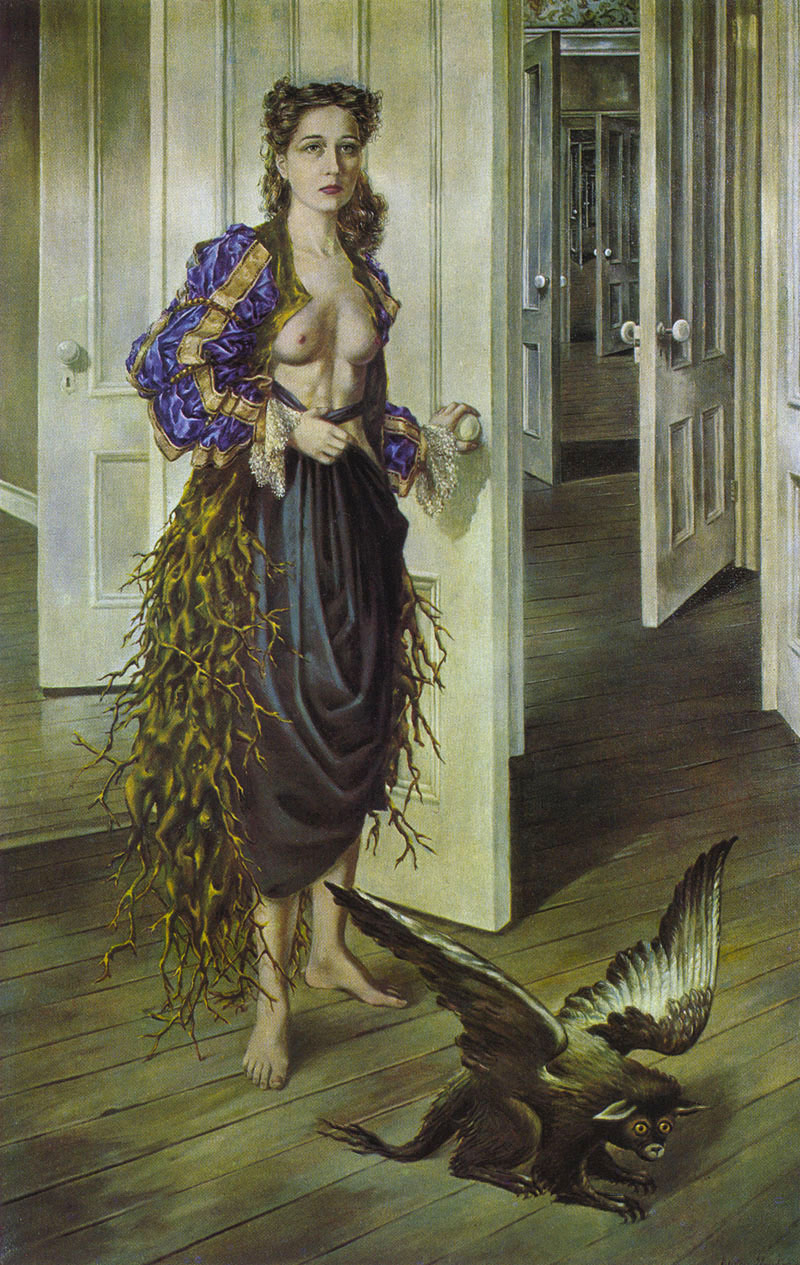
Dorothea Tanning, 1910–2012

tanning.jpg

Birthday (1942) by Dorothea Tanning.

In pre-internet days it always used to surprise me to read that Dorothea Tanning was still alive when one seldom heard much about her; Leonora Carrington seemed positively hyperactive by comparison. In the end Dorothea outlasted all her Surrealist contemporaries, and the announcement of her death this week sees the passing of that generation of art revolutionaries. Birthday became an immediate favourite when I first encountered it in art books some thirty-odd years ago, and it remains my favourite among her works. John Glassie interviewed her for Salon ten years ago when she had this to say about the painting:

Well, excuse me for this, but “Birthday” is among other dreamlike things, a topless self-portrait. Is it fair to say that at that time, 1942, people thought you were immodest?

Well, I was aware it was pretty daring, but that’s not why I did it. It was a kind of a statement, wanting the utter truth, and bareness was necessary. My breasts didn’t amount to much. Quite unremarkable. And besides, when you are feeling very solemn and painting very intensively, you think only of what you are trying to communicate.

So what have you tried to communicate as an artist? What were your goals, and have you achieved them?

I’d be satisfied with having suggested that there is more than meets the eye.

She also offered a piece of sound advice:

Keep your eye on your inner world and keep away from ads and idiots and movie stars, except when you need amusement.

New York Times: Dorothea Tanning, Surrealist Painter, Dies at 101
• Coilhouse: “My work is about leaving the door open to the imagination.”
New York magazine: Jerry Saltz on Dorothea Tanning
Guardian obituary | From 2004: “I’ve always been perverse!”

Previously on { feuilleton }
Leonora Carrington, 1917–2011
Marsi Paribatra: the Royal Surrealist
Dorothea Tanning: Early Designs for the Stage
Angels of Anarchy: Women Artists and Surrealism
The art of Leonor Fini, 1907–1996
Surrealist women

Weekend links 82

morris.jpg

At the Mountains of Madness (1979) from Halloween in Arkham by Harry O. Morris.

• Golden Age Comic Book Stories always pulls out the stops in the run up to Halloween. In addition to a wonderful collection of Harry O. Morris collages, Mr Door Tree has also been posting Virgil Finlay’s illustrations for Edgar Allan Poe, Lynd Ward’s tremendous illustrations for a collection of weird tales entitled The Haunted Omnibus, Barry Moser’s woodcuts for an edition of Frankenstein, and Virgil Finlay’s illustrations for stories and poems by HP Lovecraft.

• “Eugene Thacker suggests that we look to the genre of horror as offering a way of thinking about the unthinkable world. To confront this idea is to confront the limit of our ability to understand the world in which we live – a central motif of the horror genre. In the Dust of This Planet explores these relationships between philosophy and horror.”

• “…the reader […] becomes a conscious participant in the process of imposing a linear sequence, while at the same time remaining aware that all narrative is an act of memory, and that memory is necessarily random.” Jonathan Coe reviews Marc Saporta’s book-in-a-box, Composition No.1, recently republished by Visual Editions.

• Nearly fifty years after its first performance, Peter Weiss’s Marat/Sade is still disturbing playgoers. And nearly ninety years after its release, Alla Nazimova’s silent film production of Oscar Wilde’s Salomé is touring the UK with live musical accompaniment.

Tom of Sinland at Homotography, in which illustrator Bendix Bauer portrays some of the fashion world’s notable male designers as Tom of Finland-style characters for Horst magazine.

Neil Gaiman Presents is a new audiobook imprint which launches with works by Jonathan Carroll, Alina Simone, Keith Roberts, M. John Harrison and Steven Sherrill.

• The Weird Wild West: Paul Kirchner has put all his Dope Rider comic strips online.

Leonora Carrington prints at Viktor Wynd Fine Art, London, from November 5th.

The Fall to Earth: David Bowie, Cocaine and the Occult.

Photos of New York City, 1978–1985.

Kathy Acker recordings at Ubuweb.

The Occupied Times of London.

The Golden Age of Dirty Talk.

Pushkin silhouettes.

• This week I’ve been lost in the Velvet Goldmine (again): John, I’m Only Dancing (1972) by David Bowie | The Jean Genie (1972) by David Bowie | Drive-In Saturday (1973) by David Bowie.

Weekend links 78

carr.jpg

Struggle (2009) by Lindsey Carr.

• “Twilight Science is an imprint for sound, music and DVD editions initiated by artist Paul Schütze. We will progressively publish all back catalogue, new projects and collaborations. These will include works by Phantom City, NAPE, Schütze-Hopkins and others.” Related (because Paul Schütze remixed Main): Main Feed The Collapse, Neil Kulkarni talks to Robert Hampson.

• “You can’t really narrate or display this situation, you can only, endlessly, contemplate it. When the writer or director gets tired of the iterations, he tells us who the mole is.” Michael Wood on the novel, (superb) television series and recent film of Tinker, Tailor, Soldier, Spy.

• “Havin’ a dick is pretty fuckin’ awesome” says Horst, a new gay magazine limited to 1000 copies. Related (well, there’s a guy in and out of his underwear): Naked Lunch, a fashion shoot very tenuously based on David Cronenberg’s film.

“At first, I tried fighting bullies one-on-one, but they don’t fight fair; they fight two and three on one,” Bennett said. So the youths got together and “started carrying mace, knives, brass knuckles and stun guns, and if somebody messed with one of us then all of us would gang up on them.”

 “Gay black youths go from attacked to attackers” says the headline. A group of genuine Wild Boys; William Burroughs would have approved.

• Tor.com reminded me of Sally Cruikshank‘s amazing animated film Face Like a Frog (1987) which features a score and Cab Calloway-style song by Danny Elfman.

• It’s 1969, OK? Pádraig Ó Méalóid talks with Kevin O’Neill about the Swinging League of Extraordinary Gentlemen.

• In the Tumblr labyrinth this week: Fuck Yeah St Sebastian and Gender is Irrelevant.

• For when you need some motherfucking placeholder text: Samuel L Ipsum.

• “Study finds ‘magic mushrooms’ may improve personality long-term.”

Solar Megalomania: paintings by Leonora Carrington.

• It’s all fun and games until Charles Manson turns up.

Firmament II (1993) by Main | Firmament IV (1993) by Main | Reformation (1994) by Main.

Dalí’s Salomé

dalisalome.jpg

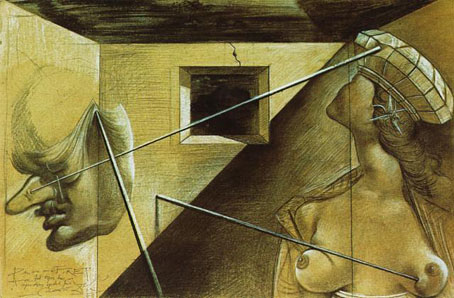
Queen Salomé (1937) by Salvador Dalí.

Of all the Surrealists, Salvador Dalí had his fingers in the most cultural pies—designing for film and theatre, writing books (including a novel, Hidden Faces), even performing occasionally, or at least making a public spectacle of himself—so it’s no surprise to find him adding to the stock of 20th-century Salomé interpretations, first in a drawing then for the stage. The stage work was something I hadn’t run across before (not since this current obsession began, anyway), a 1949 production of the Strauss opera at Covent Garden directed by Peter Brook. The now celebrated theatre director was at the outset of his career when he chose Dalí as his designer but the resultant furore shows that Brook’s ability to challenge an audience (or at least, a gaggle of theatre critics) had an early start. The critics savaged the production and the show closed after only six performances. Brook, who was sacked, had this to say:

The critics all decided that Dali and I were only out to annoy them. There, at least, I might claim that they underestimated us; if that have been our intention I think that between us we might have done much worse… (More)

Getty Images has some tantalising photos here, here and here, but I’ve not seen anything in the way of production sketches. The objections seem to have been the usual tiresomely English revulsion against anything too original, too strange or too imaginative (it’s no wonder Leonora Carrington abandoned Britain for Mexico). An article about the production from the BBC’s Music Magazine includes this detail:

In the last scene for Dali and Brooke, [Salomé] was slowly covered over by a sort of green ooze of bile that came from the head of John the Baptist, an effect of luxuriant disgust which we can imagine without too much difficulty, bearing in mind others of Dali’s images.

That piece also mentions a proposed restaging of the opera with Dalí’s designs but I’ve been unable to discover whether this took place. If anyone knows better, please leave a comment.

Elsewhere on { feuilleton }
The Salomé archive

Leonora Carrington, 1917–2011

carrington.jpg

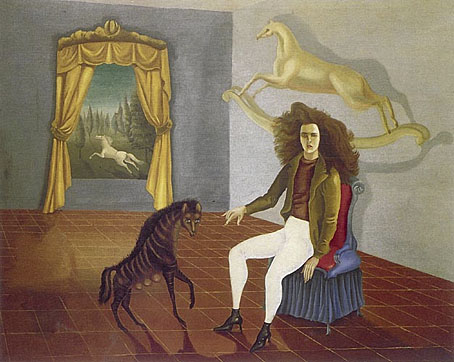
Self-portrait (1937–38) by Leonora Carrington.

Imagination and fantasy were two of the tools women artists used in the early decades of the 20th century to force their way into a male-dominated art world. The proliferation of illustrated books provided a creative platform in the Edwardian era for women shut out of art movements whose aesthetics might be avant garde but whose attitudes to sexual politics were either ignorant or reactionary. It was only with the advent of Surrealism that a notable body of women artists emerged in the field of painting and sculpture, not only Leonora Carrington but her almost namesake Leonor Fini, Dorothea Tanning, Remedios Varo, Meret Oppenheim, Kay Sage, Valentine Hugo and others. Part of this was the tenor of the time, of course, but Surrealism had no choice but to be open to anyone who came calling; if you’re going to let dreams and irrationality dictate the debate then everything that was previously fixed is up for grabs including gender dominance and sexuality. Leonora Carrington had a longer career than her contemporaries, and also distinguished herself as a writer of fantastic novels and short stories. Dalí aside, it could be argued that among the original Surrealists it was the women who stayed true to the project in subsequent decades. Max Ernst was a lover of Leonora and later married Dorothea Tanning but he left Surrealism after the Second World War for other styles of painting.

In Carrington’s work, mystical forces and surging instincts overpower the reign of reason. This is rebellion and liberation in the true surrealist sense. It is not the angry, testosterone-driven smack in the face typical of the high-profile showmen of surrealism. Rather, it is a low-key mystic subversion powered by the intrigues of seductive sibyls, sorceresses, and priestesses. (More.)

Among the obituary notices surfacing there’s a piece by Leonora’s cousin, Joanna Moorhead, who wrote a couple of years ago about her search for her celebrated relative, and a notice in the Telegraph. Ten Dreams has a small gallery of her paintings.

For Leonora Carrington by Peter Lamborn Wilson
• Coilhouse: Leonora Carrington – 6 April 1917 – 25 May 2011

Previously on { feuilleton }
Marsi Paribatra: the Royal Surrealist
Angels of Anarchy: Women Artists and Surrealism
Return to Las Pozas
The art of Leonor Fini, 1907–1996
Surrealist women
Las Pozas and Edward James