Tentacles #2: The Lost Continent

lost4.jpg

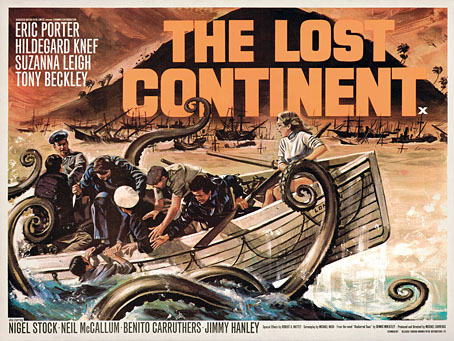
If William Hope Hodgson’s The Boats of the ‘Glen Carrig’ represents the Sublime of tentacular sea fiction then The Lost Continent, a 1968 Hammer film based on Dennis Wheatley’s 1938 novel Uncharted Seas, is the correspondingly Ridiculous end of the subgenre. The Lost Continent is an irritating film for Hodgson enthusiasts since it’s still the most Hodgsonian film out there, at least where the Sargasso side of things is concerned.

uncharted1.jpg

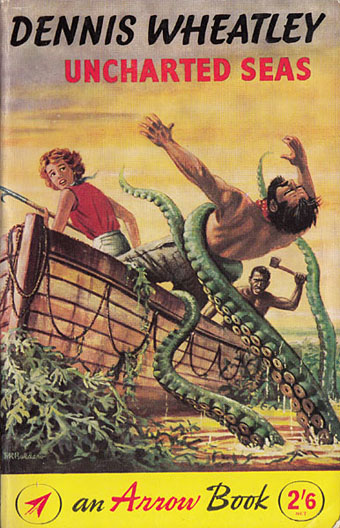
Illustration by SR Boldero (1960).

Despite its Wheatley origins the similarities to Hodgson’s sea stories are no coincidence: Wheatley chose two Hodgson titles—Carnacki, the Ghost-Finder and The Ghost Pirates—for the Dennis Wheatley Library of the Occult series that Sphere Books published in the 1970s. In the introductions Wheatley notes that Hodgson was a favourite writer whose work he discovered in the 1920s; he also mentions having collected a set of Hodgson first editions. Wheatley could have justifiably claimed that the “Weed-World” as a location wasn’t unique to Hodgson but Uncharted Seas also features the giant crabs, marauding octopuses and besieged castaways familiar from The Boats of the ‘Glen Carrig’ and the short stories.

Continue reading “Tentacles #2: The Lost Continent”

Weekend links 93

favre.jpg

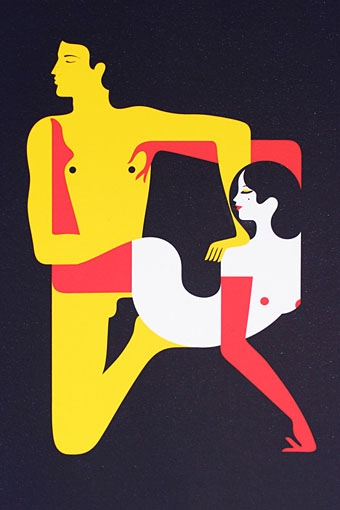
One of a series of tremendous designs by Malika Favre for a new Penguin edition of the Kama Sutra.

• New interviews: “…Americans — mired in individualism — prefer to think in terms of identity than in terms of roles and masks. An American would never have called a novel Confessions of a Mask.” Nicholas Currie, better known via his Momus mask. | “The horror in music comes from the silence,” says John Carpenter. | “It’s dangerous to be an artist. That’s what we talk about in Naked Lunch — and it’s dangerous on many different levels. Politically it can be dangerous, but psychologically it can be quite dangerous too. You make yourself very vulnerable. You put yourself out there and of course you open yourself up to criticism and attack.” David Cronenberg at the Los Angeles Review of Books.

• New books: Dotter of Her Father’s Eyes, a Joycean memoir by Mary M Talbot and Bryan Talbot. | A stack of new works from Strange Attractor including a collection of Savage Pencil‘s Trip or Squeek comic strips. | Robert Irwin’s Visions of the Jinn: Illustrators of the Arabian Nights. A shame about the high price on the latter but I’m sure it looks wonderful.

• The Blu-ray release of Wings (1927), William A. Wellman’s silent drama about air aces during the First World War, has prompted renewed attention for the passionate relationship between its two male leads, especially this deathbed scene which is tagged as the first same-sex kiss in cinema. That’s arguable, of course, but it’s certainly a touching moment.

• From 2009: Searching the Library of Babel, a list of all the stories in all 33 volumes of The Library of Babel, a 1979 Spanish language anthology of fantastic literature edited by Jorge Luis Borges.

• Lots of newpaper attention in the past week for the not-so-fresh news that magic mushrooms could help fight depression. Nature went into the detail of the latest studies.

French group Air have written the score for a rare colour print of Le voyage dans la lune (1902) by Georges Méliès. Air’s YouTube channel has extracts.

• From 1989: The Merchant of Shadows by Angela Carter.

Will Hunt on the Ghost River of Manhattan.

Selected Letters of William S. Burroughs

Sexy Boy (1998) by Air | Surfing On A Rocket (2003) by Air | Mer Du Japon (2007) by Air.

Weekend links 72

lesyeux.jpg

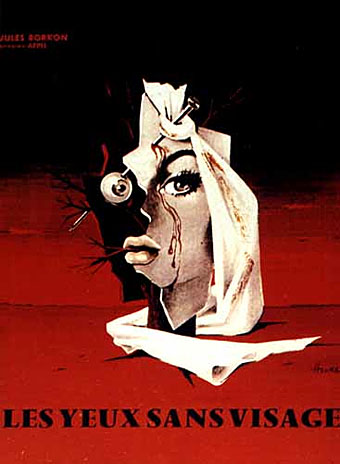
If Jean Cocteau had made a horror film it might have resembled George Franju’s dreamy and disturbing body-horror masterwork Les Yeux Sans Visage (1960). I’ve not been able to trace the artist for this poster but it’s a good example of the diluted Surrealism which was still prevalent in poster graphics at this time.

If I were asked what’s needed today, I’d say innovation, and greater timbral variety. If you truly want the audience to experience the clammy thrill of the grotesque, the uncanny and the fearful, you have to reach for the unfamilar, the perplexing, even the ugly; there’s an infinite Lovecraftian sound-world out there waiting to be explored. We need new combinations, new textures in film scoring. Horror has a licence to be weird – it’s supposed to mess with our heads. (more)

Stephen Thrower.

Stephen Thrower is an ex-member of Coil, a current member of Cyclobe, was the editor of a great magazine, Eyeball, devoted to horror cinema and what Kim Newman (casting about for a wider, non-generic label) calls “nightmare movies”, and is the author of Nightmare USA and Beyond Terror: The Films of Lucio Fulci. In other words, he’s more than qualified to write about horror film soundtracks. The reason is an event at the South Bank Centre, London, two weeks from now, Sound of Fear: The Musical Universe of Horror, one of the highlights of which will be a performance by John Carpenter’s soundtrack collaborator Alan Howarth. Related: my post about Italian horror soundtracks from 2008.

lovato.jpg

Art by Justin Lovato.

Mind Over Matter: Alan Fletcher’s The Art of Looking Sideways. “The Art of Looking Sideways captures the sensory overload of contemporary visual culture, while also acting as a primer in visual intelligence.” Related: Alan Fletcher profiled at the Design Museum.

• More music and more psychedelia: Past Present Future Space-Time “Wysing Arts Centre explores the legacy of psychedelia in this year’s annual music event”.

The Coilhouse International Silent Auction is GO and ends Sunday night if you want to bid for some rare and special things.

The Garden of Kama and Other Love Lyrics from India (1901), illustrated by John Byam Shaw.

• Chris Marker’s take on the recent London riots: Overnight.

• Bristol’s graffiti artists are redecorating the city’s streets.

• Women and knives: a Dario Argento poster gallery.

Inferno (1993) by Miranda Sex Garden, from their album Suspiria.

Morlocks, airships and curious cabinets

morlock.jpg

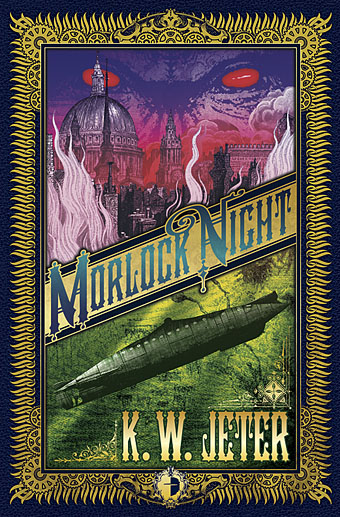
Things I was working on late last year continue to percolate or, if you prefer, build a head of steam. My cover for KW Jeter’s Morlock Night appears in a short piece by Rick Poynor in July’s Creative Review. That feature is prompted by the British Library’s Out of the World exhibition. Nice to see something of mine with Hannes Bok’s illustration for Who Goes There? by John W Campbell, the story which was filmed as The Thing from Another World, and later, John Carpenter’s The Thing.

Morlock Night is also one of my contributions to the lavish Steampunk Bible which editors SJ Chambers and Jeff VanderMeer have been promoting for the past couple of months. USA Today ran a feature on the book which included my piscine airship among the selected illustrations.

Next up will be the Thackery T Lambshead Cabinet of Curiosities for which I’ve provided a number of illustrations and decorative title pages. Jeff V has a preview shot of the cover. That will be out next month. More later.

Previously on { feuilleton }
The Steampunk Bible
Steampunk Reloaded
Steampunk overloaded!
Vickers Airship Catalogue
The Air Ship
Dirigibles
More Steampunk and the Crawling Chaos
The art of François Schuiten
Steampunk Redux
Steampunk framed
Steampunk Horror Shortcuts
The Airship Destroyer
Zeppelin vs. Pterodactyls
The Hetzel editions of Jules Verne

A Secret Wish by Propaganda

propaganda1.jpg

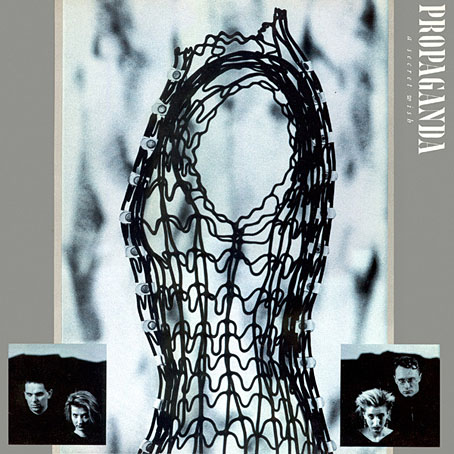
A Secret Wish (1985). Design by the London Design Partnership.

The dark Religions are departed & sweet Science reigns
— William Blake

It’s a hallmark of musical obsession when you find yourself buying the same album over and over. Propaganda’s meisterwerk from 1985, A Secret Wish, was finally released in a definitive double-CD version this week, the fourth edition I’ve bought (after the original vinyl and two other CD releases). This new set is easily the best of the lot.

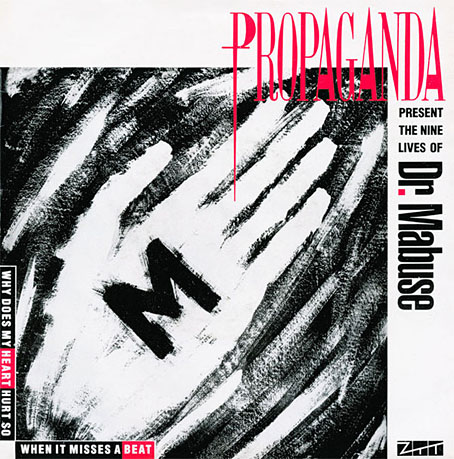
Propaganda were always my favourites among the early acts on Trevor Horn and Paul Morley’s ZTT label, smarter than Frankie Goes To Hollywood and more musical than the Art of Noise. How could I resist another quartet of Germans from Kraftwerk’s home city of Düsseldorf, a group memorably described in the music press as “ABBA from Hell”? The first single in 1984, Dr Mabuse, came along when I’d been immersed in Lotte Eisner’s celebrated study of German Expressionist cinema, The Haunted Screen; an avant-garde pop outfit devoted to the same material was just the thing I wanted to hear. Almost a mini-album, the single’s A-side was filled by an epic ten-minute song describing the nature of Dr Mabuse, a villainous anti-hero from several Fritz Lang films. On the B-side there was a cover of The Velvet Underground’s Femme Fatale (and another Lang reference in the subtitle, The Woman with the Orchid), followed by some metal bashing and a taste of the A-side’s Schönberg-esque orchestral stabs before Dr Mabuse returned again at the end. Cover versions were an important thing at ZTT, as was the idea of the 12-inch single as a self-contained work, Mabuse being a prime example. All of this came packaged in a sleeve whose Anton Corbijn painting referenced another Fritz Lang film, M… It felt as though they were doing this purely for my benefit.
propaganda2.jpg

Dr Mabuse (1984). Design by Anton Corbijn and XL.

The intertextual reference on this and subsequent releases isn’t surprising given the people involved. Paul Morley took a great delight in embellishing the ZTT releases with quotations—the Frankie album was probably the first chart-topping release with a recommended reading list—while band member Ralph Dörper had been with the Neue Deutsche Welle group Die Krupps prior to Propaganda, and it was his influence which gave the new group the abrasive industrial edge that I found so attractive. While between groups he released an experimental EP in 1983 under his own name featuring versions of In Heaven from Eraserhead and John Carpenter’s theme from Assault on Precinct 13, and it was Dörper who chose Throbbing Gristle’s Discipline as the demo song which the group used to catch the attention of ZTT. That particular cover version never made it to A Secret Wish although they did perform it live on The Tube, and a later version appeared on the remix album, Wishful Thinking. This recording is happily included on the second disc of the new reissue.

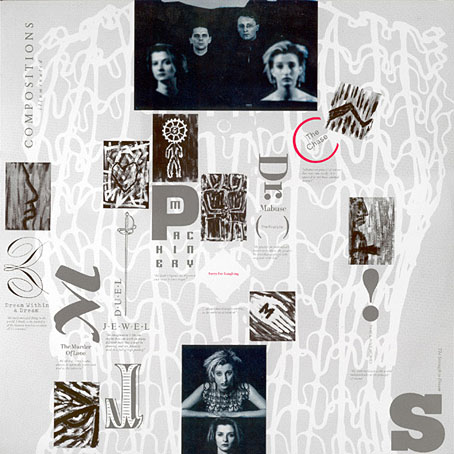
A Secret Wish was released in 1985 and pushed further buttons of obsession for me with the opening track, Dream Within A Dream, which is Edgar Allan Poe’s poem set to music. The album artwork came liberally decorated with Morley’s signifying quotes, the one for the Poe track being the opening lines from HP Lovecraft’s The Call of Cthulhu. Yes, they really were doing this for my benefit… Two further 12-inch singles appeared: Duel/Jewel was the same song presented in an “ABBA” version and a “from Hell” version: sweet and melodic versus harsh and industrial.
propaganda3.jpg

A Secret Wish inner sleeve.

The third and final single, p:Machinery, expanded the short mix from the album into another 9-minute epic whose vision of a population enslaved to industrial technology easily invokes Fritz Lang’s Metropolis, so much so that I used to play the single while running taped scenes from the film on TV. The enormous “Polish” mix of this song has always been scarce on CD, with a Japanese release in 1988, and a later reissue (with some shoddy and superfluous remixes) in 1995. Another benefit of the new edition of the album is that the extended mix provides the climax of the second disc and sounds even more enormous, its brass fanfares accurately described in a review at the time as conjuring images of cities rising from the sea.

Also present for the first time on the new CD is Do Well, the 20-minute Duel suite which was a cassette-only release, plus a number of other previously unavailable mixes. If you have this double-disc set and the Outside World single collection from 2002 then you’ll own pretty much everything that’s great about Propaganda. A lot of pop music from the 1980s sounds horribly dated now: tinny synths, empty production and a paucity of ambition. Propaganda sound as thunderingly magnificent as they did in 1985, and still unique. It’s a shame that A Secret Wish was their finest moment, things fell apart fairly soon after. But one masterpiece will always be worth fifty Duran Duran travesties.

Elsewhere on { feuilleton }
The album covers archive

Previously on { feuilleton }
Metropolis posters