Sine Fiction

sine6.jpg

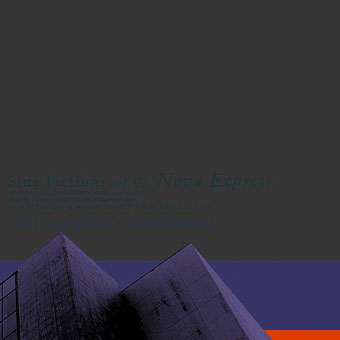
Sine Fiction VI: Nova Express (2003) by Eucci.

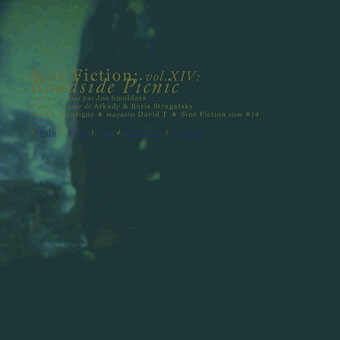
More Burroughsian music, and a selection that includes another interpretation of The Ticket That Exploded. Sine Fiction is a music project curated by Aimé Dontigny that commissions electronic artists to provide soundtracks to science fiction novels. The project has been running since 2000, and has so far managed twenty releases, the most recent of which—Dontigny’s own music for Ballard’s The Drowned World—appeared in 2011. In addition to three Burroughs titles there’s another work with considerable cult status, the Strugatsky Brothers’ Roadside Picnic, which Jos Smolders accompanies in a very minimal fashion. I’d still go for the gloriously doomy atmospheres of Stalker (1995) by Robert Rich & B. Lustmord but there’s room in the world for multiple interpretations.

All the Sine Fiction releases are available as free downloads at the No Type site or (if you prefer) at the Internet Archive.

sine7.jpg

Sine Fiction VII: Soft Machine (2003) by Kevin M Krebs.

sine9.jpg

Sine Fiction IX: The Ticket That Exploded (2003) by A_Dontigny.

sine14.jpg

Sine Fiction XIV: Roadside Picnic (2004) by Jos Smolders.

Elsewhere on { feuilleton }
The William Burroughs archive

Previously on { feuilleton }
A playlist for Halloween: Drones and atmospheres

Weekend links 143

empire.jpg

Ai No Corrida poster design by Egil Haraldsen (2001).

• “Back then, publishing an interview with Félix Guattari alongside little chats with rough trade and street walkers was unheard of — it still is for the most part.” BUTT on Kraximo, a gay Greek magazine of the 1980s.

13 books for 2013: A selection of forthcoming titles at Strange Flowers which so closely aligns with my preoccupations that I worry he’s reading my mind.

• “The Macaulay Library is the world’s largest and oldest scientific archive of biodiversity audio and video recordings.”

• A free BitTorrent Robert Anton Wilson audio and video pack. See also the RAW files at the Internet Archive.

beijing.jpg

The Pangu Building, Beijing, January 12th, 2013. Blade Runner arrives six years early.

Wired celebrates 100 years of Edward Johnston’s typeface for the London Underground.

Borges’ translation of Ulysses. Or of the last page of Ulysses as a translation of Ulysses.

0181, a new album by Four Tet, can be heard in full at SoundCloud.

• The Edge question for 2013: “What should we be worried about?

JG Ballard documentaries at Ubuweb.

Unlocking Dockstader.

• RIP Nagisa Oshima.

Ai No Corrida (1980) by Quincy Jones | Empire Of The Senses (1982) by Bill Nelson | Forbidden Colours (1983) by David Sylvian & Riuichi Sakamoto

Chronopolis by Piotr Kamler

chronopolis3.jpg

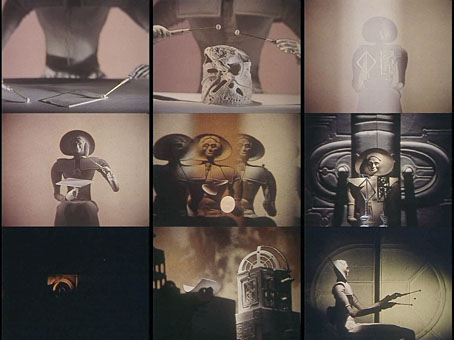
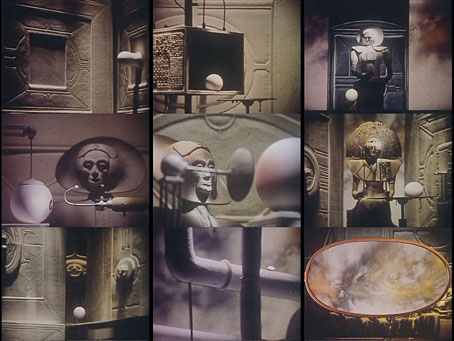
Another gem at Ubuweb, and nothing to do with JG Ballard’s SF story of the same name, Piotr Kamler’s Chronopolis (1983) is a 50-minute animated science fiction film, albeit science fiction of a much more abstract variety than one usually finds in cinema. I’m generally exasperated by the way film and TV SF does little more than play Cowboys & Indians in space so it’s refreshing to see something that’s unashamedly strange and doesn’t feel the need to explain itself. There is apparently a version of this with some English narration for those benighted American audiences everyone feels a need to pander to but the Ubuweb version is wordless, and if you can’t read French then you won’t understand the few lines of text prologue at the opening.

chronopolis1.jpg

Accompanying Kamler’s beautifully crafted and quite inexplicable scenes there’s an electronic score by composer Luc Ferrari, mostly analogue timbres whose origin is as mysterious as the events taking place on-screen. Kamler’s statuesque figures remind me of the gods and aliens that Moebius and co. were drawing in Métal Hurlant during the 1970s. Chronopolis was a French production begun in 1977 so it’s possible that French comics were an influence. Moebius himself worked on another animated SF film during this period, René Laloux’s Time Masters (1982). Chronopolis is closer in tone to the weirdness of Laloux’s earlier Fantastic Planet (1973), and all the better for it.

chronopolis2.jpg

Previously on { feuilleton }
Les Jeux des Anges by Walerian Borowczyk
Les Temps Morts by René Laloux

Weekend links 130

teraoka.jpg

Sarah and Writhing Octopus (New Wave Series, 1992) by Masami Teraoka.

Strange Flowers continues to push all my buttons. For a while now I’d been intent on writing something about the strange (unbuilt) temples designed by German artist/obsessive naturist Fidus (Hugo Höppener) but I reckon James has done a better job than I would have managed. Also last week he wrote about Schloss Schleißheim, a palatial estate outside Munich with connections to Last Year in Marienbad and another eccentric, pseudonymous German artist: Alastair (Hans Henning Voigt).

• The circus poster that inspired John Lennon’s Sgt. Pepper song Being For The Benefit Of Mr. Kite! has been reproduced as a limited edition letterpress print. Related: Wikipedia’s page about Pablo Fanque (1796–1871), “the first black circus proprietor in Britain”.

• The first two volumes of The Graphic Canon, both edited by Russ Kick, are reviewed at Literary Kicks. I’ve not seen either of these yet but volume 2 contains my interpretation of The Picture of Dorian Gray. Related: the second book previewed at Brain Pickings.

You only have to read [Alan Bennett’s] diaries to see that, underneath the wit and humour and sandwich-filled pottering around old churches, there is a deep resentment at what has happened to England in his lifetime and an instinctive distrust, sometimes amounting to deep loathing, of most politicians. Listening, for instance, to Alan Clark and Kenneth Clarke talking on the radio about the arrest of General Pinochet in 1998, he writes: “Both have that built-in shrug characteristic of 80s Conservatism, electrodes on the testicles a small price to pay when economic recovery’s at stake.”

Michael Billington on Alan Bennett: a quiet radical

Hauntologists mine the past for music’s future: Mark Pilkington draws a Venn diagram encompassing Coil, Broadcast, the Ghost Box label, Arthur Machen, MR James, Nigel Kneale, Iain Sinclair and others.

Hell Is a City: the making of a cult classic – in pictures. The mean streets of Manchester given the thriller treatment by Hammer Films in 1959. The film is released on DVD this month.

The Function Room: The Kollection, Matt Leyshon’s debut volume of horror stories, has just been published. The cover painting is one of my pieces from the 1990s.

New Worlds magazine (now apparently known as “Michael Moorcock’s New Worlds“) has been relaunched online.

konahin.jpg

A drawing from Anatomy (part 1), a series by Alex Konahin.

• The forthcoming Scott Walker album, Bish Bosch, will be released on December 3rd. 4AD has a trailer.

Cormac McCarthy Cuts to the Bone: Noah Gallagher Shannon on the early drafts of Blood Meridian.

• The Velvet Underground of English Letters: Simon Sellars Discusses JG Ballard.

• Michelle Dean on The Comfort of Bad Books.

The typewriter repairers of Los Angeles

Cats With Famous People

Marienbad (1987) by Sonoko | Komm Nach Marienbad (2011) by Marienbad | Marienbad (2012) by Julia Holter.

(Thanks to Ian and Pedro for this week’s picture links!)

Weekend links 126

dogo.jpg

Mala Reputación (1991) by Dogo Y Los Mercenarios. Cover art by Nazario Luque.

Artist Nazario Luque was Spain’s first gay comic artist who’s also known for the drawing which appeared (without permission) on the sleeve of Lou Reed Live – Take No Prisoners in 1978. On his website Nazario says he’s been described as “Exhibicionista, solidario, provocador, agitador moral, rompedor, arriesgado, polifacético, transgresor, canalla, pintiparado, morigerado o simplemente superviviente…” Via Música, maestros, a two-part post (second part is here) about album cover art by comic artists.

The BBC Radiophonic Workshop Returns. And quite conveniently, Ubuweb posts some original Radiophonic creations by electronic music genius Delia Derbyshire. Ms Derbyshire is profiled along with her other pioneering colleagues in an hour-long TV documentary, Alchemists of Sound.

• Tor.com celebrates the fiction of Shirley Jackson. Too Much Horror Fiction has a substantial collection of Shirley Jackson book covers.

Phantasmagorical and all but plotless, Nightwood flings itself madly upon the night, upon Wood, and upon the reader. Its sentences pomp along like palanquins and writhe like crucifixions. They puke, they sing. Their deliriums are frighteningly controlled. […] TS Eliot loved Nightwood so much that he shepherded its publication and wrote the introduction to the first edition. Dylan Thomas complimented it with his left hand by calling it “one of the three great prose books ever written by a woman” and with his right hand by stealing from it. […] Nightwood’s Dr. Matthew-Mighty-grain-of-salt-Dante O’Connor, florid monologist and transvestite, seems to have been a model (along with Captain Ahab) for Judge Holden in Blood Meridian. The difference is that Cormac McCarthy’s Judge is essentially Satan, whereas O’Connor is essentially Christ; they’re only just on opposite sides of the border of madness.

Austin Allen on The Life and Death of Djuna Barnes, Gonzo “Greta Garbo of American Letters”. There’s a lot more Djuna Barnes at Strange Flowers.

• Out at the end of the month, Extreme Metaphors, interviews with JG Ballard, 1967–2008, edited by Simon Sellars & Dan O’Hara.

• The favourite Polish posters of the Brothers Quay. Over at Cardboard Cutout Sundown there are more Quay book covers.

The Mancorialist: people on the streets of Manchester are given the Sartorialist treatment.

The Liverpool International Festival Of Psychedelia takes place on 29th September.

The Caves of Nottingham are explored in a detailed post at BLDGBLOG.

• In Remembrance: Bill Brent, Groundbreaking Queer Sex Publisher.

Confessions of a Bookplate Junkie

The Uranus Music Prize 2012

Fuck Yeah René Lalique

Dr Who: original theme (1963) by Ron Grainer with Delia Derbyshire | Falling (1964) by Delia Derbyshire | The Delian Mode (1968) by Delia Derbyshire | Blue Veils And Golden Sands (1968) by Delia Derbyshire.