Weekend links 474

moon.jpg

AS11-40-5877 (1969).

• A minimum of Moon-related links this week because this is a subject I always return to. Previous links to NASA’s photo archives are now redundant after they changed their website but the archive of photos from the Apollo missions are currently hosted on Flickr…while Flickr lasts, anyway. The Albums section features whole film rolls from each of the missions.

• Mixes of the week: Stephen O’Malley presents In Session: Richard Pinhas (a re-posting of a mix from last year), and The Ivy-Strangled Path Vol. XVII by David Colohan.

• Living With The Human Machines: experimental artist Sarah Angliss speaks to Matthew Neale about the cyborgs, dummies and ghosts that populate her work.

• On And On And On: A Guide to Generative Electronic Music. Related: Deconstructing Brian Eno’s Music for Airports.

• At Dennis Cooper’s: Jesse Bransford presents…A List of Grimoires for the Twilight of the Age of the Book.

A Dandy in Aspic exclusive: Paul Gallagher interviewed cult author Derek Marlowe in 1984.

• From Ted Hughes to HG Wells: Jeanette Winterson picks the best books about the Moon.

• Tate acquires vast archive of British surrealist Ithell Colquhoun.

• At Greydogtales: Ten supernatural stories which stay with you.

• Emptyset turn to machine learning on new album Blossoms.

• Paul Grimstad on the absolute originality of Georges Perec.

• Valerie Stivers on cooking with Bruno Schulz.

• Blown out ’77: in the studio with Suicide.

Astronauts on record covers.

Back Side Of The Moon (1991) by The Orb | Moonshot (1999) by Hallucinator | Under The Moon (2019) by Brian Eno with Daniel Lanois & Roger Eno

Weekend links 437

watson.jpg

Rawmarsh Road, Rotherham, 1975 by Peter Watson.

Steel Cathedrals (1985), a composition by David Sylvian (with Ryuichi Sakamoto, Kenny Wheeler, Robert Fripp & others) was originally available only on the cassette release of Sylvian’s Alchemy: An Index Of Possibilities, and a video cassette where the music accompanied views of Japanese industry by Yasuyuki Yamaguchi. The video hasn’t been reissued since but may be viewed here.

• “If, as Arthur C Clarke famously observed, any sufficiently advanced technology is indistinguishable from magic, then can we accept that any sufficiently advanced magic is also indistinguishable from technology?” asks Mark Pilkington.

• “I didn’t like the idea of cartoons as just funny jokes, they had to have some relevant piece of observation in them to do with the society we are living in,” says Ralph Steadman.

I listen to music all the time, and I’ll often seek connections across quite disparate genres of that whatever I’m looking for. Sometimes it’s an aesthetic or a feeling, sometimes a pattern or structure, but it tends to cut across genres. The thing I liked about black metal and doom metal is the slowness and weightiness of it, it’s like deep time but in music. Sunn O))), Xasthur, and other bands captured this black gravity of sound. And they also tend to eschew the traditional vocal-lead guitar set-up, and everything is in the slow-moving wash and texture of sound.

I found that in other genres like noise music (especially Keiji Haino), the European avant-garde with composers like Ligeti, Scelsi, and Dumitrescu, dark ambient artists such as Lustmord or vidnaObmana, and contemporary works like Chihei Hatakeyama’s Too Much Sadness, Rafael Anton Irisarri’s A Fragile Geography, or Christina Vantzou’s No.4. There’s a lot to talk about in terms of music and forms of sorrow or grief, certainly every musical tradition has that—the funeral dirge, requiem, lamentation, or whatever.

Eugene Thacker listing a few favourite musicians and composers during a discussion with Michael Brooks about Thacker’s new book, Infinite Resignation

• The fourth edition of Wyrd Daze—”The multimedia zine of speculative fiction + extra-ordinary music, art & writing”—is out now.

• The Library of Congress has opened its National Screening Room, an online service for viewing films in the library’s collection.

The London Library discovered some of the books that Bram Stoker used for research when he was writing Dracula.

• “Oscar Wilde’s stock has never been higher,” says John Mullan, reviewing Oscar: A Life by Matthew Sturgis.

• Mixes of the week: RA Podcast 648 by Sarah Davachi, and Secret Thirteen Mix 269 by Sstrom.

• David Lynch directs a video for A Real Indication by Thought Gang.

• “Edward Gorey lived at the ballet,” says his biographer, Mark Dery.

• A new version of Blue Velvet Blues by Acid Mothers Temple.

• Photos of cooling-tower interiors by Reginald Van de Velde.

Aaron Worth on Arthur Machen: “the HG Wells of horror”.

• The Strange World of…Barry Adamson.

Glass And Steel No. 1 (1983) by Marc Barreca | Death Is The Beginning (1996) by Steel | Painless Steel (2000) by Bohren & Der Club Of Gore

Weekend links 337

avery.jpg

A Post-traumatic History Lesson (2009) by David Avery.

• Last week it was the teaser, this week it’s the full thing: When a New Trick Comes Out, I do an Old One / Exit Pantomime Control by Moon Wiring Club, 29-minutes of woozy and degraded psychedelic VHS weirdness.

• Over the summer I watched 32 Robert Altman films. When faced with such a diverse and unpredictable filmography it helps to have a guide; Geoff Andrew suggests where to begin.

• Some tools in the ongoing war against the Agents of the Control Virus: The Best Anonymous VPN Services of 2016.

Sky Blue Press bills Auletris as a work that “breaks many taboos.” Fans of [Anaïs] Nin know that she has covered plenty of salacious territory before: tubercular nymphomaniacs, exhibitionists, voyeurs, orgies, gender bending, bondage, bestiality, incest, hermaphroditism, etc. Nin was a pioneer of women’s sex writing in English, and all contemporary erotica authors are indebted to her, whether they realize it or not. In the 1940s, she wrote risqué stories for an anonymous private collector at the rate of a dollar a page. Despite how Nin downplayed her bespoke smut as “literary prostitution,” compared to other explicit writing of her time in English, hers was revolutionary. The two steamy volumes, Delta of Venus and Little Birds, were not published for the public until the ’70s, just after her death, but they were best sellers and set a new standard for erotica.

Laura Frost reviewing Auletris, a book of rare fiction by Anaïs Nin

HP Lovecraft’s Fungi From Yuggoth and Other Poems, a new collection of readings by William E. Hart.

The Harlan Ellison® Books Preservation Project is on the brink of achieving its Kickstarter target.

The Haunted Ceiling, a neglected ghost story by HG Wells, is being published for the first time.

• A Quietus Hour Radio Special: Shirley Collins on her favourite songs.

Kellie Woodson recommends “5 transgressive horror publishers”.

Alice in Wonderland‘s engravings—a forgotten story in pictures.

• “Alan Moore’s Jerusalem is a moveable feast,” says Alan Wall.

Musiceureka: “collecting vinyl in a special way”.

• At Dennis Cooper’s: Terrarium makers.

• RIP Pauline Oliveros.

Bye Bye Butterfly (1965) by Pauline Oliveros | Lear (1989) by Pauline Oliveros / Stuart Dempster / Panaiotis | Silence Echoes (1997) by Pauline Oliveros & Randy Raine-Reusch

Roger Dean book covers

dean1.jpg

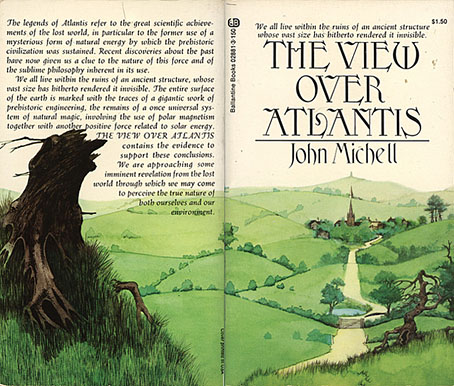
The View Over Atlantis (1972).

The covers in question are the handful that Roger Dean produced for paperbacks in the 1970s and 80s, rather than those for his own books and the ones he edited. Given the popularity of Dean’s work in the 1970s you’d expect there to be more than this although I’m not sure he would have had the time for any more work than he was doing already.

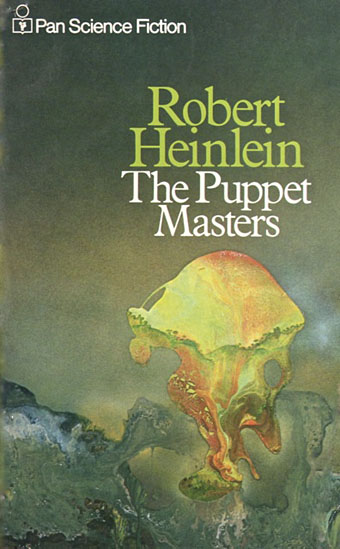
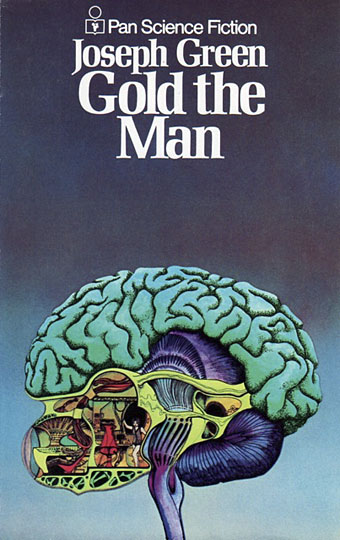
The two covers for Pan Science Fiction vexed me for a while since the art is reproduced in Dean’s Views collection but with no mention of the book titles. It’s taken some time, but ISFDB has updated its Roger Dean page so I can finally sate my curiosity. The Michell cover is an ideal illustration for the author’s theorising about ley lines but the Pan SF paintings are vague enough to be used on other books, or even on album covers.

dean2.jpg

The Puppet Masters (1973).

dean3.jpg

Gold the Man (1973).

dean4.jpg

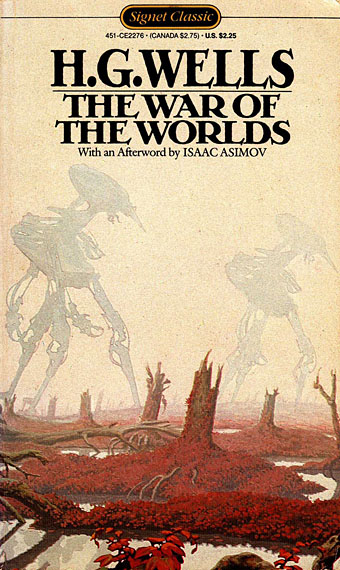
The War of the Worlds (1986).

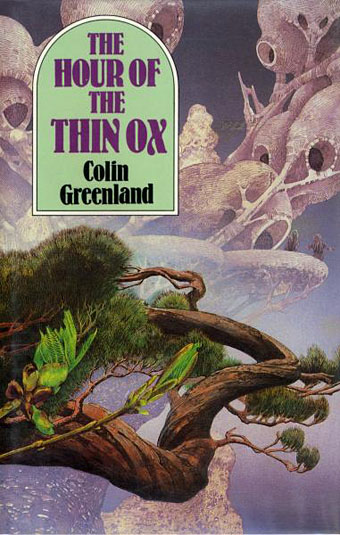
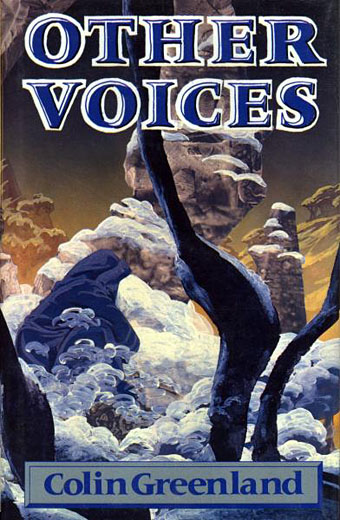
I’ve not read the Colin Greenland books so I can’t say whether their cover art relates to the novels but the Wells cover certainly does. A rare example of Dean depicting a scene from somebody else’s imagination.

dean5.jpg

The Hour of the Thin Ox (1987).

dean6.jpg

Other Voices (1988).

Elsewhere on { feuilleton }
The book covers archive

Previously on { feuilleton }
Design as virus 17: Boris and Roger Dean
Roger Dean: artist and designer

The Plutonian Drug

amazing.jpg

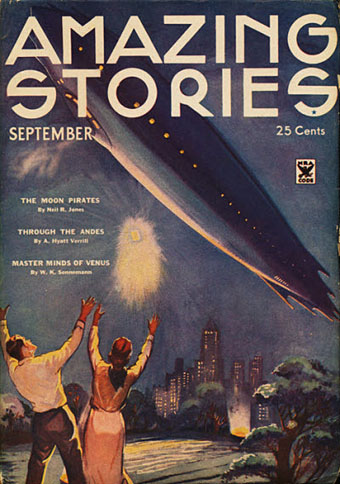
Cover art by Leo Morey.

To HP Lovecraft, Pluto was the planet Yuggoth, home to the fungoid, brain-harvesting Mi-go whose exploits are detailed in The Whisperer in Darkness (1931). Clark Ashton Smith wasn’t averse to imagining the planets of the Solar System as exotic worlds, but in The Plutonian Drug, a short story published in Amazing Stories for September 1934, he stayed closer to what was known of Pluto at the time, albeit with an exception or two:

“There are some other drugs, comparatively little known, whose effects, if possible, are even more curious than those of mnophka. I don’t suppose you have ever heard of plutonium?”

“No, I haven’t,” admitted Balcoth. “Tell me about it.”

“I can do even better than that — I can show you some of the stuff, though it isn’t much to look at — merely a fine white powder.”

Dr. Manners rose from the pneumatic-cushioned chair in which he sat facing his guest, and went to a large cabinet of synthetic ebony, whose shelves were crowded with flasks, bottles, tubes, and cartons of various sizes and forms. Returning, he handed to Balcoth a squat and tiny vial, two-thirds filled with a starchy substance.

“Plutonium,” explained Manners, “as its name would indicate, comes from forlorn, frozen Pluto, which only one terrestrial expedition has so far visited — the expedition led by the Cornell brothers, John and Augustine, which started in 1990 and did not return to earth till 1996, when nearly everyone had given it up as lost. John, as you may have heard, died during the returning voyage, together with half the personnel of the expedition: and the others reached earth with only one reserve oxygen-tank remaining.

This vial contains about a tenth of the existing supply of plutonium. Augustine Cornell, who is an old school friend of mine gave it to me three years ago, just before he embarked with the Allan Farquar crowd. I count myself pretty lucky to own anything so rare.

“The geologists of the party found the stuff when they began prying beneath the solidified gases that cover the surface of that dim, starlit planet, in an effort to learn a little about its composition and history. They couldn’t do much under the circumstances, with limited time and equipment; but they made some curious discoveries — of which plutonium was far from being the least.

“Like selenine, the stuff is a bi-product of vegetable fossilization. Doubtless it is many billion years old, and dates back to the time when Pluto possessed enough internal heat to make possible the development of certain rudimentary plant-forms on its blind surface. It must have had an atmosphere then; though no evidence of former animal-life was found by the Cornells.

“Plutonium, in addition to carbon, hydrogen, nitrogen, and oxygen, contains minute quantities of several unclassified elements. It was discovered in a crystalloid condition, but turned immediately to the fine powder that you see, as soon as it was exposed to air in the rocketship. It is readily soluble in water, forming a permanent colloid, without the least sign of deposit, no matter how long it remains in suspension.”

“You say it is a drug?” queried Balcoth. “What does it do to you?”

“I”ll come to that in a minute — though the effect is pretty hard to describe. The properties of the stuff were discovered by chance: on the return journey from Pluto, a member of the expedition, half delirious with space-fever, got hold of the unmarked jar containing it and took a small dose, imagining that it was bromide of potassium. It served to complicate his delirium for a while — since it gave him some brand-new ideas about space and time.

“Other people have experimented with it since then. The effects are quite brief (the influence never lasts more than half an hour) and they vary considerably with the individual. There is no bad aftermath, either neural, mental, or physical, as far as anyone has been able to determine. I”ve taken it myself, once or twice, and can testify to that.

“Just what it does to one, I am not sure. Perhaps it merely produces a derangement or metamorphosis of sensations, like hashish; or perhaps it serves to stimulate some rudimentary organ, some dormant sense of the human brain. At any rate there is, as clearly as I can put it, an altering of the perception of time — of actual duration — into a sort of space-perception. One sees the past, and also the future, in relation to one’s own physical self, like a landscape stretching away on either hand. You don’t see very far, it is true — merely the events of a few hours in each direction; but it’s a very curious experience; and it helps to give you a new slant on the mystery of time and space. It is altogether different from the delusions of mnophka.”

The most immediately notable detail here is the word “plutonium” which Smith was using as his own six years before the radioactive element was officially named. (By coincidence, transuranic plutonium was discovered the year Smith’s story was published.) Also of note is yet more discussion in a Smith story of real drugs such as opium and hashish. I’ve never seen any evidence that Smith was a drug user but he was happy to exploit the visionary potential of these substances. The time-viewing effects of Smith’s plutonium might have made for an effective weird tale but the piece runs out of steam fairly quickly; this is one of those stories with a promising idea that needs someone like HG Wells to do it justice. Many of Smith’s stories were written in haste so this isn’t too surprising but The Plutonian Drug lacks the imaginative scope of a piece of psychedelic science fiction like The City of the Singing Flame. Nevertheless, it was druggy enough to open Michel Parry’s Strange Ecstasies which is how I came to revisit it recently.

I was hoping the story might have been illustrated for its early printings but it seems not. The best I can find is this card design; there’s also a metal song by a band named Innsmouth that was released as a double-bill single in 2012. Smith’s story may be read in full at Eldritch Dark.


Previously on { feuilleton }
More trip texts
Yuggoth details
The Garden of Adompha
The City of the Singing Flame
Haschisch Hallucinations by HE Gowers
Odes and Sonnets by Clark Ashton Smith
Clark Ashton Smith book covers