Weekend links 276

hope.jpg

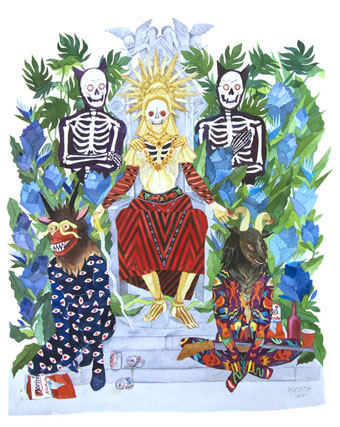
Beautiful Void: Holy Void II (2015) by Andy Diaz Hope.

• “Feeling like a woman. Looking like a man.” Rick Poynor on the cover art for Nightclubbing by Grace Jones. Related: A One Man Show, Jean-Paul Goude’s essential film of Jones’ 1982 tour where many of the songs are better than their album versions.

• Crammed Discs’ revival of the Made To Measure series continues with the release in October of Blue Velvet Revisited by Tuxedomoon & Cult With No Name, a soundtrack from the Peter Braatz documentary about David Lynch’s film.

• “We were learning from point zero; we created something that wasn’t around before…” Hans-Joachim Roedelius talking to Bruce Tantum about his work with Cluster and Harmonia.

• “In the Shangri-La pool there are no floating impurities. Apart from myself.” Iain Sinclair swims in “the highest pool in Europe” on the 52nd floor of The Shard, London.

• From 2012: “Possible Bubbles of Spacetime Curvature in the South Pacific” by Benjamin K. Tippett.

• After 23 years of delays and bootleg versions, Backwards by Coil is being given an official release.

• “Relaxed terror”, “perky dismay” and “unspecified uncertainty”: library music at Scarfolk.

• Mix of the week: a 4-hour collection of favourite music compiled by Autechre.

Masakazu Shirane and Reuben Young make a human-size kaleidoscope.

• “I always was a weird child,” says John Waters.

• A new version of Argent by Jane Weaver.

Chaos Magic (sic): The Fashion Trend

Void (2009) by Monolake | Void (2011) by Emptyset | Void (2014) by The Bug feat. Liz Harris

Weekend links 262

rozich.jpg

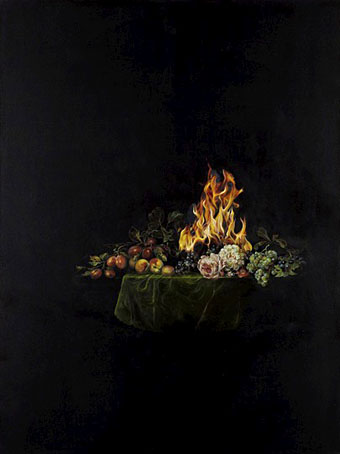
You’ll Never Be Alone, Even In Death (2014) by Stacey Rozich.

• “But the CD-R format, which eventually replaced the mix tape, turned out to be a technological letdown. ‘CD-Rs are just such an unstable format,’ Margolis says. ‘When you made 10 cassettes, the 10 cassettes generally played. If you made 10 CD-Rs, 8 of them played and 2 of ’em skipped. So that partially explains why people are going back to cassettes—it’s a cheap format that actually works.'” A huge article by Lisa Hix on the history and resilience of cassette tapes.

• “The word speculative comes from speculum, or mirror, and with speculative music the goal is to mirror the hidden processes of nature in sound.” David Metcalfe on Hawthonn, Coil and imaginal landscapes.

• Mixes of the week: FACT Mix 498 by The Cyclist, and Adventures In Sound And Music 28 May 2015 compiled by Joseph Stannard.

Nabokov was an intimate writer. His reticences, his formal estrangements, his denial of interest in any reality beyond the text all need to be measured against that. Maximum closeness: not the closeness of ostentatious empathy but the closeness of one mind addressing another in the most thrilling terms. He speaks into the ear, sometimes dripping a little poison. He contrives to have a reader identify intimately with a protagonist or narrator, but even that is not enough; the reader receives secret handshakes from the author himself, behind a narrator’s back.

Michael Dirda quoting from Nabokov in America by Robert Roper

• Books old and new: The Encyclopedia of the Dead by Danilo Kis, and Stranger Days by Rachel Kendall.

• At Dangerous Minds: Il caso Valdemar (1936), a short Italian adaptation of the Edgar Allan Poe story.

Lustpiel is “a new online magazine for gay, lustful literature”. And a fair amount of art and porn.

• “Q: Is there any subject that is never acceptable to joke about?” No, says Curtis Brown.

Machines Are Obsolete, a new piece by Pye Corner Audio for the Ghost Box label.

• Ishbelle Bee (see yesterday’s post) is interviewed at SFFWorld and Book Swoon.

Laura June on the life of Djuna Barnes, stunt reporter and shocking modernist.

• Stream the debut LP from Ghost Harmonic, a new John Foxx project.

• Portraits of the BDSM community by Natasha Gornik.

Rainer Werner Fassbinder: 10 essential films

Loplop

Mirrorball (2009) by John Foxx & Robin Guthrie | Mirror (2012) by Emptyset | Mirrored (2013) by Silje Nes

Weekend links 259

bennett.jpg

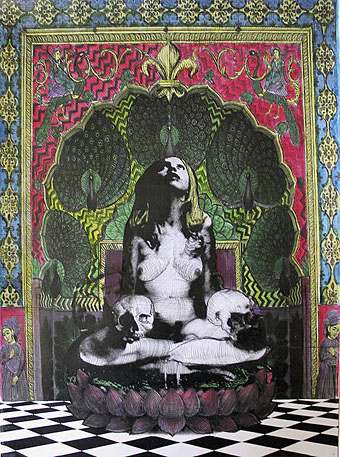
The Endlessness (2012) by Emma Bennett.

• “Clearly if you’re familiar with The Arcades Project by Walter Benjamin you’ve got a leg up on what Rivette and company are up to. […] Like all Rivette works, it’s obsessed with the interrelationship between theater and life—reality and fantasy.” David Ehrenstein makes Jacques Rivette’s Out 1 sound even more intriguing. The 729-minute film is being reissued later this year.

• “It’s all your artistic friends. They frighten me…they seem evil, somehow—somehow unhealthy. And when you’re with them, dear, you change…” Steven Cordova reviews To the Dark Tower (1946), the debut novel by gay writer Francis King.

• “Sex isn’t a subtext in The Bloody Chamber, but the text itself. (Carter would explain that she was only making explicit a ‘latent content’ that is ‘violently sexual.’)” Laura Miller on Angela Carter’s re-told fairy tales.

Yet, as a citizen, and especially as an artist, [Chimamanda Ngozi] Adichie refuses to censor herself. “There is already enough silencing in public discourse,” says Adichie, and this is certainly true when the topic is race, and especially when the conversation is in America. It is our addiction to comfort that demands our silence regarding certain truths. Too often in America, Adichie claimed, “the goal of public discourse is comfort, not truth.” Comfort, Adichie said, also demands “international digestibility,” a reduction of complicated stories to a simple narrative. In the lecture, Adichie also warned of the silencing that is sometimes a product of social media outrage.

Kay Iguh on Chimamanda Ngozi Adichie’s Arthur Miller Freedom to Write Lecture at the PEN World Voices Festival

• New books: The Strangers and Other Writings by Robert Aickman, and Murderous Passions: The Delirious Cinema of Jesús Franco by Stephen Thrower & Julian Grainger.

• The world is rediscovering Mad Max and George Miller’s prowess for action cinema so Anne Billson posted a transcript of her 1985 interview with the director.

• Mixes of the week: Dmytro Fedorenko presents artists from Ukrainian record label Kvitnu, and The Ivy-Strangled Path Vol. VII by David Colohan.

Assault on Precinct 13 goes disco: The End (John Anthony’s New Scratch Mix) (1983) by “John Carpenter” (The Splash Band).

John Coltrane talked to Frank Kofsky for an hour in November 1966.

• Sleazy Cinema: A guide to Peter Christopherson‘s music videos.

Six hours of women in electronic music.

The weird world of Alfred Kubin.

Giallo Magic Orchestra

Blood (1972) by Annette Peacock | Blood On The Moon (1981) by Chrome | Blood From The Air (1986) by Coil

Weekend links 247

buratti.jpg

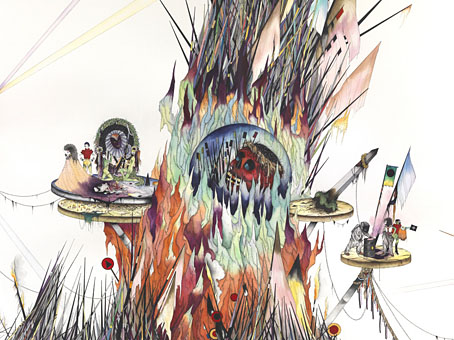
Encounter with the Priestess by Robert Buratti.

• “We were gothy, we loved the New York thing and people like Suicide, Dave loved Throbbing Gristle, we both loved the Sheffield bands…we loved the darkness to that kind of electro.” Marc Almond talking to Simon Price. Also at The Quietus, Cat’s Eyes choose their favourite soundtracks.

• “When he reveals that all he wants is to deliver a breakfast sandwich, the enigma of his desire is not so much dispelled as redoubled—why on earth would anyone want to do that?” Adam Kotsko on the unheimlich nature of old Burger King ads.

• “…commercial design is full of politics, to be a commercial designer is a political decision.” Jonathan Barnbrook talking to Katrina Schollenberger.

You need to know who Billy Wilder was. You need to know the names of people who are no longer alive. Because it’s very important—it’s what our history is made of. You need to see the movies the way they were—with the racism, the violence, and the censorship. All the things that let you see what the movie past had been so you understand where we are! But really nobody’s interested in that right now. Their interests are so bifurcated.

Joe Dante discussing film production past and present with Michael Sragow.

• From 1983: The Encyclopedia of Ecstasy, Vol. 1, a publication which creator Alistair Livingston describes as a “psychedelic goth punk fanzine”.

• Mixes of the week: No One’s There, a collection of post-punk electronica by Abigail Ward, and Secret Thirteen Mix 146 by Te/DIS.

• Frans Masereel’s My Book of Hours is “a crucial example of the power of stories without words,” says Stefany Anne Golberg.

Miles Davis and band in concert, 18th August, 1970. Pro-shot, 45 minutes.

• Lots of good reading and cultural connections at Celluloid Wicker Man.

A world map of micro-nations

Tokyo in dense fog

Tainted Love/Where Did Our Love Go? (1981) by Soft Cell | Tainted Love (1985) by Coil | Titan Arch (1991) by Coil with Marc Almond

Edgar Froese, 1944–2015

froese.jpg

“I was a big fan of Kraftwerk, Cluster and Harmonia, and I thought the first Neu! album, in particular, was just gigantically wonderful,” admits Bowie. “Looking at that against punk, I had absolutely no doubts where the future of music was going, and for me it was coming out of Germany at that time. I also liked some of the later Can things, and there was an album that I loved by Edgar Froese, Epsilon In Malaysian Pale; it’s the most beautiful, enchanting, poignant work, quite lovely. That used to be the background music to my life when I was living in Berlin.”

David Bowie, Mojo magazine, April 1997

Epsilon In Malaysian Pale was Froese’s second solo album released in September 1975. That month David Bowie was in Los Angeles recording his Station To Station album, the opening of which features phased train sounds that are strikingly similar to those that run through the first side of the Froese album. I’ve never seen this similarity mentioned by Bowie scholars but if there was an influence it’s a good example of the degree to which Tangerine Dream infiltrated the wider culture as much as Can and Neu! (Kraftwerk remain in a league of their own.)

zeit.jpg

All you need is Zeit. Cover painting by Edgar Froese.

The influence of Tangerine Dream’s albums on the Ohr and Virgin labels is now so widespread that it’s difficult to compile a definitive list of those who’ve either paid homage or copied the group’s trademark style of extended sequencer runs and phased chords. Offhand I could mention the Ricochet-like tracks on Coil’s Musick To Play In The Dark Volumes 1 & 2; the many moments on the early Ghost Box albums, one of which samples from Alpha Centauri; and some of Julian Cope’s more out-there recordings from the late 1990s. There’s also all the releases by a group of loosely affiliated musicians dedicated to maintaining the 70s sound of Mellotrons and bouncing sequencers; many of these I’ve yet to hear but I’ve enjoyed the albums by Node and Redshift.

td.jpg

Tangerine Dream have been a continual fixture in my music listening since I was a teenager; I drew most of The Call of Cthulhu to a soundtrack of Rubycon and Jon Hassell’s Aka/Darbari/Java album. I kept up with them after they departed from Virgin then jumped ship in 1986 after Johannes Schmoelling left the group. The albums continued to proliferate in recent years to an extent that even the Freeman brothers only follow the discography (with some exasperation) up to 1990 in their redoubtable Krautrock tome The Crack in the Cosmic Egg. Navigating a late career is a tricky business for a popular musician so you can’t blame Froese for carrying on the project. Those early recordings are the important ones, and he was a crucial component in their creation.

There’s a lot of Froese and TD on YouTube. If you like the early material these are some of the better moments:

Bath Tube Session, 1969: TD in psych-freakout mode. Klaus Schulze on drums, and lots of German heads looking bemused/bored.
Ossiach Lake, 1971: Playing outdoors for the TV cameras.
Paris, 1973: Footage of the group improvising in the manner of the Atem album.
Coventry Cathedral, 1975: Tony Palmer’s film of one of the cathedral concerts which caused them to be banned by the Pope from playing in churches. The original sound on this one is lost so the YT version has edits of the Ricochet album as the soundtrack.
London, 1976: Great film of the Ricochet period. Total synth porn.
Thief, 1981: The opening scene to Michael Mann’s thriller, and one of their best soundtrack moments. In The Wire this month John Carpenter enthuses about the TD score for Sorcerer but I’ve always felt Mann’s crime drama was a better match for their sound.
Warsaw, 1983: A Polish TV recording of the concert documented on the Poland (1984) album.

Previously on { feuilleton }
Synthesizing
Tangerine Dream in Poland