Pamela Colman Smith’s Annancy Stories

smith01.jpg

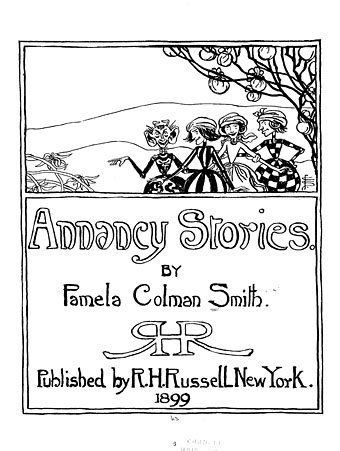
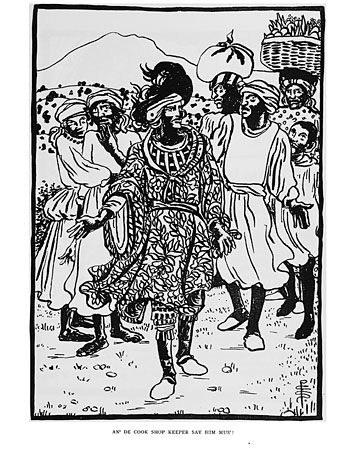
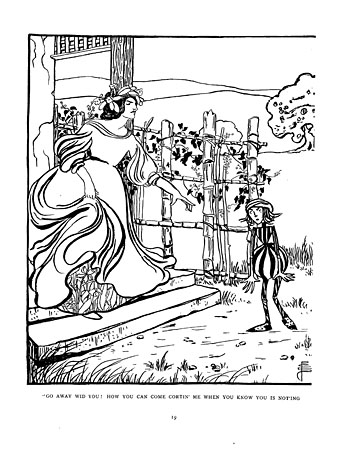
Pamela Colman Smith’s work has appeared here before but this is an example of her early illustration I hadn’t seen until now. Annancy Stories (1899) was written and illustrated by Smith, being her own presentation of the Jamaican versions of the Anansi trickster stories. Smith’s mother was Jamaican, and the family lived in Kingston for some years before moving to New York. She was only 20 when she produced this book which is illustrated throughout with full-page plates and smaller drawings. The text is in a Jamaican patois which, as the introduction notes, would have reminded American readers of the Brer Rabbit stories. There is, of course, a shared lineage there that goes back to Africa. The drawings are in a sketchier style than the marvellous Tarot designs Smith produced for the Rider-Waite deck nearly a decade later but you can see in them the origins of her late Art Nouveau style, and also that distinctive monogram in the corner of each drawing. Annacy Stories may be browsed here or downloaded here.
smith02.jpg

smith03.jpg

Continue reading “Pamela Colman Smith’s Annancy Stories”

Reverbstorm at Supervert

reverbstorm.jpg

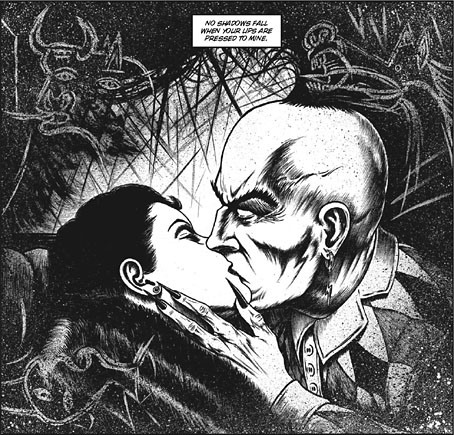
Keith Seward’s Horror Panegyric was a concise examination of David Britton’s multimedia Lord Horror project which Savoy Books published in 2007. I designed the book, the cover of which was my Arcimboldo pastiche of Lord Horror’s profile which appeared on the cover of issue 3 of Reverbstorm. The Supervert site which hosts an online copy of Horror Panegyric has this month posted my answers to some questions about Reverbstorm, the series having grown out of the first Lord Horror novel and the earlier comics:

The graphics in Reverbstorm sometimes seem more narrative than the words. How did you and David work out a scenario?

I don’t have objections per se to the usual story structures but in this series we both wanted to create something that wasn’t following familiar adventure narrative lines. The precedents for me were the European comic artists from Métal Hurlant who often favoured art over story; also Burne Hogarth whose work was a great influence on the style I used to draw Lord Horror. Hogarth’s Tarzan strips are adventure narratives but in his later books it’s the art that’s paramount. James Joyce is one of the characters in Reverbstorm, and you can also find a precedent in Ulysses where the story is overwhelmed by the surface detail.

Reverbstorm began with Paul Temple’s lyrics for the Reverbstorm song and a brief Lord Horror film treatment that Dave and Mike had put together for a production company. I don’t recall much about the treatment — I only looked at it once in the office — but it concerned Horror and Jessie Matthews in New York City, opening with a sequence where his Lordship kills some policemen in an alleyway. That vague outline can be seen in the first few pages of Reverbstorm with NYC changed to Torenbürgen. Other elements taken from the film treatment included the name Blue Blaze Laudanum — the actual robotic character came later — and the Souls which likewise became more substantially developed as the comic progressed.

Once we’d introduced all the characters things developed along thematic lines rather than strictly narrative ones. So the second part introduces the Ether Jumpers, the third part has the Apes, the fourth part the Ononoes, the fifth part Picasso and T.S. Eliot, and so on. Musical structure is an obvious parallel, and I consider some of the recurring background material to be visual leifmotifs which can indicate or imply one of the three main characters even if they aren’t present on the page. This musical analogy is an important one for appreciating the series as a whole. The entwined themes and references work in a manner that’s a lot closer to musical works than to the mechanics of an adventure narrative. (more)

Previously on { feuilleton }
Reverbstorm in print
Reverbstorm update
James Joyce in Reverbstorm
A Reverbstorm jukebox
Reverbstorm: Bauhaus Horror
Reverbstorm: an introduction and preview

Anger Sees Red

anger.jpg

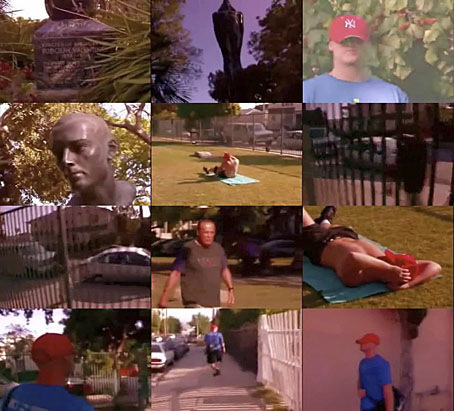
A video sketch from 2004 in which Kenneth Anger manages to give us in four minutes some familiar preoccupations: Rudolph Valentino, occult symbolism, and a hunky guy in the form of the sunbathing gentleman named Red who provides the focus of the piece. The copy on YouTube is labelled “restricted work print” so this may not be its final state.

Previously on { feuilleton }
Kenneth Anger’s Hollywood Babylon
Lucifer Rising posters
Externsteine panoramas
Missoni by Kenneth Anger
Anger in London
Arabesque for Kenneth Anger by Marie Menken
Edmund Teske
Kenneth Anger on DVD again
Mouse Heaven by Kenneth Anger
The Man We Want to Hang by Kenneth Anger
Relighting the Magick Lantern
Kenneth Anger on DVD…finally

The art of Ferenc Helbing, 1870–1958

helbing1.jpg

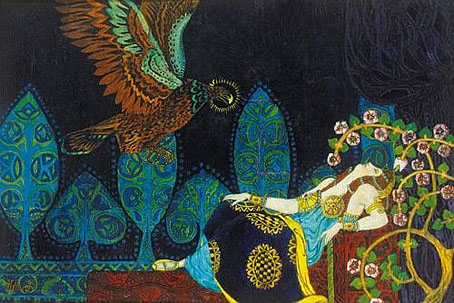
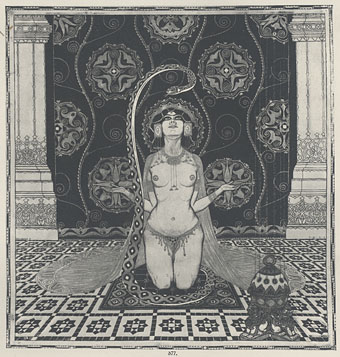
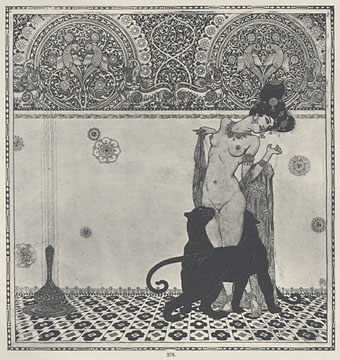
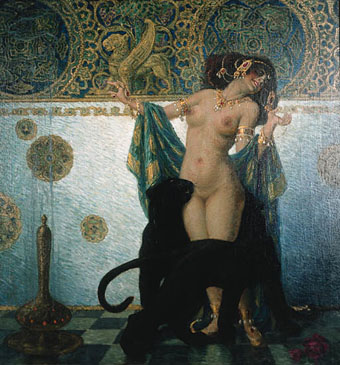
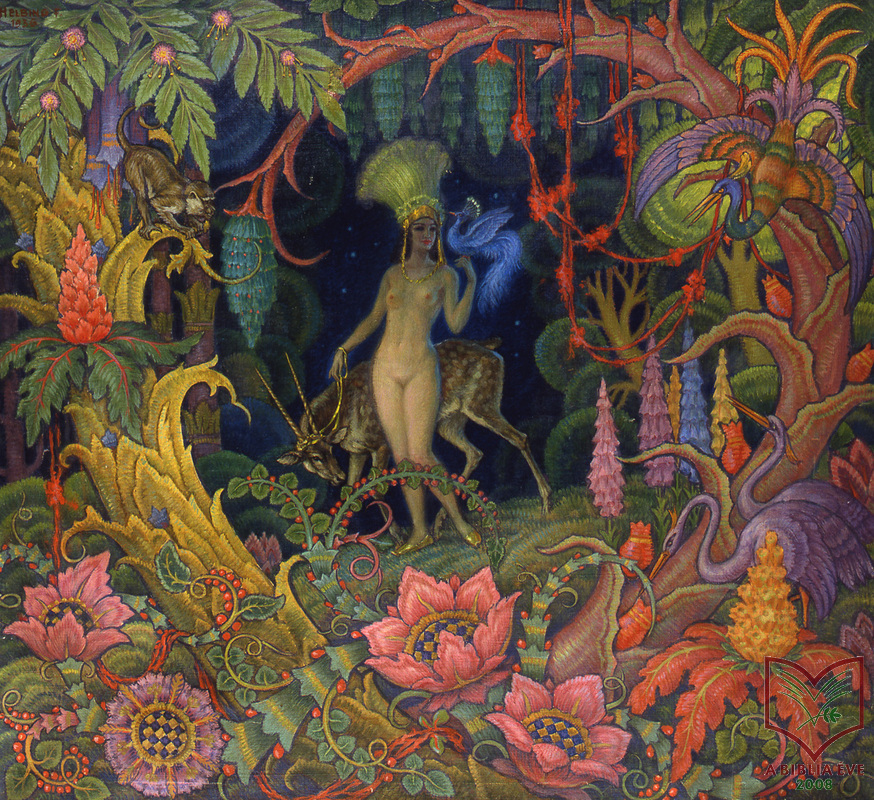
Beautiful Century drew my attention to this Hungarian artist and designer, one of many Eastern Europeans passed over in fin de siècle art books by virtue of working too far from Paris, Munich or Vienna. Helbing’s work would have been most visible to Hungarians in the designs he produced for the nation’s banknotes but on the evidence of these lavish and exotic examples he’s a match for his contemporaries elsewhere in Europe. Of the Seherezade (sic) depictions I prefer the black-and-white version over the painting. There’s more at Flickr.

helbing3.jpg

helbing2.jpg

helbing4.jpg

Seherezade (1918).

helbing5.jpg

Édenkert (1936).

Wavelength

wavelength1.jpg

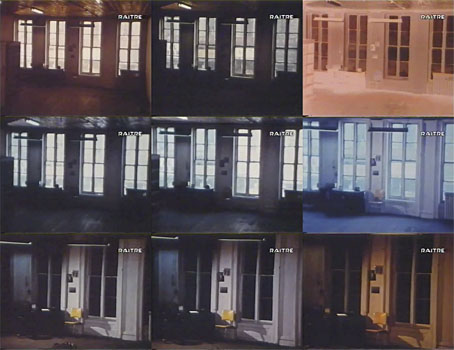
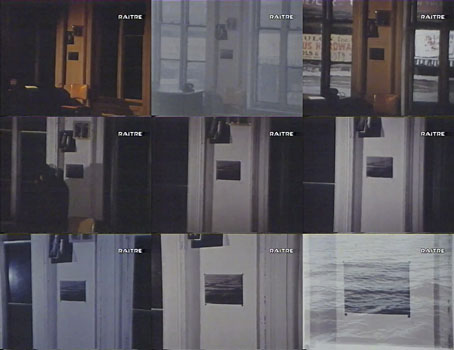
Thanks be to YouTube for once more resurrecting moments of underground cinema which would otherwise be very difficult to see. Wavelength (1967) is Michael Snow’s experimental masterwork, a 45-minute zoom across a New York loft that ends on a photograph of waves that fills the screen. This recipe for ennui is not without incident: we see a bookcase being installed, someone plays a Beatles record—Strawberry Fields Forever—a man breaks into the apartment and collapses. (He may be dead but we never find out.) Throughout this, the film is subject to flashes of colour filtering, moments of negative inversion and sudden flares of light. For at least half the running time the sound is replaced by a droning oscillator tone which rises inexorably the closer the camera brings us to its destination.

wavelength2.jpg

Between these events there’s plenty of time to meditate upon the meaning of the title: the various wavelengths of sound and light, the distance across the room to the view of the waves, the waves themselves. It’s a fascinating film which is linked for me (and may have influenced) two other takes on the long take: JG Ballard’s short story The 60 Minute Zoom (1976), in which a man monitors his wife’s infidelity from a hotel balcony, and the celebrated shot at the end of Antonioni’s The Passenger (1975) when Jack Nicholson’s character is assassinated off-screen in another hotel room while the camera floats miraculously through the iron bars of the window. You can see Wavelength in full here. I’d recommend watching it full-screen, it requires immersion.

Previously on { feuilleton }
() by Morgan Fisher
La Région Centrale
Downside Up