The Big Fix!

fix1.jpg

One of the stories that was new to me in recent book purchase, Strange Ecstasies (1973), was The Big Fix by Richard Wilson, a science-fiction piece about a junkie in New York City looking for something newer and better than the heroin habit he’s trying to quit. The story first appeared in Infinity Science Fiction for August 1956 but the first half of the narrative seemed so unlike the usual SF fare of the time that I kept flicking back to the copyright page to check the date. The Big Fix of the title (or The Big Fix! as it was in the magazine) is a substance named uru given to the narrator by Jones, an alien in disguise; smoking the drug induces a telepathic conversation with Jones followed by a journey through space to his home planet. In the second half of the story we discover why Jones (or Joro as he’s known at home) is transporting low-lifes from New York and offering them a chance to live on his world. The explanation is as pedestrian in SF terms as an episode of Star Trek, a factor which makes the first half of the story seem all the more striking, replete as it is with junk-life details, contemporary slang and discussion of the (for the time) very obscure South American drug known as yage, aka ayahuasca. Was this written from Wilson’s personal experience or had the details been lifted from a contemporary authority?

fix2.jpg

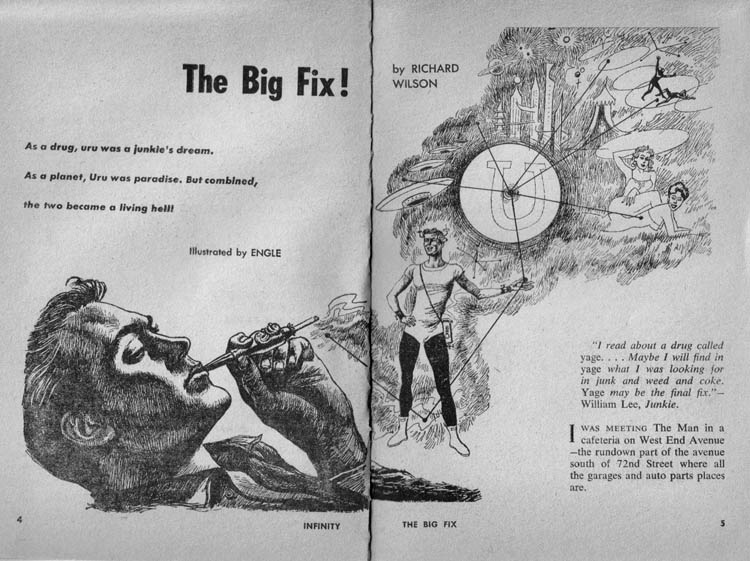
A few minutes of searching turned up the solution in an illustrated spread from the magazine: the original printing opened with a paragraph from Junkie (1953) by William Burroughs (credited as William Lee) which not only explains the accuracy of the drug and slang details but also why Wilson was mentioning yage. Burroughs’ connections with (and influence upon) the SF world are well-documented but this is a surprising example—maybe the first—of his influencing a story before he was known as William Burroughs. I wonder now if he ever knew about this instance himself, or if the excising of the Junkie paragraph from subsequent reprints marooned the detail in the magazine. At the end of the story there’s more contemporary relevance when the narrator has managed to return to Earth and is helping some researchers with their mescaline experiments, a process whose higher status he attributes to “the Huxley effect”.

Elsewhere on { feuilleton }
The William Burroughs archive

Previously on { feuilleton }
More trip texts

Spheres, a film by Norman McLaren and René Jodoin

spheres.jpg

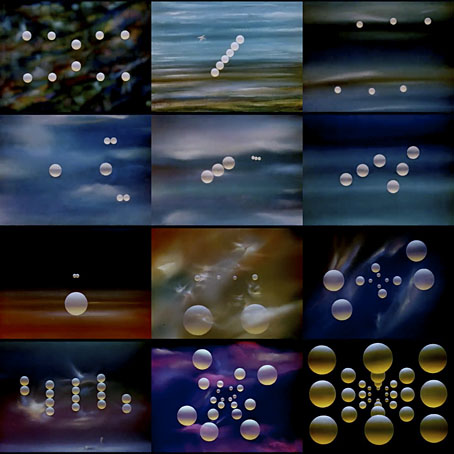
Norman McLaren’s dance films were a late development, previous decades having been spent creating animated films in a variety of techniques. Many of these were abstract works with a musical accompaniment, as is Spheres (1969), one of McLaren’s last films in this style. It’s not completely abstract: a butterfly keeps interrupting the multiplying spheres which dance through space to a piano piece by Bach. This being a Canadian production, it’s fitting that Glenn Gould is at the keyboard.

Previously on { feuilleton }
Ballet Adagio, a film by Norman McLaren
Pas de Deux by Norman McLaren
Norman McLaren

Ballet Adagio, a film by Norman McLaren

ballet.jpg

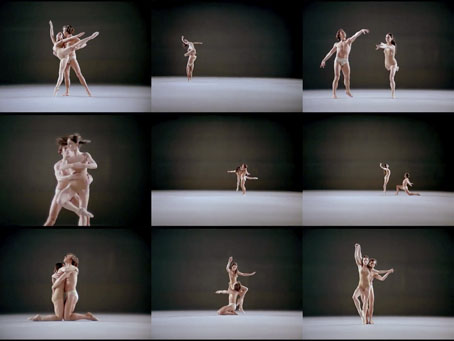
In which Norman McLaren once more brings film technology to the world of dance. McLaren’s earlier Pas de Deux (1968) used optical printing to multiply the movements of the dancers in a manner similar to Marey’s chronophotographs; in Ballet Adagio the entire dance is shown in slow motion, a common enough technique but one you seldom see applied to ballet. The music is Albinoni’s Adagio. The latter technique was employed again in the homoerotic Narcissus (1983) which can be seen in full at the NFB website.

Previously on { feuilleton }
Lodela, a film by Philippe Baylaucq
Pas de Deux by Norman McLaren
Norman McLaren

Weekend links 260

burgher.jpg

Bachelor with “demons” (Sleezy) [sic] (2015) by Elijah Burgher. One of a new series of artworks by Burgher showing at Zieher Smith & Horton, NYC.

• The week in HR Giger: Belinda Sallin on her documentary, Dark Star: HR Giger’s World; Ron Kretsch on the unseen cinema of HR Giger; Matthew Cheney thinks the Gigeresque has become too familiar. I can see his point but originality is always in short supply; asking for something new means setting yourself up for a long wait.

Pwdre ser, or Star jelly, is “a pale, foul-smelling jelly traditionally associated with meteorite falls”. The Rot of the Stars at the ICA, London, is an audio-visual art collaboration between Jo Fisher and Mark Pilkington dealing with the mysterious substance.

• Mixes of the week: A Tri Angle Records birthday DJ set by Björk; OreCast 196 mix by Ilius; Secret Thirteen Mix 153 by M!R!M.

To assume that a given group of people would be similar because of birthdate, Ryder thought, was to risk committing a fallacy. “The burden of proof is on those who insist that the cohort acquires the organised characteristics of some kind of temporal community,” he wrote. “This may be a fruitful hypothesis in the study of small groups of coevals in artistic or political movements but it scarcely applies to more than a small minority of the cohort in a mass society.”

Generational thinking is a bogus way to understand the world says Rebecca Onion

The plan for an airport above the streets of Manhattan. Related: Charles Glover‘s similar plan for London.

Errol Morris on how typography shapes our perception of truth.

Michael Moorcock enjoyed The Vorrh, a novel by Brian Catling.

Clive Barker on almost dying, hustling, and killing Pinhead.

• A new Penguin Books website for Angela Carter.

• Callum James on artist Philip Core.

A Beginner’s Guide to King Tubby

King Tubby Meets Rockers Uptown (1976) by Augustus Pablo | Star Cannibal (1982) by Hawkwind | Sleazy (1983) by Jah Wobble, The Edge, Holger Czukay

More trip texts

parry1.jpg

More psychedelia of a sort. Anthologist Michel Parry, who died last year, was a familiar name to British readers of fantasy, horror and science fiction for his themed collections: Beware of the Cat (1972; horror stories about cats), The Devil’s Children (1974; horror stories about children), The Hounds of Hell (1974; horror stories about dogs), Jack the Knife (1975; Jack the Ripper stories), The Supernatural Solution (1976; occult investigators), Sex in the 21st Century (1979), and so on.

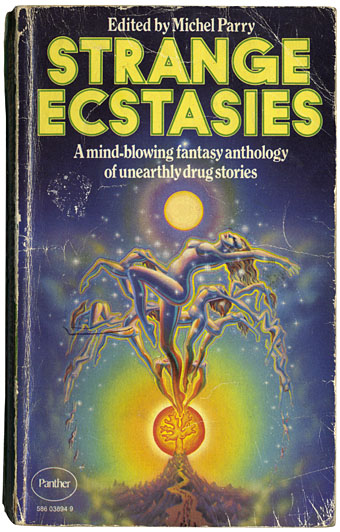
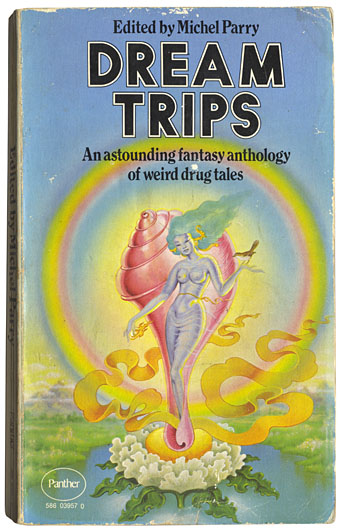
Parry also compiled multi-volume anthologies throughout the 1970s, two of which have always stood out for me: the Mayflower Books of Black Magic Stories ran to six volumes presenting a wide range of occult fiction that included a number of obscure tales from Victorian and Edwardian writers; for Panther Books he compiled three collections of drug-related fantasy and SF stories that are just as varied, and may even be unique for the way they place authors as such as Lord Dunsany and Norman Spinrad together in the same volume. Both series are very much of their time—occult psychedelia!—and are worth seeking out, if you can find them. I emphasise the last point because it’s taken me a while to find a copy of Strange Ecstasies that wasn’t being offered for bizarrely inflated prices; my paperback habit has its limits… None of these anthologies have been reprinted so they’ll become increasingly scarce. For more invented drugs, there’s a good list at Wikipedia.

parry2.jpg

Cover art by Bob Haberfield.

Strange Ecstasies (1973)
The Plutonian Drug (1934) by Clark Ashton Smith
The Dream Pills (1920) by FH Davis
The White Powder (1895) by Arthur Machen
The New Accelerator (1901) by HG Wells
The Big Fix (1956) by Richard Wilson
The Secret Songs (1962) by Fritz Leiber
The Hounds of Tindalos (1929) by Frank Belknap Long
Subjectivity (1964) by Norman Spinrad
What to Do Until the Analyst Comes (1956) by Frederik Pohl
Pipe Dream (1972) by Chris Miller

parry3.jpg

Cover art by Bob Haberfield.

Dream Trips (1974)
The Hashish Man (1910) by Lord Dunsany
As Dreams Are Made On (1973) by Joseph F. Pumilia
The Adventure of the Pipe (1898) by Richard Marsh
Dream-Dust from Mars (1938) by Manly Wade Wellman
The Life Serum (1926) by Paul S. Powers
Morning After (1957) by Robert Sheckley
Under the Knife (1896) by HG Wells
The Good Trip (1970) by Ursula K. Le Guin
No Direction Home (1971) by Norman Spinrad
The Phantom Drug (1926) by AW Kapfer

parry4.jpg

Cover art by Brian Froud.

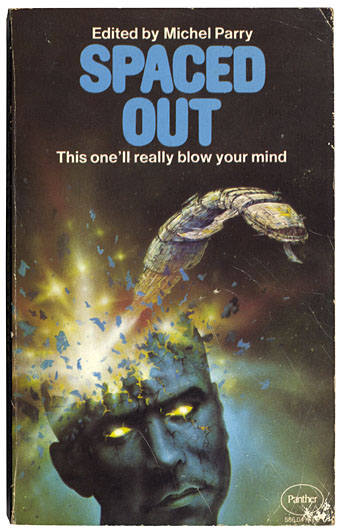
Spaced Out (1977)
The Deep Fix (1964) by Michael Moorcock
All the Weed in the World (1961) by Fritz Leiber
The Roger Bacon Formula (1929) by Fletcher Pratt
Smoke of the Snake (1934) by Carl Jacobi
Melodramine (1965) by Henry Slesar
My Head’s in a Different Place, Now (1972) by Grania Davis
Sky (1971) by RA Lafferty
All of Them Were Empty— (1972) by David Gerrold

Previously on { feuilleton }
Trip texts
Acid albums
Acid covers
Lyrical Substance Deliberated
The Art of Tripping, a documentary by Storm Thorgerson
Enter the Void
In the Land of Retinal Delights
Haschisch Hallucinations by HE Gowers
The art of LSD
Hep cats