Art that transcends

ca56.jpg

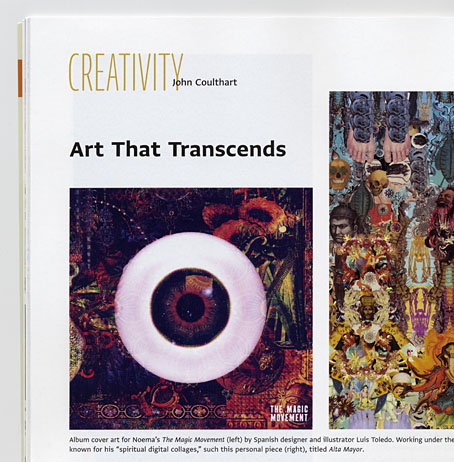
Late last year, US design magazine Communication Arts asked me to write a piece about psychedelic art, past and present. The resulting feature has been out for a couple of weeks in the May/June issue (no. 56) but I hadn’t seen it in print until a copy turned up today. Attempting to wrangle discussion of a very wide-ranging and amorphous field into 1500 words isn’t an easy task but I managed to sketch a history of psychedelic art beginning with Aldous Huxley and Humphrey Osmond’s mescaline experiments in the 1950s. Art that can be considered psychedelic goes back into prehistory but Huxley’s The Doors of Perception (1954) is the first book that considered art in general from a psychedelic viewpoint. That book, and the later Heaven and Hell (1956), are still valuable for their aesthetic meditations however much Huxley’s optimism may have been tainted by the ferment of the 1960s.
earth.jpg

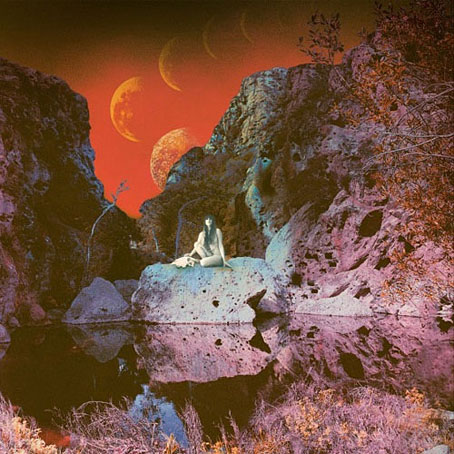
Primitive And Deadly (2014) by Earth. Art by Samantha Muljat.

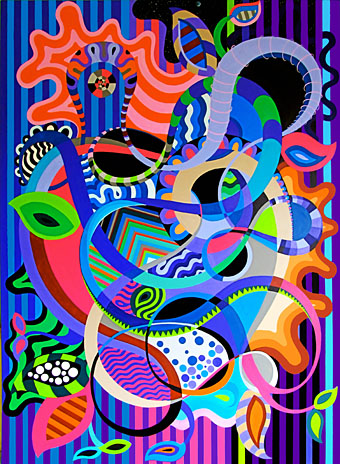
The psychedelic art of the 60s isn’t exactly overlooked so I paid more attention to tracing the influence of the psychedelic style, and also mentioning painters such as Ernst Fuchs, Alex Grey, Martina Hoffmann and Mati Klarwein. Among the more recent artists, I was pleased that Samantha Muljat‘s album cover for Earth was featured. I’ve been listening to this album a great deal over the past few months, and loved that cover as soon as I saw it. One of the other contemporary names, Brazilian artist Duda Lanna, works in a very different style: bold, vivid, and often abstract. There seems to be a lot of this kind of work around at the moment, so much so that I kept spotting new examples after the article had been delivered. It’s difficult to say whether this is a developing trend or simply a case of there being more of everything around these days. I’ll play safe and suggest it’s probably a bit of both although, as I say at the end of the article, if the movement to legalise drugs gains momentum we can expect to see a lot more psychedelic art.
lanna.jpg

Garden of Psychedelic Delights by Duda Lanna.
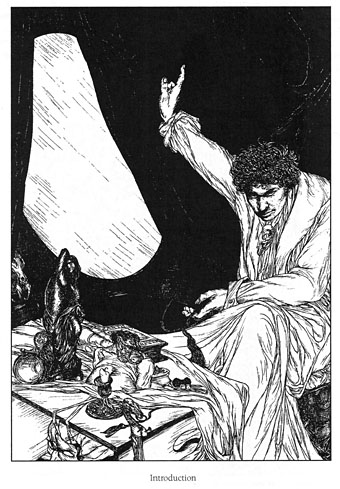
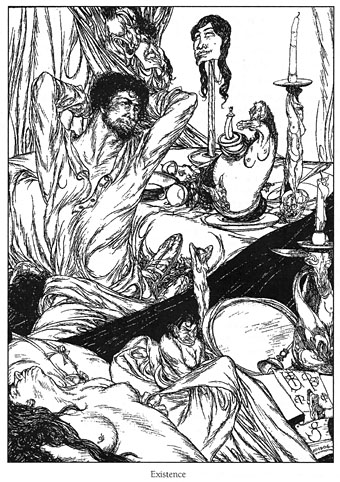
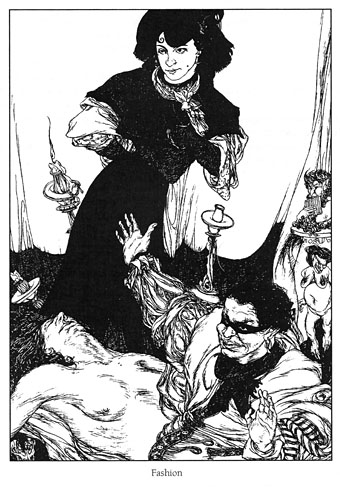
A Book of Satyrs by Austin Osman Spare

spare01.jpg

The Oxford English Dictionary notes that the word “satire” is

Formerly often confused or associated with satyr, from the common notion (found already in some ancient grammarians) that Latin ‘satira’ was derived from the Greek ‘satyr’, in allusion to the chorus of satyrs which gave its name to the Greek ‘satyric’ drama.

The word derives from “satura”

in early use a discursive composition in verse treating of a variety of subjects, in classical use a poem in which prevalent follies or vices are assailed with ridicule or with serious denunciation (OED)

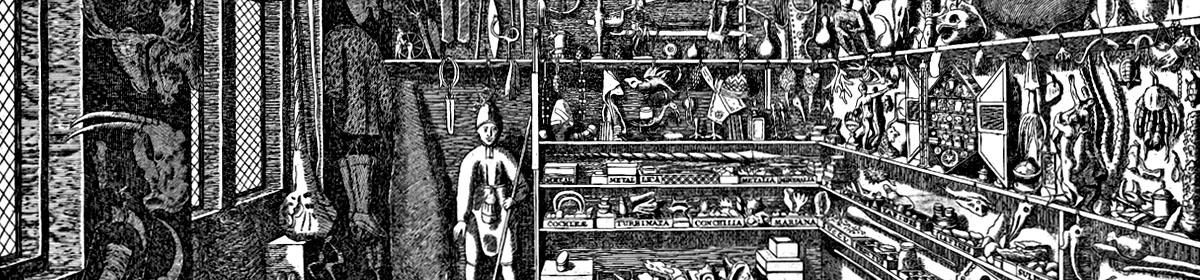
but Austin Osman Spare’s A Book of Satyrs deliberately confuses satyr with satire, being a collection of satirical drawings among which may be found a small number of satyrs. Spare’s book was published in 1907 in an edition of 300 copies; it was reprinted by John Lane in 1909, and has been reissued since but any edition of Spare seems fated to vanish almost as soon as it appears, hence this unauthorised scan at the Internet Archive. Technically, these are some of the most detailed drawings that Spare produced so it’s to their benefit that the copies are a decent size; the meaning may not always be clear but you can at least wander among the accumulations of body parts, masks and bric-a-brac. Most are dated 1906, Spare’s 20th year.

spare02.jpg

spare03.jpg

Continue reading “A Book of Satyrs by Austin Osman Spare”

Eurydice…She, So Beloved, a film by the Brothers Quay

eurydice.jpg

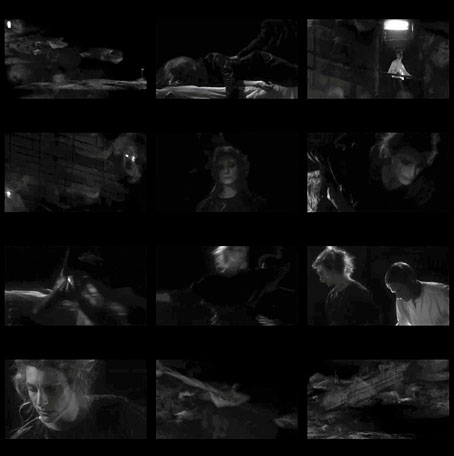
Another recent short from the Quays that’s yet to be given a wider release, Eurydice…She, So Beloved (2007) is an opera/dance piece subtitled “Film ballet in homage to the 100th anniversary of Claudio Monteverdi’s Orfeo“. Orfeo (Simon Keenlyside) sings an aria while Hermes (Kenneth Tharp) rouses Eurydice (Zenaida Yanowsky) from her sleep in a suitably Stygian and rather industrial Underworld. Watch it here.

Elsewhere on { feuilleton }
The Quay Brothers archive

Inventorium of Traces, a film by the Brothers Quay

inventorium.jpg

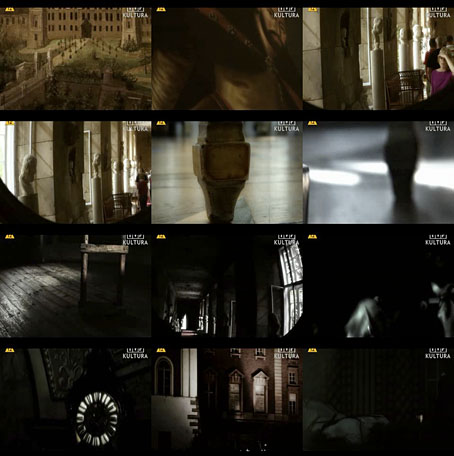
Inventorium of Traces was made in 2009 but it’s taken a while to make its way out of Poland in any complete form. In this 25-minute video piece the Quays turn their attention to Lancut Castle, a celebrated Polish stately home, and the former residence of the Potocki family. Of the latter, Jan Potocki would have an understandable attractions for the Quays being the author of The Saragossa Manuscript, a book that’s briefly alluded to when the Saragossa region is glimpsed on a map. The first half of the film shows visitors to the Castle being observed by statues and paintings, one of which is a portrait of Jan Potocki; in the second half, night falls, the building is locked, and some typical Quay business begins with flickering light and spectral animation. The music is by Krzysztof Penderecki, a composer the Quays used a year later for their superb animation, Maska, and also the composer of the soundtrack to the Wojciech Has adaptation of Potocki’s novel. The quality of the uploaded video could be better (the frame seems to be cropped) but it’s good enough for Quay obsessives. Watch it here.

Elsewhere on { feuilleton }
The Quay Brothers archive

René Gockinga revisited

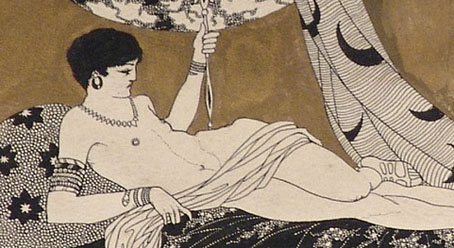
gockinga1.jpg

Presenting another guest post by Sander Bink concerning drawings by Dutch artists from the early decades of the 20th century, several of which show a distinct Beardsley influence. There’s also more than a little Harry Clarke in some of the details, especially the large Salomé picture below. Sander examines the provenance.

* * *

In our ongoing research into the influence of Aubrey Beardsley and Carel de Nerée in Dutch art of the early twentieth century, René Gockinga must be one of the most elusive. We wrote about him earlier but in the meantime we spoke to someone who has known him in the latter years of his life (he died 1962 in Amsterdam), she could not tell us more about the whereabouts of his early Beardsley-esque works. His more traditional Indonesian paintings from the 1930s sometime turn up at auction and I have also seen some samples of his post-WWII abstract paintings.

But of course, it’s the early, ‘decadent’ work, we’re most interested in. The RKD (Netherlands Institute of Art History) has pictures of about five of these, for the time being, lost drawings. So the Klein portrait was of course a great find. We were quite content and never dreamed of finding more unknown Gockinga’s (we do not know the whereabouts of the Salomé reproduced in the earlier post).

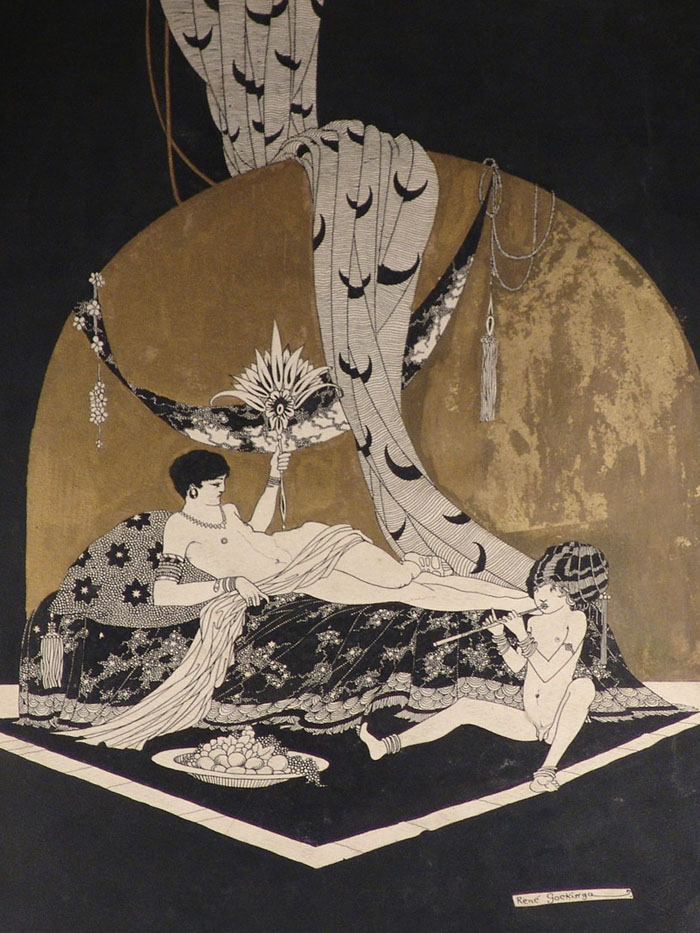
So one can image our surprise when we recently received an email from an art lover from Florida who had stumbled upon three drawings by Gockinga. At an Atlanta, Georgia antique show of all places! But then again: Gockinga has lived in New York from 1924 till 1932 or possibly 1938. At some point he might have sold his early work?

However it is, these are great and as far as we know never before seen examples of a quite talented but also quite obscure and neglected Dutch artist from the period. I suspect the main reason for this neglect could be due to the nature of his work which was probably too homo-erotic and pornographic for the (Dutch) public. As far as we know, he only had one exhibition where his Beardsley- and De Nerée influenced work was shown. That took place summer 1917 at the d’Audretsch gallery, The Hague. This  gallery which owned a large collection of work by De Nerée and Gockinga must have seen his work there. Otherwise they could have seen his work someplace else at the early De Nerée exhibitions which took place 1910–1917.

gockinga2.jpg

In the first drawing presented here the De Nerée influence is apparent in the use of the golden painted background, a technique De Nerée applied in several works from around 1903, like La Promeneuse (below; collection Meentwijck).

Continue reading “René Gockinga revisited”