Weekend links 368

nerly.jpg

Piazzetta San Marco by Moonlight (no date) by Friedrich Paul Nerly.

• RIP Heathcote Williams (Guardian obit, NYT obit): poet, playwright, actor, artist, anarchist, stage magician, and no doubt many other things besides. Being a product of the counter-culture, and one of Britain’s foremost anti-establishment writers (his polemics against the Royal Family were unceasing), Williams was a regular in the early publications produced by my colleagues at Savoy Books; in fact there’s a piece by him in The Savoy Book itself. Consequently, Williams always felt like a distant relative even though we never met. Of his many film appearances, which ranged from low-budget independent productions to Hollywood junk, he was ideally cast as Prospero in Derek Jarman’s film of The Tempest, and he audaciously steals a scene from Tilda Swinton in Sally Potter’s wonderful Orlando. Elsewhere: Jeremy Harding on Williams’ run-ins with the gatekeepers, and Why D’Ya Do It?, a song by Marianne Faithfull with lyrics by Williams.

• Mixes of the week: Secret Thirteen Mix 226 by Chihei Hatakeyama, and SydArthur Festival 2: Summer of Love Edition by Head Heritage.

Geeta Dayal on composer and musique concrète pioneer Pierre Henry whose death was also announced this week.

Jonathan Meades reviews Vinyl.Album.Cover.Art: The Complete Hipgnosis Catalogue by Aubrey Powell.

• “Brutal! Vulgar! Dirty!” Polly Stenham on Mae West and the gay comedy that shocked 1920s America.

Hannah Devlin on religious leaders getting high on psilocybin for science.

• At Dennis Cooper’s: Spotlight on…In Transit (1969) by Brigid Brophy.

• At Bibliothèque Gay: Matelots (1935) by Gregorio Prieto.

SD Sykes on reconsidering Venice, crumbling city.

Letters and Liquor

This Ain’t The Summer Of Love (1976) by Blue Öyster Cult | Orlando (1996) by Trans Am | Transit (2004) by Fennesz
Hector Guimard’s Castel Béranger

guimard01.jpg

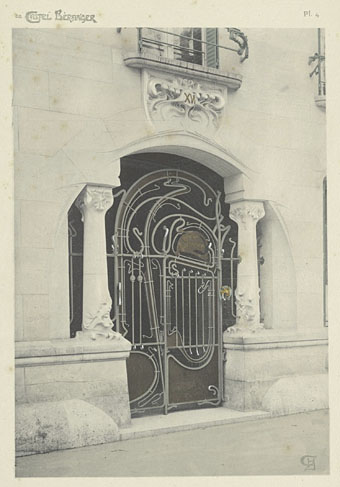
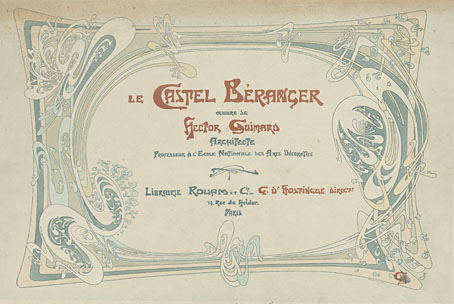
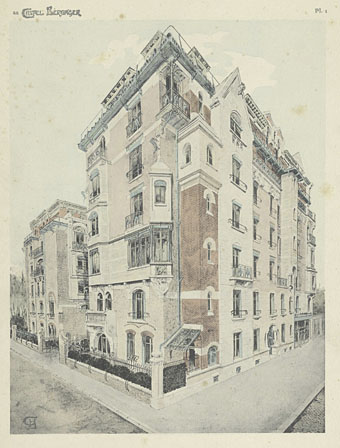
Art Nouveau is never far from these pages or from my own work, as has been the case this week when work-related research turned up this recent addition to the scanned books at the Internet Archive. Hector Guimard is best known today for his entrances to the Paris Metro not all of which survived the ravages of the 20th century. His designs for the Castel Béranger, an apartment block in Paris, slightly precede the Metro commission, and were intended by Guimard as a showcase for his own development of the Art Nouveau style.

guimard02.jpg

Like Frank Lloyd Wright, Guimard attended to every detail of the building’s construction and interior design, furniture included, and that’s what you have here, a book length guide to the building inside and out. The asymmetrical wrought-iron gate is a familiar sight from studies of Art Nouveau but other views of the building are less common. Compared to Alphonse Mucha’s control and Victor Horta’s sinuous curves, Guimard’s decoration can appear undisciplined but the wildness also makes it seem in advance of its time. Some of the wallpaper patterns for the Castel Béranger contain shapes that wouldn’t be seen again in a design context until the psychedelic posters of the 1960s. Guimard believed he was designing for the future but didn’t live to see the world that could make use of such stylistic delirium.

guimard03.jpg

Continue reading “Hector Guimard’s Castel Béranger”

Weekend links 367

sarto.jpg

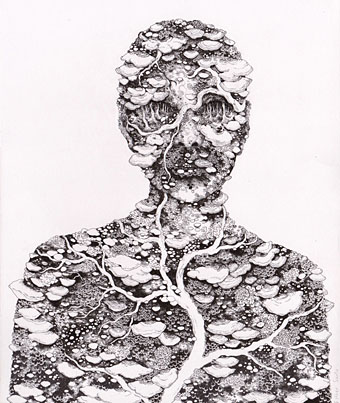
Human Nature by Esther Sarto.

I Feel Love: “Donna Summer and Giorgio Moroder created the template for dance music as we know it”. Bill Brewster on the creation of one of the greatest songs ever recorded.

The Tearoom by Robert Yang “is a (free) historical public bathroom simulator about anxiety, police surveillance, and sucking off another dude’s gun”.

Tim Walker’s Leonora Carrington-themed fashion shoot with Tilda Swinton reaches i-D‘s website at last. More pictures and in better quality.

Joe Dante on the legacy of Nigel Kneale. Related: We Are The Martians: The Legacy of Nigel Kneale, edited by Neil Snowdon.

Beth Comery‘s report on the progress of Gage Prentiss’s planned statue of HP Lovecraft for Providence, RI.

• The Plagiarist in the Kitchen: Jonathan Meades talks food and cooking with John Mitchinson.

• At Dangerous Minds: “Forget Louis Wain’s psychedelic cats, here are his crazy Cubist ceramics”.

• “Court orders Salvador Dalí‘s body be exhumed for paternity test.”

Flash the flesh: Manchester’s gay club heroes – in pictures.

Rick Poynor on the joy and sadness of dust.

MostlyCatsMostly

From The Tea-Rooms Of Mars…To The Hell-Holes Of Uranus: “Beguine”, “Mambo”, “Tango” (1981) by Landscape | I Feel Love (Patrick Cowley Mega Mix) (1982) by Donna Summer | Martian Sperm And Bagpipes (1991) by Helios Creed

From The Furthest Signals

signals.jpg

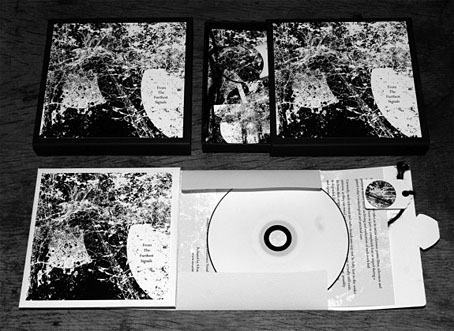
It’s been a busy year so far for A Year In The Country with two themed compilation albums being followed this month by a third, From The Furthest Signals. The latest theme is an intriguing one, taking as its starting point the erasing of broadcast tapes by British TV companies in the 1960s and early 1970s which destroyed hundreds of hours of dramas, concerts and other programmes. This was done as a money-saving measure (tape being expensive and reusable) at a time when the output of the BBC and the independent stations was regarded as mostly ephemeral and of little value. There was also a patronising class aspect to the practice: John Peel used to bitterly remind people that the BBC had saved its tapes of gardening shows while wiping concerts by the likes of Captain Beefheart.

Track list:
1) Circle/Temple – The Séance/Search for Muspel-Light
2) David Colohan – Brass Rubbings Club (Opening Titles)
3) A Year In The Country – A Multitude Of Tumblings
4) Sharron Kraus – Asterope
5) Time Attendant – The Dreaming Green
6) Depatterning – Aurora In Andromeda
7) Sproatly Smith – The Thistle Doll
8) Field Lines Cartographer – The Radio Window
9) Grey Frequency – Ident (IV)
10) Keith Seatman – Curious Noises & Distant Voices
11) Polypores – Signals Caught Off The Coast
12) The Hare And The Moon – Man Of Double Deed
13) Pulselovers – Endless Repeats/Eternal Return
14) Listening Center – Only The Credits Remain

All those wiped broadcasts may be lost down on Earth but they still exist somewhere in the halo of television and radio signals which is expanding into space. From The Furthest Signals is a speculation about the content of these remote signals, a tuning in to decayed transmissions and imagined broadcasts (that word—”broadcast”—being examined here in its widest possible sense). Some of the entries nod to fictional analogues: The Séance/Search For The Muspel Light by Circle/Temple is a reference to A Voyage to Arcturus, David Lindsay’s unique and remarkable science-fiction novel. Other entries like Brass Rubbings Club (Opening Titles) by David Colohan are suggestions for imaginary theme tunes. This is an excellent collection, one of the best to date from A Year In The Country with pieces ranging from the folk-oriented balladry of Sproatly Smith to the deteriorating electronics of Grey Frequency. The album ends with a number by Listening Center, Only The Credits Remain, whose weightless harmonies wouldn’t be out of place on Apollo by Brian Eno & Daniel Lanois.

From The Furthest Signals is out now in the familiar range of hand-crafted monochrome formats.

Previously on { feuilleton }
The Restless Field
The Marks Upon The Land
The Forest / The Wald
The Quietened Bunker
Fractures

Weekend links 366

kashiki.jpg

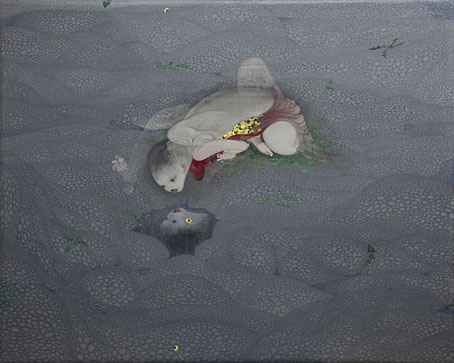
Dandelion (2009) by Tomoko Kashiki.

• “Standard Ebooks takes ebooks from sources like Project Gutenberg, formats and typesets them using a carefully designed and professional-grade style guide, lightly modernizes them, fully proofreads and corrects them, and then builds them to take advantage of state-of-the-art ereader and browser technology.”

Obscenity and the Arts, a previously unpublished essay by Anthony Burgess, will appear in book form later this year via Pariah Press.

• Mixes of the week: VF Mix 97: Talk Talk by The Last Dinosaur, and Secret Thirteen Mix 225 by Janek Schaefer.

Rub any two writers together and similarities will show. No two writers, however different, are completely different. Here’s a crucial instance: Lovecraft and Ballard both put architecture at the heart of their fiction, even though neither had the slightest formal training in the subject. And it is via this interest that the two intersect in an unexpected way. They are connected, through time and space, by that most humble of architectural events: the corner, the junction between two walls. What Lovecraft and Ballard did was to make the corner into a place of nightmares — and in doing so, they reveal its secret history.

Will Wiles in a long and rewarding essay, The Corner of Lovecraft and Ballard

• Dungeons Deep, Forests Dark – A beginner’s guide to Dungeon Synth by Daniel Pietersen.

Alex Ross on Joséphin Péladan, the Symbolists and the occult roots of Modernism.

• Cooling the Tube: engineering heat out of the [London] Underground by IanVisits.

Caroline on the mysteries of Pye Corner: Flames, poltergeists and bodysnatchers.

• The Saint of Sin City – Tony Kail Visits Las Vegas’ Santuario de la Santa Muerte.

• Photographs of Art Nouveau architecture by Keiichi Tahara.

• A stream of the new Porter Ricks album, Anguilla Electrica.

Jasper Sharp on 100 years of Japanese animation.

• At Dennis Cooper’s: 197 clocks.

On The Corner [Take 4] (1972) by Miles Davis | Corner Crew Dub (1976) by Augustus Pablo | Empty Avenues And Dark Corners (Pye Corner Audio Mix) (2013) by John Foxx and the Belbury Circle