Giger’s Tarot

giger13.jpg

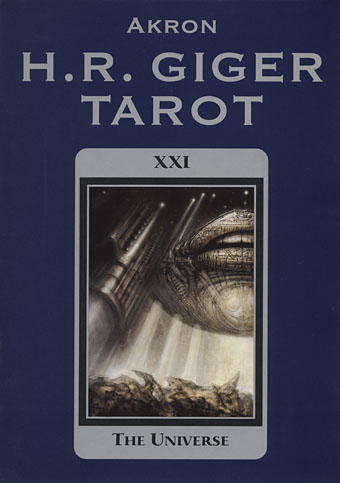
This week’s posts reminded me that I have a copy of the HR Giger Tarot set published by Taschen under their Evergreen imprint in 2000. The set is Taschen’s reworking of Giger & Akron’s Baphomet Tarot der Unterwelt set from 1994, and I recall this being one of the last things Taschen created with Giger after spending the previous decade producing a run of books, diaries and posters featuring his paintings. Inside a box you find a set of 22 oversize Tarot trumps presenting some of Giger’s works against metallic silver surrounds. There’s also a poster-size sheet for card readings printed with his pentagram design plus a 224-page paperback book by Swiss Tarot scholar Akron, aka CF Frey, which interprets the paintings as they relate to the Major Arcana. (The Baphomet set had a hardback book and the pentagram design printed on the back of each card.)
giger12.jpg

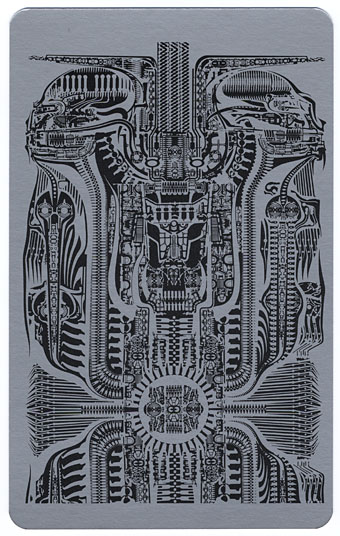
The design on the back of the cards, printed in black on metallic silver.

If you’re familiar with Tarot symbolism you don’t have to use these cards to find the correspondences intriguing. The trump ordering is an odd mix of the Crowley scheme with the more traditional designations. Two of the trumps have also been given new names: The Hanged Man is now The Hanged Woman while Crowley’s Art (formerly Temperance) has become Alchemy, an association which works since the card in the Crowley deck depicts the Androgyne of alchemical symbolism. I can imagine some Tarot collectors finding these cards far too dark and nasty, but when so many Tarot designs today are various degrees of garish or twee there’s plenty of room for a Giger or two to harsh the New Age mellow.

The card set has been out of print for years but Abebooks still carries copies at reasonable prices. A few examples of the cards follow.
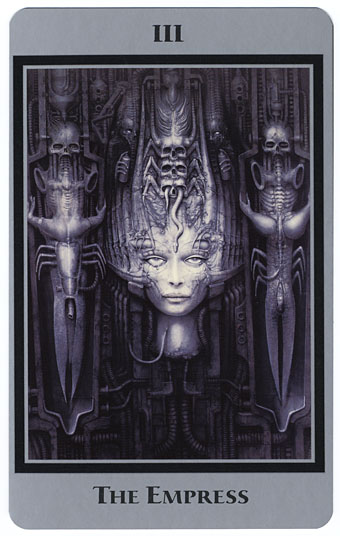
giger14.jpg

Continue reading “Giger’s Tarot”

HR Giger album covers

giger4.jpg

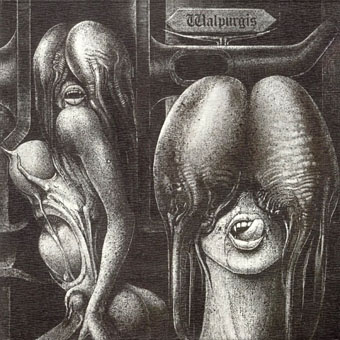
Walpurgis (1969) by The Shiver.

An inevitable follow-up to yesterday’s post, this continues an occasional look at album cover art by people better known for their work elsewhere. Giger’s album covers fall into two categories: those with some direct involvement from the artist and those which are merely reuses of pre-existing paintings. The former category is the one that’s of concern here.

The Shiver were a German Swiss group who Discogs label as “Krautrock”, a term with an unfortunate tendency these days to get attached to any German music that isn’t James Last. From what I’ve heard the group are a lot more ordinary than that, doing the kind of late psychedelic/early progressive rock common to many European bands in 1969.

Update: Further research reveals that The Shiver were Swiss, not German as they’re listed at Discogs. They evolved later into Island (see below) which explains why both groups released albums bearing Giger cover art.

giger5.jpg

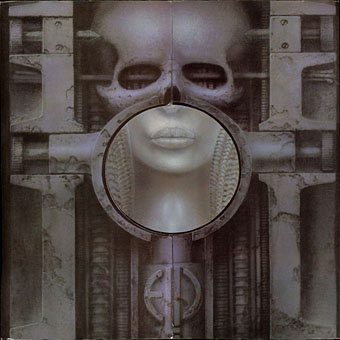
Brain Salad Surgery (1973) by Emerson, Lake & Palmer.

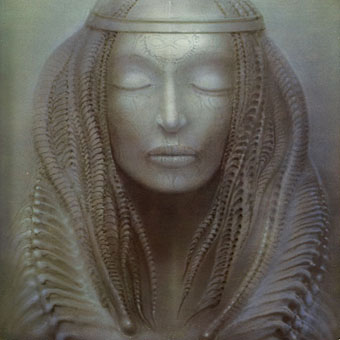
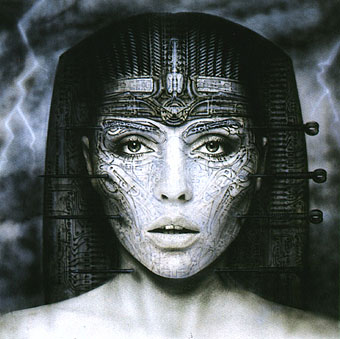
And speaking of prog… I’ve always loved the cover for this album which in its vinyl edition opens out to reveal the spectral woman beneath. The female face is named Isis on a poster I still have somewhere. Despite liking the cover I never really liked ELP so this is one album of the period I’ve yet to hear.

giger6.jpg

Brain Salad Surgery interior.

giger7.jpg

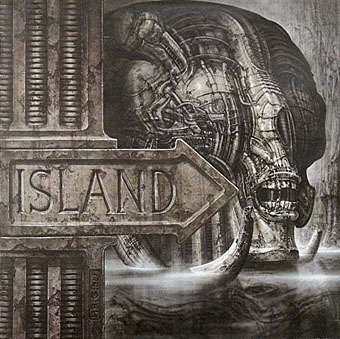
Pictures (1977) by Island.

And yet more prog… Island were a Swiss group. The cover painting is Necronom IIIa (1976) with some Giger lettering added.

giger8.jpg

Attahk (1978) by Magma.

Magma are (of course) Christian Vander’s ongoing jazz/prog/opera/Zeuhl/sf/freakout music project. Giger declares a taste for jazz and jazz rock in one of his books so I imagine this commission would have appealed more than others, Magma’s approach to jazz having an apocalyptic tendency. Track titles like Liriïk Necronomicus Kanht (In Which Our Heroes Ourgon & Gorgo Meet) wouldn’t have done much harm either. The safety-pin sunglasses were inspired by the safety-pin fashions of punk.

giger9.jpg

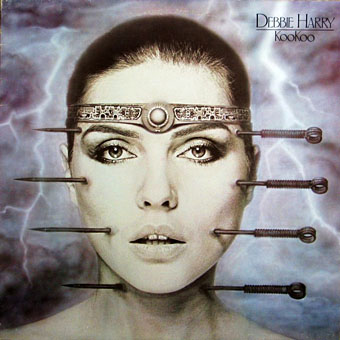
KooKoo (1981) by Debbie Harry.

And speaking of punk… Giger considered Debbie Harry to be “the Queen of the Punks” so he decided to pierce her face accordingly. The album isn’t punk, however, it’s a collection of smart and funky pop songs produced by Nile Rodgers & Bernard Edwards. Two singles from the album have Giger-directed videos, Backfired (which HRG also appears in), and Now I Know You Know which has Ms Harry posing against the Passagen paintings in a black wig and a biomechanical body stocking. There’s more about the KooKoo album at the Giger site.

giger10.jpg

gige11.jpg

Elsewhere on { feuilleton }
The album covers archive

Previously on { feuilleton }
Giger’s Necronomicon
Dan O’Bannon, 1946–2009
Alejandro Jodorowsky’s Dune
The monstrous tome

Giger’s Necronomicon

giger1.jpg

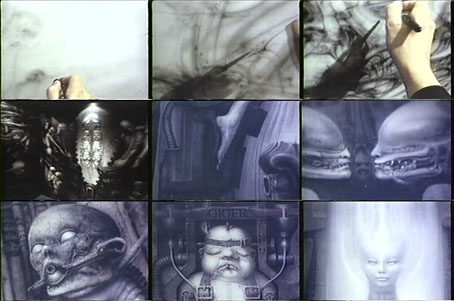
Another artist documentary only this time the artist concerned is a full participant and co-creator. Giger’s Necronomicon was filmed from 1972 to 1976 and functions as a taster for the first book collection of the artist’s work, also called Giger’s Necronomicon, which was published a year later. JJ Wittmer was the co-director. The paintings are very familiar now so it’s worth being reminded how shocking and outré Giger’s work seemed in the 1970s. In addition to interviews with the artist’s parents and some of the painting’s owners there are shots of a very modish gallery event, and we get to see inside Giger’s studio and witness one of the paintings being produced. The sound quality is somewhat erratic since the video appears to come from a Japanese tape but the voiceover is in English. The most notable thing about Giger’s Necronomicon is that all the mobile camera shots are from the artist’s point of view, we only see him when he looks in a mirror.

Giger’s Necronomicon: part 1 | part 2 | part 3 | part 4

giger2.jpg

There’s some additional interest here for Krautrock aficionados. Giger’s books mention his associations with a couple of peripheral figures from the Swiss end of Cosmic Courier/Cosmic Jokers scene: Sergius Golowin and Walter Wegmüller. Golowin is credited with one of the spacier albums on the Cosmic Courier label but he was better known in Switzerland as a writer, and he appears briefly in Giger’s Necronomicon offering some thoughts about the artist’s paintings. The music for the film sounds like the ambient jazz doodlings of Stomu Yamash’ta but is the work of Joël Vandroogenbroeck and Carole Muriel. Vandroogenbroeck recorded a lot of library music, including one release entitled Biomechanoid (1980) which has a Giger cover painting. Prior to this he was a member of German group Brainticket and plays on Cottonwoodhill (1970), an album with a (deserved) reputation as the most demented Krautrock release.

giger3.jpg

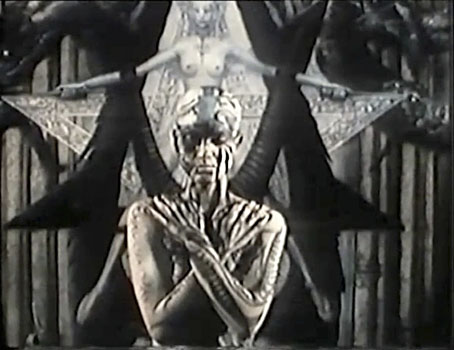
Also at YouTube is another Giger film from the same period, Giger’s Second Celebration of the Four (1977), a four-minute piece directed by JJ Wittmer showing a ritualistic club event. The combination of robes, torches and some of Giger’s more Satanic imagery resembles a black metal music video, albeit with a jazzy soundtrack.

Elsewhere on { feuilleton }
The fantastic art archive

Previously on { feuilleton }
Dan O’Bannon, 1946–2009
Alejandro Jodorowsky’s Dune
The monstrous tome

Weekend links 137

jacobsen.jpg

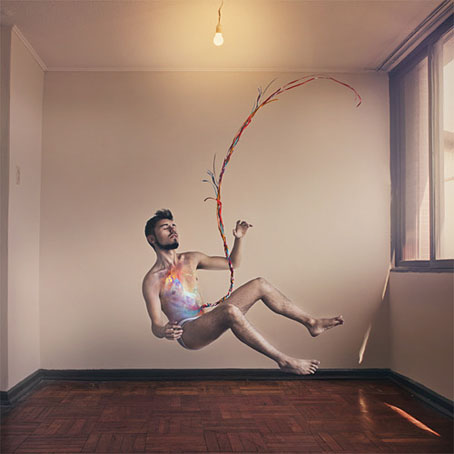
Self-portrait by Jon Jacobsen from his Home series.

Steven Arnold: Cabinet of Curiosities is “a retrospective exhibition of this groundbreaking yet under-recognized queer artist at the ONE Archives Gallery & Museum in West Hollywood. The exhibition celebrates Arnold’s radical imagination, presenting many of his tableaux vivant photographs alongside never before exhibited drawings, sketchbooks, paintings and original poster art. In conjunction with the exhibition, ONE will screen Arnold’s four films, including Luminous Procuress (1970), which featured The Cockettes and was lauded by Salvador Dalí.” The exhibition runs to  January 12, 2013.

• “The boundary-pushing techno/sound design duo Emptyset will transform London’s cavernous industrial space Ambika P3 into an immersive sound installation for one night only—and here’s how they’re going to do it”.

• “At one time he was a well-known figure in Montparnasse, where he had a reputation as a master of the occult sciences.” Aleister Crowley is interviewed about his expulsion from France in 1929.

Our normal waking consciousness, rational consciousness as we call it, is but one special type of consciousness, whilst all about it, parted from it by the filmiest of screens, there lie potential forms of consciousness entirely different. We may go through life without suspecting their existence; but apply the requisite stimulus, and at a touch they are there in all their completeness… No account of the universe in its totality can be final which leaves these other forms of consciousness quite disregarded… [T]hey forbid our premature closing of accounts with reality.

William James (1842–1910) quoted in What Should We Do With Our Visions of Heaven—and Hell? by John Horgan at Scientific American.

Screws is an album of piano music by Nils Frahm that’s currently available as a free download (inc. aiffs).

• At Pinterest: Art Visonnaire. Related: Ain’t We Got Fun: The magical surrealism of Jen Ray.

Rowan Somerville “challenges the purpose and legitimacy” of the Bad Sex Awards.

Jimmy’s End: the website for the film by Alan Moore & Mitch Jenkins.

Douglas Rushkoff in conversation with Genesis Breyer P-Orridge.

• Linda Rodriguez McRobbie explores The History of Boredom.

• Recreating the sounds of the BBC Radiophonic Workshop.

Alchemical Emblems, Occult Diagrams, and Memory Arts.

Rocaille: A Blog about Decadence, Kitsch and Godliness.

• A new video for Goddess Eyes II by Julia Holter.

• The complete audio recordings of Jean Cocteau.

The Rumpus interview with Russ Kick.

Forgotten Bookmarks

• RIP Spain Rodriguez

Astradyne (1980) by Ultravox (produced by Conny Plank) | Biomutanten (1981) by Les Vampyrettes (Conny Plank & Holger Czukay) | Never Gonna Cry Again (1981) by Eurythmics (feat. Holger Czukay, produced by Conny Plank).

The art of Thomas Cole, 1801–1848

cole1.jpg

The Titan’s Goblet (1833).

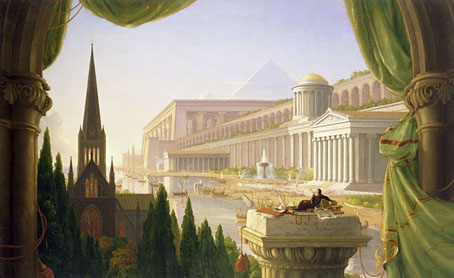
Thomas Cole’s Titan’s Goblet isn’t featured at the Google Art Project, unfortunately, but the following paintings are, and all benefit from being able to explore their details. Cole’s colossal vessel predates Surrealism by a century, and is one of many paintings which always has me mentally labelling him as the American John Martin (1789–1854). Having thought of him for years as an American artist–not least because he founded the Hudson River School–it’s a surprise to learn he was born in Bolton, a town not far from Manchester, with his parents emigrating to the US when he was 17. John Martin also grew up in the north of England so there’s another similarity, although the more important comparison concerns their use of painting to convey the spectacularly vast and unreal scenes common to the imaginative side of Romantic art. The Titan’s Goblet is unusual in not having any particular symbolic or moral significance, unlike the pictures below, it’s Magritte-like in its careful depiction of the impossible. The Subsiding of the Waters of the Deluge, on the other hand, could be exhibited beside Francis Danby’s The Deluge (1840) for a “before and after” effect. Like Martin, Cole enjoyed painting architecture of an exaggerated scale. The Architect’s Dream features an Egyptian temple of stupendous size, while the pyramid looming in the background is closer to William Hope Hodgson’s seven-mile-high Last Redoubt than any structure on the Nile plain.

Of equal interest are Cole’s two well-known series: The Course of Empire (1833–36) and The Voyage of Life (1842), both of which I’d love to see at Art Project size.

cole2.jpg

Expulsion from the Garden of Eden (1828).

cole3.jpg

The Subsiding of the Waters of the Deluge (1829).

cole4.jpg

The Architect’s Dream (1840).

Elsewhere on { feuilleton }
The fantastic art archive

Previously on { feuilleton }
John Martin’s musical afterlife
Albert Bierstadt in Yosemite
Danby’s Deluge
John Martin: Heaven & Hell
Darkness visible
Two American paintings
The apocalyptic art of Francis Danby