Claudio Bravo’s packages

bravo01.jpg

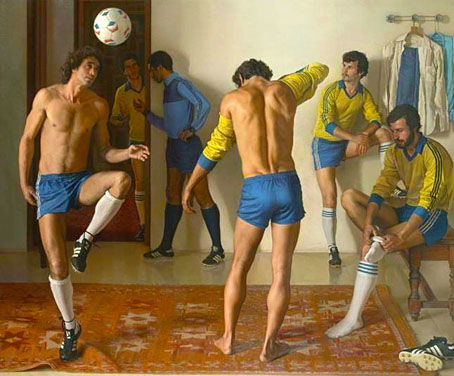
Before the Game.

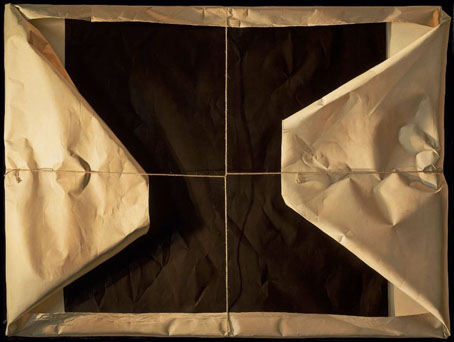
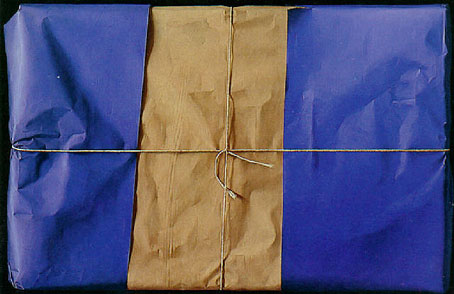
(Sorry, but that pun was unavoidable.) Claudio Bravo was a Chilean hyperrealist painter who died last year. I don’t recall having come across him before but it’s a hazard of a photographic style that your work may superficially be taken for the output of other artists. Looked at more closely his painting went through distinct phases with an increasing interest in the study of wrapped-paper packages. These trompe l’oeil paintings allow the meticulous detail to remain while giving an impression at a distance of colour field abstraction. I’m rather taken with the later pictures but then I’ve always been partial to hyperreal techniques.

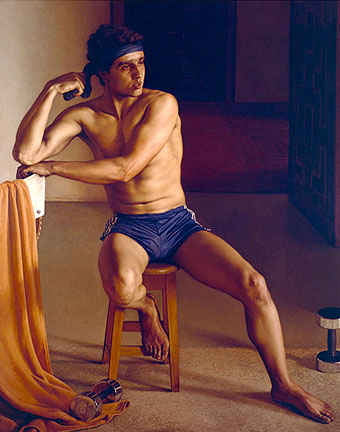
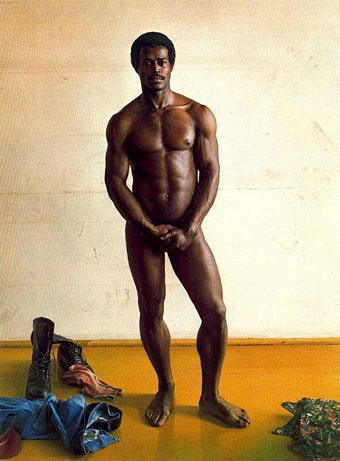
Another recurrent theme is the male body in various states of dress or undress, and rendered with as much presence as the paintings and drawings of British artist Michael Leonard. One of the drawings below could almost be one of Leonard’s. Bravo painted woman as well so we can’t read too much into this, but he did live in Morocco for many years, and one of his paintings from the 1970s depicts a swimming pool at Fire Island. Make of that what you will. (Thanks to Paul for the tip!)

bravo08.jpg

Homage to St Theresa.

bravo02.jpg

Noureddine.

bravo09.jpg

Blue and Beige Package.

bravo07.jpg

Nude (Portrait of Mr Couchez).

Continue reading “Claudio Bravo’s packages”

Polanski details

polanski01.jpg

Roman Polanski as Alfred in Dance of the Vampires (1967).

I’ve always admired the attention to detail in Roman Polanski’s films, a quality evident not only in his careful adaptations but also in areas that lesser filmmakers might ignore. Dance of the Vampires (1967) is a good example (sorry, I refuse to call it by the title MGM used for its edited US release): the sets and decor are remarkable, and the editing and camera work so skilfully blends studio constructions with location shots that for years I was convinced the film was made in a genuine European castle. The atmosphere is so carefully sustained that I found the whole thing as terrifying on first viewing as any Hammer film, despite the broad humour. In the set-piece moments Polanski (and soundtrack composer Krzysztof Komeda) put many of the later Hammer vampire films to shame.


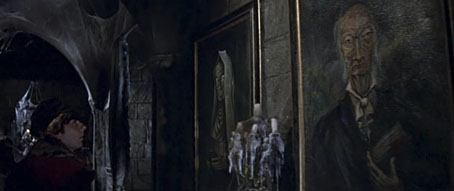
The Vampire Portraits
polanski02.jpg

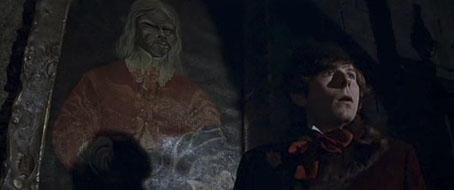
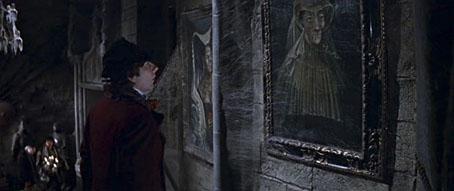
The production design and art direction for Dance of the Vampires was created by Wilfred Shingleton and Fred Carter, both of whom later worked on Polanski’s Macbeth, and who fill the rooms with mouldering furnishings and rotting decoration. One striking sequence concerns a walk through a gallery of vampire portraits that are the creepiest paintings seen on film since Ivan Albright’s portrait of a decrepit Dorian Gray. Film credits in the 1960s were sparse so there’s no indication of the artist responsible. However, one portrait glimpsed at the end of the gallery (below) is a copy of the “Ugly Duchess” painting by Quinten Matsys.
polanski03.jpg


Rosemary’s Book

polanski04.jpg

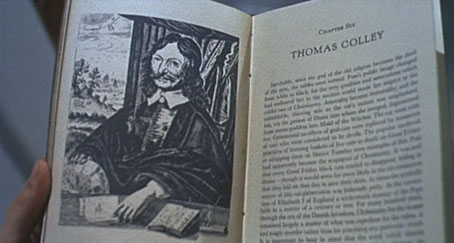
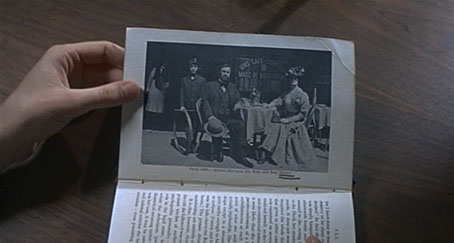
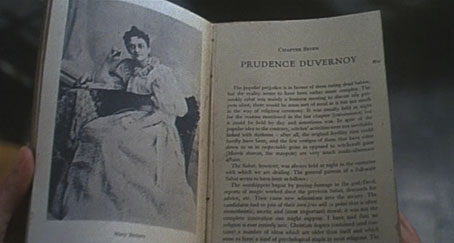
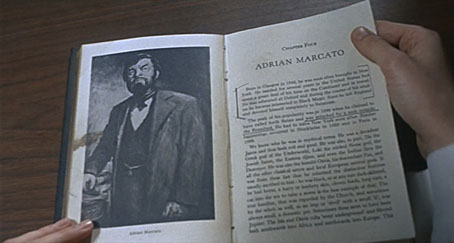
A sign that filmmakers care about detail is when they make their fictional books look like the genuine article. The history of witchcraft in Rosemary’s Baby (1968) could easily have been glimpsed very briefly but Polanski shows Rosemary leafing through its pages in a sequence of Hitchcock-like view-reaction-view shots that make it appear as convincing as possible. The shots also make the viewer examine the book through Rosemary’s eyes, something Polanski does throughout the film.
polanski05.jpg

polanski06.jpg

polanski07.jpg


Trelkovsky’s Paintings

polanski09.jpg

The Tenant (1976) is Polanski’s third study of apartment-dwelling paranoia, a superb adaptation of Roland Topor’s novel, Le Locataire chimérique (1964). The screenplay removes some of Topor’s ambiguity—and the film is spoiled by unsympathetic dubbing of the French actors—but in every other respect it’s as good as Repulsion for its portrait of an isolated individual (here portrayed by Polanski himself) surrendering to madness.
polanski10.jpg

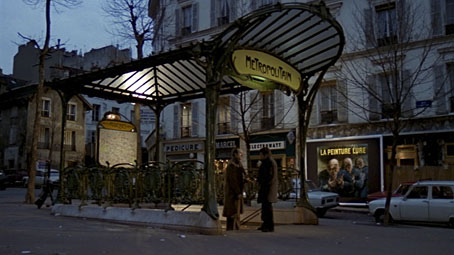
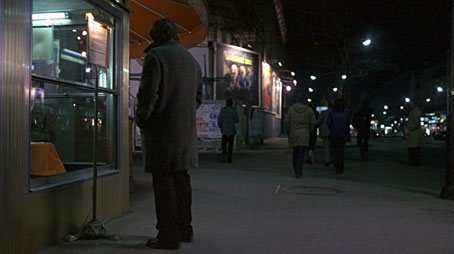
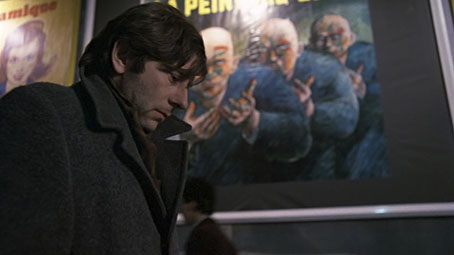
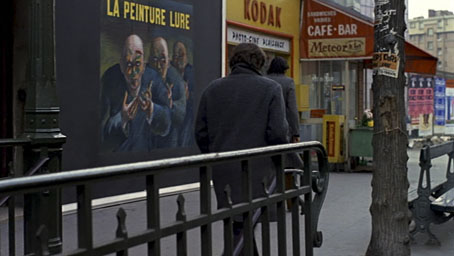
Among the many visual details which add to the unease is the appearance halfway through the film of billboards advertising…what? A painting exhibition? Or something more sinister? We never find out. The presence of these figures and their slogan—”La Peinture Lure”—remains as cryptic as many of the other unresolved questions which prey upon the beleaguered Trelkovsky.
polanski11.jpg

polanski12.jpg


Corso’s Postcard

polanski13.jpg

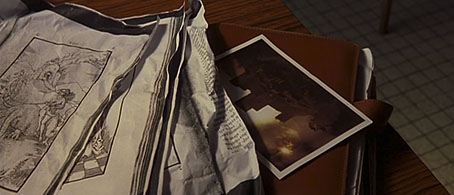
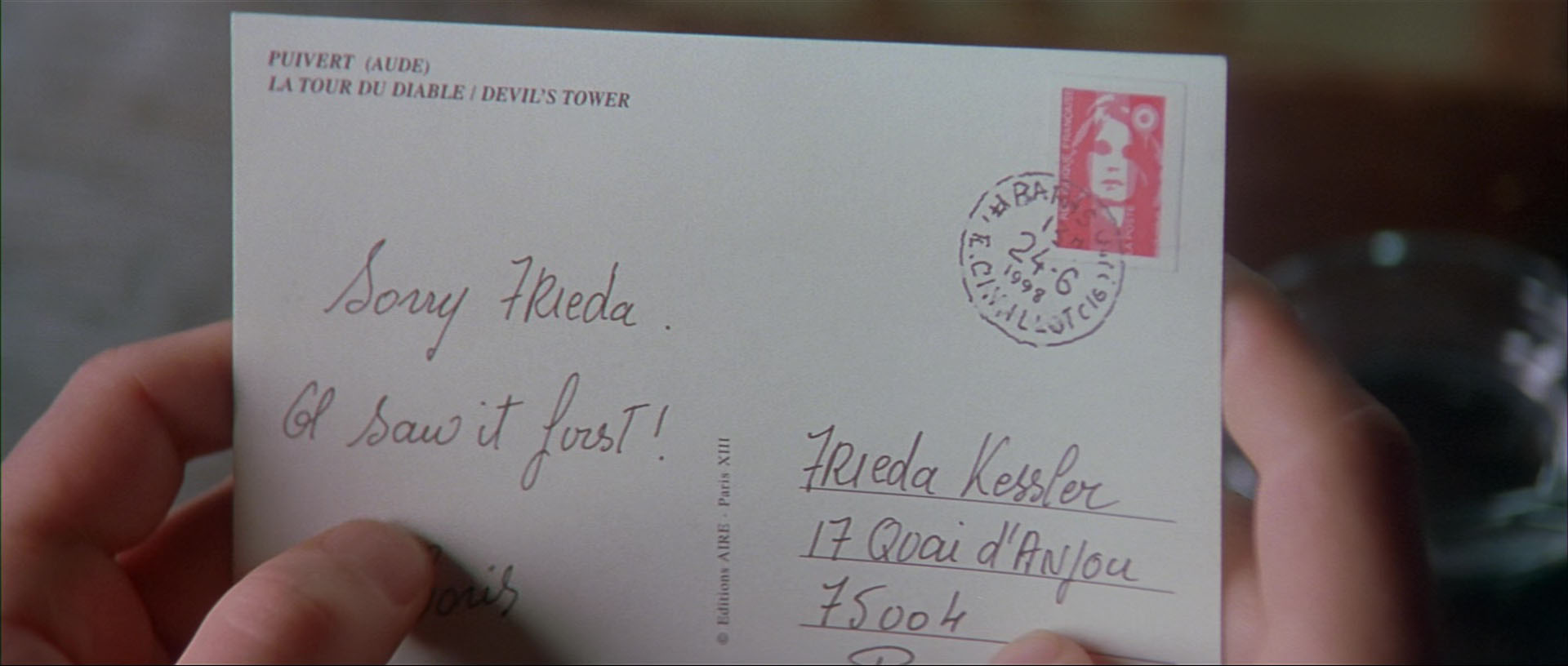
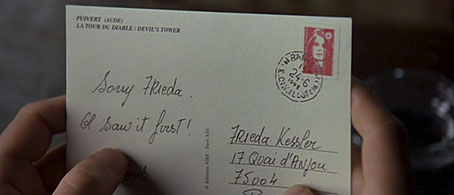
I’m in the minority of people who like The Ninth Gate (1999) a great deal even though it takes some liberties with Arturo Pérez-Reverte’s wonderful novel The Dumas Club. Once again, the bibliographic details are perfectly done, a crucial matter in a film about the antiquarian book trade. Near the end of the film Dean Corso (played by Johnny Depp) finds a postcard that leads him to the final location. On the back of the card there’s a blink-and-you-miss-it detail. Polanski’s wife, Emmanuelle Seigner, plays the mysterious and nameless woman who follows Corso throughout the film. By this point we already know she possesses occult powers so it’s not really surprising to see her face in the postage stamp, something that Corso doesn’t seem to notice.
polanski14.jpg

Previously on { feuilleton }
Repulsion posters
Atalanta Fugiens
Le Grand Macabre
Les Temps Morts by René Laloux
The writhing on the wall
Peake’s glassblowers

peake1.jpg

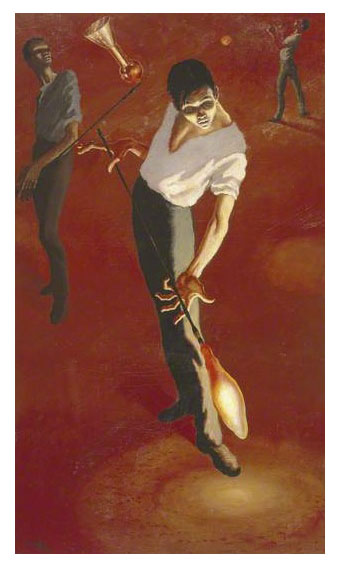
The Evolution of the Cathode Ray (Radiolocation) Tube (1943).

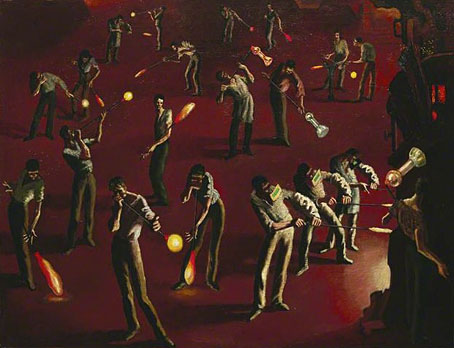
The BBC recently completed its Your Paintings project which displays online all the oil paintings in Britain’s galleries, over 210,000 works in all. I’ve glanced through the catalogue a couple of times but so far I’ve been too preoccupied to seach for many of the pictures that may not have been visible until now. The most immediate benefit of the site is the ability to go through the painting collections of small museums whose websites often show little or no artwork at all. Typing Mervyn Peake’s name into the search box revealed many paintings I’d not seen before. The Glassblower has pride of place in Manchester’s city centre gallery but its companion piece is one I’d not seen before. The two paintings and a poem, The Glassblowers, were the result of a commission by the War Artists Advisory Committee. Some of Peake’s preparatory sketches and an accompanying essay can be found in Mervyn Peake: the Man and his Art (2006).

peake2.jpg

The Glassblower (1944). Not the greatest reproduction, there’s a larger copy with colours closer to the original painting at the official Peake website.

Previously on { feuilleton }
Mervyn Peake in Coronation Street
The Worlds of Mervyn Peake
A profusion of Peake
Mervyn Peake at Maison d’Ailleurs
Peake’s Pan
Buccaneers #1
Mervyn Peake in Lilliput
The Illustrators of Alice

The weekend artists, 2012

barnes.jpg

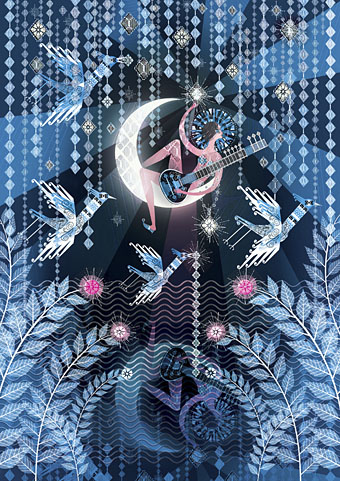
Lucy in the Sky with Diamonds (2012) by Lesley Barnes. She also has peacock wrapping paper.

The most popular post of the year was one I made last December featuring all the artists whose work had appeared throughout 2011 in the weekend links posts. (The surge of views occurred early in January when it was linked on Stumbleupon.) Since I’ve been away this week there aren’t any links so here’s a retrospective of things that caught my eye in 2012.

durette.jpg

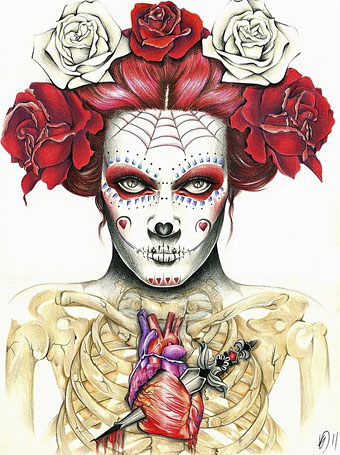
Heartsick (2011) by Kelly Durette.

jacobsen.jpg

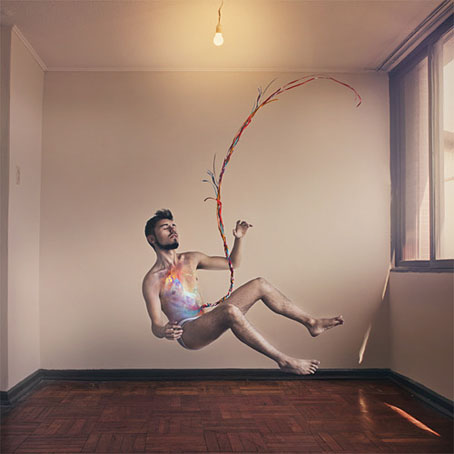
Self-portrait by Jon Jacobsen from his Home series.

tintenfisches.jpg

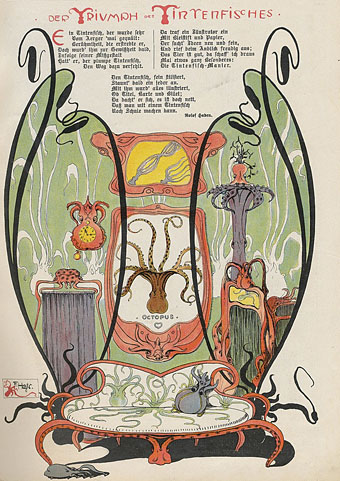
Der Triumph des Tintenfisches from Meggendorfer-Blätter (c. 1900). Via Beautiful Century.

kuhlman.jpg

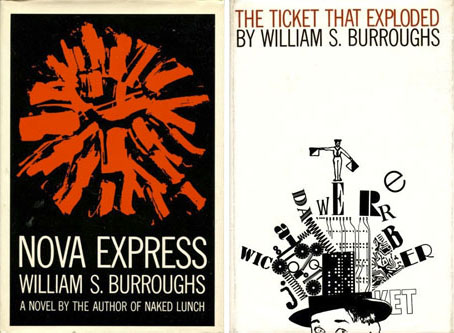
Two Grove Press covers by Roy Kuhlman. From Arden Kuhlman Riordan’s Pinterest page collecting her father’s cover designs.

ulian.jpg

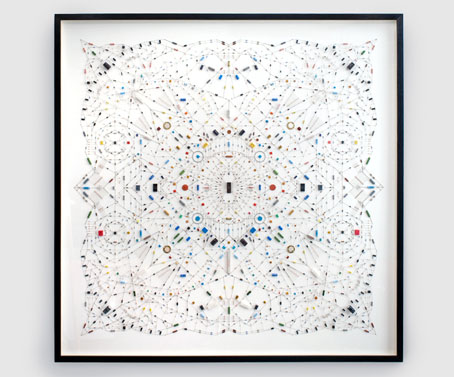
Technological mandala 02 (The beginning) (2012) by Leonardo Ulian.

Continue reading “The weekend artists, 2012”

Caresses by Fernand Khnopff

khnopff1.jpg

khnopff2.jpg

khnopff3.jpg

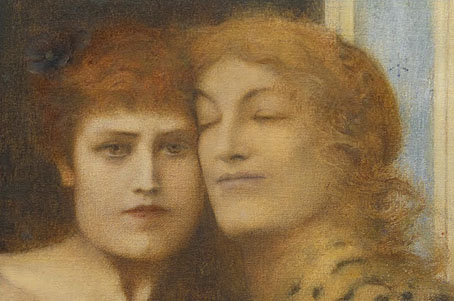
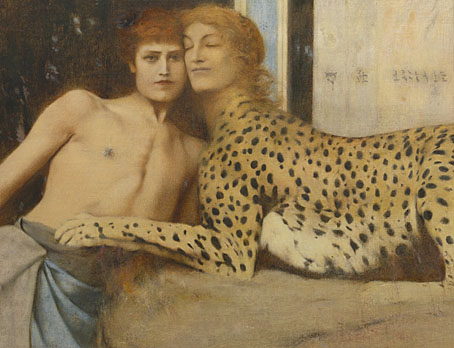
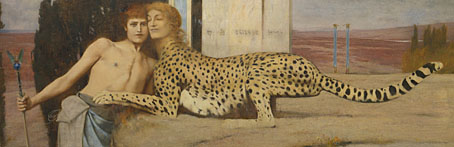
Details from Caresses aka The Caress (1896), the most famous painting by Belgian Symbolist Fernand Khnopff which can now be explored in detail at the Google Art Project. Caresses was one of Khnopff’s more enigmatic works although the term is a relative one when it comes to an oeuvre in which enigma is the default position. The combination of a young male, a feline female and the trappings of antiquity suggests Oedipus and the Sphinx although the Sphinx of mythology is a far more threatening presence. Adding to the enigma is the fact that Khnopff’s sister, Marguerite, was his model in most of his paintings which means we can recognise her heavily-jawed features in the male figure as well as the female. The essence of Symbolism for me has always been an atmosphere of unresolved pictorial mystery, a quality which this painting exemplifies.

khnopff4.jpg

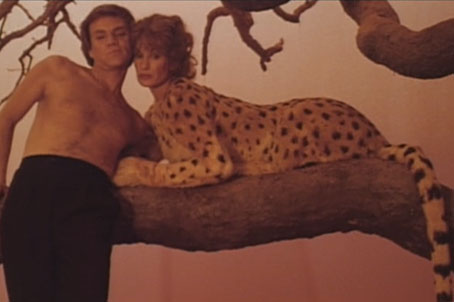
Malcolm McDowell and Ruth Brigitte Tocki in a deleted scene from Cat People (1982).

The mystery would have been carried over to the cinematic world in 1982 if the producers of Cat People had kept their nerve. The “Leopard Tree” dream sequence was to have featured a moment when Irena (Nastassia Kinski) meets her dead brother and mother in a pose which recapitulates Khnopff’s painting. The painting itself also appeared earlier in the film although it’s so long since I watched it I forget now whether that moment was also excised. The dream sequence may have been stretching audience credulity too far but the symbolism is fitting not least for the incestuous nature of the story. Here’s the scene in the final cut set to Giorgio Moroder’s fantastic score.

khnopff5.jpg

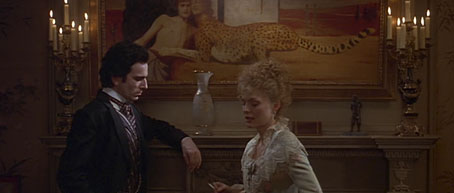
Daniel Day-Lewis and Michelle Pfeiffer.

The painting definitely did appear on-screen in 1993 where it overshadows a crucial conversation in Martin Scorsese’s adaptation of The Age of Innocence. Given that the setting is New York in the 1870s the usage is slightly anachronistic but once again the symbolism works for a scene which concerns unacceptable and unrequited passions.

Previously on { feuilleton }
Symbolist cinema
Bruges-la-Morte