Weekend links 146

snake.jpg

A Chinese postage stamp celebrating the Year of the Snake.

Cyclopean is a collaboration from Burnt Friedman, Jono Podmore and Can founding members Jaki Liebezeit, and Irmin Schmidt. The Quietus has a preview of all the tracks from their forthcoming EP. Great stuff.

Ten Things You (Possibly) Don’t Know About Kraftwerk. Related: a Speak & Spell emulator, and Atomium, a new single by Karl Bartos.

• In 1975 Barney Bubbles designed an inner sleeve for Hawkwind’s Warrior on the Edge of Time album, and this scarce recipe booklet.

• “We should all use language carefully. That is an obligation on the literate. But carefully doesn’t mean fearfully,” says Jenny Diski.

• Faber’s car-crash of a cover design for the 50th anniversary edition of The Bell Jar by Sylvia Plath caused an outbreak of parodies.

• At Strange Flowers: Ancient dreams and antique corruptions, Salomé via Gustave Moreau and Huysmans.

• FACT Mix 368 is a very varied collection of recent music and older pieces curated by Holly Herndon.

• At Ubuweb: eleven out-of-print recordings of Harry Bertoia’s sound sculptures.

Laurie Anderson and Brian Eno in conversation at Interview magazine.

Michael Chabon on Wes Anderson’s Worlds.

Snake Rag (1923) by King Oliver’s Creole Jazz Band | Rattlesnake Shake (1969) by Fleetwood Mac | Snakes Crawl (1980) by Bush Tetras | Ananta Snake Dance (1980) by Suns of Arqa | Snakeblood (2000) by Leftfield

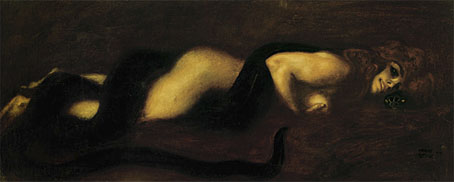
Stuck’s serpents

stuck1.jpg

The Sin (1894).

Some pictures in honour of the Chinese year of the Water Snake which begins this Sunday. Paintings of women with snakes are legion, even after you winnow out all the Eve and the Serpent pictures, so you need to narrow the field of view. Artists of the 19th century must have been delighted when Gustave Flaubert published Salammbô in 1862, chapter 10 of which—The Serpent—gave them an excuse to depict an exotic woman involved with a snake completely free of any Biblical trappings.

stuck3.jpg

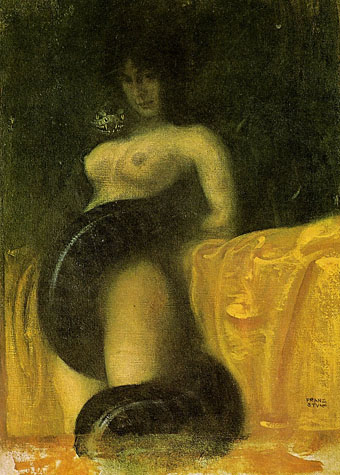
Sensuality (1891).

Franz Stuck’s celebrated trio of serpent women can be read as Eve figures but their provocative posing is more in line with the prurient misogyny common to much art of the period, an attitude which condemned women for being so tempting whilst also secretly lusting after their bodies. Sensuality is remarkable for the way its oiled snake is so firmly lodged between the woman’s thighs. Stuck was never very interested in Christian themes—many of his other works are a Teutonic take on Classical subjects—so I wonder whether his use of the word “sin” was merely a fig leaf for delivering imagery he wouldn’t have otherwise been able to exhibit.

stuck2.jpg

The Sin (1893).

wilson.jpg

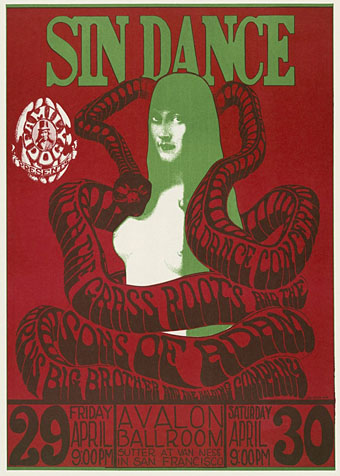
Sin Dance (1966) by Wes Wilson.

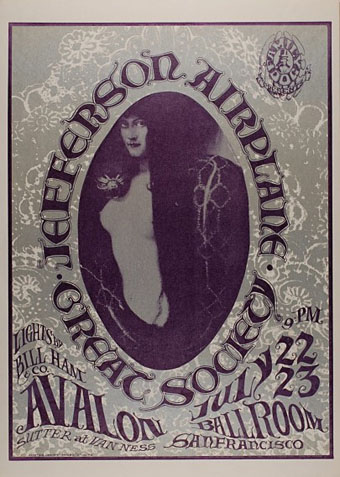
Symbolist art was rediscovered in the 1960s after decades of neglect, and the psychedelic poster artists happily plundered the art books for suitable imagery. Stuck’s Sin returned to the world in these two Avalon Ballroom posters. Wes Wilson’s Sin Dance was a design for an event which was cancelled so this might explain why the same painting appeared a few months later on a Stanley Mouse and Alton Kelley poster. The Mouse & Kelley version was printed with metallic inks.

For more of Franz Stuck’s work see WikiPaintings.

mouse.jpg

Jefferson Airplane at the Avalon Ballroom (1966) by Mouse & Kelley.

Previously on { feuilleton }
Serpentine pulchritude
Salammbô illustrated
The Feminine Sphinx
Men with snakes

Decapitations

heads03.jpg

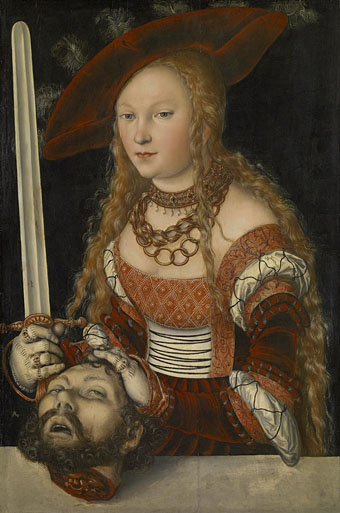
Judith with the Head of Holofernes (1520–1540) by Lucas Cranach the Elder.

It doesn’t take much effort to refute the jeremiads of those who complain that popular culture is exclusively violent, all that’s usually required is to direct attention to Titus Andronicus or The Revenger’s Tragedy. Compared to the stage, the art world seems at first to be more circumspect, especially in the 19th century when the battles scenes of history painters sprawled across acres of canvas, all of them devoid of the physical trauma of warfare.

salome6.jpg

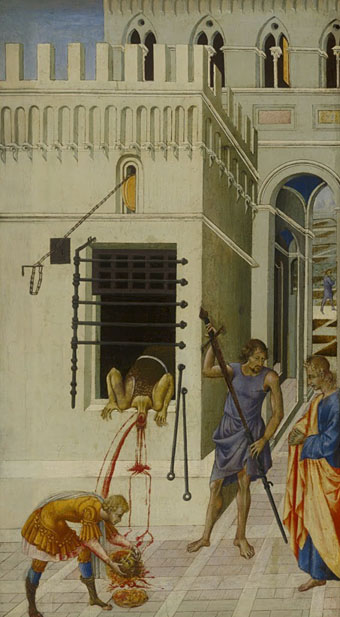
The Beheading of Saint John the Baptist (1455–60) by Giovanni di Paolo.

There are exceptions, however, and the nearer you move to Shakespeare’s time the more examples you’ll find. Paintings produced in an age when violent street executions were still a common sight would have seemed less surprising to their intended audience than they do to our eyes. Several of the paintings here provide a useful contrast with the many sanitised depictions of John the Baptist’s severed head in the Salomé archive.

heads01.jpg

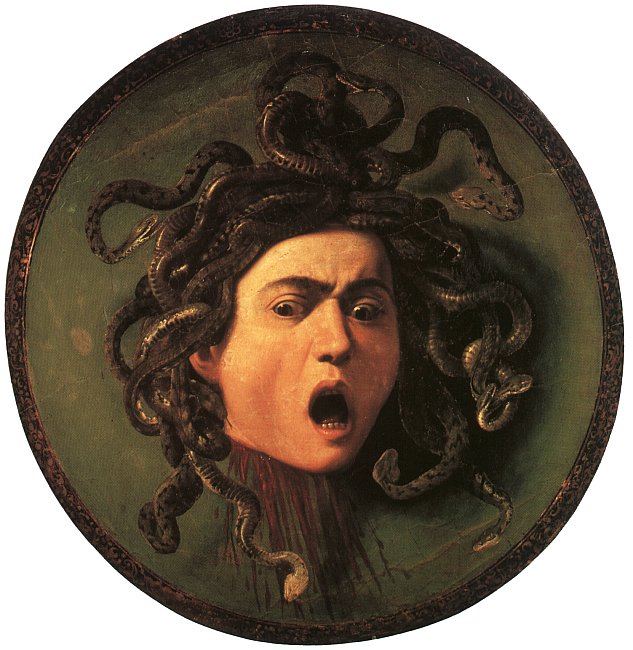
Medusa (c. 1590) by Caravaggio.

Of all the paintings of Medusa’s head the one by Caravaggio is the sole example with a gout of spurting blood. It’s also unusual for being painted on a convex panel intended to resemble the reflecting shield of the Gorgon’s killer, Perseus. Given the violent life of the artist the gore isn’t so surprising although the jet of red in his painting of Judith beheading Holofernes still seems shocking if you’ve never seen it before.

heads04.jpg

Judith Beheading Holofernes (1598–99) by Caravaggio.

The Biblical story of Judith and Holofernes may be the poor cousin to the more popular story of Salomé but depictions of the crucial event make an impression by being consistently gruesome. I suspect the reason is less to do with the story itself than with the success of Caravaggio’s paintings among cultured Europeans. The copying or imitation of celebrated works became a thriving industry in the days of the Grand Tour with the result that 17th- and 18th-century art is overburdened with variations on earlier paintings.

Continue reading “Decapitations”

Weekend links 142

bowie.jpg

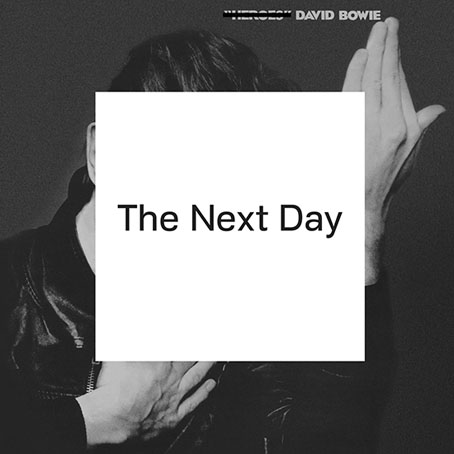
Gratifying this week to see album cover art under discussion even if the heat-to-light ratio was as unbalanced as it usually is when pop culture is the subject. Jonathan Barnbrook, who also designed the Heathen (2002) and Reality (2003) packaging for David Bowie, wrote about the thinking behind the new cover on his blog. (And for the time being let’s note that this is still only a cover design, we don’t know what else is on its way.)

For my part I’ll point out that the artist-as-cover-image is the great cliché of album design, and the bigger the name the more the rule applies; Neville Brody complains about this in the first book of his work, as does Storm Thorgerson in the Hipgnosis books. In Bowie’s case the rule has been applied almost universally since his debut album in 1967, the only variations being illustrational ones or slight dodges like having his feet appear on the front of Lodger and his back facing the viewer on Earthling. Consequently the new design is a radical gesture from an artist who could have got away with a photo of himself du jour. By way of contrast, consider that Rod Stewart is a year older than David Bowie and presented the world with this artefact in October 2012.

Related: Hard Format responds to the cover, Chris Roberts on “Picasso resurrected in a Rolf Harris era“, and Alexis Petridis on The inside story of how David Bowie made The Next Day.

The Quicksilver typeface, designed by Dean Morris when he was only 16, bought by Letraset and now an indelible feature of pop design from the 1970s. Morris describes his experience here (“they shunned rapidographs!”) and collects examples of the print history here.

When the days are short, we are closest to the medieval world. To the avoidance of mirrors where death improves our portraits every morning with a few more lines and shadows. What would once have been a sermon, a conjuring of hellfire, a phantom slide show, is now an entertainment. But before we can begin again, we have to kick free of the embrace of our inconvenient predecessors, that compost legion of the anonymous dead. They come uninvited, requiring us to sign up for what the late Derek Raymond called the general contract: a brief turn in the light, then extinction. Eternal darkness. How to live with such knowledge? William Burroughs admired the unswerving bleakness of Beckett’s gaze, the way he reduced compensatory illusions to zero. Nowhere left to crawl. And nothing to crawl on. Last breath is last breath. Stare into the abyss and the abyss will stare right back.

Iain Sinclair reviews The Undiscovered Country: Journeys Among the Dead by Carl Watkins

Broadcast’s James Cargill on Morricone, Minidiscs and Scoring Berberian Sound Studio. Related: Melmoth the Wanderer posts a new mix, The Curious Episode of the Wizard’s Skull, and more spooky sounds are on their way from The Haxan Cloak.

• A Firm Turn Toward the Objective: Joanne Meister on meeting the great Swiss designer Josef Müller-Brockmann.
duchess.jpg

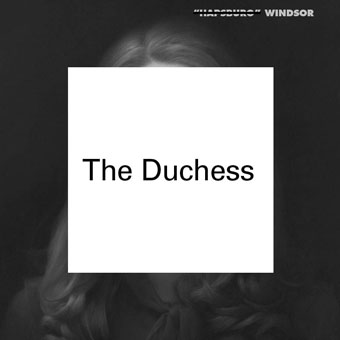
Twitter user @thisnorthernboy reworked Paul Emsley’s portrait of Kate Middleton. @barnbrook approved.

• The Beatles of Comedy: David Free on the Monty Python team.

• The history of the London Underground poster.

Impossible Architecture by Filip Dujardin.

• At Pinterest: Art Dolls & Sculpture

• Grace Jones’ Nightclubbing album has been on repeat play this week: Warm Leatherette/Walking In The Rain | I’ve Seen That Face Before (Libertango) | Demolition Man