Charles Ricketts’ Hero and Leander

ricketts1.jpg

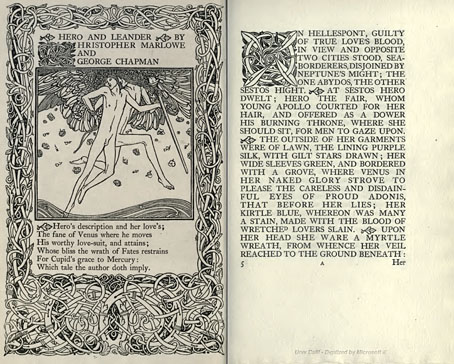
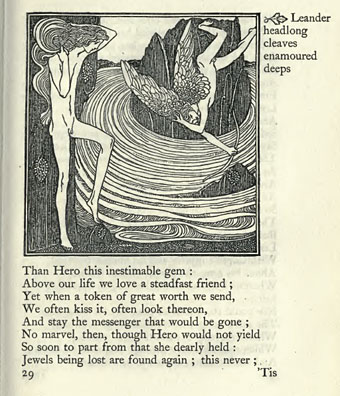
Enthusiasts of Charles Ricketts’ illustrations can find book collections of his drawings and paintings but the artist (with partner Charles Shannon) was also a printer, typographer and book designer who would no doubt have preferred his illustrations to be seen in their intended setting. The Internet Archive has a few choice examples of Rickett’s books, of which the most profusely illustrated is Hero and Leander (1894), Christopher Marlowe’s poem (completed by George Chapman).

ricketts2.jpg

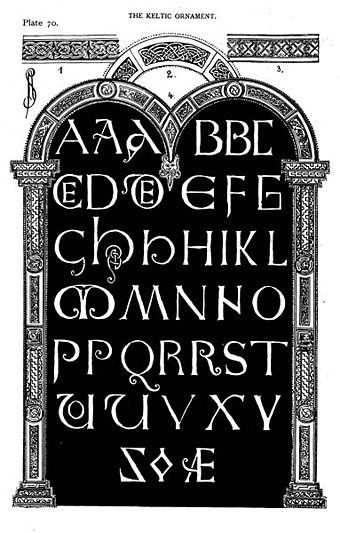
Also of interest is Danaë (1903) by Thomas Sturge Moore with its black and red type, A Bibliography of the Books Issued by Hacon & Ricketts (1904), and A Defence of the Revival of Printing (1899). The latter is of interest to book designers and typographers for its presentation of Ricketts’ aesthetic philosophy. Ricketts’ and Shannon’s books made continual use of a small leaf motif as a pilcrow to mark a fresh paragraph. In A Defence of the Revival of Printing Ricketts discusses his replacement for the ampersand (&), which he disliked, preferring instead a new character combining the letters E and T, ampersands being a contraction of the Latin word “et”. There’s also some discussion of his unique type designs which he charmingly refers to as “founts”, preferring, like contemporary William Morris, the antique terminology.

ricketts3.jpg

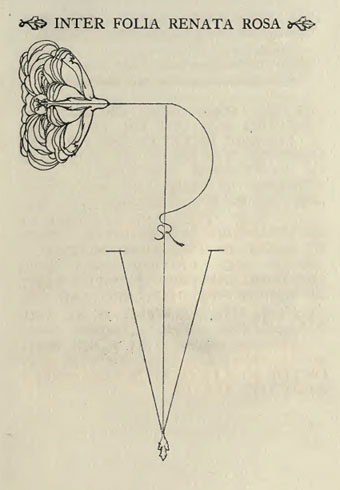
Colophon from Hero and Leander. A rose forms the monogram of Ricketts’ and Shannon’s Vale Press.

Elsewhere on { feuilleton }
The illustrators archive

Previously on { feuilleton }
Art Nouveau illustration
Dorian Gray revisited

Plates: Volume 2

plates.jpg

My third CD design for the Tectonic label is another piece of relative minimalism which once again features photos by Liz Eve. All the backgrounds on this occasion are microscope close-ups of vinyl records, very fitting for a double-CD collection of recent 12″ releases.

The Tectonic logo (which predates my involvement with the label) is based on the Technics logo and for this release I tidied the label logo slightly, a process which led to the discovery that the Technics design used a variant of the Clarendon typeface for its letter shapes (it’s not an exact match). This in turn led me to use Clarendon in various weights across the packaging, something which made a change from the usual sans serif or monospace font. The great Saul Bass frequently used Clarendon for his title sequences; if it’s good enough for Saul, it’s certainly good enough for me.

Tectonic main man Rob Ellis talked to Fact magazine about the new release earlier this week.

Previously on { feuilleton }
Aerial by 2562
New things for November

The Best of Michael Moorcock

mm1.jpg

The first of the books I’ve been designing for Tachyon Publications appears this month. Two more are due to follow and I’m working on another at the moment; more about those titles later.

The Best of Michael Moorcock was a pleasure to be involved with not only because I’ve been reading Moorcock’s fiction for a very long time but I’ve also been fortunate during that time to get to know the writer and Linda Moorcock, his wife. Mike likes the work I’ve done in the past for Savoy Books and we did have an anthology of his favourite pieces by other writers planned for Constable & Robinson back in 2005. That book didn’t work out so this makes up for its cancellation. This is an excellent anthology, put together initially as a private enterprise by editor John Davey who managed the difficult task of compiling a collection which ranges over forty years of writing. Ann and Jeff VanderMeer came aboard as co-editors for the Tachyon edition.

I’ve been working mainly on the interior design of the Tachyon volumes (although I’ve also done the cover for Jeff VanderMeer’s forthcoming Booklife) and for this title I took a cue from Ann Morn’s cover design which features a pair of gates emblazoned with large letter Ms. The title spread above takes the letter M from the typeface used for the author’s name and multiplies that to create an equivalent set of gates for the reader to pass through. I try to play down the pyrotechnics for fiction—the words are the important thing, not the graphic design—but since this was a story collection I thought I’d try illustrating each piece using the title typography alone. Most of these are done by using a suitable typeface but for a few pieces I managed to create an arrangement that reflected the story. Behold the Man (below) is the Nebula Award-winning story of a journey back in time to find the historical Jesus. The cross shape not only relates to the Biblical theme but also implies the crossed time streams and Moorcock’s layered, cross-cut narrative.

mm2.jpg

The Best of Michael Moorcock is available now from the usual sources and received a glowing review in the Guardian. Later this month, and other work permitting, I’m hoping to make a start on what will effectively be a companion volume, Savoy’s long-delayed Into the Media Web, another collection by John Davey which this time collects the best of Moorcock’s copious essays, reviews and other non-fiction.

Previously on { feuilleton }
Designing Booklife
The Sonic Assassins
Revenant volumes: Bob Haberfield, New Worlds and others
An announcement redux

Gramato-graphices

gramato-graphices.jpg

Or Gramato-graphices. In quo varia scripturae emblemata, belgicis, germanicis, italicis, hispanicis, gallicis characteribus exaata… scripta, aeri incisa, et impressa per Cornelium Boissenium Enchusanum to give the full title. A treatise on penmanship and calligraphy from 1605 by Cornelis Dirckszoon Boissens. Also another free scan at the Internet Archive. Searching for better reproductions turned up this stunning engraving by Boissens in the Rijksmuseum collection.

Elsewhere on { feuilleton }
The illustrators archive
The etching and engraving archive

Previously on { feuilleton }
John Bickham’s Fables and other short poems
Letters and Lettering
Studies in Pen Art
Flourishes

Design as virus 8: Keep Calm and Carry On

keepcalm1.jpg

Continuing an occasional series.

The poster at the top left is the unused Ministry of Information design created to maintain Britain’s resolve after war had been declared in September 1939. This simple slogan struck a chord recently among Britons sick of the climate of fear, security theatre and authoritarian coercion which, deliberately or not, appears to benefit politicians and the agents of the State more than the populace who pay their wages. The BBC asked whether this was the greatest motivational poster ever. The Guardian noted the popularity of the slogan and its inevitable commercial exploitation:

…one day in 2000, Stuart Manley, co-owner with his wife Mary of Barter Books in Alnwick, Northumberland, was sifting through a box of hardbacks he had bought at auction when he saw “A big piece of paper folded up at the bottom. I opened it out, and I thought, wow. That’s quite something. I showed it to Mary, and she agreed. So we framed it and put it up on the bookshop wall. And that’s where it all started.”

The reworked version at the top right is one of the opening pages from The Black Dossier (2007) by Alan Moore and Kevin O’Neill. The crown is replaced by a portcullis and Gill Sans is dropped in favour of Edward Johnston’s sans serif typeface which has been used throughout the London Underground system since the 1930s.

keepcalm2.jpg

The original poster has been undergoing numerous redesigns, from the jokey to the serious. The green design is one of the better variants by designer Matt Jones.

The blue design is part of an advertising campaign by the British Home Office intended to promote their new “Policing Pledge”, “a set of promises to local residents that not only gives more information about who their local neighbourhood policing team is, but also ensures that communities will have a stronger voice in telling the police what they think is most important and what they are most worried about.”

Laudable as this intention may be, I was very surprised when I saw this poster on a bus shelter earlier in the week. While the Home Office and its advertising people are fully entitled to reclaim a design which originated with the State in the first place, one of the reasons the original poster strikes a chord is because it runs counter to anti-terrorist nonsense like this. It speaks, among other things, to people sick of being lied to by politicians and spied on by police and security services. To see a forgotten design experience a swelling of grassroots popularity then be co-opted by the State itself is as depressing as it would have been had Richard Nixon used psychedelic posters to campaign for his re-election. To see a campaign use slogans which treat the rights of defendants as flippantly as the poster remixers when this present government has spent the past ten years undermining the rights of its citizens is simply a disgrace.

Update: A Flickr pool catalogues the variations.

Previously on { feuilleton }
Design as virus 7: eyes and triangles
Design as virus 6: Cassandre
Design as virus 5: Gideon Glaser
Design as virus 4: Metamorphoses
Design as virus 3: the sincerest form of flattery
Design as virus 2: album covers
Design as virus 1: Victorian borders