Weekend links 427

davis.jpg

Inside an O’Neill Cylinder, an orbital megastructure. Painting by Don Davis, 1975.

• RIP Lindsay Kemp: dancer, actor, choreographer and (if we have to drop names) mentor to David Bowie and Kate Bush. Kemp’s work has been featured here on a number of occasions, particularly his landmark productions of an all-male Salomé, and Flowers, A Pantomime for Jean Genet. There was also considerable overlap with Kemp’s troupe and the films of Derek Jarman via appearances by Kemp himself, David Haughton and the irrepressible Jack Birkett. The Genet production was filmed in 1982, and is now available on DVD. (There’s also a rougher copy with unmatched audio and video.) From 1970: Pierrot in Turquoise, or The Looking Glass Murders, a Commedia dell’arte performance for Scottish TV featuring David Bowie. And reversing roles, Mick Rock’s video for Bowie’s John, I’m Only Dancing featuring Kemp and company.

• At Expanding Mind: Erik Davis in conversation with activist and writer David Nickles about “the DMT Nexus, psychedelic militancy, extraction tek, the Statement on Open Science for Psychedelic Medicines, MAPS, and the trouble with for-profit psilocybin companies”.

• From the end of August to January 2019: Spellbound at the Ashmolean; “Spellbinding stories, fascinating objects…from crystal balls and magic mirrors to witch bottles and curse poppets”.

On Earth, as on the International Space Station, the collective misperception of a flat plane helps build community and culture. We are all equal in our geometric relationship to one another. The reality, of course, is that we do not stand parallel. Each of our bodies corresponds with a distinct radial vector on the surface of a sphere, pointing away from a common center that we can never perceive or occupy. Our vectors diverge by imperceptible angles.

In “inside-out” worlds like the Bernal Sphere and the concave Earth, the situation is reversed. Our feet all point outward, into an inaccessible, but technologically habitable void, while our heads point inward, some of us apparently “upside-down.” Standing, we rise toward a visible center, which can be reached simply by climbing a hill, strapping on wings, and jumping into the air, as low-tech as Icarus.

The Shape of Space by Fred Scharmen

• Michael Moorcock again, interviewed this time by Bernard Braden in 1968. I think this one was for a Braden TV series which was never broadcast.

• “Stupid things are best”: Neil Fox on Conny Plank: The Potential of Noise, a documentary about the great music producer.

• Mixes of the week: XLR8R Podcast 556 by Helios, and An Ode to Eris with An Other Ode to Eris by The Ephemeral Man.

• A monstrous primer on the works of HP Lovecraft by Emma Stefansky. With illustrations by Michael Bukowski.

• Silent Agents by Julius-Christian Schreiner: photographs of hostile architecture from around the world.

• Back to the Futuro: Mark Hodgkinson on the spaceship house that landed in Yorkshire.

• The Great Chinese Art Heist by Alex W. Palmer.

• Rhizome: a new recording by Drew McDowall.

• The Starman Tarot

• Mad Pierrot (1978) by Yellow Magic Orchestra | Spellbound (1981) by Siouxsie And The Banshees | Sphere (2011) by Emptyset

Weekend links 376

newton.jpg

The House by the Canal (1945) by Algernon Cecil Newton.

• RIP Tobe Hooper. Black Hole Reviews recounts the troubled history of The Texas Chain Saw Massacre in Britain, a film that was given a short-lived cinema release then banned for 20 years. Elsewhere: Who sampled from Tobe Hooper’s films? Tucktonia, a model village whose London buildings were destroyed for Hooper’s Lifeforce.

• Graphic language of the wall: Rick Poynor on Brassaï’s photographs of graffiti for Le Livre de Poche. More Poynor: National Theatre Posters: A Design History is available for pre-order from Unit Editions. There’s more from the latter here.

• “A question of queer as a kind of futurism: an attitude or tendency that connects mid-20th-century performers and photographers to contemporary digital art and fashion.” Brian Dillon reviewing Queer British Art at Tate Britain.

In evolutionary terms, the intelligence of octopuses is an anomaly. The last common ancestor between octopuses on the one hand, and humans and other intelligent animals (monkeys, dolphins, dogs, crows) on the other, was probably a primitive, blind worm-like creature that existed six hundred million years ago. Other creatures that are so evolutionarily distant from humans—lobsters, snails, slugs, clams—rate pretty low on the cognitive scale. But octopuses—and to some extent their cephalopod cousins, cuttlefish and squid—frustrate the neat evolutionary division between clever vertebrates and simple-minded invertebrates. They are sophisticated problem solvers; they learn, and can use tools; and they show a capacity for mimicry, deception and, some think, humour. Just how refined their abilities are is a matter of scientific debate: their very strangeness makes octopuses hard to study. Their intelligence is like ours, and utterly unlike ours. Octopuses are the closest we can come, on earth, to knowing what it might be like to encounter intelligent aliens.

Amia Srinivasan reviewing Other Minds: The Octopus and the Evolution of Intelligent Life by Peter Godfrey-Smith, and The Soul of an Octopus: A Surprising Exploration into the Wonder of Consciousness by Sy Montgomery

• Royal Academy of Arts to reveal explicit side of Dalí and Duchamp.

• At Wormwoodiana: Mark Valentine on The Mystic Umbrellas.

• Norton Critical Edition’s Periodic Table of Literary Villains.

• Mix of the week: FACT mix 616 by Lanark Artefax.

• Virus Fonts has a new website.

• Little Umbrellas (1969) by Frank Zappa | Umbrellas (1971) by Weather Report | Black Umbrellas (2003) by Broadcast

Weekend links 373

YDKMorimoe.jpg

Untitled (2011) by YDK Morimoe. Via Jim Post at Dennis Cooper’s.

• For The Climax Of The Night by Total Leatherette is almost certainly the only album you’ll see this year with autofellatio cover art. Faux Fox gives a taste of the new album, while an earlier piece, Squeeze Hunk, features a Tom of Finland-style video. And speaking of which, Dome Karukoski’s feature film, Tom of Finland, is released in the UK this week. Related: Tom of Finland coffee.

• The death of playwright Joe Orton in 1967 prompted yet more 50th anniversary articles this week. Mentioned here before, and better value than all the textual appraisal, is the BBC’s 70-minute TV documentary from 1982, A Genius Like Us: A Portrait of Joe Orton, which includes interviews with family, friends, colleagues and Orton’s biographer, John Lahr.

• Two skulls, 50,000 postcards and a book that took 50 years to finish: Stuart Jeffries visits artist Tom Phillips.

• New at the Internet Archive: 25,000 78RPM records. You can never go wrong with Duke Ellington.

• Lock Your Door and The Reformation of St. Jules: Algernon Blackwood filmed in 1949.

• Redemption, an exhibition of art by Fay Pomerance (1912–2001) at Ushaw College, Durham.

• At Dirge Magazine: Daniel Pietersen on the myth of the sunken city.

• Mix of the week: FACT Mix 613 by Aaron Dilloway.

• Laetitia Sadier’s favourite albums.

• RIP Hywel Bennett

• Sunken City (1961) by Les Baxter | Ys (1971) by Alan Stivell | Atlantis (1971) by Deuter

Weekend links 368

nerly.jpg

Piazzetta San Marco by Moonlight (no date) by Friedrich Paul Nerly.

• RIP Heathcote Williams (Guardian obit, NYT obit): poet, playwright, actor, artist, anarchist, stage magician, and no doubt many other things besides. Being a product of the counter-culture, and one of Britain’s foremost anti-establishment writers (his polemics against the Royal Family were unceasing), Williams was a regular in the early publications produced by my colleagues at Savoy Books; in fact there’s a piece by him in The Savoy Book itself. Consequently, Williams always felt like a distant relative even though we never met. Of his many film appearances, which ranged from low-budget independent productions to Hollywood junk, he was ideally cast as Prospero in Derek Jarman’s film of The Tempest, and he audaciously steals a scene from Tilda Swinton in Sally Potter’s wonderful Orlando. Elsewhere: Jeremy Harding on Williams’ run-ins with the gatekeepers, and Why D’Ya Do It?, a song by Marianne Faithfull with lyrics by Williams.

• Mixes of the week: Secret Thirteen Mix 226 by Chihei Hatakeyama, and SydArthur Festival 2: Summer of Love Edition by Head Heritage.

• Geeta Dayal on composer and musique concrète pioneer Pierre Henry whose death was also announced this week.

• Jonathan Meades reviews Vinyl.Album.Cover.Art: The Complete Hipgnosis Catalogue by Aubrey Powell.

• “Brutal! Vulgar! Dirty!” Polly Stenham on Mae West and the gay comedy that shocked 1920s America.

• Hannah Devlin on religious leaders getting high on psilocybin for science.

• At Dennis Cooper’s: Spotlight on…In Transit (1969) by Brigid Brophy.

• At Bibliothèque Gay: Matelots (1935) by Gregorio Prieto.

• SD Sykes on reconsidering Venice, crumbling city.

• Letters and Liquor

• This Ain’t The Summer Of Love (1976) by Blue Öyster Cult | Orlando (1996) by Trans Am | Transit (2004) by Fennesz

The art of John Thompson

thompson01.jpg

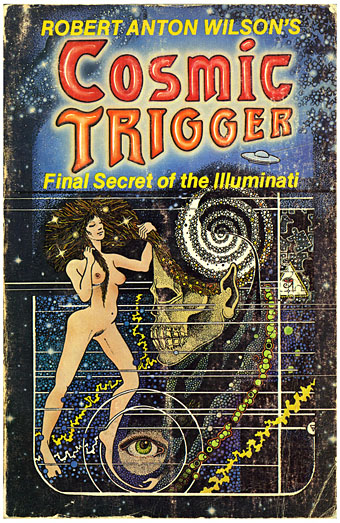
Cosmic Trigger: Final Secret of the Illuminati (And/Or Press, 1977).

John Thompson’s detailed, mystical and erotic illustrations gained prominence in the San Francisco comic scene in the late 1960s–early 1970s, appearing in a handful of titles drawn in their entirety by Thompson or done as collaborations with local artists including Robert Crumb. But it’s as an illustrator of Robert Anton Wilson’s Cosmic Trigger that Thompson is probably best known, something I was reminded of recently with the opening of Daisy Campbell’s play based on Wilson’s book. Wilson had seen Thompson’s comics work, and approached him as illustrator of his (ostensibly) non-fiction sequel to the very popular Illuminatus! trilogy, an encounter that Thompson elaborates on in this interview.

thompson02.jpg

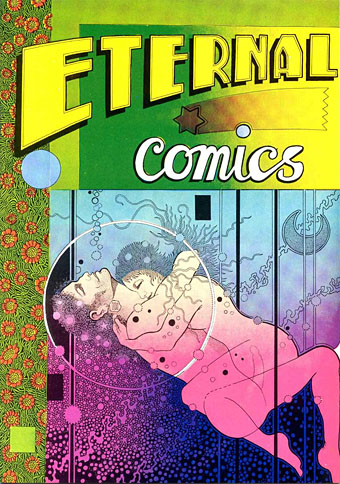
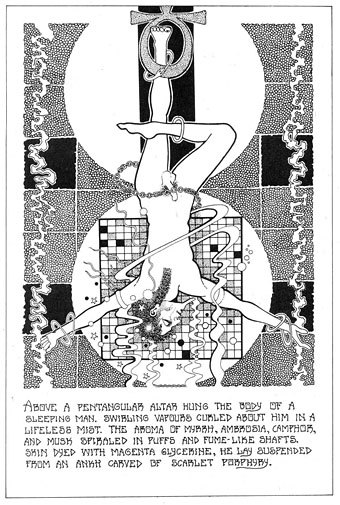
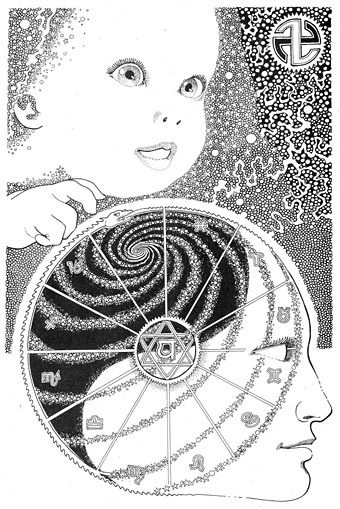
Here in the UK the comics published by Last Gasp et al weren’t always easy to find (imported comics were still being seized by UK customs into the 1990s), so Cosmic Trigger was my first introduction to Thompson’s art via a sighting of the US edition in a London shop in 1978. The UK paperback was a disappointment when it appeared a year or so later: Thompson’s cover art had been replaced with something more generic but they did at least retain the interior illustrations, albeit shrunk to fit the smaller book size. Many of the drawings in Cosmic Trigger had appeared already in Thompson’s comics which may seem surprising when they don’t resemble typical comic pages, but Thompson’s comics are unusual even compared to the undergrounds of the time. The undergrounds were most obviously radical in the wildness and excess of their content, especially where sex and drugs were concerned. But there’s a smaller subset of underground strips whose approach to narrative is so far removed from typical comic storytelling as to verge on the abstract. Victor Moscoso’s comics exemplify this style but even an ostensible traditionalist like Robert Crumb could experiment with the form (see his Cubist Bee Bop Comics in XYZ, 1972). Thompson’s comics are of this type at all times, blending motifs from a variety of myths and religions with Tantric yoga, astrology, alchemy and pop culture. When speech balloons appear they often contain allusive, esoteric phrases along with untranslated Greek or Hebrew text. It’s a beguiling mix which shows the ability of the comic book to do more than simply ape the stories of film or television. As with many other things from the late 1960s it’s a direction that hasn’t been pursued very much since.

thompson03.jpg

The interview with Thompson explains why he seemed to vanish after the work for Cosmic Trigger: he says he quit comics and illustration to become a therapist although he still creates private work. The examples here are from The Kingdom of Heaven is Within You (1969), Kukawy [sic] Comics 1 (1969; “Kukawy” is actually a Greek word meaning Cyclops), Tales from the Sphinx 2 (1972) and Eternal Comics (1973).

thompson04.jpg

Continue reading “The art of John Thompson”