Strange Adventures: a film list

alphaville1.jpg

This is science fiction.

Presenting the list I mentioned earlier in which I highlight a number of worthwhile science-fiction films (also some TV productions) that aren’t the usual Hollywood fare. I’ve spent the past few years watching many of these while searching for more. This isn’t a definitive collection, and it isn’t filled with favourites; I’ve deliberately omitted a number of popular films that would count as such. It’s more a map of my generic tastes, and an answer to a question that isn’t always spoken aloud in discussions I’ve had about SF films but which remains implicit: “Okay, if you dislike all this stuff then what do you like?” I tend to like marginal things, hybrids, edge cases, the tangential, the unusual and the experimental. And for the past two decades I’ve increasingly come to value anything that isn’t a Hollywood product. There are two Hollywood productions on this list but neither of them were very successful. Not everything here has been overlooked or neglected but many of the entries have, either because they made a poor showing at the box office or because they have the effrontery to be filmed in languages other than English. Not everything is in the first rank, either, but they’re all worth seeing if you can find them.

liquid1.jpg

Liquid Sky.

The starting point is around 1960 because prior to this date any marginal or unusual examples of SF cinema are harder to find. A genre has to be somewhat set in its ways before radically different artistic approaches emerge, and pre-1960 there wasn’t much testing of the SF boundaries in the film world. Science-fiction cinema has also tended to lag behind the written word, so even though the literature was growing more sophisticated during the 1950s, films from the same period are mostly filled with monsters, spaceships and mad scientists. By the 1960s enough written science fiction was playing with (or ignoring) genre stereotypes for a “New Wave” to be identified. Some of the films detailed here might be regarded as cinematic equivalents of SF’s New Wave but I’ll leave it to others to argue the finer points of definition. A few of the choices are a result of directors going in unexpected directions, with several selections being one-off genre excursions by people better known for other things. I’ve omitted many films and/or directors that receive persistent attention, so there’s no David Cronenberg, Nicolas Roeg, Andrei Tarkovsky or John Carpenter; and no Mad Max 2, Akira, Ghost in the Shell or The Prisoner. A couple of edge cases are so slight I couldn’t really justify their inclusion so you’ll have to look elsewhere for appraisals of The Unknown Man of Shandigor (a spy satire with Alphaville influences) and Trouble in Mind (more of a neo-noir fantasy). 2010 is the cut-off point. I’ve never been someone who watches all the latest things so it often takes me years to catch up with recent releases.

avalon2.jpg

Avalon.

I can imagine there might be questions about the availability of some of these films. All I can say is search around. I’ve managed to accumulate half the things on this list on either DVD or blu-ray so they’re not all impossible to find. I did consider posting links but the whole issue of region coding complicates matters. Most of the short films circulate on YouTube, as do a number of the features although these don’t always include subtitles. Have I missed something good? (Don’t say Zardoz….) The comments are open.


Invention for Destruction (Czechoslovakia, 1958)

invention.jpg

An evil millionaire named Artigas plans to use a super-explosive device to conquer the world from his headquarters inside an enormous volcano.

(Previously.) It seems fitting to start with a film that adapts a novel by one of the founders of the genre, Jules Verne. Karel Zeman’s third feature extended his technical effects to combine live-action with animation, creating a film in which the engraved illustrations of Verne’s novels are brought to life. With music by Zdeněk Liška.


La Jetée (France, 1962)

lajetee.jpg

The story of a man forced to explore his memories in the wake of World War III’s devastation, told through still images.

Chris Marker’s haunting short is one of the great time-travel stories, a 25-minute film that JG Ballard often listed as a favourite. Memory was a recurrent theme in Marker’s work, and memories here provide a physical route into the past, with the predicament of the unnamed protagonist concentrated on a single memory from his childhood. Marker’s interests ranged widely but he haunts the margins of science-fiction cinema in France, assisting Walerian Borowczyk with an early animation, Les Astronauts (1959), as well as the Pierre Kast entry below.


Alphaville: A Strange Adventure of Lemmy Caution (France, 1965)

alphaville2.jpg

A secret agent is sent to the distant space city of Alphaville where he must find a missing person and free the city from its tyrannical ruler.

Another Ballard favourite, and not a neglected film by any means but the first in our collection of one-off SF excursions by directors better-known for other things. Alphaville is also important for being the first film to present itself as science fiction without any of the obvious or expected trappings of the genre. Paris in 1965 is Alphaville because Godard says it is. In part this is the director doing his usual thing of self-consciously adopting a genre; this is “science fiction” in the same way that Breathless is “crime”. But the conceptual leap was an important one for cinema, a step that freed film-makers from the need to build expensive sets and dress their cast in silver jump-suits. With Raoul Coutard’s high-contrast photography, Paul Misraki’s noirish score, Eddie Constantine’s bull-in-a-china-shop performance (he makes Ralph Meeker in Kiss Me Deadly seem soft-hearted), and the incomparable Anna Karina.


The Heat of a Thousand Suns (France, 1965)

heat.jpg

(Previously) A one-off animated short by Pierre Kast with assistance from Chris Marker, drawings by Eduardo Luiz, and an electronic score by Bernard Parmegiani. A young man with his own spaceship solves the problem of faster-than-light travel then heads into the cosmos with his pet cat.


Fahrenheit 451 (UK, 1966)

fahrenheit.jpg

In an oppressive future, a fireman whose duty is to destroy all books begins to question his task.

Francois Truffaut’s first colour feature has always seemed a little dull despite its incendiary subject matter and the Hitchcockian urgency of Bernard Herrmann’s score. It might have been improved with an actor other than Oskar Werner in the central role but there’s still a lot I like about this one: the music, the shots of the SAFEGE monorail, Nicolas Roeg’s striking photography, and Julie Christie in a double role. There’s also some amusement for Brits in seeing a Frenchman presenting ticky-tacky English suburbia as a soulless dystopia. With spoken titles, flat-screen TVs in every home (it’ll never happen…), and Genet novels condemned to the flames.


Je t’aime, Je t’aime (France, 1968)

jetaime.jpg

After attempting suicide, Claude is recruited for a time travel experiment, but, when the machine goes haywire, he may be trapped hurtling through his memories.

(Previously.) Much as I like toying with the idea that Last Year in Marienbad is science fiction there really isn’t anything in it that easily justifies the claim. Director Alain Resnais said that this one wasn’t SF either but it does at least feature a time machine. Resnais had collaborated with Chris Marker in the 1950s, and the pair remained friends, so it’s tempting to see this as a riff on La Jetée. (There’s even an echo of Marker’s film in the title…) Both films use a doomed romance as a focus for their examination of memory and time, and both feature choral scores, the music for this one being composed by Krzysztof Penderecki.


Continue reading “Strange Adventures: a film list”

Weekend links 652

colquhoun.jpg

Landscape with Antiquities (1955) By Ithell Colquhoun.

• “The ontological horror at the core of these stories is that the stone–which represents the natural world and the uses we carve out for it–is unknowable. It’s been here, affecting the land, whether erected as a monument or laid as bricks, for longer than we can fathom, and its inaccessible past has some frightening bearing on the present.” Sean McGeady on 50 years of stone-tape theory, from Nigel Kneale to Ben Wheatley. Also a reminder that Christmas ghosts on TV could be more than another adaptation of MR James.

• “Midnight is the time when one can recall, with ribald delight, the names of all the Great Works which every gentleman ought to have read but which some of us have not. For there is almost as much clotted nonsense written about literature as there is about theology.” At Wormwoodiana: That Black-Edged Light: A Note on HM Tomlinson.

• “Anxious but stubborn herself, she was a lucid observer of social awkwardness, her subject matter in her books being primarily worry: at disasters real and imagined (comet-fall, floods, unplanned chaos), but also at small-scale domestic panics (such as how to mollify unwanted guests).” Mark Sinker reviewing Tove Jansson, a new biography by Paul Gravett.

Dennis Cooper’s favourite fiction, poetry, non-fiction, film, art, and internet of 2022. Thanks again for the link here!

• “A is for Alphabet and Architecture.” Public Domain Review now has an index. Rather slight but still useful.

Ju-on: The Curse and four other Y2K J-Horror movies you may have missed: a list by James Balmont.

• At Smithsonian Magazine: Listen to the sound of a dust devil swirling around on Mars.

• Unquiet Things offers the latest accumulation of Intermittent Eyeball Fodder.

Stone God (1957) by Martin Denny | Sanctuary Stone (1973) by Midwinter | Children Of Stone (2006) by Espers

Manuel Göttsching, 1952–2022

ashra.jpg

Cover design for the French release by Peter Butschkow.

Another post about the recently deceased; my apologies. In an unhappy coincidence, Angelo Badalamenti’s death was also announced today. 2022 has been one of those years when you wish the good people could stick around for a while longer.

gottsching.jpg

upper left: Ash Ra Tempel (1971) by Ash Ra Tempel; upper right: Inventions For Electric Guitar (1975) by Ash Ra Tempel/Manuel Göttsching; lower left: New Age Of Earth (1976) by Ashra; lower right: E2–E4 (1984) by Manuel Göttsching.

If I had to make a choice, these discs are my four favourite Göttsching-related releases, although I’m partial to just about everything he was involved with, whether under his own name, in Ash Ra Tempel, Ashra or The Cosmic Jokers, the fake group concocted by Rolf-Ulrich Kaiser. The Ash Ra Tempel debut is a power trio on a Kosmische voyage, and remarkably assured considering that two of the players were still in their teens. Inventions For Electric Guitar is really Göttsching’s first solo album, a demonstration that you could create music that sounded “electronic” (in the Tangerine Dream sense) with nothing more than an overdubbed guitar, an echo unit and a four-track recorder. As for New Age Of Earth, if you can look past the hippyish title you’ll find one of the finest synthesizer albums of the decade, one that just happens to be made by a guitarist. E2–E4 is the album that took these explorations further while also predicting future developments. There was nothing else like it in the mid-1980s. The techno-heads who contribute to its inflated reputation only ever listen to vinyl but on CD it’s a single piece of music that runs for 59 minutes.

ashra2.jpg

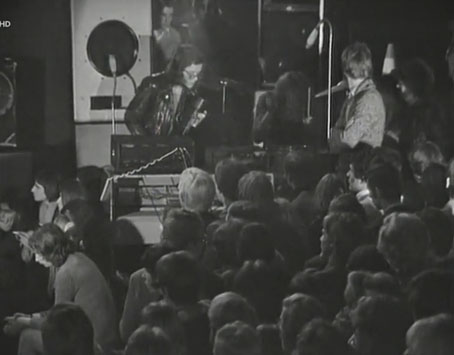
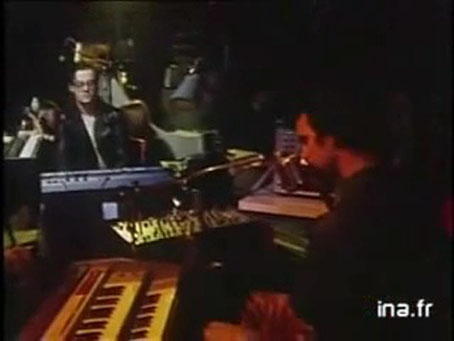
Attention from those techno-heads has ensured that there’s a lot of live footage of Göttsching’s Ashra line-ups in later years. There’s very little from the 1970s or 80s, unfortunately, but Göttsching, Lutz Ulbrich and Harald Grosskopf did make this appearance on Musical Express for Spain’s Televisión Española in 1981. This was the same programme that filmed Vangelis improvising in his studio, embracing opportunities missed by the BBC. ¡Gracias!

• “Manuel Göttsching laid the groundwork for generations of electronic musicians,” says Brian Coney.
• From 2017: “Everything was in the moment.” Manuel Göttsching discussing his career with Robert Barry.

Sticks

1: Illustrations by Lee Brown Coye

coye1.jpg

One recurring feature in Coye’s work is the motif of wooden sticks, often in latticework-like patterns. This was inspired by a 1938 discovery in an abandoned farmhouse.

Coye had returned to the North Pitcher, New York, area where he spent much of his childhood. While wandering deep in the woods, Coye discovered an abandoned farmhouse. Boards and pieces of wood which had been set perpendicular to one another surrounded the site. Neither inside nor out could Coye find an explanation for the presence of these crossed sticks. In the years following, Coye remained interested in the significance of his discovery.

When Coye returned to the site in 1963, there was nothing left of the building or the sticks (the area had suffered severe flooding), and he never found out why the sticks were there or who it was that had arranged them in such a manner. Because of the strangeness of the entire experience, these forms never left Coye, and they appear in many of his paintings and illustrations. [Via]

coye4.jpg

coye2.jpg

coye3.jpg

coye6.jpg

coye5.jpg


2: A short story by Karl Edward Wagner

whispers.jpg

Whispers #3, March 1974. Cover art by Lee Brown Coye.

The story [Sticks] is really Lee Brown Coye’s and is about Lee Brown Coye, as the Afterword [in Whispers #3] explains. Coye had described the events upon which Sticks was based to me, and when Stuart David Schiff decided to bring out a special Lee Brown Coye issue of Whispers, I stole time from my final few months of medical school to write a story inspired by Coye’s experiences. Sticks is shot through with in-jokes and references which the serious fantasy/horror fan will recognize. I wrote the story as a favour and tribute to Lee, and I never expected it to be read by anyone beyond the thousand or so fans who read Whispers. To my surprise, Sticks became one of my best known and best liked stories. It won the British Fantasy Award and was a runner-up in the World Fantasy Award for best short fiction. The story has been anthologized numerous times and translated into several languages. It was broadcast on National Public Radio on Hallowe’en 1982 and was to have been produced for the short lived television series, Darkroom. Not bad for an in-joke. [Via]


3: Season one of True Detective

truedetective.jpg


4: An invented soundtrack album by Kish Kollectiv

dwellers.jpg

Produced for UK television in 1982 by ATV, the undeservedly obscure Dwellers in the Earth is a loose adaptation of the late Karl Edward Wagner’s short story Sticks (itself an inspiration for The Blair Witch Project). The film—thought lost for many years until a somewhat degraded can of film reel turned up in a private collection in Hong Kong in 2009—has been routinely described as one of the scariest made-for-television horror movies of all time. It was directed by the late Freddie Francis and starred Robert Powell and Jenny Agutter with Michael Ironside, Ian McCulloch and Linda Hayden in supporting roles.

With the kind permission of the composer’s widow, Nadezhda Mastandrea, Kish Kollektiv has painstakingly recreated Staszek Korolenko’s long lost soundtrack score for the mysterious film. The UK-based Kollektiv gratefully acknowledges Mr. Korolenko’s huge influence on its own work. The Anglo-Belarusian composer died at the age of only 43, while the master recordings of many of his scores were later destroyed when the cellar of his family home flooded in 1989. [Via]

Previously on { feuilleton }
Owls and flowers
In the Key of Yellow

Weekend links 644

binnie.jpg

Yoshitoshi’s Ghosts (2004) by Paul Binnie.

• “The later Grand Etteilla series, printed well into the nineteenth century, and the present-day proliferation of Tarot decks, following ephemeral fads and fashions, all trace their origins to this beautiful and beguiling creation from the enigmatic Egyptophile at 48 Rue de L’Oseille.” Kevin Dann on the Livre de Thot Tarot (ca. 1789) by Jean-Baptiste Alliette, better known as “Etteilla”.

• “Death is not a subject he has ever shied away from, in his fiction or conversation. Indeed, he has measured other writers by how seriously they address it.” Richard B. Woodward on his friend, Cormac McCarthy, and McCarthy’s new novels. There’s an exclusive extract from The Passenger here.

• “…addicts, psychopaths, lovelorn outsiders, cult leaders, lesbian and gay icons…you name it, the vampire has become it.” Christopher Frayling on the perennial popularity of the vampire, and a new book collection of vampire film posters.

Robert Wilson‘s new production of Ubu Roi by Alfred Jarry is “a sinister, multilingual pantomime bathed in red light and looped in noise…fittingly violent, absurd, ominous and infantile”.

• “What kind of music goes with a show that originates in deep space?” Aquarium Drunkard on Sonny Sharrock’s final recordings, the soundtrack music for Space Ghost Coast To Coast.

• At Wormwoodiana: Mark Valentine takes a fresh look at the health of secondhand bookshops in Britain.

• Tokyo nightlife photographed by Hosokawa Ryohei.

• New music: Approach by Lawrence English.

The Passenger (1977) by Iggy Pop | The Passenger (1987) by Siouxsie And The Banshees | The Passenger (1997) by Lunachicks