Ghost clocks

ghost1.jpg

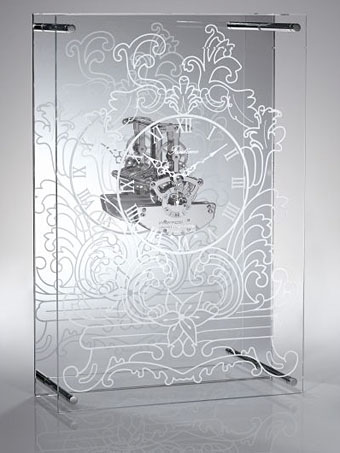
Ghost Clock by Yee Ling Wan (2005).

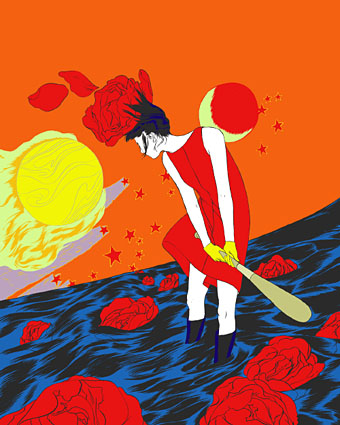
We’ve had skeleton clocks and mystery clocks this week, ghost clocks would seem the next logical step. There don’t seem to be many devices which fit the label unfortunately but this pair are interesting enough. Yee Ling Wan’s clock is relatively cheap (around £70) compared to yesterday’s antiques and can be purchased from a number of online outlets.

ghost2.jpg

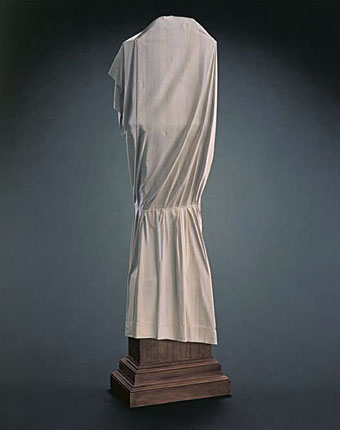
Ghost Clock by Wendell Castle (1985).

Wendell Castle’s Ghost Clock isn’t a timepiece at all but is a solid block of mahogany carved and laminated to give a trompe l’oeil impression of a sheeted grandfather clock. The wrapped object and the confounding of expectations reminds me of Magritte who may have been an inspiration. Ce n’est pas une horloge, perhaps.

Previously on { feuilleton }
Mystery clocks
Skeleton clocks
The Midsummer Chronophage
The Corpus Clock

Mystery clocks

mystery1.jpg

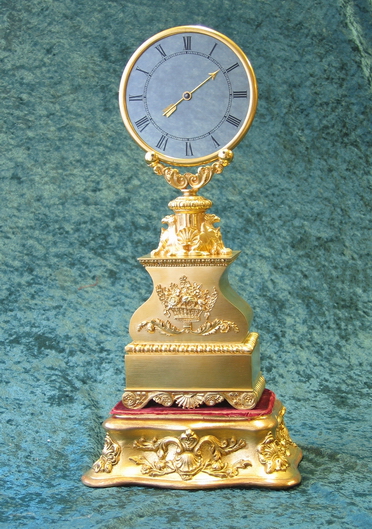
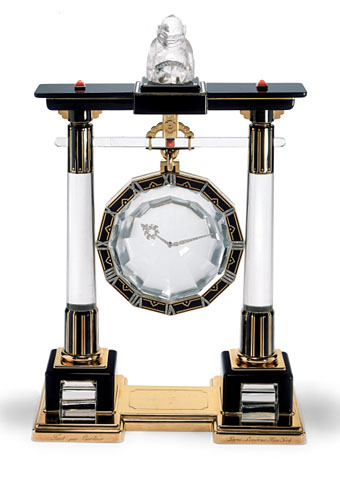
Yesterday’s post concerned skeleton clocks so I have to follow up with something about mystery clocks, those fascinating devices whose hands move without any apparent attachment to gears or clockwork. It’s the glass that moves, of course, and the trick is easily puzzled out in many of the pieces with circular faces. Rather more ingenious are square clocks like the simple and elegant Smiths Electric Mystery Clock from 1934 which used a central pane of glass moving from side to side to operate the hands. Especially impressive is this one-off piece which is entirely clear and seems to have no moving parts at all.

The clocks shown here are among the more lavish examples. The piece above is an early model from circa 1837 credited to Jean Eugène Robert-Houdin, the renowned stage magician who was also a notable inventor, clockmaker and scientist. Below is one of a series of Art Deco-styled clocks made by Cartier during the 1920s. Having the clock suspended rather than supported is an unusual touch which adds just that bit more mystery.

mystery2.jpg

Previously on { feuilleton }
Skeleton clocks
The Midsummer Chronophage
The Corpus Clock

Skeleton clocks

clock1.jpg

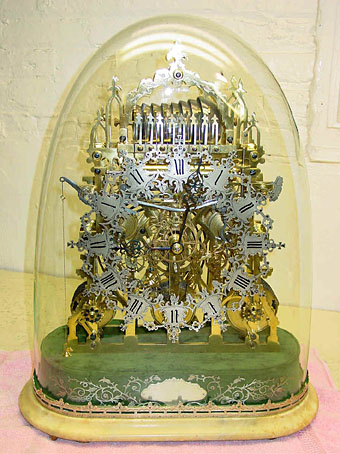
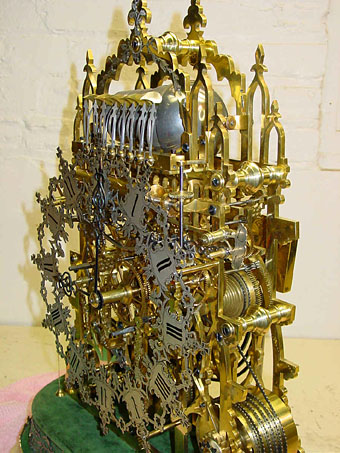
Behold the complexity of the Smith of Clerkenwell skeleton clock from 1865, one of many such intricate devices at this site devoted to the collection, restoration and construction of skeleton clocks old and new. The Clerkenwell manufacturers also made a musical version of this machine and I like this moonphase astronomical clock from 1870. Don’t mention Steampunk, these chronometers are surely Clockpunk if they’re anything.

clock2.jpg

Previously on { feuilleton }
The Midsummer Chronophage
The Corpus Clock

Weekend links: Ghosts, Spooks and Spectres edition

spectres.jpg

Cover design by Philip Gough.

Ghosts, Spooks and Spectres (1972 reprint). Editor Charles Molin collected nineteen ghost stories by writers including Oscar Wilde (The Canterville Ghost), Charles Dickens (The Signal-Man), J. Sheridan Le Fanu (Madame Crowl’s Ghost) and HG Wells (The Inexperienced Ghost). This was one of my favourite books when I was ten-years old. There’s nuffin like a Puffin. Puffin Books’ parent company, Penguin, is 75 this year.

• The good people at the Outer Alliance have posted an interview with me here in which I talk about the subversive sexualities of sf in the 1970s and also admit to writing fiction.

• There’s just time to mention It Came From Pebble Mill, an event which includes another screening of David Rudkin’s Penda’s Fen.

• “In our society, there has tended to be a very strong compartmentalization of different experiences, different cultural forms, different genres. We can talk in a very broad sense and say art is separate from science, for example, or body is separate from mind, or we can talk in a specific sense and say one certain form of dance music is separate from one form of, say, heavy metal. I don’t really buy those compartmentalizations. I understand why they exist, how they’ve come into being and why they’re convenient, but it’s not the way I think, it’s not the way I experience the world, it’s not the way I believe things should be.” From an interview by Colin Marshall with David Toop at 3QD. Toop’s latest book is Sinister Resonance: The Mediumship of the Listener.

The Kingdom of the Pearl by Léonard Rosenthal, illustrated by Edmund Dulac.

Ghost Stations by Dollboy, a CD package. And then there’s the Ghostly Bento.

7 Inch Cinema are Birmingham-based cultural historians.

• Mark Pilkington’s Mirage Men now has its own site.

Borges on Pleasure Island: JLB and his love of RLS.

• RIP Arne Nordheim, Norwegian composer.

• Charlie Visnic’s Modular Ghost Synth.

On the trail of Tutankhamen’s penis.

Photos by Thom Ayres.

Ghosts by Japan | Spooky Rhodes by Laika | Purple Dusk by Spectre.

The Midsummer Chronophage

chronophage.jpg

The Midsummer Chronophage.

John C Taylor’s Corpus Chronophage—the extraordinary mechanical clock surmounted by a time-devouring monster—was featured here following news of its installation at Corpus Christi College, Cambridge, in 2008. Two years later its creator is ready to unveil a new clock which he calls The Midsummer Chronophage.

The Midsummer Chronophage pays homage to the 18th century clockmaker John Harrison, inventor of the marine chronometer and the ‘grasshopper’ escapement, a low-friction mechanism for converting pendulum motion into rotational motion. The Midsummer Chronophage takes the grasshopper escapement out of the clock and presents it on the outside as a sculpture. The mythical creature is also the world’s largest grasshopper escapement.

The face of The Midsummer Chronophage is a 24 carat gold-plated steel disc almost 1.5M in diameter, polished to resemble a pond of liquid metal with ripples that allude to the Big Bang. It was created by a series of underwater explosions.

The Midsummer Chronophage has no hands or numbers but displays time by aligning slits in discs behind the clock face back lit with blue LEDS; these slits are arranged in three concentric rings displaying hours, minutes and seconds.

Dr Taylor’s new clock can be seen at London’s Masterpiece Fair from 23rd of June. For those outside London there are more pictures of the device here, and videos of the Corpus Clock in action here.

Previously on { feuilleton }
Andrew Chase’s steel cheetah
Another Midsummer Night
The Corpus Clock
A Midsummer Night’s Dadd
William Heath Robinson’s Midsummer Night’s Dream
The Bowes Swan