Weekend links 501

ashman.jpg

Cover art by Michael Ashman, 1979.

• RIP Terry Jones, not only a writer, actor and director but also a presenter of the BBC’s short-lived Paperbacks series in 1981, a programme that included Angela Carter among its guests. Related: The Box (1981), a short film directed by Micky Dolenz, based on a play by Terry Jones and Michael Palin.

• “[David] Lynch in a suit and tie that echoes the formal dress of Twin Peaks’ FBI Agent Cooper, presses a small capuchin monkey, called Jack Cruz, to confess to the murder of Max.” What Did Jack Do?

• The week in Ghost Box: Flying Lotus and Julian House collaborate on a promo for the Moog Subsequent 25 synthesizer, while at Grave Goods Jim Jupp answers questions from beyond.

Bruce Sterling: “This is an essay about lists of moral principles for the creators of Artificial Intelligence. I collect these lists, and I have to confess that I find them funny.”

• A campaign to protect and maintain Derek Jarman’s Prospect Cottage.

• Winners of the Wiki Loves Monuments 2019 photo competition.

• Mix of the week: Sehnsucht by The Ephemeral Man.

• Susan Schulten on Emma Willard’s Maps of Time.

• At Dennis Cooper’s: Roland Topor’s Brains.

• At Strange Flowers: 20 books for 2020.

Beat Box (1984) by Art Of Noise | Glory Box (1994) by Portishead | Black Box (1995) by Scorn

Weekend links 498

mead.jpg

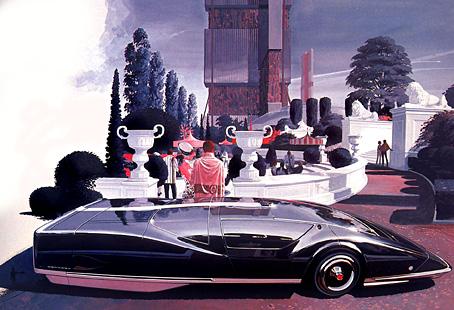
The Sentinel 280, a car design by Syd Mead from 1964.

• “Boris Dolgov did not exist. The man who bore that name may have existed, but there never was a man in the United States with that name until 1956, too late for Weird Tales.” Teller of Weird Tales on the mysterious identity of a magazine artist.

• Saying goodbye to 2019 also meant saying farewell to Vaughan Oliver, Neil Innes and Syd Mead. Related: Vaughan Oliver at Discogs; I’m The Urban Spaceman; a look back at Syd Mead’s vehicle designs.

Lanre Bakare on how ambient music became cool. (Again. This begs the question of when it became uncool, especially when a ten-year-old Brian Eno piece about “the death of uncool” is being quoted.)

Westerners interpreted the peyote experience very differently from the practitioners of the peyote religion, where the focus was “ritual, song and prayer, and to dissect one’s private sensations was to miss the point”. Writers such as Havelock Ellis, who published an essay on his peyote experiences in the Lancet in 1897 (it’s likely that he also administered the substance to his friends W.B. Yeats and Arthur Symons), instead tended to focus on its visual effects. Ellis described “the brilliance, delicacy and variety of the colours” and “their lovely and various textures”. Peyote reached Europe in tandem with the X-ray, cinema and electric lights, Jay notes, and “nothing delighted the eye of the mescal eater so much as the new electrical sublime”.

Emily Witt reviewing Mescaline: A Global History of the First Psychedelic by Mike Jay

Peter Bradshaw takes on the thankless task of ranking Federico Fellini’s feature films.

Geoff Manaugh on when Russia and America coöperated to avert a Y2K apocalypse.

• “Music is an ideal medium for interstellar communication,” says Daniel Oberhaus.

Keith Allison on Karel Zeman, a creator of remarkable cinematic fantasies.

•  Japanese Designer New Year’s Cards of 2020.

• At Dennis Cooper’s: Vera Chytilová Day.

2020 in public domain.

Sentinel (1992) by Mike Oldfield | Sentinels (2001) by Cyclobe | Sentinel (2004) by Transglobal Underground

Weekend links 493

gaycomix.jpg

Art by Rand Holmes for Gay Comix No. 1, September 1980.

• In the universe next door, Los Angeles in November, 2019 looks like the drawings in the Blade Runner Sketchbook (1982). The book has been out of print for many years but available online for a while, although seldom in a downloadable form. A recent upload at the Internet Archive remedies this. In addition to the familiar Syd Mead designs for flying cars and street furniture there are some Moebius-like doodles by Ridley Scott, and Mead’s design for Tyrell’s cryogenic crypt, a detail that would have formed part of an unfilmed sub-plot.

• RIP Howard Cruse, comic artist and pioneering editor of the first few issues of Gay Comix in the 1980s. Cruse produced work outside the gay sphere (I first encountered his strips in Heavy Metal) but the stories that he and other artists created for Gay Comix (later Gay Comics) were some of the first by lesbians and gay men chronicling their own lives, as opposed to porn fantasies or the more recent trend of bolting a token sexuality to a superhero. John Seven talked to Cruse about his career in 2007.

• “On the eve of the First World War Stefan George had started recruiting his own twink army…” Well, if you really must have an army… Strange Flowers presents part one of a guide to the city of Vienna.

In Wild Air, 2016–2018: all 72 of Heath Killen’s requests for a list of six interesting things from artists, writers, scientists, ecologists, musicians, historians and others. My answers are at number 55.

• “Satan is a friend of mine”: Sander Bink on a forgotten occult novel, Goetia (1893) by Frits Lapidoth.

• Picturing a voice: Rob Mullender-Ross on Margaret Watts-Hughes and the Eidophone.

• “They broke the rules”: Killian Fox on the film posters of the French New Wave.

• At Dennis Cooper’s: Jan Švankmajer Day.

Ogi No Mato (1976) by Ensemble Nipponia | Rêve (1979) by Vangelis | Blade Runner Esper “Retirement” Edition, Part III (1982)

Peter Strickland’s Stone Tape

stonetape.jpg

My annual Halloween post breaks with its usual music mix/playlist format this year for a recording of The Stone Tape, Peter Strickland’s hour-long radio drama made for Halloween in 2015. This was an adaptation, co-written with Matthew Graham, of Nigel Kneale’s celebrated TV play of the same name, first broadcast in 1972 for the BBC’s Christmas ghost-story slot then unavailable for many years. The combination of Kneale’s name and the impossibility of easily seeing the play gave The Stone Tape a reputation somewhat greater than it might otherwise have warranted. The drama has a number of shortcomings by contemporary standards: the whole thing is shot on video, so it compares unfavourably to the ghost films the BBC were making throughout the 1970s, and the acting is also quite histrionic in places. On the plus side there’s a woman scientist as the central character (an excellent performance by Jane Asher), and another of Kneale’s examinations of a horror staple—the haunted house, in this case—which adeptly twists your expectations while combining science and the supernatural in equal measure.

Strickland’s adaptation uses the same scenario—struggling electronics company moves into a house with a haunted reputation—but with the events moved slightly forward to 1979. The director’s fondness for electronic music shifts the emphasis of the story to the capabilities of electronic sound, both its destructive potential and its use as a diagnostic tool. James Cargill, formerly of Broadcast, now in Children Of Alice, was the soundtrack composer on Strickland’s second feature film, Berberian Sound Studio, and here creates the music and electronic sounds. The radio play is closer to Berberian Sound Studio than anything else Strickland has done to date, and could even be regarded as a companion piece with its recording equipment and repeated screams. (Eugenia Caruso provides screams for both.) As with the film, two thirds into the drama the narrative becomes much more diffuse and fragmented; the recording medium itself is foregrounded for a lengthy sequence that works like an audio equivalent of found-footage horror films. The hazard of this is that the layered nature of Kneale’s horrors may not be so apparent if you’ve not seen the TV version (I can’t say) but the sound design is excellent throughout, and benefits from the use of headphones to appreciate its subtleties. There’s also some sly reference to Alvin Lucier if you’re familiar with his compositions. Jane Asher makes a cameo appearance as the mother of the character she portrayed in the TV version.

The Stone Tape may be listened to or downloaded here.

Previously on { feuilleton }
Nigel Kneale’s Woman in Black
Stone Tapes and Quatermasses
Nigel Kneale’s Nineteen Eighty-Four
The Stone Tape

Weekend links 488

ziegler

Poster by Zdeněk Ziegler for Marketa Lazarová (1966), a film by František Vláčil.

• I’ve spent the past couple of weeks watching a number of films by Béla Tarr, including his 432-minute masterwork, Sátántangó (1994). The latter was based on a novel by László Krasznahorkai, an author who not only worked with Tarr on the screenplay but helped with several of his other features. So this piece by David Schurman Wallace, about a more recent Krasznahorkai novel, Baron Wenckheim’s Homecoming, arrives at just the right moment.

The Paris Review unlocked its Art of Fiction interview with Italo Calvino. William Weaver and Daniel Pettigrew ask the questions. And at the same site: Ivan Brunetti on the deceptive simplicity of Charles Schulz’s Peanuts.

• Halloween approaches so Sudip Bose suggests 10 pieces of orchestral music to set the mood. I made a similar list of my own in 2011. Related: Adam Scovell on 10 lesser-known folk horror films.

I thought, “When I grow up, I’m going to be in a group making this kind of music.” Slowly and Shirley, I did grow up and found myself in a group but they weren’t making that kind of music. It was a hole of longing in my guts that I needed to fix.

Andy Partridge, aka Sir John Johns, on his love of psychedelic music and the remixed reissue of the Dukes Of Stratosphear catalogue

Faye Lessler on how the Internet Archive is digitizing LPs to preserve generations of audio.

• Photographing the Dark: Allison C. Meier on Nadar’s descent into the Paris Catacombs.

• At Wormwoodiana: Go Back at Once, Robert Aickman‘s unpublished second novel.

• Queen of the Flies: Mica Levi talks to Charlie Bridgen about her soundtrack music.

• At Dangerous Minds: Sex, Nazis, and classical music: Ken Russell’s Lisztomania.

• The first new Ghost Box recording artist of 2020 will be…Paul Weller.

• Mix of the week: There’s No Going Back by The Ephemeral Man.

• The Dead Travel Fast: The Gothic Ballad of Lenore in paint.

Catacombs/Cum Mortuis In Lingua Mortua (1980) by Mussorgsky (George Solti/Chicago SO) | Fade In Hong Kong (1981) by Video Liszt | La Ballade De Lenore (1986) by Shub-Niggurath