The Gate to the Mind’s Eye

tgttme1.jpg

Turn a 6 on its head and you’ll see a number 9. Do the same with the psychedelic culture of the 1960s and you get the 1990s when psychedelia emerged again, after a fashion, in a profusion of new drugs (plus the same old ones), “ambient” music (a lot of which was never very ambient at all), and, of course, computer graphics. The resemblance of the overlit, weightless world of early computer graphics to the vivid inner landscapes of psychedelic hallucination prompted people like Timothy Leary to declare computers to be their new drug of choice, while also inspiring the resurrection of the kind of visual tripping aid that would have been considered dead and buried in the very un-psychedelic 1980s. (There were a few musical exceptions in that decade—the Paisley Underground, the Dukes of Stratosphear albums, Around The World In A Day by Prince & The Revolution—but all these were counter to the dominant trends of the time.)

tgttme2.jpg

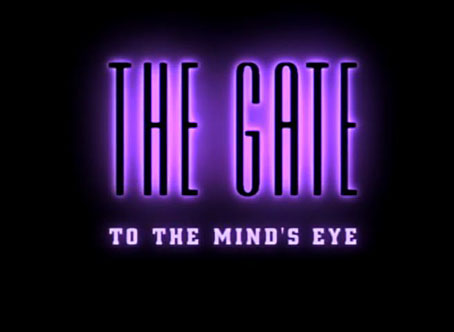
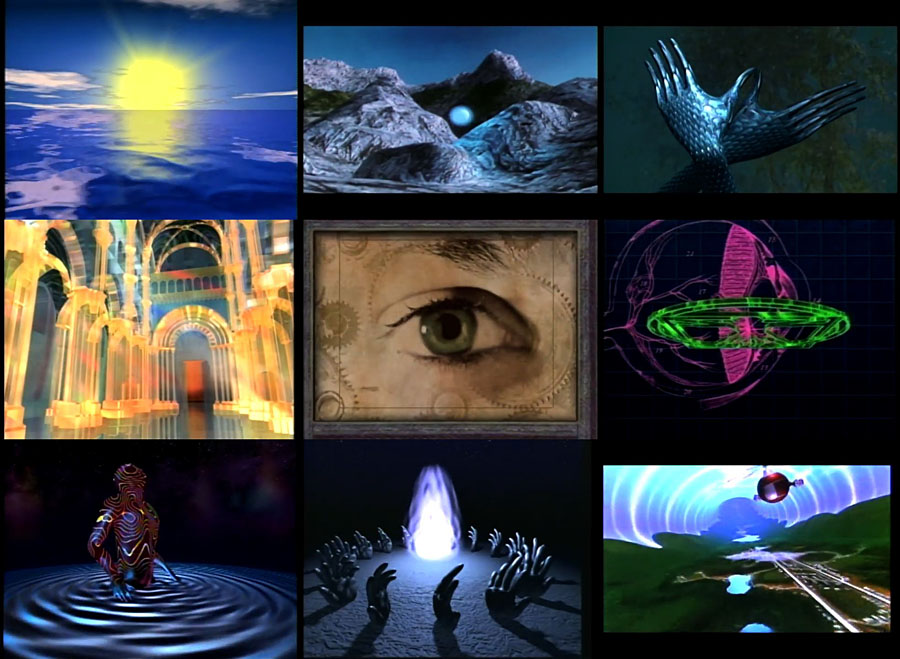
CD-ROMS were the hippest vehicle for far-out visuals in the mid-90s. Brian Eno was vocal in his criticism of the limitations of the point-and-click CD-ROM format but he still provided music for a thing called Headcandy in 1994, one of a series of “video kaleidoscopes” with 3-D visuals created by Chris Juul and Doug Jipson. Not so overtly druggy was a series of VHS tapes and laserdiscs released throughout the 1990s by Odyssey Productions, all of which had the words “Mind’s Eye” in their titles: The Mind’s Eye: A Computer Animation Odyssey (1990), Beyond the Mind’s Eye (1992), The Gate to the Mind’s Eye (1994) and Odyssey Into The Mind’s Eye (1996). Where Headcandy and its relations created far-out visuals using original data encoded on a CD-ROM, the Mind’s Eye laserdiscs wowed the viewer by stitching together the latest examples of CGI from a variety of sources—showreels, TV ads, music videos and so on—giving you an hour of coloured balls bouncing across crystal mountains, pulsating blobs of mercury, shiny objects zooming through corridors and vortices, together with the clumsy figure animation that’s a consistent feature of early computer graphics. Each instalment was provided with a soundtrack by a different musician, so each release is really a long music video in itself, rather like The Orb’s Adventures Beyond The Ultraworld (Patterns & Textures) (1992), a 50-minute collage of rave footage, dolphins, spacewalking astronauts and cheap video effects soundtracked by live music from The Orb.

tgttme3.jpg

The Gate to the Mind’s Eye is highlighted here mainly for its having a soundtrack by Thomas Dolby that I hadn’t heard before. Other instalments feature original music by Jan Hammer (which may be okay), and Kerry Livgren from Kansas (which promises to be as unpalatable as Giorgio Moroder’s misconceived mauling of Fritz Lang’s Metropolis). The Gate to the Mind’s Eye doesn’t feature the best of Dolby’s music, it should be said, which may explain why the soundtrack CD has only been reissued once since 1994, while the visual material looks like a combination of music video and computer game. But there’s a lot of this stuff around today, especially at the Internet Archive which now has a laserdisc section containing several uploads from Odyssey Productions and its affiliate, Miramar Productions. Closer to the psychedelic ideal is a series of discs from Japan with the uninventive name of Video Drug. The Internet Archive has five discs from this series. I might have been happy to watch these in the 1990s when late-night TV in the UK was either dull or non-existent but today I’m more taken with outmoded things like Electric Light Voyage aka Ascent 1, a video release from 1979 which featured analogue video effects of a type you don’t find at all in the digital world.

Elsewhere on { feuilleton }
The abstract cinema archive

Previously on { feuilleton }
Kusama’s Self-Obliteration, a film by Jud Yalkut
Science Friction by Stan VanDerBeek

Switched-On… hits and misses

so01.jpg

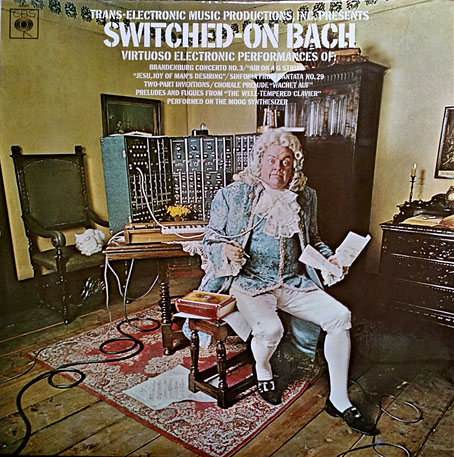
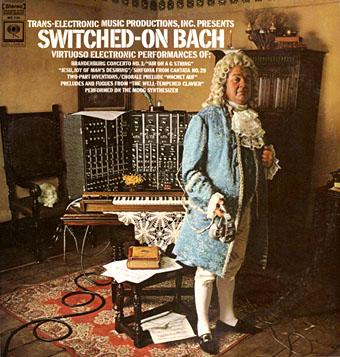
The first pressing of Switched-On Bach with a cover showing a Bach-alike confounded/dismayed by the sounds issuing from the machine behind him. The cover was soon swapped for the one below.

After mentioning the proliferation of Switched-On… synthesizer albums in the previous post, curiosity impelled me to see how many of these things were out there. A lot more than I expected is the answer, almost enough to make this cul-de-sac of novelty exploitation into a sub-genre of its own. As mentioned earlier, it was the huge success of Switched-On Bach (1968) by Wendy Carlos that began the trend. The album had a rare crossover appeal so that it could be sold to classical listeners as well as to a younger audience interested in electronic sounds, those for whom the words “switched on” echoed the druggy/erotic intersection of “turned on”. Carlos had an advantage over other musicians thanks to a long association with Robert Moog which meant she had a head start in exploring the recording potential of the new Moog synthesizer and innovations like Moog’s touch-sensitive keyboard. In 1968 few people could afford a Moog system; those who could usually needed to hire technicians like Paul Beaver and Bernie Krause to help them operate the thing. For a brief while it was enough to simply use the instrument to make strange noises, hence Mick Jagger’s droning score for Kenneth Anger’s Invocation of my Demon Brother (1969), and George Harrison’s preposterous Electronic Sound (1969), 44 minutes of very amateurish Moog-doodling. Switched-On Bach sounds a little primitive today—it sounds primitive next to its follow-up albums, The Well-Tempered Synthesizer (1969) and Switched-On Bach II (1973)—but Carlos and collaborators Rachel Elkind and Benjamin Folkman spent much more time refining their recording techniques than the knob-twiddling horde who rushed to capitalise on their success.

so02.jpg

The rules of the Switched-On… idiom are as follows: a title that begins with the words “Switched-On”, obviously, although there’s a subset of the form in which an album may have a different title while a subtitle mentions something about “switched-on recordings”; the music must be cover versions of familiar songs or compositions, originality here is surplus to requirements; and it’s not essential but the cover art often alludes in some way to synthesizer technology and/or “the future”, with the latter represented by Space Age typefaces such as Amelia, Computer, Countdown or Data 70. I’ve not heard many of these albums, and I’m fairly certain that I don’t want to hear most of them, but I’ve heard enough Carlos cash-ins to know that the cover designs are often the best thing about them. The remastered CDs that Wendy Carlos released in the 1990s feature additional tracks that give some idea of the amount of work involved in the creation of each album. The early cash-ins, by contrast, tend to avoid time-consuming multi-track composition in favour of using a synthesizer as though it’s merely an expensive keyboard. The success of these albums musically may be gauged by the lack of reissues. They may be of interest to the so-bad-it’s-good “Incredibly Strange Music” crowd but I prefer to spend my time listening to other things. Beware.

so03.jpg

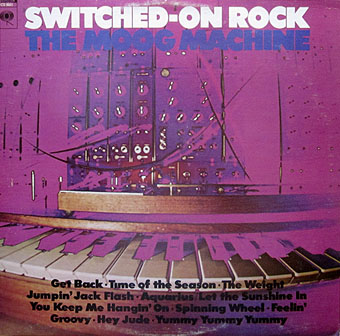
Switched-On Rock (1969) by The Moog Machine.

so04.jpg

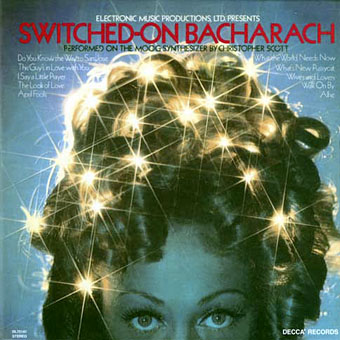
Switched-On Bacharach (1969) by Christopher Scott.

so05.jpg

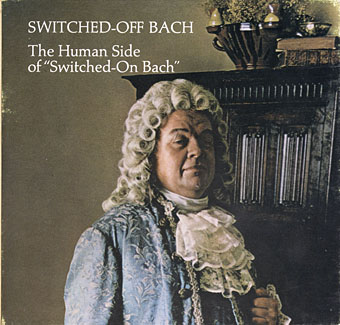
Switched-Off Bach (1969) by Various Artists.

CBS exploits the success of the electronic album by packaging a collection of earlier non-electronic recordings.

Continue reading “Switched-On… hits and misses”

Weekend links 566

hokusai.jpg

The Amida Falls in the Far Reaches of the Kisokaido Road. From the series A Tour of Waterfalls in Various Provinces (c. 1832) by Hokusai.

• New music: In Love With A Ghost by Kevin Richard Martin (aka Kevin Martin, The Bug, etc), a preview from his forthcoming alternative score for Andrei Tarkovsky’s Solaris (1972). In other hands I’d probably dismiss a further addition to the trend of creating new scores for films that don’t require them. Tarkovsky’s film certainly doesn’t need any new music, and we’ve already had an album-length homage from Ben Frost & Daníel Bjarnason. But I like Martin’s sombre atmospherics so he gets a pass with this one.

• “[Pauline] Oliveros wrote a piece for the New York Times in 1970 titled And Don’t Call Them Lady Composers, focusing on the difficulties of women being noticed and taken seriously in her field. It’s still online and could have been written yesterday.” Jude Rogers on Sisters With Transistors, a documentary about women in electronic music. Madeleine Siedel interviewed Lisa Rovner, the film’s director. Watch the trailer.

Submissions to the 16th number of Dada journal Maintenant will be open at the beginning of October, 2021, following an announcement of the theme of the new issue in September. All you would-be (or actual) Dadaists out there have the summer to plot your potential contributions.

Our reverence for originals takes an absurdly extreme form in the recent craze for NFTs (non-fungible tokens), where collectors and traders spend huge sums of money on unique ‘ownership’ of a digital artwork that anyone can download for free. Since there’s no such thing as the original of a digital file, the artist can now certify the file as the one and only ‘original copy’, and make a fortune. Time will tell whether this is a transient fad or a new way of establishing the feeling of a relationship to the mind of the digital artist.

But our reverence for originals isn’t universal. Treating the original as special and sacred is a Western attitude. In China and Japan, for example, it’s acceptable to create exact replicas, and these are valued as much as the original—especially because an ancient original might degrade over time, but a new replica will show us how the work looked originally. And, as mentioned, there are studios in China where artists are employed to create fakes. Perhaps our culture teaches us to respond to artworks by inferring the mind behind the art.

“Works of art compel our attention—but can they change us?” asks Ellen Winner

• “What Don basically did here is find a series of one or two bar riffs, or parts, that he liked, have me write them down, and then say, in essence, ‘make something out of this’.” John French (aka Drumbo) recalls the making of Trout Mask Replica.

• From 1988 (and relevant this week because I’m reading a Pynchon novel): Thomas Pynchon’s review of Love in the Time of Cholera.

• Andy Thomas on fusion legend Ryo Kawasaki, pioneer of the synth guitar.

• At Dennis Cooper’s: Dimitri Kirsanoff Day.

Gareth Jones’ favourite music.

• RIP Monte Hellman.

The Sea Named “Solaris” (1978) by Tomita | Solaris (2014) by Docetism | Solaris Return (2019) by Jenzeits

Weekend links 563

tonto.jpg

Cover art by Jeffrey Schrier for the 1975 reissue of Zero Time by Tonto’s Expanding Head Band.

• RIP Malcolm Cecil, electronic musician, and producer of Stevie Wonder, among many others. The term pioneer is over-used when discussing electronic artists, but it’s an accurate one when applied to Cecil and his partner in Tonto’s Expanding Head Band, Robert Margouleff. The first Tonto album, Zero Time (1971), was a collection of fully-realised all-electronic compositions recorded in the days when “electronic music” in the rock sphere usually meant rock-band-plus-synth-burbles. As I said in a post about Tonto’s debut album a few years ago, “Jetsex sounds like an outtake from Kraftwerk’s Autobahn (albeit three years early) while Timewhys wouldn’t have been out of place on The Human League’s Travelogue album almost a decade later”. Cecil may be seen in this short film showing off the bespoke synth gear that comprised The Original New Timbral Orchestra (aka TONTO), while he talks at length about his career in issue 4 of Synapse magazine here. Cecil and Margouleff parted company in the mid-70s shortly after releasing a second album, It’s About Time (1974), a collection of jazzy instrumentals that’s overdue a proper reissue.

• “Every film production company they showed it to said it was ‘too weird’ to ever be made. ” Next month Strange Attractor publishes The Otherwise, a script by Mark E. Smith and Graham Duff for an unmade horror film.

• More horror: Predator’s Ball by Uni; music video as horror scenario in which you can play spot-the-reference: Alice in Wonderland, Rocky Horror, Leigh Bowery (?), Pasolini’s Salò (?)…

• At Bibliothèque Gay: Narkiss by Jean Lorrain, another homoerotic classic newly translated into Spanish, and with new illustrations.

• The week in Gary Panter: Nicole Rudick on Gary Panter’s Punk Everyman, and the man himself writing about his life and art.

• At Wormwoodiana: Mark Valentine investigates the connections between Charles Williams and Sax Rohmer.

• At Dangerous Minds: New Age Steppers, “the only ever post-punk supergroup”.

• Mix of the week: XLR8R Podcast 689, a feast of funk compiled by Steve Arrington.

• At Public Domain Review: Agostino Ramelli’s Theatre of Machines (1588).

• At Dennis Cooper’s: Pier Paolo Pasolini Day.

Valentina Magaletti’s favourite music.

Louvre site des collections

Narcissus Queen (1958) by Martin Denny | Narciso (1974) by Pierrot Lunaire | Narkissos (2006) by Sadistic Mikaela Band

Weekend links 556

wilson.jpg

Captain Edward St. Miquel Tilden Bradshaw and his Crew Come to Grips with Bloodthirsty Foe Pirates by S. Clay Wilson, Zap Comix no. 3, 1968.

• RIP S. Clay Wilson, the wild man of American comics. The scene of mayhem above is typical in being barely coherent at a small size; click for a larger view. Patrick Rosenkranz at The Comics Journal describes Wilson as “the most influential artist of his generation…creating an extensive body of work that will defy authority and offend propriety until the end of days”. When Moebius was writing in the 1980s about the founding of Métal Hurlant he had this to say about the American undergrounds: “They were the first in the world to use comics as a means of communication, to express real emotions. Before, comics were used only to do stories, entertainment. They had some great moments but they were all very conventional. The American Underground showed us in Europe how to express true feelings, how to tell something to the reader through the comics. They blew the minds of the few professionals in Europe who saw them.” Also at TCJ, the S. Clay Wilson Interview. Wilson sent me a postcard once. I wish I knew what the hell I’d done with it.

• Michael Hoenig, synthesist for Agitation Free and (briefly) Tangerine Dream, plays one of the pieces from his debut album of electronic music, Departure From The Northern Wasteland, on a radio show in 1977. Hoenig’s album is long overdue a remastering and re-release.

• “My job, which the BBC has tasked me to do, is to provoke people and ask them, ‘Have you thought about looking at the world this way?'” Adam Curtis talks to Michael J. Brooks about his new TV series, Can’t Get You Out Of My Head.

m_chat.jpg

{ feuilleton } celebrates its 15th birthday today. Monsieur Chat, the mascot of this place, is happy about that but then Monsieur Chat is happy about most things.

• At Greydogtales: Opening The Book of Carnacki. A call for contributions to a collection of new stories about William Hope Hodgson’s occult detective. I’d be tempted if I didn’t already have more than enough to keep me occupied.

• “I’m being asked to talk about it a great deal at the moment, with the pandemic.” Roger Corman and Jane Asher on filming The Masque of the Red Death.

• New music: Cygnus Sutra by Mike Shannon, “a soundtrack to a fantasy/sci-fi epic not yet written”.

• A trailer for The Witch of King’s Cross, a documentary about occult artist Rosaleen Norton.

• At Dennis Cooper’s: Spotlight on…Hans Bellmer & Paul Eluard The Games of the Doll (1949).

• RIP also this week to Rowena Morrill, fantasy artist, and to Chick Corea.

• “Computers will never write good novels,” says Angus Fletcher.

• DJ Food on Zodiac posters by Funky Features, 1967.

• Mix of the week: Fact Mix 794 by Lutto Lento.

Annie Nightingale’s favourite music.

Zodiac (1984) by Boogie Boys | From The Zodiacal Light (2014) by Earth | Zodiac Black (2017) by Goldfrapp