Weekend links 422

kolosimo.jpg

Wu Ming, a communist writing collective known for its historical fiction, sees Kolosimo as using pseudohistory as a tool to shake people from their belief that capitalist society is natural and transhistorical, opening minds to other possibilities for how humans can live. They regret that popular proponents of his theories today, like Graham Hancock and Erich von Däniken, are unable to recognize the political motivations behind his project: “Nothing of his radicality survives in today’s copycats… Every corner has been blunted, the heresy has become telegenic, but we know that the revolution will not be televised.”

The secret history of Marxist alien hunters by AM Gittlitz

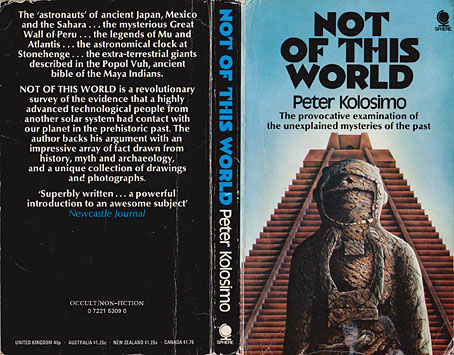
I received the Sphere edition of Peter Kolosimo’s book as a Christmas present in 1974, and being 12 years old at the time took its theories fairly seriously. As a work of pseudohistory it’s as poor as the books of Erich von Däniken but I always liked the title, and it happens to be the place I first encountered the mysterious words “Popol Vuh”, a name that would acquire a very different significance a few years later. Kolosimo also joins Kenneth Grant in taking HP Lovecraft’s work as a thin fictionalisation of supposed fact. For a serious dismantling of Not of This World see this review (the first of three parts) by “skeptical xenoarchaelogist” Jason Colavito.

• The Archons are back: Erik Davis talks with Gnostic scholar Matthew Dillon about religious mourning, the Nag Hammadi library, sex-magick Jesus, the Gnostic Eden, David Icke’s lizards, and the power of the Archons as an allegory of contemporary technological and political power.

Crystal Voyager (1973) is a surfing film by David Elfick that ends with a 23-minute sequence of slow-motion waves set to Echoes by Pink Floyd. Some of the same footage later appeared in the final scenes of Peter Weir’s The Last Wave (1977).

• Sweet artifice: “Dandies in the age of decadence favoured synthetics over nature, nowhere more so than in perfumery’s fabulous counterfeits,” says Catherine Maxwell.

• Now for a lampshade solo: Pascal Wyse on how the Radiophonic Workshop built the future of sound.

• Wilde about Paris: Alex Dean on the sex, drink and liberation of Oscar Wilde’s “lost” years.

Bee in the City: the vanguard of an invading army from Planet Bee.

• Five books that most inspired Alexander McQueen.

Colin Newman‘s favourite albums.

Echoes (1969) by Leon Thomas | Echo Waves (1974) by Ash Ra Tempel | Not Of This World (1988) by Danzig

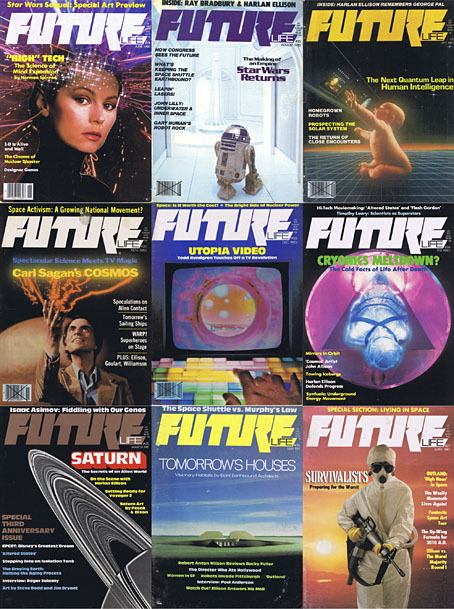
The artists of Future Life

future.jpg

My earlier post about Future Life magazine mentioned the regular Portfolio series which featured interviews with illustrators and space artists, the latter group being the people who providing conceptual paintings for astronomy books and government entities such as NASA. Since the magazine files at the Internet Archive aren’t searchable I thought it worth making note of the interviews here, for my own benefit as much as anything else. (This blog has often served as a useful notebook.)

fl01-bonestell.jpg

Issue 1: Chesley Bonestell.

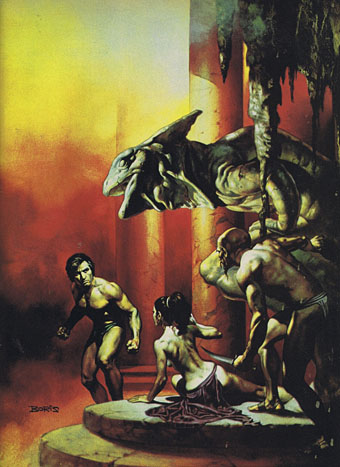
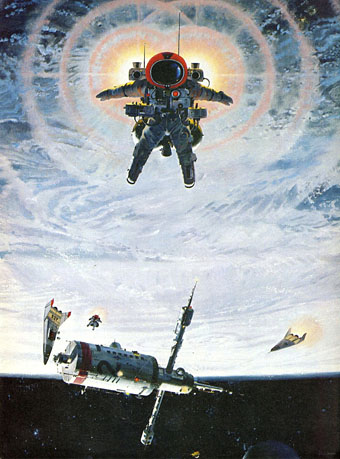
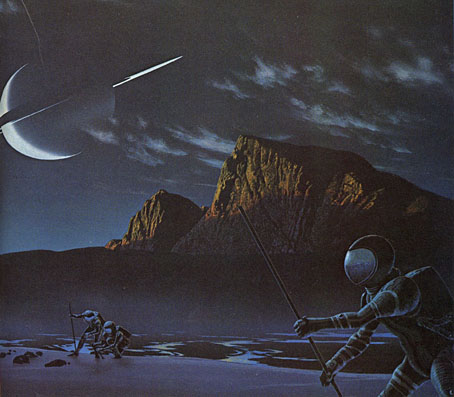
Many of the artists featured in Future Life were receiving their first (in some cases, only) high-profile feature at a time when little attention was given to the producers of this kind of work even in popular science-fiction magazines. The story magazines have always run interviews with writers but prior to Future Life, Science Fiction Monthly was the only magazine that I’d seen with a regular illustration feature, and that title didn’t last very long. Future Life covered some of the same people, Chris Foss, for example, while seeking out the prominent figures of the US illustration world. Not all the art is to my taste at all but the interviews are of interest even if you don’t like the pictures. One surprise was finding an interview in one of the issues that I’d missed with Ludek Pesek, a Czech artist whose views of the Solar System and depictions of the evolution of life on Earth I knew from the Puffin books he worked on with Peter Ryan. Those books were aimed at a young readership and were great favourites of mine before I’d seen anything by Foss and co. Another of the space artists interviewed is David Hardy, a British contemporary of Pesek’s whose view of an alien planet will be familiar to Hawkwind enthusiasts on the back cover of Hall Of The Mountain Grill. Another notable feature of the series is the lack of women artists, although this isn’t so surprising given that women creating pictures of space hardware are few even today. All the same, they might have featured Rowena Morrill, a popular cover artist for SF and fantasy novels at the time, and someone whose work I prefer to many of the people they did profile.

fl03-boris.jpg

Issue 3: Boris Vallejo.

fl04-mccall.jpg

Issue 4: Robert McCall.

fl05-nagaoka.jpg

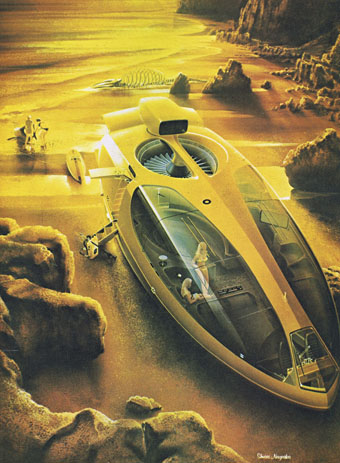
Issue 5: Shusei Nagaoka.

A Japanese artist best known in the West for his album-cover art for ELO, Earth, Wind and Fire, and many others.

fl06-miller.jpg

Issue 6: Ron Miller.

fl07-hildebrandt.jpg

Issue 7: The Brothers Hildebrandt.

fl08-hardy.jpg

Issue 8: David Hardy.

Continue reading “The artists of Future Life”

Future Life magazine

future1.jpg

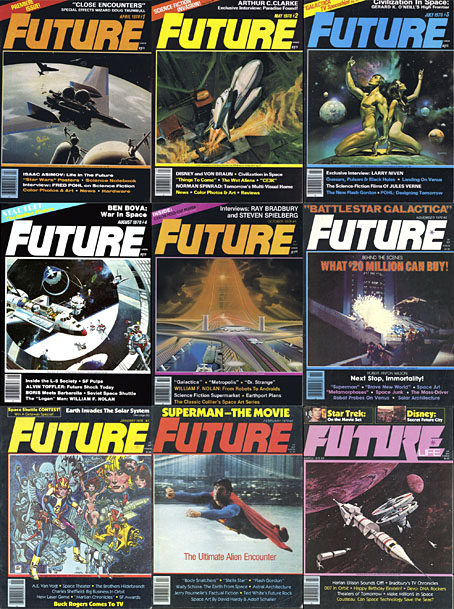
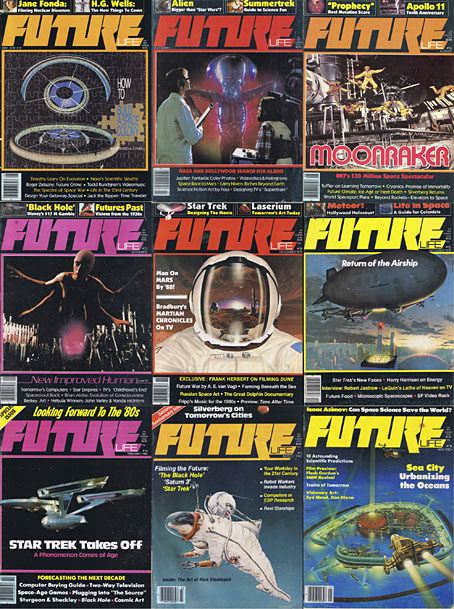
One thing I never expected about the future was that so many of my youthful enthusiasms would keep rising from the past, but here’s another, stumbling into the room reeking of cemetery earth and old newsprint. Future Life was a spinoff from Starlog magazine, and where the parent title concerned itself with science fiction and fantasy in film and television, the focus of Future Life was technology, popular science, scientific speculation, and written science fiction (all from an American perspective, of course); film and TV productions were there to attract general readers but never dominated the proceedings. Future Life ran for 31 issues from 1978 to 1981, and in many ways the magazine was a kind of OMNI-lite: not as lavish as its rival but not as expensive either. For a while this was a magazine I always looked out for (together with Heavy Metal, with whom it shared a music writer, Lou Stathis) but I missed the first nine issues, and many of the later ones before it vanished altogether, so it’s gratifying to find the complete run available as a job lot at the Internet Archive.

future2.jpg

It’s become commonplace today to regard Generation X as the first generation with no optimistic future to look forward to, but Future Life shows how much optimism there was at the beginning of the 1980s. The mood darkened just as the magazine expired, with genuine fears of a nuclear war persisting through much of the decade, and the Challenger disaster reminding everyone that leaving the planet was still a hazardous business. Future Life wasn’t blind to the problems posed by technology—there were features about the dangers posed by nuclear power and climate change—but it remained upbeat about the potentials, especially where space colonies were concerned. Most issues carried an art feature although these were generally about realistic space artists or spaceship painters, with none of the eye-popping weirdness favoured by OMNI. But this magazine was my first introduction to the work of Syd Mead, a few years before Blade Runner made him deservedly famous. On the writing side, many of the articles were by popular science fiction writers—Roger Zelazny on computer crime, Norman Spinrad on a pet theme, the future of drug-taking—which you can now read with the full benefit of hindsight. In later issues there was Harlan Ellison filing a succession of lengthy and inimitable film essays; several pieces by Robert Anton Wilson; and some good music articles with features on Larry Fast (issue 12) and Robert Fripp (issue 14), while Lou Stathis profiled and interviewed Bernie Krause (issue 18), The Residents (issue 19), Patrick Gleeson (issue 22), Jon Hassell (issue 24), Captain Beefheart (issue 25), and everyone’s favourite robots, Kraftwerk (issue 31).

future3.jpg

The Internet Archive currently has all the files stuck on a single page so most people will either have to download everything at once (I’d advise using the torrent file) or sample issues at random. Fortunately there’s a very thorough breakdown of the entire run of magazines here for those who prefer to pick through the detail. In the universe next door we’re reading these back issues while floating above the earth in our L5 space colonies.

Previously on { feuilleton }
Science Fiction Monthly

Weekend links 404

bellver.jpg

Magazine illustration of The Fallen Angel (1877) by Ricardo Bellver, a statue for The Fountain of the Fallen Angel in Madrid

• Obituaries of the late Stephen Hawking were obliged to concentrate on the professor’s disabilities and global celebrity while skirting around the trickier questions of what he actually spent the best part of his life thinking, writing and talking about. Roger Penrose was not only a friend of Hawking’s for many years but also one of his equally skilled professional colleagues. Penrose’s piece for the Guardian was notable for the way it provided a succinct but informed summary of Hawking’s work at the forefront of theoretical physics.

Brian Eno has announced a box set of old or previously unheard recordings for his artworks, Music For Installations. (Be warned that the various editions range from expensive to very expensive.)

• Flame 1 is the name of a collaboration between The Bug and Burial. The Quietus has an exclusive preview from the forthcoming album.

• Mixes of the week: XLR8R Podcast 533 by µ-Ziq, and Secret Thirteen Mix 249 by Eva Geist.

• Buy High, Sell Cheap: Elianna Kan interviews Alejandro Jodorowsky.

• At Dangerous Minds: Addams Family comic books from 1974.

• Advanced Creepology: Re-Reading Lolita by Michael Doliner.

• A Quietus list of the 40 best compilation albums of all time.

• At Spoon & Tamago: An anti-decluttering house.

• At Dennis Cooper’s: The Spheres.

Physical (1981) by Olivia Newton-John | (Let’s Get) Physical (1990) by Revolting Cocks | UK Girls (Physical) (2001) by Goldfrapp

Weekend links 398

deon.jpg

Untitled art by Felix D’Eon. Via Dangerous Minds.

• “The music inside lived up to the cover’s challenge: a collage of pop-culture nostalgia, hard-rock guitar, piano-driven melodies, stylised high vocals, strange musical structures and experimental sound pictures. Roxy Music’s eponymous album sounded like nothing else in 1971 and 1972—and like nothing else the group would ever attempt again.” Jon Savage on the creation of Roxy Music’s debut album.

• Behind the scenes of the BFI’s forthcoming Derek Jarman box-sets. Jarman appears in a rare acting role (not one of his strengths) in Dead Cat (1989) a short film by David Lewis which is only now being released on DVD.

• Rob Young’s long-awaited book about Cologne’s finest, Can, has finally been given a publication date. All Gates Open: The Story of Can will be published by Faber in May.

• At the Lever Gallery, London: UNCOVERED: Illustrating the Sixties and Seventies. Wallpaper magazine has a related feature about the exhibition.

Trim Tabroid [sic]: Yui Takada’s Instagram showing Japanese tabloid pages reduced to abstraction by careful pruning.

• On Fairy Tales: Carol Mavor and Marina Warner in discussion for the London Review Bookshop podcast.

• Mixes of the week: XLR8R podcast 527 by Peter Van Hoesen, and Secret Thirteen Mix 245 by Chikiss.

• Dubbing is a Must: Oli Warwick on the modern sound of leftfield dub.

This Book Is Bound in Lab-Grown Jellyfish Leather.

Cornelius’s Favourite Albums

Dubism (1976) by The Upsetters | Dub Fi Gwan (1979) by King Tubby | Dub Yalil (1995) by Natacha Atlas