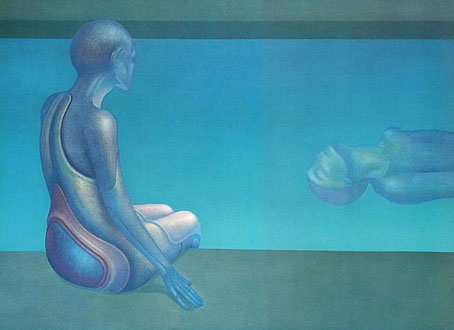
Michel Henricot, 1936–2022

henricot1.jpg

Deux Personnages (1974).

Jan of JKK Fine Arts was in touch this week to inform me that the French artist Michel Henricot died in February, a month before the opening of an exhibition of his work organised by JKK Fine Arts for the International Cultural Centre in Cracow, Poland.
henricot2.jpg

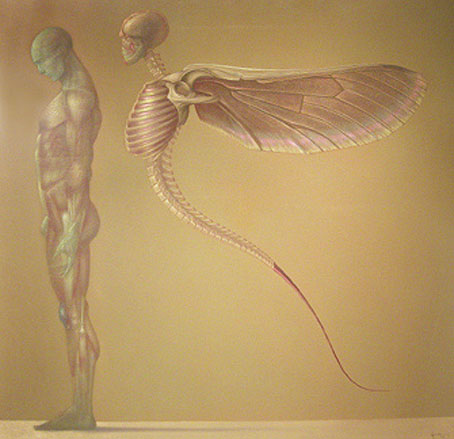
Le Voyageur IV (1996).

I first encountered Henricot’s work in the pages of OMNI magazine where he was one of several featured artists who can be grouped together as “fantastic realists”—Ernst Fuchs, Mati Klarwein, HR Giger, Robert Venosa, Rudolf Hausner, De Es Schwertberger—although the label wouldn’t have necessarily been agreed to by any of them apart from Fuchs and Hausner, both of whom were members of the Vienna School of Fantastic Realism in the 1960s. Henricot’s sombre and obsessive figure studies were a good fit for the magazine, with the science fiction context lending his paintings suggestions of the futuristic or alien that might otherwise be absent in the empty space of an art gallery.
henricot3.jpg

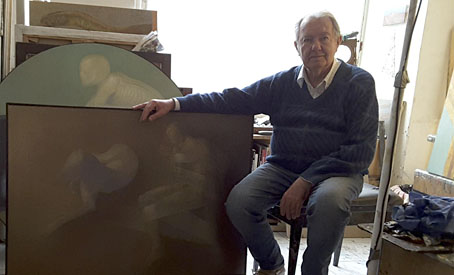
The artist photographed by Jan K. Kapera.

Despite such a high-profile showcase Henricot’s work has never been as visible as his more famous contemporaries so I’m grateful to Jan for supplying additional information, including the artist’s actual birth date, 8th July, 1936, rather than the erroneous dates found all over the internet. Henricot was friends with Leonor Fini, an artist whose work was also preoccupied with the human figure, often just as stylised and set against featureless monochrome backgrounds. Like Henricot, Fini’s art gets tagged as Surrealist even though her own obsessive paintings evolved away from any particular school. Henricot’s Les Promeneuses (1954) was definitely reaching for a Dalínean/Delvaux-like quality, but if his mature work belongs anywhere it’s with that small collection of French artists who don’t comprise any defined movement but who share a taste for the fantastic, the strange and the inexplicable: Sibylle Ruppert, Jean-Marie Poumeyrol, Jean-Pierre Ugarte, Gérard Trignac, Erik Desmazières, Jean-Paul Faccon, Pierre Clayette, Raymond Bertrand, Roland Cat, Gilles Rimbault, Jean-Michel Mathieux-Marie, and others. If I was given the opportunity to put together an art show for a French gallery (or even the Pompidou Centre…), these are some of the artists I’d choose.
henricot4.jpg

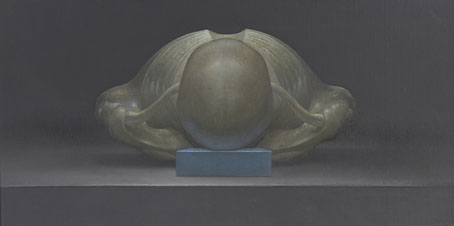
Le Silence (1979).

Henricot will be running at the International Cultural Centre, Cracow, until the end of April.

Elsewhere on { feuilleton }
The fantastic art archive

Previously on { feuilleton }
Saint Sebastian in NYC
The art of Michel Henricot

Weekend links 612

remps.jpg

Cabinet of Curiosities (c. 1690s) by Domenico Remps.

• “…the human voice is an astonishing landscape”. Jeremy Allen on Desert Equations: Azax Attra (1986) by Sussan Deyhim & Richard Horowitz, an album which is being reissued by Crammed Discs with bonus tracks and an inexplicably rearranged track list. Good as it is, their follow-up release from 1996, Majoun, is even better, and might be better known if it hadn’t been so thoroughly abandoned by Sony Classical.

• “On view through May 29, By Her Hand: Artemisia Gentileschi and Women Artists in Italy, 1500–1800 showcases masterpieces done by 17 Italian women to make the case for a broader view of women’s participation in the Italian Renaissance.” Nora McGreevy reports.

• “We had a far more profound effect on society than we really understood, and some of us paid for that”: Jane Lapiner and David Simpson of the San Francisco Diggers talking to Jay Babcock in another installment of Jay’s verbal history of the hippie anarchists.

• “Close your eyes and you could almost imagine it’s the muffled screams of a ghost trapped in a bottle.” Daryl Worthington on 25 years of The Ballasted Orchestra by Stars Of The Lid.

• More Dangerous Visions and New Worlds: Mike Stax talks with Michael Moorcock about music, science fiction, politics, and their intersections in the 1960s.

• “Cormac McCarthy to publish two new novels.” Oboy oboy.

• At Dennis Cooper’s: Larry Gottheim Day.

Metal Machine Music For Airports

Marginalia Search

Music For Meditation I (1973) by Eberhard Schoener | Music For Evenings (1980) by Young Marble Giants | Music for Twin Peaks Episode #30 (Part I) (1996) by Stars Of The Lid

Weekend links 611

ltpf.jpg

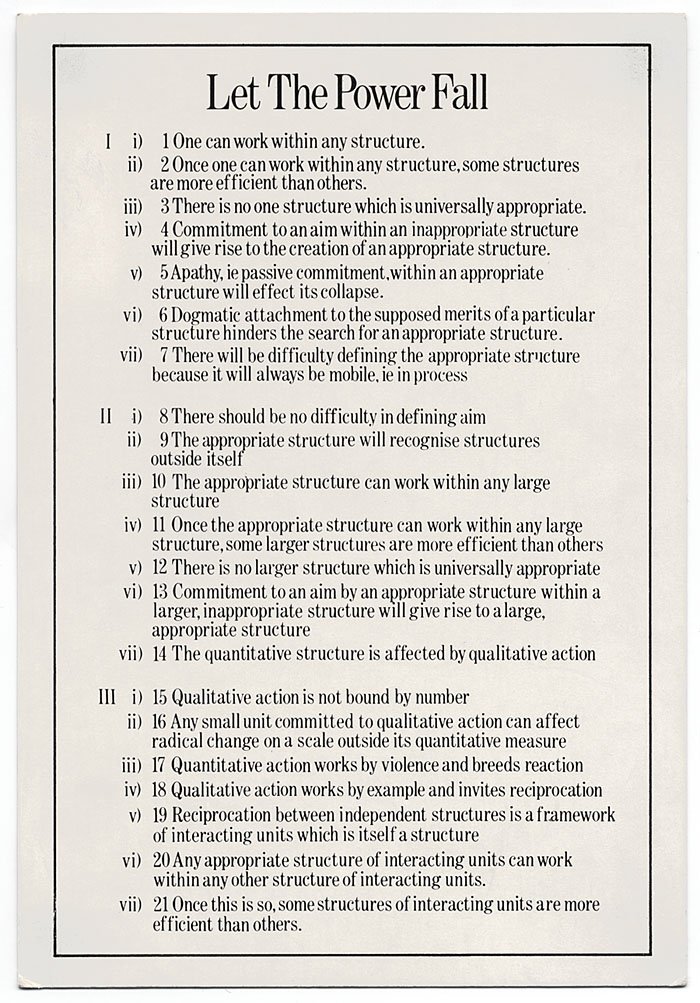
Let The Power Fall (1981) by Robert Fripp. A postcard included with the original vinyl release of the Let The Power Fall album.

Exposures 1977–1983 is the title of another wallet-busting CD/DVD/blu-ray box which will be released by DGM at the end of May. Unlike the previous King Crimson sets this one will be devoted to Robert Fripp’s first run of solo releases, covering the albums that emerged from the artistic campaign he described at the time as “The Drive to 1981”: Exposure (1979), God Save The Queen/Under Heavy Manners (1980), The League Of Gentlemen (1981), and Let The Power Fall (1981). If you’re as interested as I am in this period of Fripp’s career then this is all very exciting. Exposure has been reissued several times over the years, and exists in three different “editions” featuring alternate mixes and song variations, but the other albums have been unavailable in any form for decades, possibly as a result of the turmoil caused by the mismanagement and eventual collapse of the EG label. In addition to the reissues the box will include live recordings, a League Of Gentlemen Peel session plus a substantial quantity of Frippertronics material, including the loops that were recorded for Eno & Byrne’s My Life In The Bush Of Ghosts. Fripp retained a credit for his contribution to Regiment but the results are so far down in the mix that they’re easy to miss. Related: The Drive to 1981: Robert Fripp’s Art-Rock Classic Exposure.

• Galerie Georges-Philippe & Nathalie Valloisin, Paris, is currently creeping out visitors to Strange Aeons—We will meet you there, an exhibition by Peybak (Peyman Barabadi and Babak Alebrahim Dehkordi) that borrows its title from HP Lovecraft and includes a number of creatures, “neither embryos nor chimeras”, which may be found prostrate and breathing on the gallery floor.

• New music: Sub Zero, in which Kevin Richard Martin returns to the subterranean/subaqueous/subarctic zones he charted on his Isolationism and Driftworks compilations in the 1990s; plus The Carrier by Large Plants, an album of “psych rock belters” coming soon on the Ghost Box label.

• Science fiction as revolution: Joe Banks talks to Iain McIntyre, co-editor of Dangerous Visions and New Worlds—Radical Science Fiction, 1950–1985, about the flourishing of the New Wave of SF in the 1960s and 70s.

• “We know from his letters that Joyce sent a Greek flag to Nutting for him to colour-match. So, he was aiming for ‘Greek’ blue.” It’s that book again. Cleo Hanaway-Oakley on Ulysses, blindness and blue.

• Intermittent Eyeball Fodder: More visual delights gathered by S. Elizabeth.

• Steven Heller’s font of the month is Nicholas.

• Galerie Dennis Cooper presents…Liz Larner.

Let The Power Fall (1971) by Max Romeo | Minor Man (1981) by The League Of Gentlemen ft. Danielle Dax | Heptaparapashinokh (1981) by The League Of Gentlemen

Weekend links 610

durer.jpg

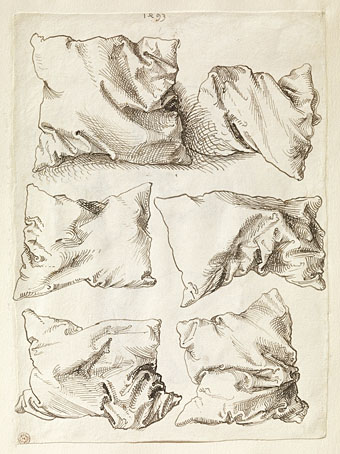
Pillow Studies (1493) by Albrecht Dürer.

• “Without ever writing a song, without ever fronting a group, Khan changed the face of British music.” Michael Hann talks to Morgan Khan about bringing New York Electro to the UK with his Streets Sounds label.

James Balmont offers “an introduction to Japan’s visceral cyberpunk cinema in five cult films”. This reminds me that I’ve not seen Shinya Tsukamoto’s Tetsuo films for years. Time to reacquaint myself.

• At Aquarium Drunkard: 15-minutes of Alice Coltrane from 1970, talking about her music and performing with Pharoah Sanders et al. Amazing.

Clive Hicks-Jenkins presents Beauty & Beast, an animated fairy tale made to showcase his toy theatre design.

• Carl Dreyer’s horror masterpiece, Vampyr (1932), is released on blu-ray by Eureka in May.

• At Wormwoodiana: Mark Valentine explores the mysteries of the Egg Language.

• DJ Food unearths paintings by Syd Mead for a Celcon Steel brochure, 1965.

• Jamie Sutcliffe enters The Strange World of Junji Ito.

• Mix of the week: Isolatedmix 117 by Refracted.

Keeley Forsyth‘s favourite music.

Electrocharge (1980) by Blackbeard | Electrodub1 (1980) by Chris Carter | Ano Electro (Andante) (1993) by The Sabres Of Paradise

Arena: Andrei Tarkovsky

tarkovsky1.jpg

More slow cinema. The Antonioni documentary was broadcast by the BBC in their regular Arena arts strand, as was this 50-minute profile from 1987. Andrei Tarkovsky is a favourite Arena of mine, one I’ve watched many times over the years, whether original broadcast, VHS tape or digitised copy. As with the Antonioni film it’s one of many such episodes which functions as an ideal introduction to its subject.

tarkovsky2.jpg

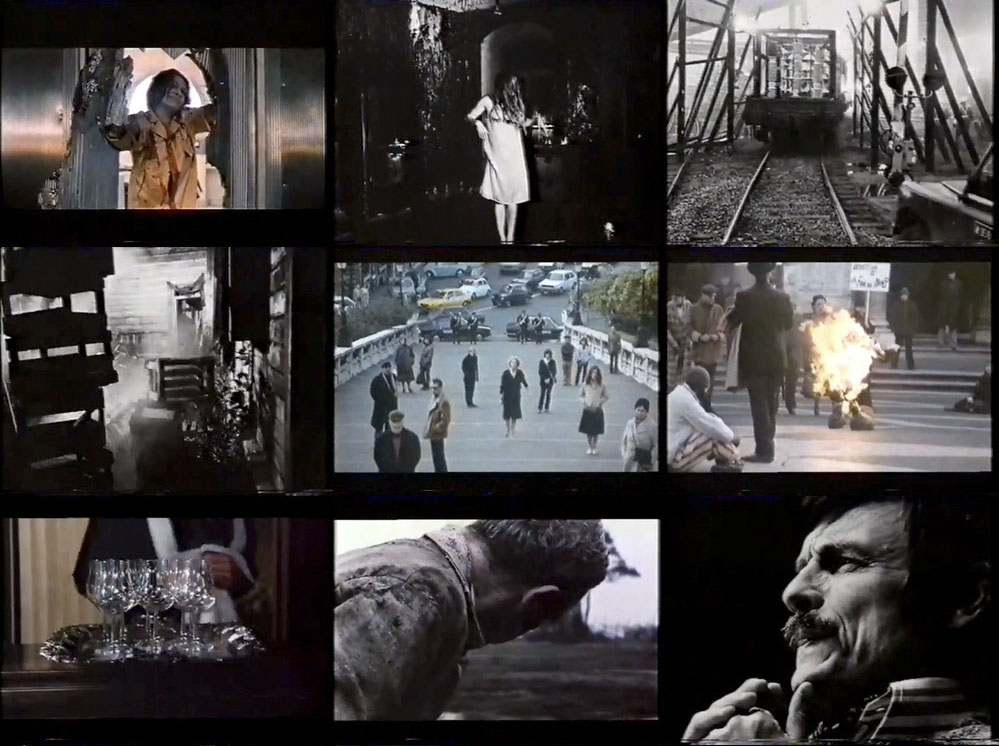
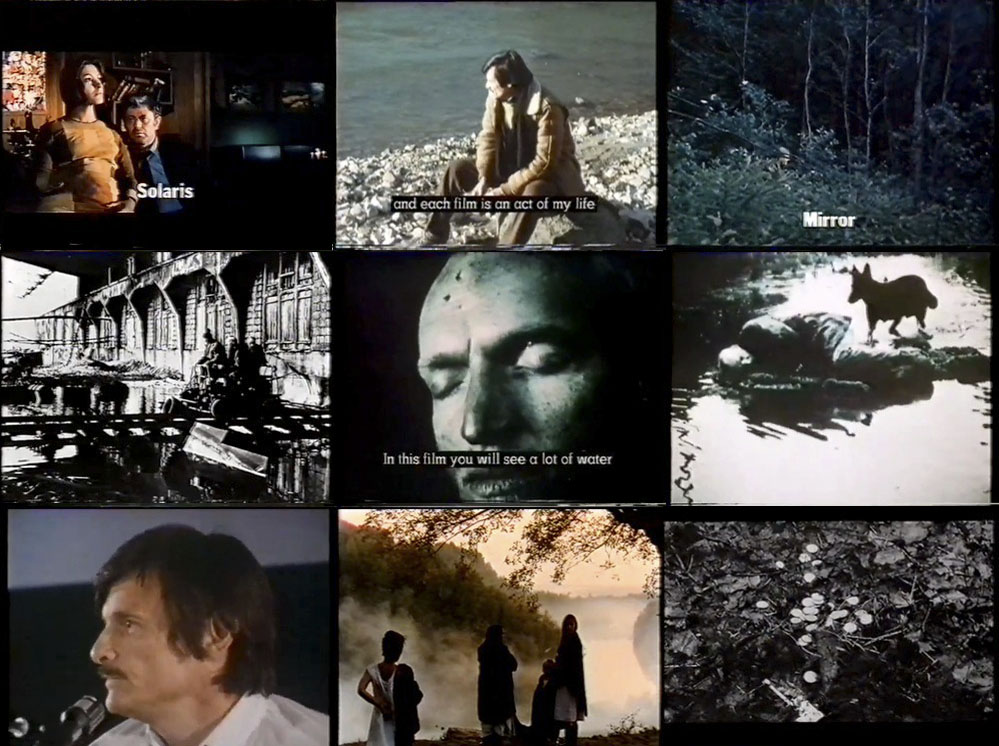
1986 was the year of Tarkovsky’s untimely death so Charlie Pattinson’s documentary served as a memorial as well as a celebration of a director whose reputation had been growing throughout the decade. I love the way this one starts cold with a series of clips from all seven of the feature films; no comment required. Further clips follow but the real value is in the extracts from interviews and talks given by the director which punctuate the biographical chronology. The first of these is a declaration of Tarkovsky’s belief that film-making is a unique medium in its ability to capture and assemble temporal moments, something he explored in depth in his book, Sculpting in Time. In his talks and his writings he can often seem overly serious when discussing his work, especially in a world where film-making is largely regarded as merely another division of the entertainment industry. But he regarded both art and film-making as serious affairs, and many of his films required considerable effort to be made at all. Hollywood has long been notorious for confounding the endeavours of maverick directors but the apparatchiks at Goskino were seldom better, continually rejecting new proposals or interfering with the films after they were made. Tarkovsky’s diaries are filled with accounts of his struggles with the bureaucrats who oversaw film production. When he wasn’t fighting censorship attempts or refusals to release a new film, he was dealing with other refusals to approve his projects altogether. We’re fortunate that Stalker exists at all when most of the exterior footage needed to be reshot after the negative was ruined by incompetent processing. This calamity wasn’t the director’s fault but Goskino were reluctant at first to let him finish the film. These constant struggles eventually compelled him to leave the Soviet Union in order to make films elsewhere, a painful decision which is discussed in the final part of Pattinson’s documentary by the director’s wife and production assistant, Larisa. The pair were allowed to leave the country but they were also forced to do so without their young son, a typically cruel and petty punishment by the Soviet authorities.

In the Antonioni post I mentioned that Tarkovsky’s present popularity is sustained by Solaris and Stalker much more than by his other films. People who only know the director from his excursions into science fiction may be surprised to hear him dismiss Solaris as his least successful feature on a personal level. Documentaries such as this may encourage some of those viewers to explore the rest of his filmography.

Previously on { feuilleton }
Zone music
Sine Fiction
Rerberg and Tarkovsky: The Reverse Side Of “Stalker”
The Stalker meme