Weekend links: Hodgson edition

hodgson.jpg

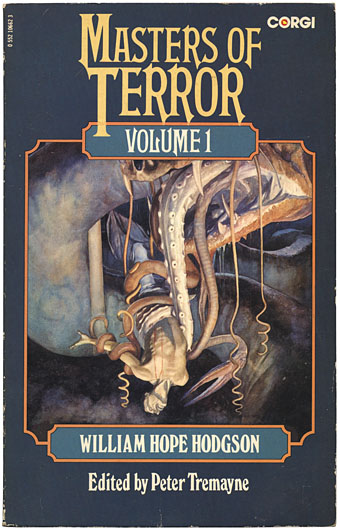
Masters of Terror, Vol 1, Corgi Books, 1977. No illustrator credited.

It was all happening this week so there’s a lot to get through. Are you ready? Deep breath…

For ye Hogge doth be of ye outer Monstrous Ones, nor shall any human come nigh him nor continue meddling when ye hear his voice, for in ye earlier life upon the world did the Hogge have power, and shall again in ye end.

The Hog (c. 1910) by William Hope Hodgson.

• “The Hog is Hodgson’s most nakedly Jungian setpiece; fetid waves of archetypes sweep repeatedly against the thin walls of quotidian reality.” Thus Iain Sinclair, writing in a 1991 afterword to Carnaki the Ghost-Finder which I highly recommend to both Hodgson and Sinclair enthusiasts. China Miéville dissected Hodgson’s Hog on Wednesday and a few hours later a student protest in London turned into an assault on the Tory HQ. Coincidence? Here at {feuilleton} we only offer the facts, it’s up to you to join the dots. M John Harrison approved. Of the protest, that is, not the raising of Porcine Malevolence from the Gulfs Beyond, although he might approve of that as well.

• Further Hodgsonia: Science of The Night Land: Dying Suns and Earth Energy while for real devotees there’s Andy Robertson’s Night Land site.

• “Amplifying the vibrations of the ether” for a view “beyond the limits of ordinary life”: The Fugitive Futurist (1924), a remarkable short film at the BFI’s YouTube channel in which Trafalgar Square is flooded, a monorail crosses Tower Bridge and a dirigible takes to the air over the Houses of Parliament. Also Trafalgar Square Riot (1913), a newsreel with suffragettes at the centre of a civil disturbance. Some of the critics of Wednesday’s events seem to have forgotten that women gained the vote in this country only after repeatedly smashing windows and causing trouble.

• Related to the above: How to Hex a Corporation at Arthur magazine. And let’s not forget Hakim Bey’s Occult Assault on Institutions.
ian_miller4

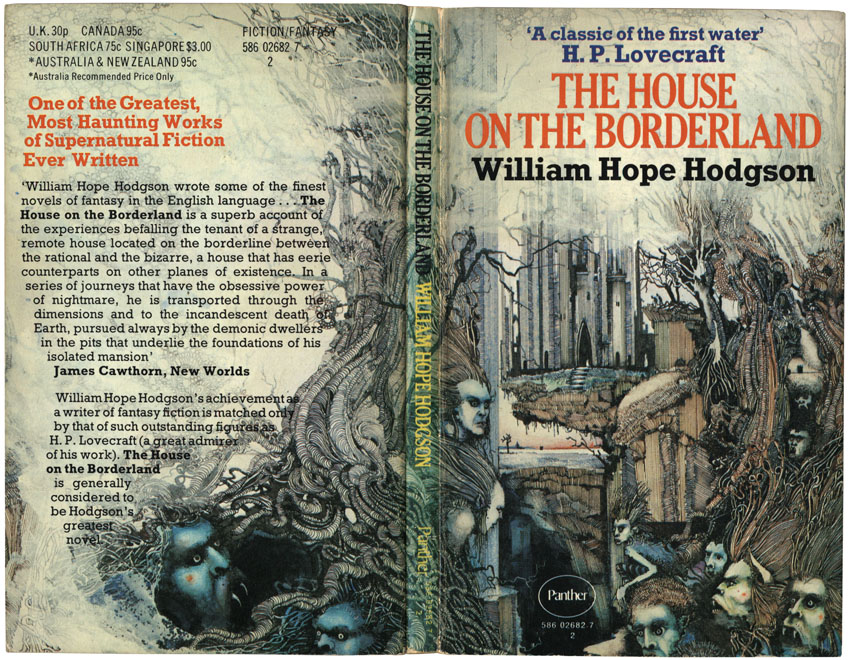
Cover illustration by Ian Miller (1972). The other great cover for THOTB was by Ed Emshwiller in 1962.

The wanderings of the Narrator’s spirit through limitless light-years of cosmic space and Kalpas of eternity, and its witnessing of the solar system’s final destruction, constitute something almost unique in standard literature.

HP Lovecraft reviewing Hodgson’s The House on the Borderland in Supernatural Horror in Literature.

• Lovecraft has long cast a shadow over Hodgson’s fevered visions even though words of praise like those above have done much to keep the earlier writer’s work in print. I’ve been talking for years about doing a series of illustrations for The House on the Borderland and may yet make good on that threat; never say never. Meanwhile, Rick Poyner returned to Design Observer this week pondering the challenge of non-Euclidean architecture in What does HP Lovecraft look like?
hodgson2.jpg

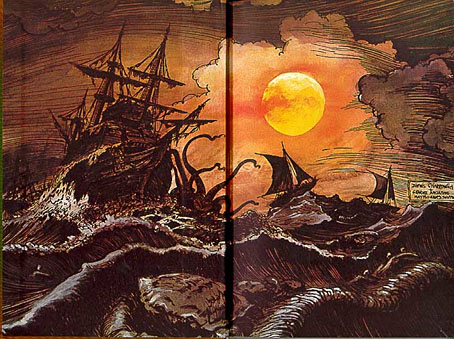
Druillet illustrates Hodgson (1971).

• In his latest piece of Barney Bubbles detective work, Paul Gorman discovered the identity of BB’s first design employer, the alluded to but never named Michael Tucker. More surprising for me than the Robert Brownjohn connection is that there’s now a tenuous link between Barney Bubbles and William Gerhardi.

777 classical music album covers from the collection of Dr Horst Scherg. Related: The Golden Age of Wacky Classical LP Covers — Westminster Gold and the Westminster Gold discography.

Chez Fini: Little Augury looks at the work and workplaces (and cats!) of the marvellous Leonor Fini.

• There’s yet more Lovecraft (and much else besides) in Nomad Codes, a new book from Erik Davis.

• The Irrepressibles: “They’re scared of what we’re going to do next”.

• New Scientist asks Is this evidence that we can see the future?

Of Electricity And Water: A Thomas Dolby Interview.

Jarvis Cocker talks to Brian Eno.

Fuck Yeah, Gay Vintage

Hog Callin’ Blues (1962) by Charles Mingus. Play loud and often.

Weekend links 36

high_society.jpg

Mervyn Peake’s Caterpillar from Alice’s Adventures in Wonderland finds itself used to promote High Society, an exhibition at the Wellcome Collection devoted to the long history of human drug-taking. There’s more about the exhibition here and also an accompanying book by Mike Jay from Thames & Hudson. Related: The Most Dangerous Drug:

A group of British drug experts gathered by the Independent Scientific Committee on Drugs (ISCD) rated alcohol higher than most or all of the other drugs for health damage, mortality, impairment of mental functioning, accidental injury, economic cost, loss of relationships, and negative impact on community.

• Unless the magazine Man, Myth & Magic was advertised on TV in 1970 (and I suspect it would have been) Austin Osman Spare’s work has never been seen on British television, certainly not in any detail or with a credit to the artist. This week the BBC finally paid him some attention with a brief spot on The Culture Show as a result of the Fallen Visionary exhibition which is still running (until November 14) in London. Alan Moore, Fulgur‘s Robert Ansell and others attempt to summarise Spare’s career in seven minutes.

fujita.jpg

Neil Fujita designs: Mingus Ah Um (1959) and The Godfather (1969).

• RIP graphic designer Neil Fujita. Related:

“By taking the “G” and extending it to the “D,” I created a house for “God.” The way the word was designed was part of the logo and so was the type design. So when Paramount Pictures does a film version or Random House, which bought out the book from Putnam, does another Godfather book, I still get a design credit. In fact, before the first Godfather film opened in New York I saw a huge billboard going up in Times Square with my design on it. I actually got them to stop work on it until we were able to come to an agreement.” Waxing Chromatic: An Interview with S. Neil Fujita

French SF illustration. Related: Where did science fiction come from? A primer on the pulps, a feature by Jess Nevins with some of the craziest covers you’ll see this month.

• Gay-bashers in 1970s San Francisco had to beware the wrath of the Lavender Panthers.

• More Marian Bantjes as she discusses her work in an audio interview.

Music from Saharan cellphones.

Origami Beauty Shots.

Krautrock.com

Better Git It In Your Soul (1959) by Charles Mingus.

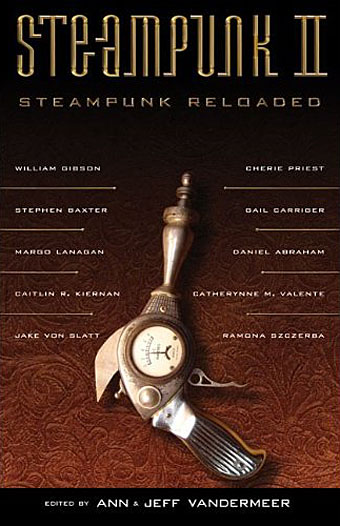
Steampunk Reloaded

sr00.jpg

Cover design by Ann Monn. Cover image by Dan Jones / Tinkerbots.

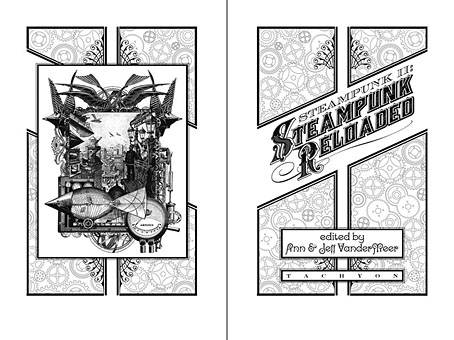
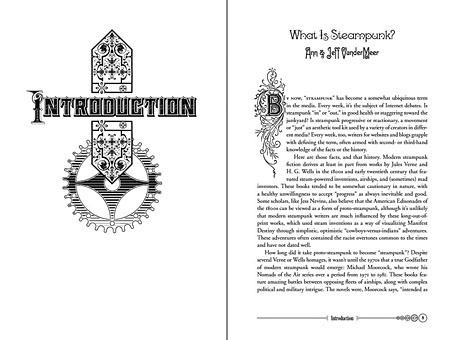
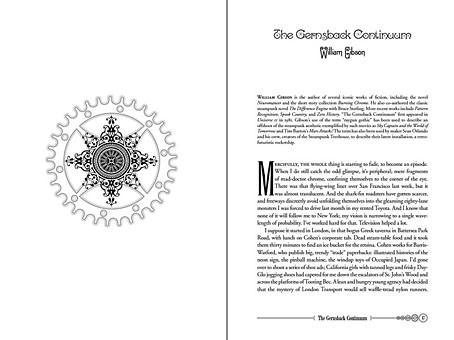
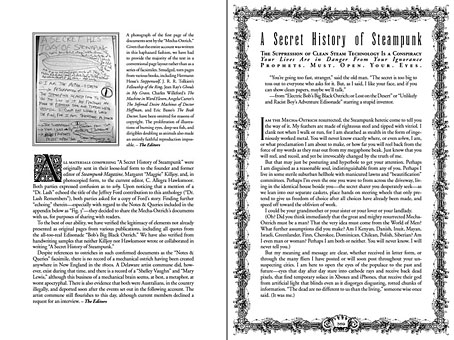
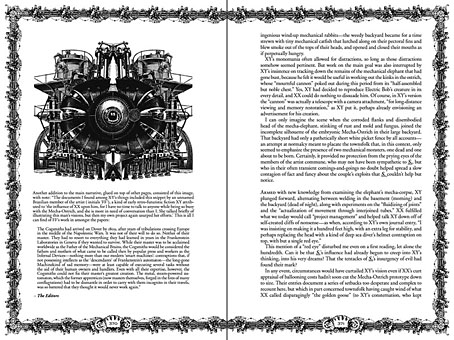
Here at last is the steampunk anthology I mentioned back in September and whose interiors I designed. This is another Tachyon publication, and also another anthology edited by Ann & Jeff VanderMeer. I went further with the design for this than I have done for other Tachyon books, partly because if there’s one thing steampunk lends itself to, it’s decoration but also because the book includes illustrations from Ramona Szczerba, Eric Orchard, and others, plus a comic strip by Sydney Padua; adding extra spot illustrations stopped the pictorial material from seeming too isolated.

sr01.jpg

Title spread. The illustration on the left is one I created last year.

This is a sequel to an earlier steampunk anthology by the same editors but the contents are just as strong as the first collection with excellent stories throughout. (For a review, see here.) By coincidence the book is published in the wake of a recent (and inevitable) backlash against steampunk as science fiction sub-genre and cultural phenomenon. This collection can serve as a repudiation to some of the lazier accusations that writers are ignoring the moral and physical squalor of the Victorian era and the legacies of imperialism; several stories in Steampunk Reloaded address those very issues. For my part I’ve read Friedrich Engels’ Condition of the Working Class in England, Henry Mayhew’s London Labour and the London Poor, and Kellow Chesney’s The Victorian Underworld so I don’t feel in urgent need of a lecture on the iniquities of the 19th century, thank you very much.

sr02.jpg

While we’re on the subject, the cover of The Steampunk Bible, edited by Jeff VanderMeer and SJ Chambers, has been revealed here. Abrams will be publishing this next year and having seen some of the interior pages it’s going to be a splendid book. More about that later. Further pages from Steampunk Reloaded follow.

Update: A couple more reviews here and here.

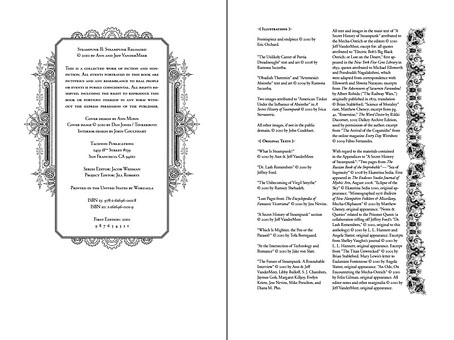
sr03.jpg

Contents spread.

sr04.jpg

sr05.jpg

sr09.jpg

A detail of one of the page footers.

sr06.jpg

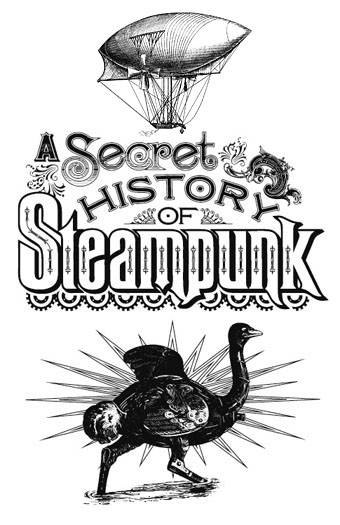
Title page for A Secret History of Steampunk, a self-contained section within the body of the book.

sr07.jpg

sr08.jpg

Previously on { feuilleton }
Steampunk overloaded!
Skeleton clocks
Vickers Airship Catalogue
The Air Ship
Dirigibles
More Steampunk and the Crawling Chaos
The art of François Schuiten
Steampunk Redux
Steampunk framed
Steampunk Horror Shortcuts
The Airship Destroyer
Zeppelin vs. Pterodactyls

Weekend links 34

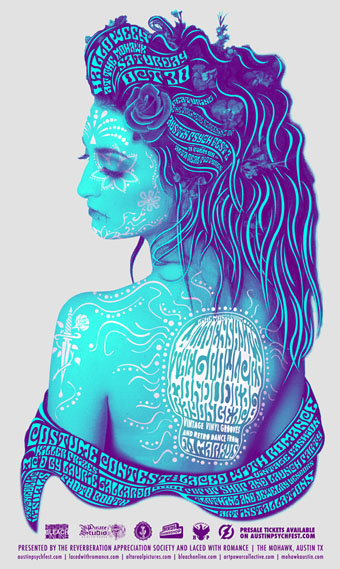
austin.jpg

Halloween in Austin, Texas this year will look and sound like this.

• “Blade Runner will prove invincible“: Philip K Dick’s letter of praise to the film’s producers. Related: one of the Blade Runner designers, Syd Mead, has recently styled New York’s Bar Basque and Foodparc.

• “I decided to go into fields where mathematicians would never go because the problems were badly stated…I have played a strange role that none of my students dare to take.” RIP Benoît Mandelbrot.

Science and poetry: “a richly vexed topic badly in need of rethinking”. Related: Why the Singularity isn’t going to happen.

• In case you missed this week’s earlier announcement, a reminder that I was interviewed at Coilhouse. My vanity: it knows no bounds.

• Franklin Booth’s illustrations for The Flying Islands of the Night (1913) by James Whitcomb Riley.

On the Verge (1950) by Maurice Sandoz, illustrated by Salvador Dalí. Also this and this.

bowie.jpg

Bowie Sphinx, 1969. Photo by Brian Ward.

The Laughing Gnostic: David Bowie and the Occult.

• “Moonlighting as a Conjurer of Chemicals“: Isaac Newton’s alchemical interests.

• “A sense of otherness that goes right back“: Alan Garner at Alderley Edge.

Jimmy’s End—Alan Moore’s new feature film and spin-off TV series.

A Guide to the New Ruins of Great Britain by Owen Hatherley.

• The It Gets Better Project now has a dedicated website.

Quicksand (1971) by David Bowie.

Infernal entrances

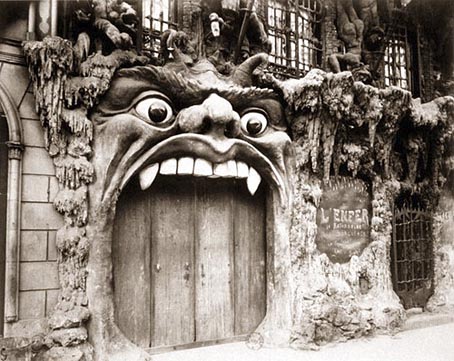
atget.jpg

L’Enfer, Boulevard de Clichy (1911).

A recent posting at The Haunted Lamp showed the interior of L’Enfer, a Montmartre cabaret which described itself as “unique au monde”, pictured here in a memorable photo by Eugène Atget. The interior and portions of the exterior were certainly unique enough, and look like they were created by the same people who designed the carnival show for Harry Lachman’s film Dante’s Inferno (1935), but the yawning mouth as an entrance isn’t without precedent. Some prior examples follow.

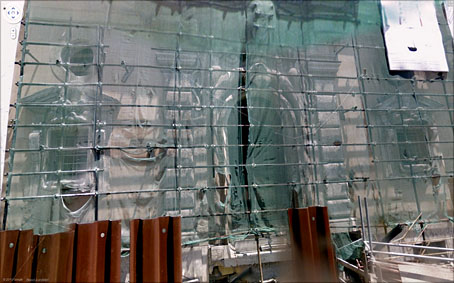
zuccari.jpg

Palazzo Zuccari.

L’Enfer is long gone, unfortunately, but the entrance to the Palazzo Zuccari in the Via Gregoriana, Rome, is still extant despite being hundreds of years older. I was hoping that Google’s Street View would have some good pictures but they managed to capture the building in the midst of renovation. A friend of mine was working at an office in this street when I was in Rome in 1993 and the yawning mouths and windows are a very curious sight in a narrow road near the Spanish Steps. Flickr has better views, here, here and here.

bomarzo.jpg

Ogre, Parco dei Mostri.

The Rome palazzo is named after the Mannerist artist who lived there, Federico Zuccari (c. 1542/1543–1609), and Zuccari’s inspiration for his doorway came from another Mannerist creation, the Parco dei Mostri at Bomarzo. The mouth in this case isn’t an entrance to the underworld but a devouring ogre, and one of the park’s many grotesque attractions. I wonder if this was also an inspiration for the giant floating head in John Boorman’s ludicrous science fiction film, Zardoz (1974).

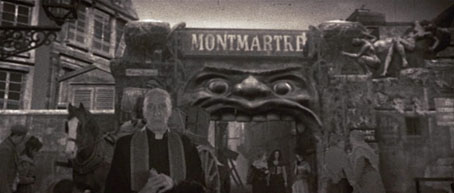
moulin.jpg

Moulin Rouge!

And speaking of films, Baz Luhrmann used the L’Enfer entrance as a gateway to Montmartre itself in the zooming shot which opens Moulin Rouge!. I like that idea, as though it’s an iniquitous equivalent of the old Temple Bar gateway to the City of London. For more pictures of L’Enfer, and details of its history, see here and here. If anyone knows of any other notable doorways like these, please leave a comment.

Update: Nathalie found another Bomarzo influence while Jescie on Twitter drew my attention to a set from this German film.

Previously on { feuilleton }
Villa d’Este
Harry Lachman’s Inferno
Atget’s Paris